Doing What’s Right? For Whom?

The advocates have their little fiefdoms and Potemkin Villages on socialist media, where they try to prop each other up, evident in the latest screed by the PZP darter and real estate agent in the Minden/Gardnerville area.

Go to page three in the August edition of Horse Tales.

As nonprofits, their top priority is themselves: If they don’t keep their base fired up and the donations rolling in, their organizations collapse.

A little empathy and financial support might be appropriate if they were sincere.

But not this crowd.

The author belabors the injuries and deaths at the Antelope roundup but tiptoes around the issue of permitted grazing.

Cha-ching, cha-ching.

The Campaign Against America’s Wild Horses is toxic, the kiss of death to wild horses.

As for its affiliates, offshoots and supporters, which include the writer, they are known by the company they keep.

Contrary to the closing paragraph in the article, they don’t do what’s right, at least not for wild horses.

Pummeling mares with pesticide-laced darts can never be considered protection, unless you’re talking about the public-lands ranchers.

RELATED: Advocate Recites Litany Against Roundups, Points to Better Way.

Pesticide Pushers 07-17-23

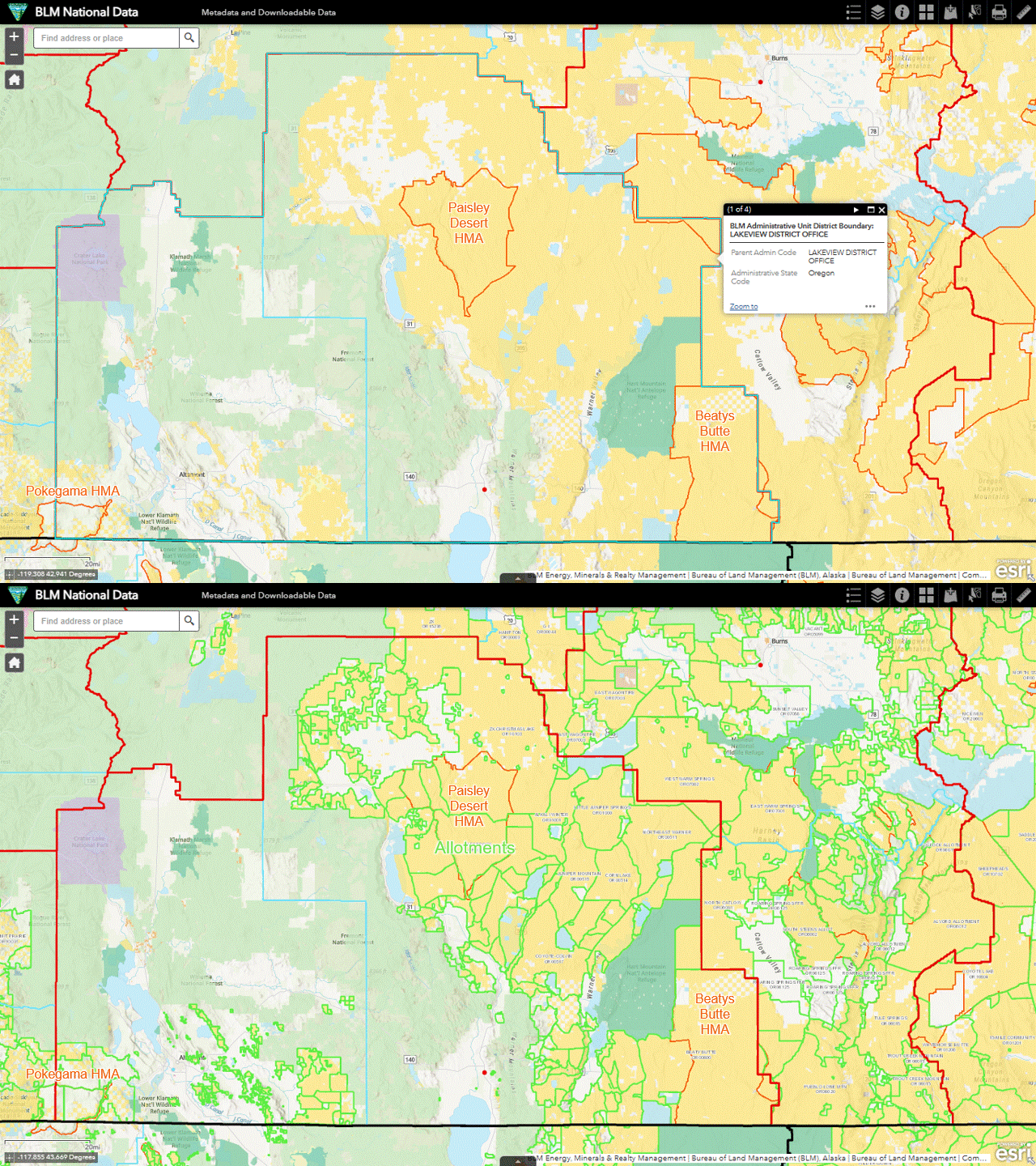
Antelope Roundup North, Day 41

The incident began on July 9.  Results through August 18:

  • Scope: Spruce-Pequop, Goshute, Antelope Valley HMAs
  • Purpose: Pest control, resource enforcement, rancher protection
  • Target: Horses
  • Type: Planned
  • Method: Helicopter
  • Category: Cruel and costly*
  • Better way: Poison mares with ovary-killing pesticides*
  • Captured: 1,914, up from 1,870 on Day 39
  • Average daily take: 46.7
  • Capture goal: 2,000
  • Removal goal: 2,000
  • Returned: 5, no change from Day 39
  • Deaths: 27, up from 26 on Day 39
  • Shipped: 1,824, up from 1,781 on Day 39

The figures above are based on the daily reports, not the totals posted by the BLM.

The sidebar on the gather page says the number of horses captured is 1,920 and the number shipped is 1,826.

A case of missing teeth was reported as a death on Day 41.

The death rate is 1.4%.

The capture total includes 751 stallions, 867 mares and 296 foals.

Youngsters represented 15.5% of the animals gathered.

Of the adults, 46.4% were male and 53.6% were female.

A 16% birth rate corresponds to a growth rate of 11% per year, a bit less than the 20% growth rate used by land managers to predict herd sizes and management actions.

Body condition scores on Days 40 and 41 ranged from 2 to 4.

They’re not starving but a few may be struggling.  Not unusual for older horses or mares with foals.

The location of the trap site was not disclosed.

The HMAs and surrounding lands are subject to permitted grazing.

*According to advocates.

Antelope Complex with Allotments 07-06-23

Day 41 ended with 58 unaccounted-for animals.

Other statistics:

  • Forage liberated to date: 22,908 AUMs per year
  • Water liberated to date: 19,090 gallons per day
  • Forage assigned to livestock: Unknown
  • Horses displaced from area by permitted grazing: Unknown
  • True AML: Unknown
  • Stocking rate at new AML: Unknown
  • Horses removed because of drilling and mining: Ask the advocates

Overpopulation means more horses than allowed by plan, not necessarily more horses than the land can support.

RELATED: Antelope Roundup North, Day 39.

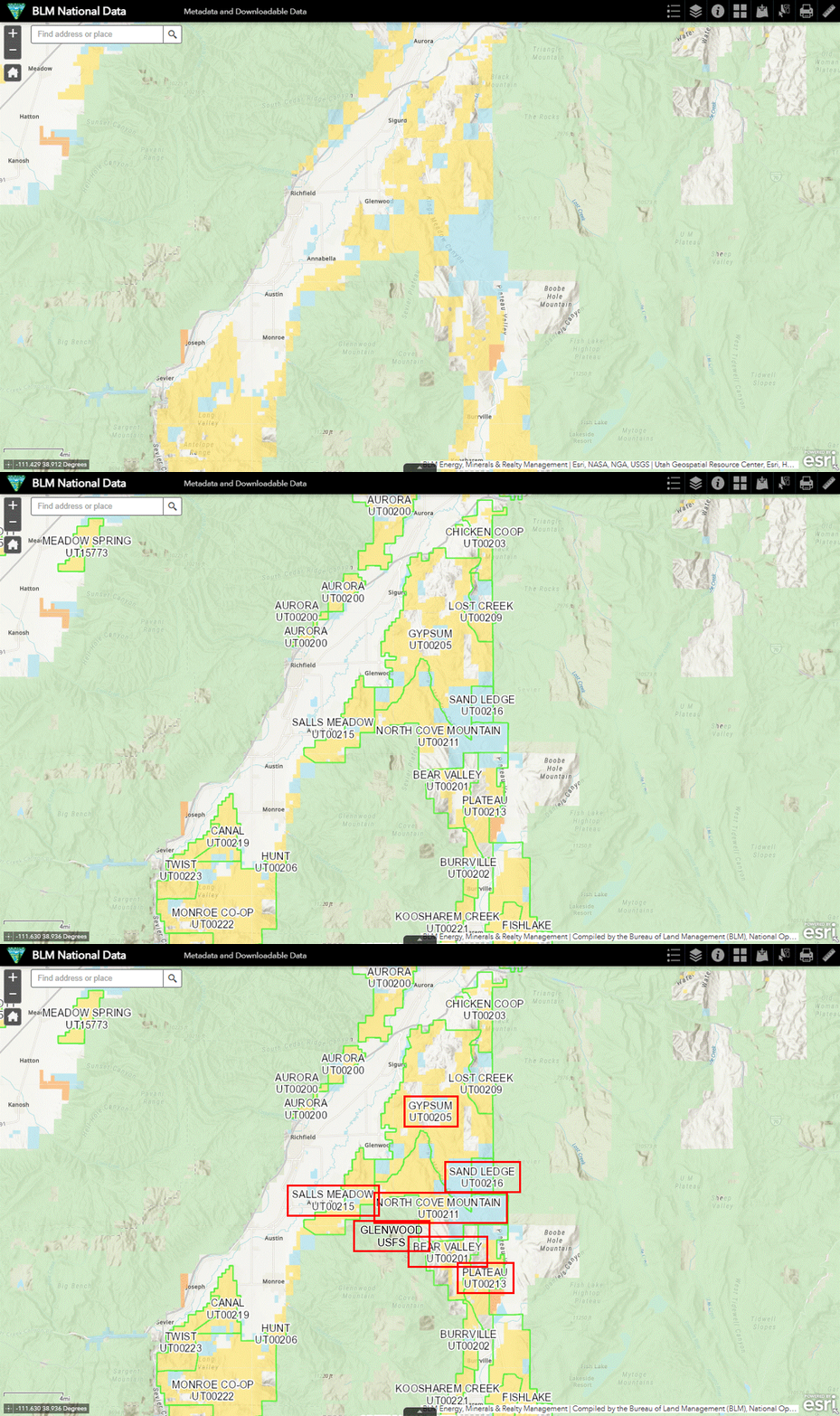
Clover Valley Base Property Available for $5.25 Million

Located south of Wells, NV, the ranch covers 2,518 deeded acres, according to the listing, with grazing preference on a 6,000-acre Forest Service allotment.

There are 900 acres under irrigation producing nearly 1,000 tons of hay annually.

The Annual Operating Instructions for the allotment indicate 90 cow/calf pairs on approximately a 3.3 month grazing season for a total of 305 AUMs per year.

Livestock retreat to the base property during the off season.

The allotment is west of the deeded acreage in the Ruby Mountains.

The Western Watersheds Map shows the arrangement.  Click to open in new tab.

The allotment does not overlap any wild horse areas, but it might be a rewilding opportunity, to be achieved by asking the Forest Service for a change in livestock type and season of use, as American Prairie did for bison in Montana.

At 50 AUMs per year per thousand acres, forage in the allotment is equivalent to four wild horses per thousand acres, despite claims by the bureaucrats that public lands in the western U.S. can only support one wild horse per thousand acres (27,000 animals on 27 million acres).

Clover Valley Ranch with Allotment 08-18-23

Advocate Recites Litany Against Roundups, Points to Better Way

A more cost-effective and humane option would be for the BLM to significantly increase its use of proven and safe immunocontraceptive vaccines, according to an opinion piece dated August 17 in the Reno Gazette Journal.

This is why we despise them.

They want the horses off the range as much as the bureaucrats and ranchers, but they want it done with ovary-killing pesticides, not motorized equipment.

For Your Innocent Ants and Roaches 10-23-22

Palomino Buttes Roundup Over

The incident concluded on August 16, with 192 horses captured, 192 shipped, none released and no deaths.

The number of unaccounted-for animals was zero.

The pre-gather population was thought to be 254.

The goal was 225.

The capture total included 81 stallions, 83 mares and 28 foals.

Youngsters represented 14.6% of the horses gathered.

Of the adults, 49.4% were male and 50.6% were female.

Approximately 25 mares will be returned to the area after treatment with a fertility control pesticide.

The HMA is subject to permitted grazing.

Livestock receive 5.5 times more forage than the horses.

The HMA has an HMAP.

RELATED: Palomino Buttes, Stinkingwater Roundups Announced.

Antelope Roundup Summary, Day 39

The incidents began on July 9.  The South roundup ended on July 26.  The North roundup continues.

Combined results through August 16:

The figures above are based on the daily reports, not the totals posted by the BLM.

The death rate is 1.2%.

The capture total includes 1,096 stallions, 1,358 mares and 523 foals.

Youngsters represented 17.6% of the animals gathered.

Of the adults, 44.7% were male and 55.3% were female.

A birth rate of 18% per year corresponds to a herd growth rate of 13% per year.

Day 39 ended with 58 unaccounted-for animals.

The HMAs and surrounding lands are subject to permitted grazing, with livestock receiving over seven times more forage than the horses inside the Complex.

That resource would support an additional 6,079 wild horses, putting the True AML at 6,868.

You don’t have a wild horse problem, as the advocates would have you believe, you have a resource management problem.

*According to advocates.

RELATED: Antelope Roundup North, Day 39Antelope Roundup South Over.

Antelope Complex with Allotments 07-06-23

Antelope Roundup North, Day 39

The incident began on July 9.  Results through August 16:

  • Scope: Spruce-Pequop, Goshute, Antelope Valley HMAs
  • Purpose: Pest control, resource enforcement, rancher protection
  • Target: Horses
  • Type: Planned
  • Method: Helicopter
  • Category: Cruel and costly*
  • Better way: Poison mares with ovary-killing pesticides*
  • Captured: 1,870, up from 1,813 on Day 37
  • Average daily take: 47.9
  • Capture goal: 2,000
  • Removal goal: 2,000
  • Returned: 5, no change from Day 37
  • Deaths: 26, up from 23 on Day 37
  • Shipped: 1,781, up from 1,739 on Day 37

The figures above are based on the daily reports, not the totals posted by the BLM.

The sidebar on the gather page says the number of horses captured is 1,876 and the number shipped is 1,783.

Blindness in one eye was reported as a death on Day 38.

On Day 39, low body condition and club feet were reported as deaths.

These horses survived the chase and would be alive today if there was no roundup.

The death rate is 1.4%.

The capture total includes 728 stallions, 851 mares and 291 foals.

Youngsters represented 15.6% of the animals gathered.

Of the adults, 46.1% were male and 53.9% were female.

A 16% birth rate corresponds to a growth rate of 11% per year, a bit less than the 20% growth rate used by land managers to predict herd sizes and management actions.

Body condition scores on Days 38 and 39 ranged from 2 to 4.

They’re not starving but a few may be struggling.  Not unusual for mares with foals.

The location of the trap site was not disclosed.

The HMAs and surrounding lands are subject to permitted grazing.

*According to advocates.

Antelope Complex with Allotments 07-06-23

Day 39 ended with 58 unaccounted-for animals.

Other statistics:

  • Forage liberated to date: 22,380 AUMs per year
  • Water liberated to date: 18,650 gallons per day
  • Forage assigned to livestock: Unknown
  • Horses displaced from area by permitted grazing: Unknown
  • True AML: Unknown
  • Stocking rate at new AML: Unknown
  • Horses removed because of drilling and mining: Ask the advocates

Overpopulation means more horses than allowed by plan, not necessarily more horses than the land can support.

RELATED: Antelope Roundup North, Day 37.

Cherry Creek Base Property Hits Market for $15 Million

Butte Vally Ranch covers nearly 900,000 acres, including 7,300 deeded acres, in four counties between Wells and Ely, NV, according to the agent’s description.

The owner runs 700 head of cattle and 5,000 head of sheep on public lands offering 20,641 AUMs per year.

There are 570 acres under pivot with approximately 2,000 acres of riparian meadow.

The map on page 7 of the brochure shows private lands in red and public lands in purple.

The purple outline suggests the new owner will have grazing preference on 14 BLM allotments, identified with the National Data Viewer.

These parcels are managed by three BLM field offices, necessitating three Allotment Master Reports (Wells | Bristlecone | Basin & Range).

The ranch does not hold all of the active AUMs, indicated by “N” in the All AUMs column of the following table.

It may operate as Butte Valley Land & Livestock on some allotments and Mountain Air Cattle Company on others, but this is not explained in the listing.  Mountain Air could be an affiliate or lessee.

West Cherry Creek is in the Wells Field Office.  The next seven are in Bristlecone and the last six are in Basin & Range (National Monument).

The total acreage falls short of the amount indicated in the listing.

Butte Valley Ranch Allotment Calcs 08-13-23

The allotments are mediocre in terms of forage availability, offering a weighted average 35.5 AUMs per year per thousand public acres, enough to support three wild horses per thousand public acres.

Still, the BLM insists that public lands in the western U.S. can only sustain one wild horse per thousand acres (27,000 animals on 27 million acres).

A little more than half of the public acreage is in the Improve category.

The condition of the Custodial acreage is not known.

As the new owner, you could accept the status quo and compete with wild horses, indicated by the last column in the table, or you could develop a rewilding plan and petition the BLM for a change in livestock types and seasons of use, as American Prairie did for bison in Montana.

This is the concept of leverage.  A few thousand private acres control hundreds of thousands of public acres.  The ranchers have been doing this for years.

Would the rewilders, such as the CANA Foundation, actually try this?

Don’t hold your breath.

The base property, located inside the northern allotments, is connected to the southern allotments by the trails.

The National Data Viewer shows the allotments relative to the HAs and HMAs.

The northern allotments lie within the Maverick-Medicine and Triple B HMAs, frequent targets of motorized removals.  Now you know why.

Butte Valley Ranch Northern Allotments 08-16-23

Jakes Unit Trail, not shown in the map, begins at the southern edge of Medicine Butte and runs south, transitioning to the Preston Lund Trail.

Preston Lund continues southward, joining up with the White River Trail, which connects to Dry Farm and Needles.

Dry Farm and Needles overlap the Golden Gate and Seaman Range HAs, areas unfit for wild horses but not for privately owned livestock.

Butte Valley Ranch Southern Allotments 08-16-23

Access to the other four allotments is unknown.  Click on images to open in new tabs.

The asking price does not include the current inventory of cattle and sheep.

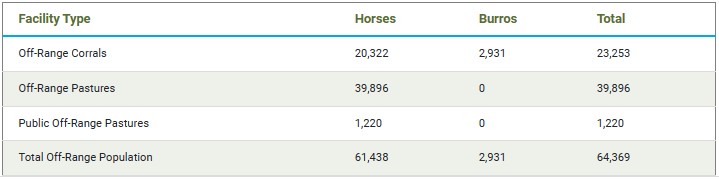
From a resource viewpoint, those animals are equivalent to 1,700 wild horses, about three percent of those in off-range holding.

Palomino Buttes Has HMAP!

It was updated in 2009 to incorporate population and habitat objectives from the 1992 Three Rivers RMP, according to Section 1.2 of the 2023 Final EA for management actions in the HMA, yet livestock receive 5.5 times more forage than the horses.

That’s exactly what you’d expect!

Pay no attention to the advocates, they are clueless.

RELATED: How Many Wild Horses Can the Palomino Buttes HMA Support?

Antelope Roundup North, Day 37

The incident began on July 9.  Results through August 14:

  • Scope: Spruce-Pequop, Goshute, Antelope Valley HMAs
  • Purpose: Pest control, resource enforcement, rancher protection
  • Target: Horses
  • Type: Planned
  • Method: Helicopter
  • Category: Cruel and costly*
  • Better way: Poison mares with ovary-killing pesticides*
  • Captured: 1,813, up from 1,765 on Day 35
  • Average daily take: 49.0
  • Capture goal: 2,000
  • Removal goal: 2,000
  • Returned: 5, no change from Day 35
  • Deaths: 23, up from 22 on Day 35
  • Shipped: 1,739, up from 1,676 on Day 35

The figures above are based on the daily reports, not the totals posted by the BLM.

The number of horses captured is 1,819 and the number shipped is 1,741 according to the figures in the sidebar.

No horses were gathered on Day 36 and a case of swayback was reported as a death.

The death rate is 1.3%.

The capture total includes 710 stallions, 823 mares and 280 foals.

Youngsters represented 15.4% of the animals gathered.

Of the adults, 46.3% were male and 53.7% were female.

A 15% birth rate corresponds to a growth rate of 10% per year, a bit less than the 20% growth rate used by land managers to predict herd sizes and management actions.

Body condition scores on Day 37 ranged from 3 to 4.  They’re not starving.

The location of the trap site was not disclosed.

The HMAs and surrounding lands are subject to permitted grazing.

*According to advocates.

Antelope Complex with Allotments 07-06-23

Day 37 ended with 46 unaccounted-for animals.

Other statistics:

  • Forage liberated to date: 21,696 AUMs per year
  • Water liberated to date: 18,080 gallons per day
  • Forage assigned to livestock: Unknown
  • Horses displaced from area by permitted grazing: Unknown
  • True AML: Unknown
  • Stocking rate at new AML: Unknown
  • Horses removed because of drilling and mining: Ask the advocates

Overpopulation means more horses than allowed by plan, not necessarily more horses than the land can support.

RELATED: Antelope Roundup North, Day 35.

How Many Wild Horses Can the Palomino Buttes HMA Support?

The boundaries of the Palomino Buttes and Weaver Lake allotments coincide almost perfectly with the boundary of the HMA, except for a small wiggle on the southern edge and a minor indentation on the western edge.

Therefore, the forage assigned to livestock in these allotments represents horses displaced from the HMA by permitted grazing.  No per-acre calculations are required.

Palomino Buttes offers 2,806 AUMs per year on 48,100 public acres and Weaver Lake offers 1,396 AUMs per year on 23,548 public acres, according to the Allotment Master Report.

The combined resource, 4,202 AUMs per year, would support 350 wild horses.

The True AML would be 64 + 350 = 414, to be achieved by confining the ranchers to their multi-million-dollar base properties and expecting them to pay the going rate to feed their animals.

The HMA covers 72,359 public acres, so the stocking rate at the new AML would be 5.7 wild horses per thousand public acres.

The Virginia Range was carrying ten before the advocates got involved.

The pre-gather population is thought to be 254.

You don’t have a wild horse problem, you have a resource management problem.

RELATED: Palomino Buttes, Stinkingwater Roundups Announced.

Palomino Buttes HMA with Allotments 06-15-23

Palomino Buttes, Stinkingwater Roundups Announced

Western Horse Watchers saw the gather pages but not the news release.  It may have been published recently but backdated to July 31, burying it in the list.

The incident at Palomino Buttes is set to begin today.

A helicopter will push the horses into the trap, according to the gather page, and operations will be open to public observation.

The capture and removal goals are 225 and 200, respectively.

The current population is thought to be 254.

Around 25 mares will be treated with fertility control and returned to the HMA, which covers 74,234 total acres in eastern Oregon, including 72,359 public acres.

The AML ranges from 32 to 64, the number of horses allowed by plan, not the number of horses the land can sustain.  This is why the BLM said “while allowing for other animals and resource uses” in the news release.  The other resource use is animal agriculture (permitted grazing), indicated in the map below.

Captured animals will be taken to the off-range corrals in Hines.

The Stinkingwater roundup will begin on August 17, according to the gather page.

The incident will be carried out with a helicopter, and operations will be open to public observation.

The July 13 schedule indicates capture and removal goals of 85 and 65.

The current population is thought to be 103.

Around 20 mares will be returned to the HMA after receiving fertility control treatments of unspecified type.

The leading candidates are GonaCon Equine and Zonastat-H, both EPA-registered pesticides.  The bureaucrats prefer the former while the advocates prefer the latter.

The AML ranges from 40 to 80.

Unlike Palomino Buttes, the Stinkingwater HMA is the same size as the HA, covering 92,086 total acres with 78,312 public acres.  Refer to the 2023 HA/HMA Report for these and other such figures.

Like Palomino Buttes, captured animals will be taken to the corrals in Hines.

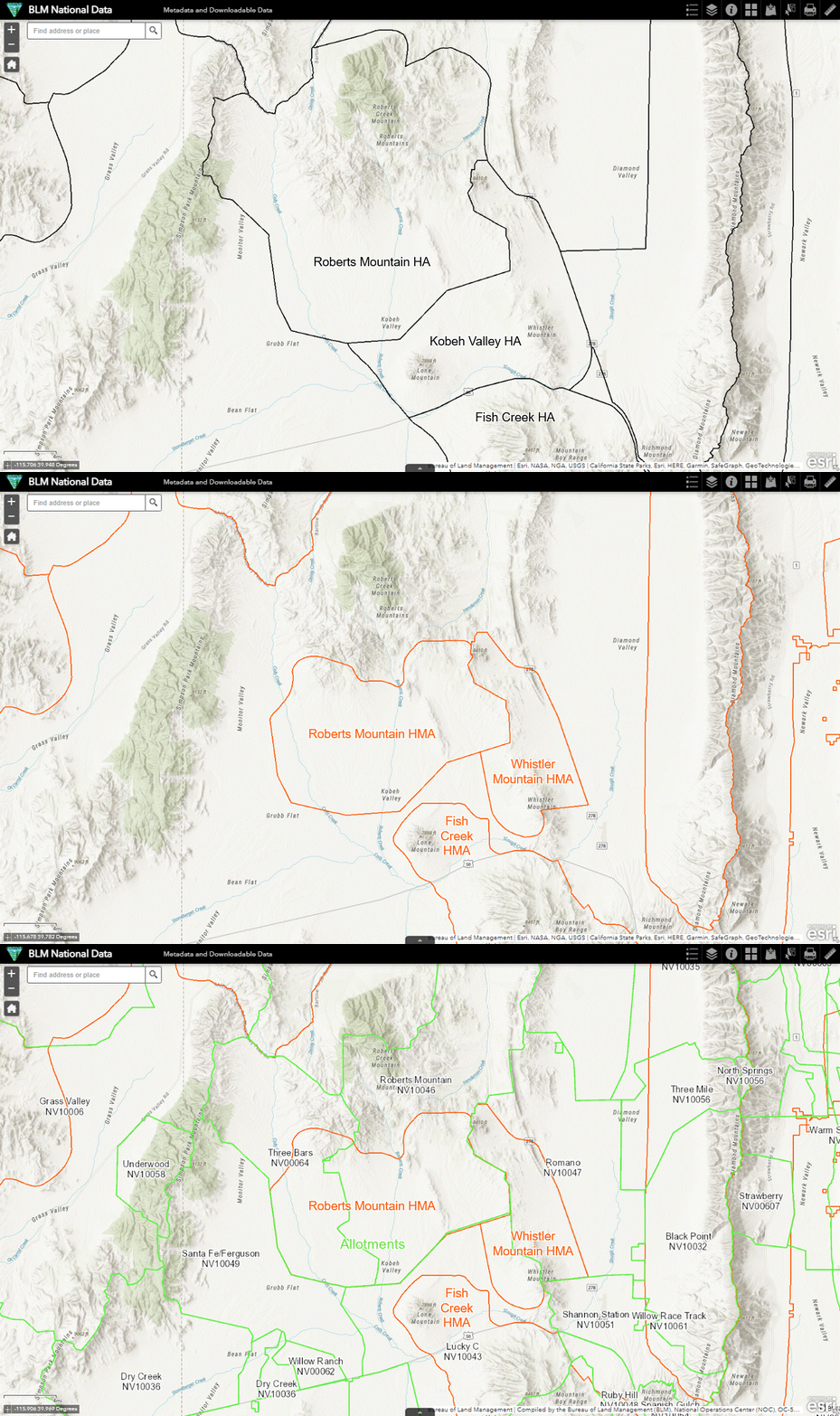
The following map from the National Data Viewer shows HA boundaries in black, HMA boundaries in orange and allotment boundaries in green.  Click to open in new tab.

Much of the land identified for wild horses in 1971 (areas in black) has been declared unfit for them but not for privately owned livestock.

This is the pattern that has to be stopped and reversed.

Don’t look to the advocates for leadership.  They were defeated a long time ago.

Palomino Buttes and Stinkingwater HMAs with Allotments 08-14-23

Reveille HMA Transformed by Catch-Treat-Release

With 30 stallions and 27 nonviable mares returned post-gather, the herd can be moved into the nonreproducing column.

Although GonaCon Equine may not be the #1 choice of the wild horse advocates, they got what they wanted: Nonmotorized removal by ovary-killing pesticide.

This is what they’re doing on the Salt River and Virginia Range.

With few if any births expected in the next five years, and a death rate of five percent per year, the Reveille herd will shrink around 22%.

Next up: Hog Creek HMA.

RELATED: Catch-Treat-Release, Misuse of GonaCon, Roll Out at Reveille.

Antelope Roundup North, Day 35

The incident began on July 9.  Results through August 12:

  • Scope: Spruce-Pequop, Goshute, Antelope Valley HMAs
  • Purpose: Pest control, resource enforcement, rancher protection
  • Target: Horses
  • Type: Planned
  • Method: Helicopter
  • Category: Cruel and costly*
  • Better way: Poison mares with ovary-killing pesticides*
  • Captured: 1,765, up from 1,701 on Day 33
  • Average daily take: 50.4
  • Capture goal: 2,000
  • Removal goal: 2,000
  • Returned: 5, no change from Day 33
  • Deaths: 22, no change from Day 33
  • Shipped: 1,676, up from 1,644 on Day 33

The figures above are based on the daily reports, not the totals posted by the BLM.

The number of horses captured is 1,771 and the number shipped is 1,678 according to the figures in the sidebar.

No horses were gathered on Day 34.

The death rate is 1.2%.

The capture total includes 691 stallions, 801 mares and 273 foals.

Youngsters represented 15.5% of the animals gathered.

Of the adults, 46.3% were male and 53.7% were female.

A 16% birth rate corresponds to a growth rate of 11% per year, a bit less than the 20% growth rate used by land managers to predict herd sizes and management actions.

Body condition scores on Day 35 ranged from 3 to 4.  They’re not starving.

The location of the trap site was not disclosed.

The HMAs and surrounding lands are subject to permitted grazing.

*According to advocates.

Antelope Complex with Allotments 07-06-23

Day 35 ended with 62 unaccounted-for animals.

Other statistics:

  • Forage liberated to date: 21,120 AUMs per year
  • Water liberated to date: 17,600 gallons per day
  • Forage assigned to livestock: Unknown
  • Horses displaced from area by permitted grazing: Unknown
  • True AML: Unknown
  • Stocking rate at new AML: Unknown
  • Horses removed because of drilling and mining: Ask the advocates

Overpopulation means more horses than allowed by plan, not necessarily more horses than the land can support.

RELATED: Antelope Roundup North, Day 33.