Help Wanted: CAAWH Seeks Development Director

The successful candidate will plan and implement a comprehensive major giving program to steward and cultivate current supporters and expand the donor base, according to the solicitation on Idealist.

The Campaign Against America’s Wild Horses is a leader in non-motorized removal of wild horse herds in the American West, which they accomplish by poisoning the mares with Zonastat-H, an ovary-killing pesticide.

If you are honest about the methods in your new role, you will fail.

More WHBAB Meeting Materials Posted

The list includes updates from the Forest Service and BLM for on-range and off-range programs.

The Facility Report shows 57,045 horses and 2,440 burros in off-range holding.

Heavy precipitation across the west alleviated the effects of drought but there are no remarks about winterkill.

A new contract for catch-treat-release goes into effect later this year.

A report showing forage allocations for livestock in the lawful homes of wild horses and burros was not provided.

There is no discussion regarding the use of ovary-killing pesticides to control horses and burros that interfere with animal agriculture, a purpose for which the products were not registered.

RELATED: WHBAB Meeting Agenda Posted.

Comment Period Extended for Proposed Public Lands Rule

The deadline has been moved from June 20 to July 5, according to a BLM news release dated June 15.

Click on the Browse Documents tab at the rulemaking docket for a link to the text and other functions such as viewing and submitting comments.

The BLM rulemaking page includes links to FAQs, handouts and the slide deck used in the presentations.

The proposed rule would designate conservation as a use within FLPMA’s multiple use and sustained yield framework, an attempt to amend the statute without going through the legislative process.

RELATED: Meeting Details Published for New Public Lands Rule.

How Many Wild Horses Can the Clan Alpine HMA Support?

There are three layers of forage demand in the HMA:

  • Wild horses
  • Livestock
  • Wildlife

To estimate the carrying capacity of the HMA—the number of horses it could support if it was managed principally for them as specified in the original statute—convert the livestock AUMs to horses and add the result to the AML.  This is the True AML.

The horse and livestock layers are compared in Table 7 of the Draft EA.

Table 7 Clan Alpine EA 06-18-23

Inspection of the table yields the following remarks:

  • The livestock layer can be assessed in a straightforward manner [unusual]
  • Horses receive more forage than livestock [unusual]
  • All of the HMA is subject to permitted grazing [typical]
  • The forage allocation for horses in Dixie Valley should be 4,740 [typo?]

Continuing with the task at hand:

1. Determine the forage assigned to livestock inside the HMA.

2,546 + 2,614 + 1,636 = 6,796 AUMs per year

2. Convert the livestock AUMs to horses.

6,796 ÷ 12 = 566.3

3. Add the result to the AML.

979 + 566 = 1,545

How many wild horses have been displaced from their lawful home by permitted grazing?  566.

How many horses can the HMA support if the ranchers were confined to their base properties in a year-round off-season?  1,545.

How many horses would be found in the HMA if the Wild Horse Fire Brigade was put into practice?  0.

What is the cost of holding those animals in contracted feedlots?

566 × 5 × 365 = $1,032,950 per year

How much does the BLM receive from the permittees?

6,796 × 1.35 = $9,174.60 per year

Would you say that’s a wise use of the public lands?  No.

Is the HMA overpopulated?  Given the current population of 1,688, yes.

How is the HMA managed?  The RMP pits 979 wild horses against livestock equivalent to 566 cow/calf pairs in a 12-month grazing season.

The Allotment Master Report puts all three allotments in the Improve category.

Figures like those in Table 7 should be published for every HMA and WHT, not in hard-to-find planning documents but in the home page for each area.

An assumption in the above calculations is that there is considerable dietary overlap between horses and livestock.

RELATED: Clan Alpine Pest Control Plan Out for Public Review.

Clan Alpine Pest Control Plan Out for Public Review

A story dated June 16 by KOLO News indicated that the project had moved to document review and that a Draft EA had been released for public consumption.

Western Horse Watchers was unable to find an announcement at the BLM news site.

Table 3 describes four options for wild horse management.

The Proposed Action, Alternative 1, features gathers and removals in and around the HMA to achieve low AML, sex ratio skewing in favor of males and poisoning of females with ovary-killing pesticides, over a ten-year period.

The final decision, the last major step in the process, could authorize the Proposed Action or a combination of elements from other alternatives, such as castration and ovariectomy.

The goal of this and other such projects is to ensure that ranchers receive their allocated share of the food and water on a day-in/day-out basis.

The HMA covers 302,226 total acres in central Nevada, including 298,064 public acres, according to the latest HA/HMA Report.

The AML, representing the number of horses allowed by plan, not the number of horses the land can support, ranges from 612 to 979.

Forage demand at the upper end of AML works out to 11,748 AUMs per year.

The stocking rate at the upper limit is 3.3 wild horses per thousand public acres, considerably higher than the target rate across all HMAs of one wild horse per thousand acres (27,000 animals on 27 million acres).

The HMA intersects three allotments, described in Table 1 of the EA.

The “Livestock AUMs” column shows headcounts, not authorized forage.

The National Data Viewer shows the arrangement.  Click on image to open in new tab.

Clan Alpine HMA with Allotments 06-17-23

The current population is thought to be 1,688.

The 1993 HMAP, which can only ratify and reinforce the resource allocations of the land-use plan, calls for

  • Maintaining the population at AML
  • Achieving a thriving ecological balance
  • Proactively managing the horse population

It is not the be-all/end-all for wild horses as the advocates would have you believe.

Comments can be submitted online through July 17.

The HMA is not on the latest roundup schedule.

RELATED: BLM Reopens Clan Alpine Scoping Period.

Thriving Ecological Balance-3

Currituck Mare Collapses, Dies

Witnesses say a stallion chased her aggressively, when she fell to the ground and died instantly, according to a report by OBX Today.

The story did not indicate if she had been isolated from the gene pool by safe, proven and reversible fertility control.

The article was written by herd manager and PZP darter Meg Puckett.

Contrary to the remark about the dangers of wild horses, the advocates are a far greater threat to them than they are to humans.

Errors in Palomino Buttes Grazing Data?

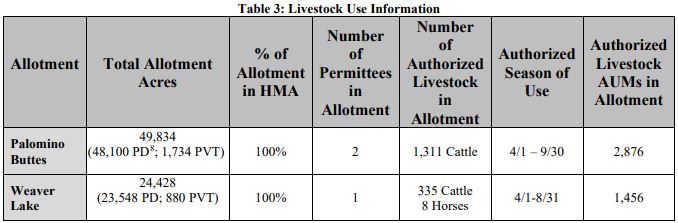
Table 3 in the Draft EA shows AUMs, grazing seasons and numbers of animals.

Palomino Buttes Grazing Data 06-16-23

If 1,311 cattle are allowed in the Palomino Buttes Allotment for six months, 7,866 AUMs would be required.

If only 2,876 AUMs are authorized, the number of animals could not exceed 479.

If Weaver Lake can accommodate 335 cattle and eight horses on a five-month grazing season, 1,715 AUMs would be required.

If only 1,456 AUMs are available, the number of animals would be 291.

The Allotment Master Report suggests the AUMs are correct, or nearly so.

The Authorization Use Report indicates the grazing seasons are valid.

The headcounts need to be reviewed, a substantive comment on the EA, unless the ranchers have developed new breeds that gain weight with less food.

Curiously, the forage allocations that pit 64 wild horses against an equivalent 361 cow/calf pairs in a year-round grazing season have been sanctioned by an HMAP, the be-all/end-all for wild horses according to the advocates.

RELATED: Palomino Buttes Pest Control Plan Out for Public Review.

Foal-Free Friday, Shrinking the Breeding Population Edition

Zonastat-H, the ovary-killing pesticide known as PZP, skews sex ratios in favor of females.

The advocates refer to this as mares living longer.

The Park Service reported in March that the herd on the Maryland side of Assateague Island consisted of 29 stallions and 46 mares.

The Assateague Island Alliance indicated 14 bands as of June 7, implying that 14 stallions were trying to breed.

They also indicated that the current herd of 81 included seven foals, suggesting that only a handful of mares can bear fruit.

Thus, the breeding population is not 81, but much smaller.

Given that only seven foals were born in 2023, the breeding population could range from eight (one stallion and seven mares) to fourteen (seven stallions and seven mares).

Why aren’t the advocates worried about genetic diversity?

Why the low birth rate?  The darting program was shut off seven years ago.

Trends in Assateague Population 04-27-23

Most of the mares have been ruined by the safe, proven and reversible fertility control vaccine.

Moreover, it’s not an accident.

You can’t have a surplus of viable females when you’re trying to drive the population into the ground.

This is what’s happening at the Salt River and Virginia Range, courtesy of the Campaign Against America’s Wild Horses and its army of nitwits.

The advocates know that PZP is a sterilant.  If they pummel the mares for at least five years, the herd won’t bounce back.

They can then walk away and ruin another one, with the aid of your donations, to the delight of the bureaucrats and ranchers.

RELATED: Foal-Free Friday, Choosing the Best Poison Edition.

Palomino Buttes Pest Control Plan Out for Public Review

The BLM opened a new project in ePlanning on June 14, skipping the scoping period and moving directly to document review, in what may be an attempt to fast-track a decision.

The Proposed Action, Alternative A in the Draft EA, features gathers and removals over a ten-year period, with intensive use of ovary-killing pesticides.

The population would never drop below 32 adults, consisting of 16 mares treated with said pesticides and 16 studs.

The initial roundup would gather as many horses as possible, followed by selective return to the low end of AML.

The HMA covers 74,234 total acres in eastern Oregon, including 72,359 public acres, according to the March 2023 HA/HMA Report.

The AML ranges from 32 to 64.

The stocking rate at the upper end of AML is 0.9 wild horses per thousand public acres, slightly less than the target rate across all HMAs of one wild horse per thousand acres.

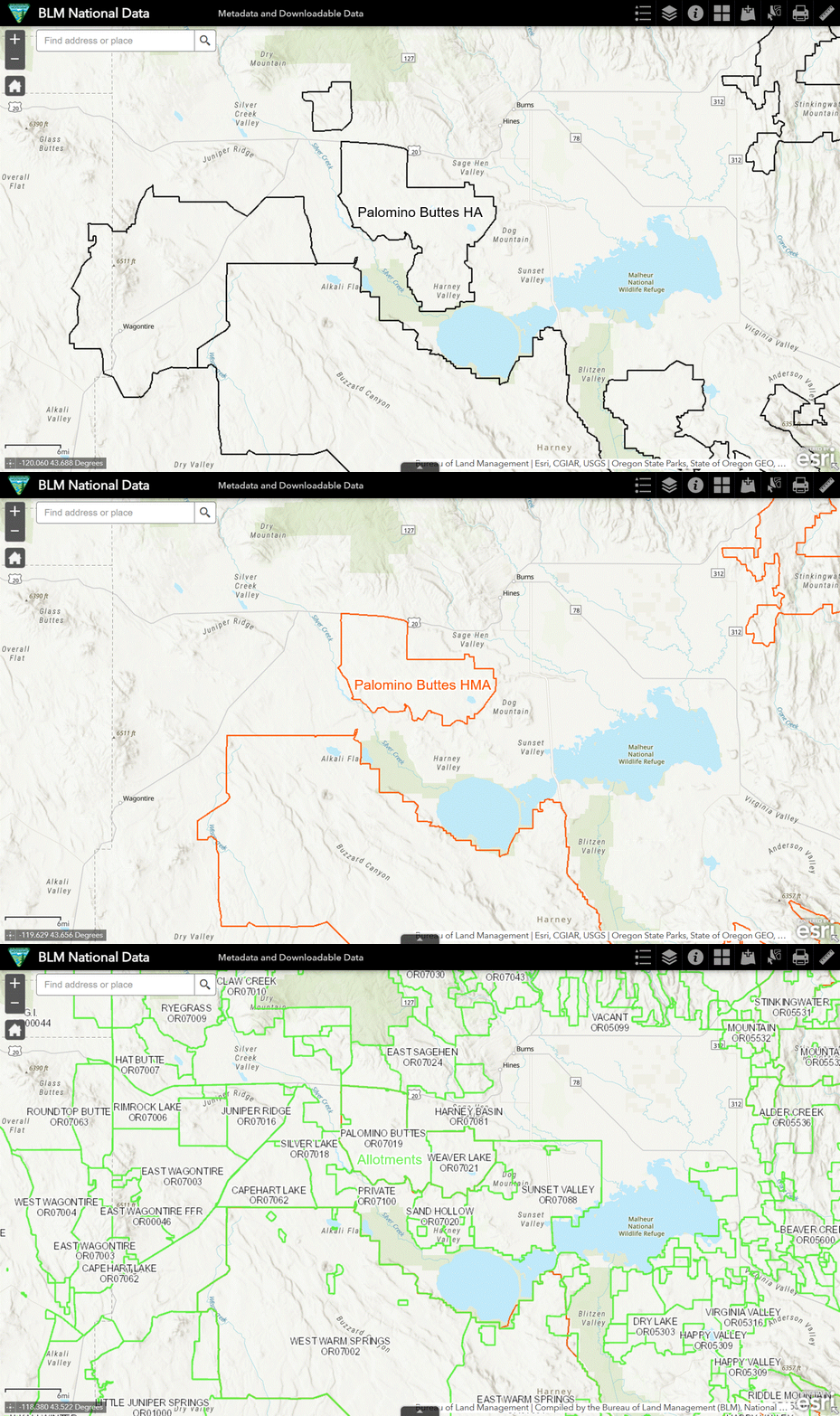
The HMA coincides roughly with the Palomino Buttes and Weaver Lake allotments, as discussed in Section 3.2.1 of the EA.

The National Data Viewer shows the arrangement.  Click on image to open in new tab.

Palomino Buttes HMA with Allotments 06-15-23

Livestock receive 4,332 AUMs per year, compared to 768 AUMs per year for the horses.

The HMA is managed primarily for animal agriculture.

The 64 wild horses allowed by plan will compete with livestock equivalent to 361 cow/calf pairs on a twelve-month grazing season.

Comments will be accepted through July 16, but only in writing or by email.

The HMA appears in the latest roundup schedule, with a start date of August 14.

RELATED: Status of Allotments at Palomino Buttes HMA.

FY23 Roundup Schedule Grows

The capture and removal goals have increased from 7,194 and 5,857 in the April 18 schedule to 7,223 and 5,971 in the June 14 schedule.

Alamo has been added as an emergency with a start date of June 12.  A gather page has been created but there are no daily reports.

Helicopters will take to the air on July 1 at the Reveille HMA as pest control actions resume after foaling season.

Drive-trapping is the fastest and most efficient way of shifting food and water to the public-lands ranchers and enforcing the resource allocations of the land-use plans.

Fertility control pesticides, on the same EPA list as toxic chemicals, slow population growth or stop it altogether, although they have not been approved for use in animal agriculture.

The incidents may or may not be announced at the BLM news site.

RELATED: Roundup Schedule Updated.

Forest Service Seeks Input on EA for Murderer’s Creek HMAP

Today’s news release follows the BLM’s by a few days.

How will the new HMAP function?

The 140 wild horses allowed by plan will be accompanied by livestock equivalent to 647 cow/calf pairs on a twelve-month grazing season, excessive forage consumption will be remedied by removing the horses, and the mares will be poisoned with ovary-killing pesticides.

Comments will be accepted through July 14.

RELATED: Draft EA for Murderer’s Creek HMAP Out for Public Review.

Murderer’s Creek HMAP Shows Folly of Wild Horse Advocates

If you attended the 2022 Save Our Wild Horses conference, you probably went home thinking that herd management area plans (HMAPs) were the be-all/end-all for wild horses.

It was a bunch of crap but that’s what the advocates do to separate you from your money.

The Forest Service has crafted one for the Murderer’s Creek JMA and an assessment of the environmental effects is out for public review.

Appendix L, copied to the Analysis folder of the project, indicates at the top of page 13 (page 18 in the pdf) that livestock receive 7,770 head-months of forage in the JMA, roughly equal to 7,770 AUMs per year, compared to 1,680 AUMs per year for horses.

This means that 647 wild horses have been displaced from their lawful home by permitted grazing and livestock receive 82% of the authorized forage, neglecting wildlife.

The JMA is managed primarily for animal agriculture and the new HMAP will ratify and reinforce that, as explained last year.

The horses have been cheated by the bureaucrats in favor of the ranchers with the approval of the advocates.

Welcome to the wild horse world.

RELATED: Draft EA for Murderer’s Creek HMAP Out for Public Review.

Assateague Pony Census, June 2023

The herd contained 81 horses in June, according to the Assateague Island Alliance, up from 79 in May.

Seven foals have been born this year.

The number of deaths was not reported.

The list indicates names and bands, but not sex, so the ratio of females to males cannot be determined.

Mares outnumbered stallions 1.7 to 1 in March.

If the herd has organized into fourteen bands and only seven mares gave birth, the breeding population must be around 21, not 81.

Why aren’t the advocates concerned about genetic diversity?

The safe, proven and reversible darting program was shut off in 2016.

RELATED: Assateague Pony Census, May 2023.

Draft EA for Murderer’s Creek HMAP Out for Public Review

Initially, the plan was to develop the HMAP in Phase I and identify enforcement actions in Phase II, but those tasks have been combined into one set of planning documents, based on feedback from unnamed stakeholders.

The BLM news release says the current population exceeds 500 horses, resulting in degradation of natural resources in and around the JMA.

The new management plan will promote the health and vitality of the Murderer’s Creek herd and achieve and maintain a thriving natural ecological balance, alongside other important uses on the landscape (such as animal agriculture).

The Joint Management Area covers 142,740 total acres in central Oregon, including 108,488 public acres.

The 140 horses allowed by plan require 1,680 AUMs per.

The stocking rate allowed by plan is 1.3 wild horses per thousand public acres, slightly more than the target rate across all HMAs of one wild horse per thousand acres (27,000 animals on 27 million acres).

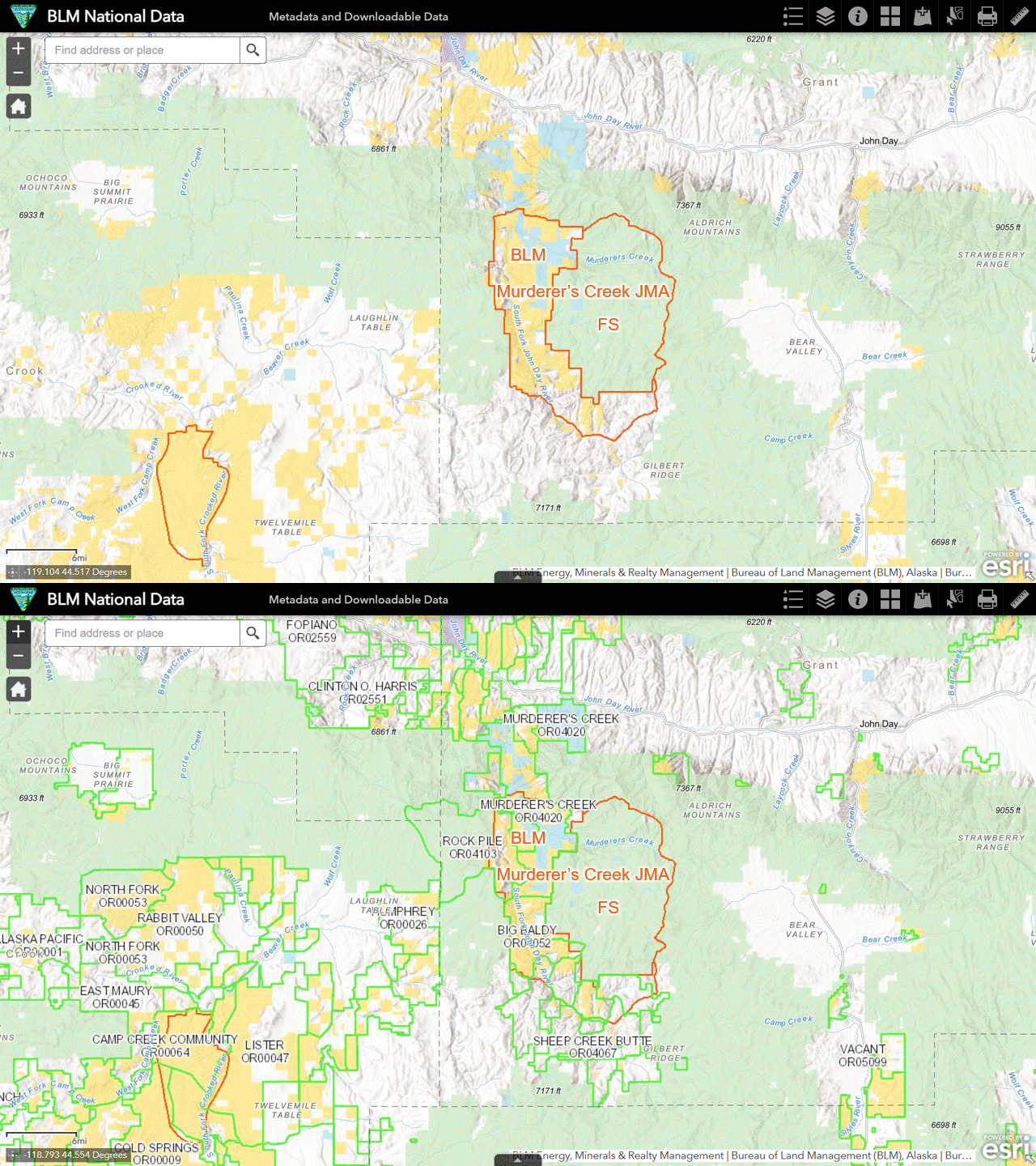
The JMA is subject to permitted grazing.  The National Data Viewer shows the BLM and FS portions but does not show the FS allotments.  The BLM allotments are shown with green borders.  Click on image to open in new tab.

Murderers Creek JMA with Allotments 06-12-23

The Proposed Action, Alternative 2 in the EA, features gathers and removals to achieve AML, sex ratio skewing in favor of males, treatment of mares with fertility control pesticides, use of IUDs and transfer of mares from other areas to boost genetic diversity.

The EA and other supporting documents have been copied to the Analysis folder at the project site.

Comments will be accepted through July 14.

If you can’t access the EA, you can read it here.

RELATED: Comments Invited on Murderer’s Creek Management Plan.

In-Person Adoptions Suspended at Wheatland Corrals

Low placement rates, compared those of online adoptions, prompted the change, according to a news release dated June 8.

The feedlot covers 200 acres in southeastern Wyoming and can house up to 3,500 wild horses and burros, while privately owned cattle and sheep are dispersed at much lower rates on lands set aside for the horses and burros.

There’s nothing in the statute that says AMLs must be small relative to the available resources.

They could correspond to 100% of the authorized forage, neglecting the small amounts assigned to wildlife.

But the government chooses to manage HMAs primarily for livestock, and that’s why there are almost as many wild horses and burros in off-range holding as on the range.

The advocates, defeated a long time ago, snuff out new life with their fertility control pesticides, giving the ranchers exactly what they want.

They are buffoons, no longer deserving of your financial support.

RELATED: Adoptions Resume at Wheatland Off-Range Corrals.

Thriving Ecological Balance-3