Advocates to Forest Service: Let Us Get Rid of Alpine Wild Horses

This story by ABC15 News features the ringleader of the Salt River Wild Horse Darting Group and field marshal of the Campaign Against America’s Wild Horses, who offered to facilitate the removal of some of the horses while keeping the remnant in check with the Montana Solution.

Not one word about public-lands ranching and the allotments that overlap the area.

RELATED: ASNF Wild Horse Removal Now Law Enforcement Action.

ASNF Wild Horse Removal Now Law Enforcement Action

A closure notice appears on the ASNF alerts page for removal of unauthorized livestock under Order 03-01-22-06.

The justification statement refers to the capture of unauthorized horses in the Alpine and Springerville Ranger Districts, Apache-Sitgreaves National Forests.  Paragraph 2.

No EIS or EA required.  Paragraph 3.

Forest Service law enforcement officers, forest protection officers, sheriff deputies, fire wardens and fire prevention technicians will patrol the affected area.  Paragraph 5.

The closure notice prohibits the following acts:

Going into or being upon the Restricted Area

The order went into effect on March 14 and runs through April 14.

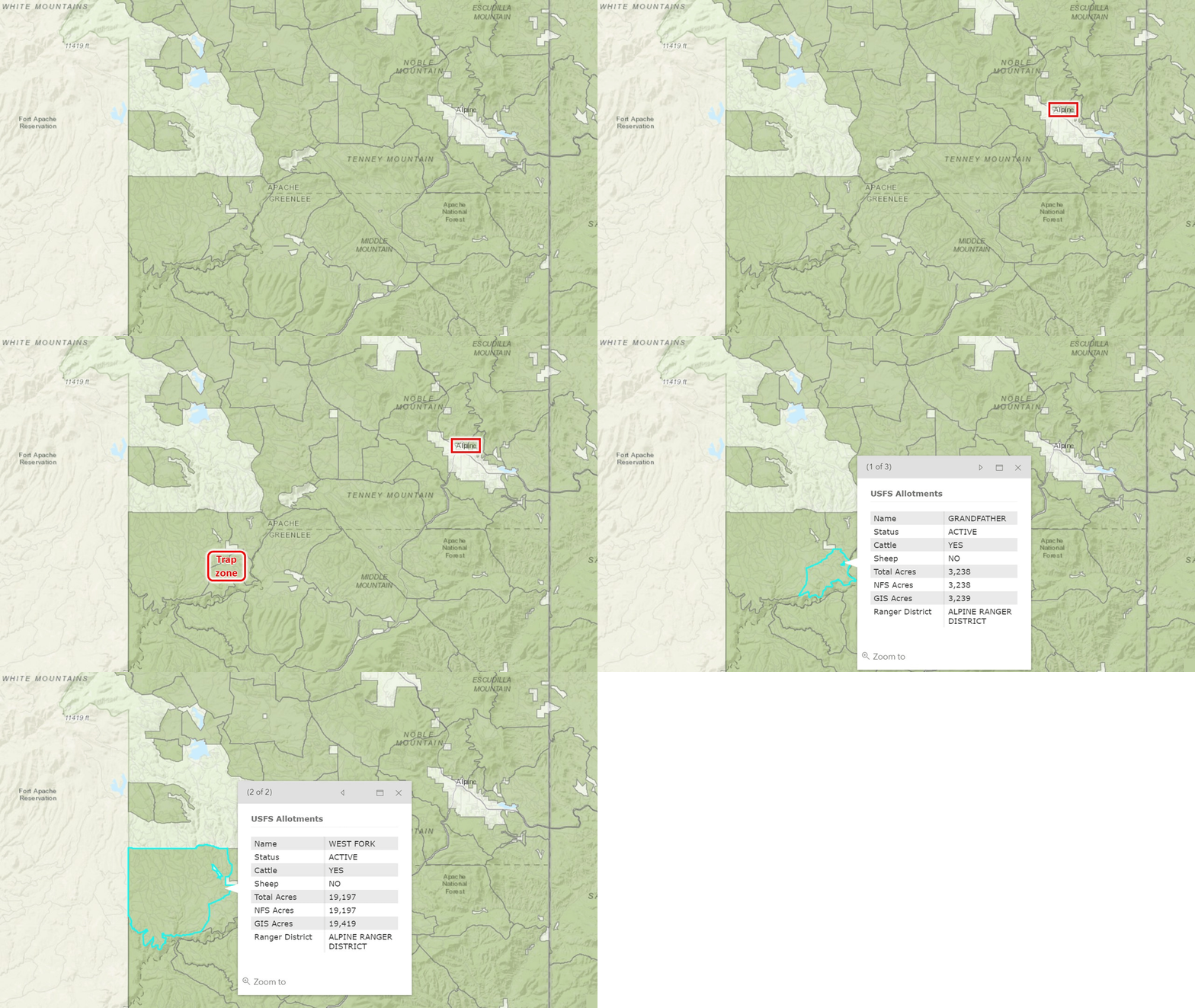
A map provided with the closure order puts the trap zone southwest of Alpine.

A public affairs officer with the Forest Service would not respond to these questions:

1. Is the action associated with the case brought by the Center for Biological Diversity?

2. If so, is the gather area in the jumping mouse habitat?

3. Are the gather area and surrounding lands subject to permitted grazing?

Western Horse Watchers believes the answers are “Yes.”

The 2019 complaint by CBD describes damage to jumping mouse habitat by horses, cattle and elk in and around the West Fork of the Black River, Boggy Creek and Centerfire Creek, all of which appear on the closure map.  Page 45.

The Restricted Area (trap zone) overlaps two grazing allotments according to the Western Watersheds map.  (Click on image to open in new tab.)
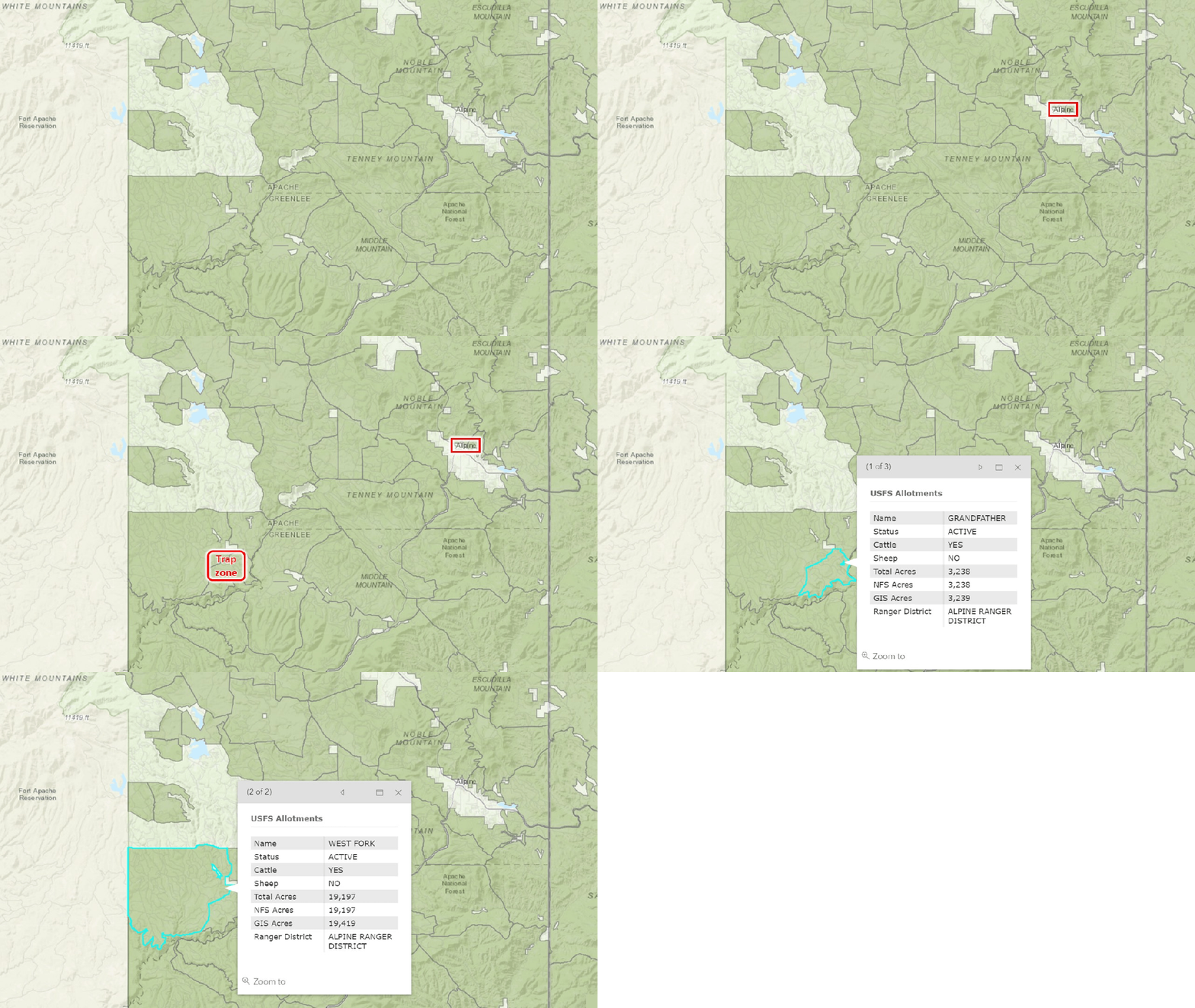
ASNF Jumping Mouse Allotments 03-24-22

The PAO said that unauthorized cattle had been removed from the area between September 2020 and September 2021 but did not comment on authorized cattle.

He did not indicate if said livestock were returned to the forest to graze on the other side of the fence, a benefit for which the horses are not eligible.

RELATED: Wild Horses Destroying Jumping Mouse Habitat?

Axtell Burros Guarding Cattle for Public-Lands Rancher!

A story posted today by Colorado Public Radio refers to the thousands of acres of public land he leases from the federal government every summer, but does not indicate if those areas are managed by the BLM or Forest Service.

The permittee tried to obtain the burros directly from the BLM but ran into bureaucratic hurdles, according to the article, but everything changed when CPW got involved.

RELATED: How Did CPW Acquire Axtell Wild Burros?

Scoping Begins for Livestock Management Plan at TRNP

The project is discussed in an article posted today by The Dickinson Press of Dickinson, ND, which can only be viewed by subscribers.

A newsletter was posted by the Park Service for public review.

Comments will be accepted until April 15.

A public meeting will occur on March 30.  An online option is available.

Alternatives for management of cattle and horses include:

  • No changes
  • Reduction of herds over time to no livestock
  • Non-reproductive herds at South Unit and North Unit
  • Non-reproductive herds at South Unit and Elkhorn Unit
  • Reproductive herds of horses and cattle
  • Non-reproductive herd of horses and removal of cattle

The preferred action was not identified.

The original wild horses of TRNP, thought to be descendants of Sitting Bull’s herd, were removed but some were rescued by Frank and Leo Kuntz.  The horses you see today are only an exhibit and this is acknowledged in the newsletter.

Poster Suggestions for Wild Horse Rallies

Artwork supplied by participants.

1. Public-lands ranching

LIVESTOCK BELONG IN FEEDLOTS

NOT WILD HORSES

CONFINE THE RANCHERS

TO THEIR BASE PROPERTIES

2. Land-use plans

THE PROBLEM IS

RESOURCE MANAGEMENT

NOT WILD HORSES

3. The Montana Solution

DARTING PROGRAMS ARE

HELICOPTER ROUNDUPS

IN SLOW MOTION

4. The advocates

NEXT TO THE FEDERAL GOVERNMENT

NOBODY’S GETTING RID OF MORE WILD HORSES

THAN THE ADVOCATES

5. News and information

BIG TECH AND MEDIA

DON’T BRING YOU THE TRUTH

ABOUT WILD HORSES

THEY BURY IT

RELATED: Carson City Wild Horse Rally Part of Nationwide Protest.

Aim of Wild Horse Rallies?

Roundups are not the problem, they are a symptom of the problem.

If you want to help the horses, don’t focus on the horses.

The advocates focus on the horses.

Instead, look upstream in the management process: Land-use plans that put ranching interests far above those of the horses.

Roundups don’t allocate resources.  They can’t change resource allocations.  They enforce resource allocations already on the books.

Demand that the government manage their congressionally designated habitats principally for them, not privately owned livestock, as specified in the original statute.

RELATED: Carson City Wild Horse Rally Part of Nationwide Protest.

How Many Wild Horses Can the Four Mile HMA Support?

A new resource enforcement project for the Bible Springs Complex has been created but no documents have been posted and public involvement has not been requested.

The Complex includes the Tilly Creek, Bible Spring and Four Mile HMAs.

The preliminary environmental assessment is still months away so let’s use other data sources, such as the Western Watersheds map and RAS to bootstrap the answer.

  • Identify allotments that overlap the HMA
  • Determine average forage production on those allotments
  • Convert to wild horses
  • Calculate the True AML

The HMA covers 61,273 acres and the 60 horses currently allowed by plan require 60 × 12 = 720 AUMs per year.  The stocking rate allowed by plan is about one wild horse per thousand acres, in line with the target rate across all HMAs (27,000 animals on 27 million acres).

The land must produce 720 ÷ 61,273 × 1,000 = 11.8 AUMs per year per thousand acres to support the horses.

Can it produce more?

The HMA intersects six grazing allotments according to the map.  (Click on image to open in new tab.)

Four Mile HMA Allotments 03-20-22

The Allotment Master Report provides acreage, management status and active AUMs.

Four Mile Allotment Calcs 03-20-22

Three of the allotments are in the Improve category along with 56.1% of the public acres.

The average forage production for livestock across the six allotments, the total AUMs divided by the total acres times 1,000, is 44.7 AUMs per year per thousand acres, almost four times higher than the amount needed for the horses.

The total forage production in the HMA is 11.8 + 44.7 = 56.5 AUMs per year per thousand acres, which would support 56.5 ÷ 12 = 4.7 wild horses per thousand acres.

The HMA contains 61,000 acres so the True AML should be around 4.7 × 61 = 286.

The number of horses displaced from the HMA by permitted grazing is 286 – 60 = 226.

The True AML can be achieved by confining the ranchers to their base properties and letting them pay market rates to feed their animals.

What do you think happens during the off season?

RELATED: New Resource Enforcement Plan for Bible Springs Complex?

Isolating Horses from Water?

The March edition of Horse Tales is out and the column on page 4 by the real estate agent and PZP darter in the Minden/Gardnerville area has a few suggestions for land owners that can help wild horses.

If you’re going to place a deed restriction on your property to protect springs and creeks, why not add a prohibition for the Montana Solution?

The advocates are a much greater threat to the horses than droughts, motorists and developers.

PZP-Free Zone 03-19-22

How Did CPW Acquire Axtell Wild Burros?

Were they sale eligible?  Their ages ranged from five to eleven years.

Have they already been offered unsuccessfully for adoption at least three times?

Adopters are usually limited to four animals per year but six were supplied.

Was title transferred from BLM?  Who is the official owner?

Are they still federally protected?

The donation, as it was billed in the story by The Grand Junction Daily Sentinel, has become a pilot program to see if wild burros can prevent wolf attacks on privately owned livestock.

Or maybe they’re just decoys, a new method for disposing excess animals?

RELATED: Axtell Burros Shipped to Cattle Ranch Came from Nevada WHR?

Axtell Burros Shipped to Cattle Ranch Came from Nevada WHR?

A story posted this morning by The Grand Junction Daily Sentinel says the animals “had just come off the high country in Nevada.”

The only burros captured recently in the state were taken from the Nevada WHR, according to records maintained by Western Horse Watchers.

The AML for burros in that area is zero but it is not subject to permitted grazing.

The gather page indicated that captured horses would be shipped to the off-range corrals at Palomino Valley but the burros would be transported to Axtell.

The incident concluded on January 3.

RELATED: Axtell Burros Have New Job: Protecting Cattle from Wolves.

Axtell Burros Have New Job: Protecting Cattle from Wolves

Two jacks and four jennies were taken from the off-range corrals in Utah to a ranch near Walden, CO, according to a story posted yesterday by KDVR News of Denver, courtesy of Colorado Parks and Wildlife.

The agency is required to restore and manage gray wolves in the state by the end of 2023, following the passing of Proposition 114, and wolf kills are already increasing.

The ranch covers 11,000 acres but Western Horse Watchers was unable to determine if it secures grazing preference on public lands.

Best Way to Control Wild Horses

Yesterday’s column by the Campaign Against America’s Wild Horses in The Salt Lake Tribune referred to helicopter roundups as “pointless,” as if the government routinely engages in the capture, branding, harassment and death of the animals without regard to the statute.

Section 1331 notwithstanding, removal of wild horses from their congressionally designated habitats, by any method, including helicopters, wranglers and PZP, shifts resources back to the public-lands ranchers, as specified in management plans that put ranching interests far above those of the horses.

Did the writer explain that?

Of course not.

She starts with the premise that the horses have to go, then tries to convince her readers that the Montana Solution is best suited to the task, forgetting that darted mares still eat, exactly what the bureaucrats and ranchers don’t want.

As noted previously, the technique will likely find favor in a mopping-up role, protecting the ranchers after the fact by making sure the herds don’t bounce back.

RELATED: Advocates to America: Let Us Get Rid of Your Wild Horses.

Advocates to America: Let Us Get Rid of Your Wild Horses

Refer to this column in The Salt Lake Tribune by the communications director of the Campaign Against America’s Wild Horses.

They want the horses off the range as much as the bureaucrats and ranchers, but they want it done with PZP not helicopters.

You’ll never hear them talk about resource allocations, mismanagement of HMAs and confining the ranchers to their base properties because those discussions might make life better for the horses.

RELATED: Do “Stay Wild” Caps Absolve the Advocates from Wrongdoing?

Love Triangle 03-17-22

Horses Clash with Livestock at Blackfeet Nation?

The Reservation covers 1.5 million acres in northwest Montana and is home to around 16,000 free-roaming horses, according to a story posted yesterday by the Cut Bank Pioneer Press of Cut Bank, MT.

The Branch of Agriculture and Rangeland Development, Bureau of Indian Affairs, offers oversight and technical assistance for rangeland protection and improvements, among other things, and provides leasing and permitting services for farmers and ranchers.