
Haaland Urged to Hit ‘Reset’ Button in WHB Program

A press release issued today by The Cloud Foundation recommends three actions for future management of wild horses and burros:

  • Protect their natural behaviors
  • Give them their fair share of forage on public lands
  • Fix inadequate standards during roundups, in holding facilities and at adoption

How about “managing principally for wild horses and burros” and “managing at the minimum feasible level,” per the original statute, while rolling back federal regulations aimed at “managing primarily for livestock?”
Piceance Appeal Deadline Nears

The appeal period closes on March 23, according to a report by Vail Daily.

The 337 wild horses found five years ago have blossomed into 1,200, for an average annual growth rate of 29% per year!

The story includes comments by one of the two sisters who recently received a Trailblazer award.  With 74% of the BLM grazing land in Colorado failing to meet standards for rangeland health, and most of the allotments not inhabited by free-roaming horses, she doesn’t have a leg to stand on.

RELATED: Piceance Decision Record Signed.

Focus on Beef This Weekend

Commissioners of Mesa County, CO designated March 20 “Meat-In Day,” according to a report posted today by KREX News of Grand Junction.

Western Horse Watchers encourages you to enjoy beef and beef products not produced on America’s public lands.  Sadly, you may have a hard time making the determination.

The Mesa County Republican Women will host a BBQ from 12 until 2 PM in Grand Junction.  The story did not say if they’ll be offering range-fed steaks.

Government dependency and redistribution of wealth are not hallmarks of conservatism, which has been traditionally associated with the Republican Party.

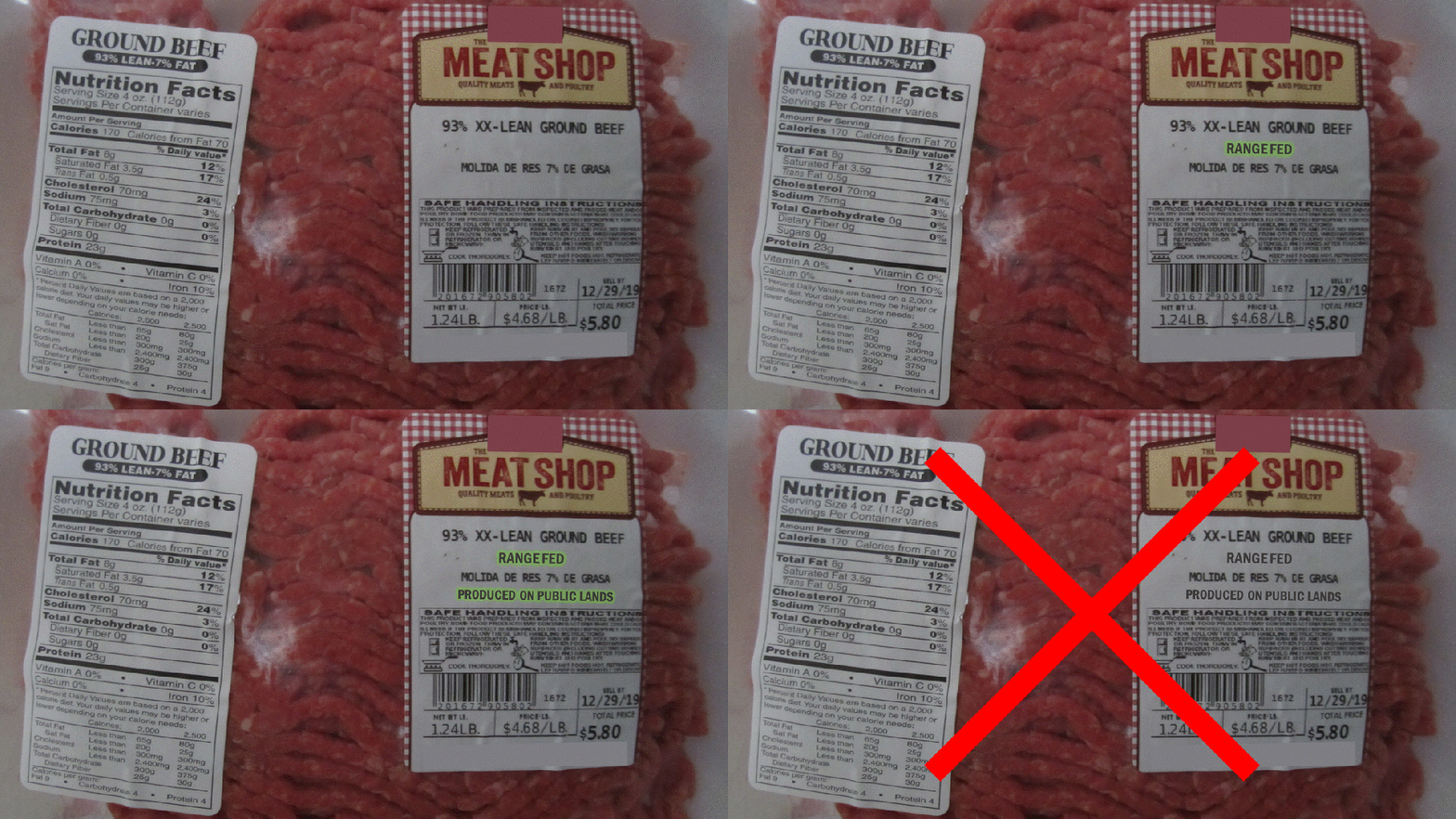
Range Fed Beef

Allotment Status in Arizona

The Allotment Information report in RAS for all districts and field offices in Arizona yielded 824 unique rows after filtering out 36 duplicates.  The duplicates corresponded to allotments with more than one permit.

The breakdown by category shows a majority with custodial status.

  • Improve: 203
  • Maintain: 183
  • Custodial: 435
  • Unclassified: 3

With 25% of the allotments in the Improve category, you might conclude that grazing lands in Arizona are in fairly good shape.

The breakdown by acreage shows a greater disparity:

  • Improve: 5,103,211
  • Maintain: 3,507,113
  • Custodial: 2,748,535
  • Unclassified: 119,374

Roughly 44% of the land does not meet standards for rangeland health.  For every acre in the Maintain category, there are 1.5 acres in the Improve category.

The condition of the custodial allotments is not known.

Privately owned livestock can access over 11 million acres of BLM lands in the state, compared to 1.5 million acres for wild horses and burros.

The status of allotments managed by the Forest Service is unknown.

RELATED: Status of Allotments in Nevada.

Comments Invited on Draft EA for SoCal Burro Removals

BLM announced yesterday the beginning of a 30-day comment period for wild burro management actions in the Centennial, Panamint and Slate Range HAs over a ten-year timeframe.

The Proposed Action, discussed in Section 2.0 of the EA, will remove all burros from the project area.  The current population is thought to be around 939 animals.

Wild horses are found in Centennial but are not included in the project scope.

The HAs cover about 1.7 million acres on the east side of Highway 395, adjacent to Death Valley National Park, site of another burro removal project.

The maps in Appendix B show the general arrangement.

The number of burros allowed by plan is zero, along with the target stocking rates.

The Allotment Information report in RAS shows other mandated uses of public lands in the Ridgecrest Field Office.  Remarks on pages 15 and 16 of the EA indicate that grazing allotments exist in Centennial and Slate Range but not in Panamint.

Comments will be accepted until April 15.

Wild Horse Detractors Receive Trailblazer Awards

The awards were presented to two sisters, according to a story posted today by the Rio Blanco Herald Times.

One of them, executive director of the White River and Douglas Creek Conservation Districts, speaks about the impact of wild horses in this video by Protect the Harvest, a cheerleader group for the public-lands ranchers.

The other, a steward of the public lands and president of the Colorado Cattlemen’s Association, operates a cattle ranch near Fruita, CO.

The Operator Information and Allotment Information reports in RAS tie the ranch to the North Fork Kannah Creek and Whitewater Common allotments.

The Allotment Master report puts both of them in the Improve category.

RELATED: Allotment Categories Explained.

Status of Allotments in Nevada

The Allotment Information report in RAS for all districts and field offices in Nevada yielded 781 unique rows after filtering out 317 duplicates.  The duplicates corresponded to allotments with more than one permit.

The breakdown across the three defined categories is fairly even:

  • Improve: 264
  • Maintain: 262
  • Custodial: 223
  • Unclassified: 32

With 34% of the allotments in the Improve category, you might conclude that rangeland health in Nevada is not that bad.

However, the breakdown by public acreage tells a different story:

  • Improve: 27,101,387
  • Maintain: 8,969,671
  • Custodial: 4,798,196
  • Unclassified: 1,060,381

Roughly 65% of the land does not meet standards for rangeland health.  For every acre in the Maintain category, you have three acres in the Improve category.  The condition of the custodial allotments is not known.

Privately owned livestock can access 42 million acres of BLM lands in the state, compared to 15 million acres for wild horses and burros.

Western Horse Watchers has not been able to find a reporting system for allotments managed by the Forest Service.

RELATED: Allotment Status in Colorado.

Haaland to Head Interior

She was confirmed by a narrow 51-40 vote, according to a report by AP News.

Her responsibilities will include wild horses and burros living on public lands managed by the BLM.

The Secretary of Agriculture is responsible for wild horses and burros living on lands managed by the Forest Service.

In the original WHB Act, Congress placed the welfare of these animals in the hands of these two individuals.

RELATED: Senate to Confirm Haaland?

Allotment Status in Colorado

The Allotment Information report in RAS for all districts and field offices in Colorado yielded 2,318 unique rows after filtering out 190 duplicates.  Those rows corresponded to allotments with more than one permit.

The breakdown by category shows a large number with custodial status.

  • Improve: 649
  • Maintain: 428
  • Custodial: 1,237
  • Unclassified: 4

With 28% of the allotments in the Improve category, you might get the impression that public lands in Colorado subject to permitted grazing are in fairly good shape.

However, the breakdown by acreage tells a different story:

  • Improve: 5,741,814
  • Maintain: 1,225,536
  • Custodial: 834,957
  • Unclassified: 520

Almost 74% of the land does not meet standards for rangeland health.

The condition of the custodial allotments is not known.

Privately owned livestock can access nearly eight million acres of BLM lands in the state, compared to 0.4 million acres for wild horses.

RELATED: Status of Allotments in Wyoming.

Three Allotment Categories Are Not Enough

Western Horse Watchers has already suggested Category D for allotments ruined by wild horses and burros, even in areas where the AML is zero.

But now there’s another issue: Man-made climate change.

For allotments threatened by global warming, which should be all of them, Western Horse Watchers proposes Category W—not for warming but for Woke—because only the enlightened can see what’s truly going on.

The rest of us dolts, including your host, only see sedentary animals congregating around water holes, polluting them with their droppings.

The new category would relieve the ranchers of any responsibility for rangeland health.

RELATED: Rewilding Western Rangelands?

Thriving Ecological Balance-3

The Multiple-Use Mission of ‘Perseverance’

A drawback of the automatic darting machine introduced last year is that the horses have to come to it, necessitating the continual restocking of bait.

But what if it was mobile and could go on the offensive?  Artificial intelligence would identify the target and steer the machine to the appropriate distance.

Multiple-Use Mission of Perseverance

Contraceptive darts, loaded into twelve-round cartridges that resemble baseball bats, would be fired automatically.  A ballistics computer would aim the device based on wind speed and direction.

Spent cartridges would be jettisoned.

The rover demonstrates the concept.  No more youngsters consuming critical resources in the Designated Area.

RELATED: ‘Perseverance’ Finds No Pinyon Pines or Juniper Trees.