
BLM is aware of the contraption but describes it as “unproven” in Section 2.4.11 of the Final EA for wild horse management actions in the Confusion HMA. If the machine is modified to read RFID chips in the neck, it may be suitable for providing booster doses of GonaCon-Equine in the field, according to the discussion.
Month: October 2020
Mullen Fire to Affect Red Desert Roundup?
The fire is not near the gather area but the BLM corrals at Rock Springs, one of the destinations for captured horses, are on standby in case the horses at Deerwood Ranch must be evacuated.

A roundup in the Red Desert Complex was cut short two years ago due to inadequate corral space. The 2020 roundup is set to begin this week.
RELATED: Deerwood Off-Range Pasture Threatened by Mullen Fire?
Confusion DR Setting New Precedent in WH Management?
The Decision Record issued yesterday states that “…sterilization is the minimum feasible level of management possible for the Confusion HMA.”
Section 2.2.4 in the Final EA for the Gather Plan indicates that the procedures would be carried out at a private facility and would not be open to public observation.
This is unacceptable.
In the future, writers of new gather plans will only need to point to this one to justify their ill-conceived ideas. Each step in the process moves the program farther from its original charter, which is to manage the land principally for wild horses.
NOTE: The documents were combined into one file. The Decision Record is not searchable but the Final EA is.
RELATED: Confusion Roundup Pending.

Confusion Roundup Pending
BLM announced today the signing of a Decision Record, allowing plans for a roundup to move ahead, subject to a 30-day appeal period. The DR authorized the Proposed Action (Alternative D) in the EA. Both documents were posted as one file.
The operation would capture 560 wild horses and return 60, including those who received ‘population growth suppression.’ The news release did not indicate if the treatments applied to males and females.
The Confusion HMA covers about 235,000 acres in western Utah and has an AML of 115, for an aimed-at stocking rate of 0.5 horses per thousand acres. As mentioned earlier this year, fractional stocking rates may indicate large amounts of forage diverted to privately owned livestock.
The current population is thought to be 661, including 546 excess horses.
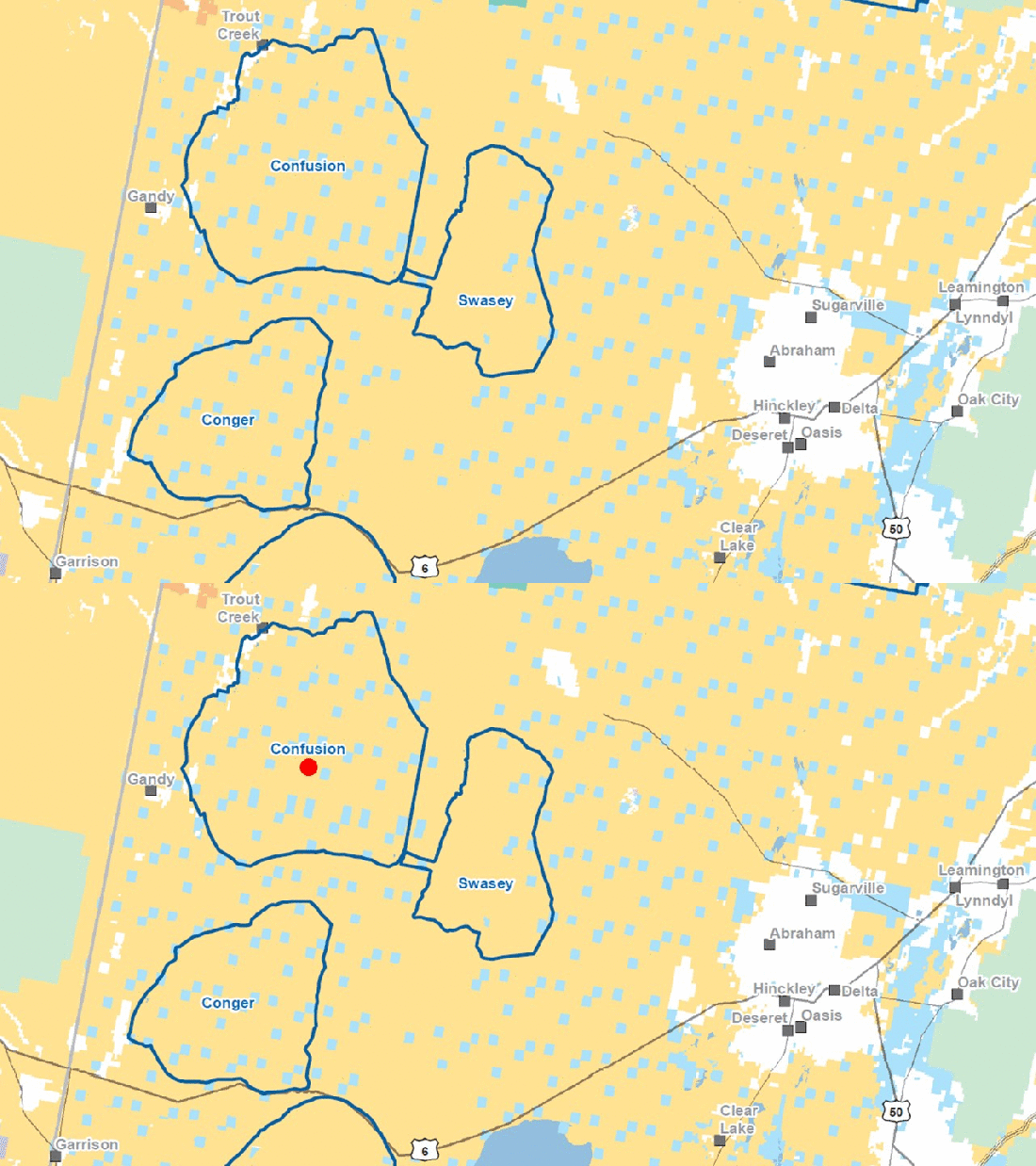
The HMA intersects five grazing allotments, with the horses receiving just 12% of the total authorized forage, excluding wildlife.
The forage allocated to livestock puts the true AML at 932, meaning there are no excess horses in the HMA and the roundup is unnecessary.
Deerwood Off-Range Pasture Threatened by Mullen Fire?
A report by Wyo4News says the BLM is monitoring the situation in southeastern Wyoming and is prepared to evacuate the horses to corrals in Rock Springs if necessary.
The fire started September 17 in the Medicine Bow National Forest.
The 4700-acre Deerwood Ranch has a capacity of 350 wild horses, according to the BLM page for public off-range pastures.
Devil’s Garden Roundup Over
The Forest Service reported this morning that the operation ended on October 3, with 506 horses gathered and one death. The number of horses shipped was not provided.
The sum of the daily reports indicates 502 horses captured. Foals accounted for approximately 16% of the total.
Do the numbers balance? Who knows.
The WHT was not overpopulated. The AML was minimized to maximize the resources available to privately owned livestock, referred to as the ‘economy of Modoc county’ in the news release.
Pokegama Update
The daily reports show no activity since September 18, when the incident began.
RELATED: Pokegama Roundup Underway.
Mustang Monday
Horses have the day off. On the Black Mountain HMA with Ednei Ferreira.
Stewart Creek Horses Get Short End of Stick
The Red Desert roundup begins this week, affecting five HMAs. The news release said the current wild horse population in the Complex is approximately 3,000, compared to a total AML of 724.
If each HMA is at 4X AML, the need for this and other management actions, such as fertility control, is obvious.
The operation was originally authorized in 2016 but the supporting documents were revised in 2017. Data in the Final EA are not sufficient for a report on the entire Complex but do allow reports for a few of the HMAs.
The Stewart Creek HMA covers 168,000 acres and has an AML of 175. The horses allowed by plan require 2,100 AUMs per year and the stocking rate is approximately one wild horse per thousand acres, in line with the average rate across all HMAs.
The HMA intersects one allotment, shown in white on the following map. The EA states on page 54 (page 58 in the pdf) that the allotment boundary is similar to the HMA boundary except the allotment includes about 5,000 acres outside the HMA. Thus, the estimated size of the allotment is 173,000 acres.

Table 5 in the EA provides the grazing season and authorized forage. Livestock calculations are based on cow/calf pairs for a direct comparison to wild horses. The resource requirements of wild horses and cow/calf pairs are said to be equivalent.
The portion of the allotment inside the HMA is 168,000 ÷ 173,000 = .971.

The estimated forage available to livestock inside the HMA is 8,138 AUMs per year, assuming the resource is evenly distributed across the parcel (97.1% of 8,380).
The Stewart Creek permittees would have to place 1,292 cow/calf pairs inside the HMA to graze off 8,138 AUMs in 6.3 months. The stocking rate would be 7.7 cow/calf pairs per thousand acres.
These management indicators are compared in the following charts.

The HMA is managed primarily for livestock, with the horses receiving 21% of the total authorized forage (excluding wildlife).
If the HMA is at 4X AML, the pre-gather population of 700 would include 525 excess horses and the area would be classified as ‘overpopulated.’.
However, the forage assigned to livestock would support an additional 678 wild horses, for a true AML of 853. There are no excess horses in the HMA, there is no need for a roundup and there is no justification for a fertility control program.
RELATED: Red Desert Horses Get Short End of Stick?, Rationale for AMLs?

YouTube Update
Not sure if Google is still sending out email notifications of new videos so if you’re subscribed to the channel here is a link to the latest. Or you can watch it here.
South Steens Follow-Up
At the conclusion of the roundup, BLM reported that 62 studs had been captured along with 103 mares. Do those numbers look like they came from a herd that’s 50% males, 50% females?
The question can be answered with the most rudimentary of statistical calculations, where n = 165 and p-bar = .5.
The observed values of 62 and 103 fall outside the calculated limits of 63.2 and 101.8.
Therefore, the answer is ‘No.’ An assignable cause should be sought.
One possibility is that mares prefer private property. Another possibility is that the contractor targeted family bands. That might explain the rather large percentage of foals captured (24.3% of the total).
Or perhaps the herd was not composed of 50% males and 50% females. Do studs die off at an early age, leaving the mares and foals behind?
Would a sex ratio of 40% males and 60% females be considered normal? If so, then attempts to skew it in the other direction would be considered malicious, interfering with a natural process, just like PZP darting.
But it makes sense in an age where ‘management at the minimum feasible level’ has been replaced with ‘management primarily for livestock,’ privately owned, of course.
RELATED: South Steens Roundup Ends.

Cibola-Trigo Outside-HMA Roundup Over?
The daily reports stopped on September 30. The goal has been reached but no news release has been issued. Here are the totals based on the daily results:
- Burros captured: 307
- Goal: 300
- Deaths: 1
- Shipped: 327
- Returned: 5
A jenny died on September 23 after colliding with a panel. Foals accounted for roughly 16% of the burros captured. The number of foals on September 17 was not provided.
Do the numbers balance? Given that more animals were shipped than gathered the answer is probably ‘No.’
Animals gathered = Animals shipped + Animal deaths + Animals returned
Therefore,
Animals gathered − Animal shipped − Animal deaths − Animals returned
should be zero.
307 − 327 − 1 − 5 = −26
The numbers don’t balance. Send in the auditors.
RELATED: Cibola-Trigo Roundup Resumes, Data Quality Program Needed at BLM.
Devil’s Garden Roundup Day 23
The incident started on September 9. Gather stats through October 1:
- Horses captured: 463
- Escaped: 5
- Goal: 500
- Deaths: 5
- Shipped: Not reported
No deaths occurred on Days 22 and 23. The Forest Service reported a total of 467 horses captured in this week’s summary but the sum of the daily results is 463.
Foals accounted for 14.7% of the total. The number of horses held on site is not known.
The daily reports can be found here.
Contrary to the statement in the weekly summary, the horses remaining in Devil’s Garden don’t have more food to eat and more room to roam. The forage and land allocated to wild horses are specified in resource management plans and RMPs aren’t affected by roundups.
RELATED: Devil’s Garden Roundup Day 21.
Axtell Tour Set for Mid Month
A public tour of the off-range corrals in Axtell, UT will occur on October 15, according to a BLM news release published today.
The facility currently houses animals from the Frisco, Shawave and Sulphur roundups.
The government removes wild horses from western rangelands and places them in facilities like this at a cost of roughly $5 per day per horse so it can collect about four and a half cents per day for each cow/calf pair that replaces them.
Taxpayers cover the difference and the ranchers get rich.
Colt Sitting On Fence?
He’s six months old today but his mane still hasn’t figured out which way to fall.
RELATED: To the Left or To the Right?

Data Quality Program Needed at BLM
The Shawave roundup ended with three unaccounted-for horses.
The numbers from the Diamond roundup don’t balance.
The Black Mountain roundup is off to a bad start, with a discrepancy in the number of burros captured.
Wouldn’t hurt to have a program at the Forest Service also, as the number of horses gathered at Devil’s Garden doesn’t match the total from the daily results.
Black Mountain Roundup in Progress
The incident began on September 23 with no news release. Gather stats through September 30:
- Burros captured: 71
- Goal: 500
- Deaths: 1
- Shipped: Not reported
BLM is reporting 74 burros gathered but the daily results yield 71. Foals accounted for 15.5% of the total.
One animal was found dead in the corrals on September 28.
The HMA is in northwestern Arizona and includes the old mining town of Oatman.
RELATED: Black Mountain Decision Record Signed, Roundup Pending.
 Western Horse Watchers Association