West Douglas Roundup Ends

The incident concluded today with 122 horses captured, 117 shipped, none released and four dead.

There was one unaccounted-for animal.

122 – 117 – 0 – 4 = 1

More foals were shipped than caught.

West Douglas Final Results 09-09-23

Youngsters represented 17.2% of the horses captured.

Of the adults, 56.4% were male and 43.6% were female.

A 17% birth rate corresponds to a 12% growth rate.

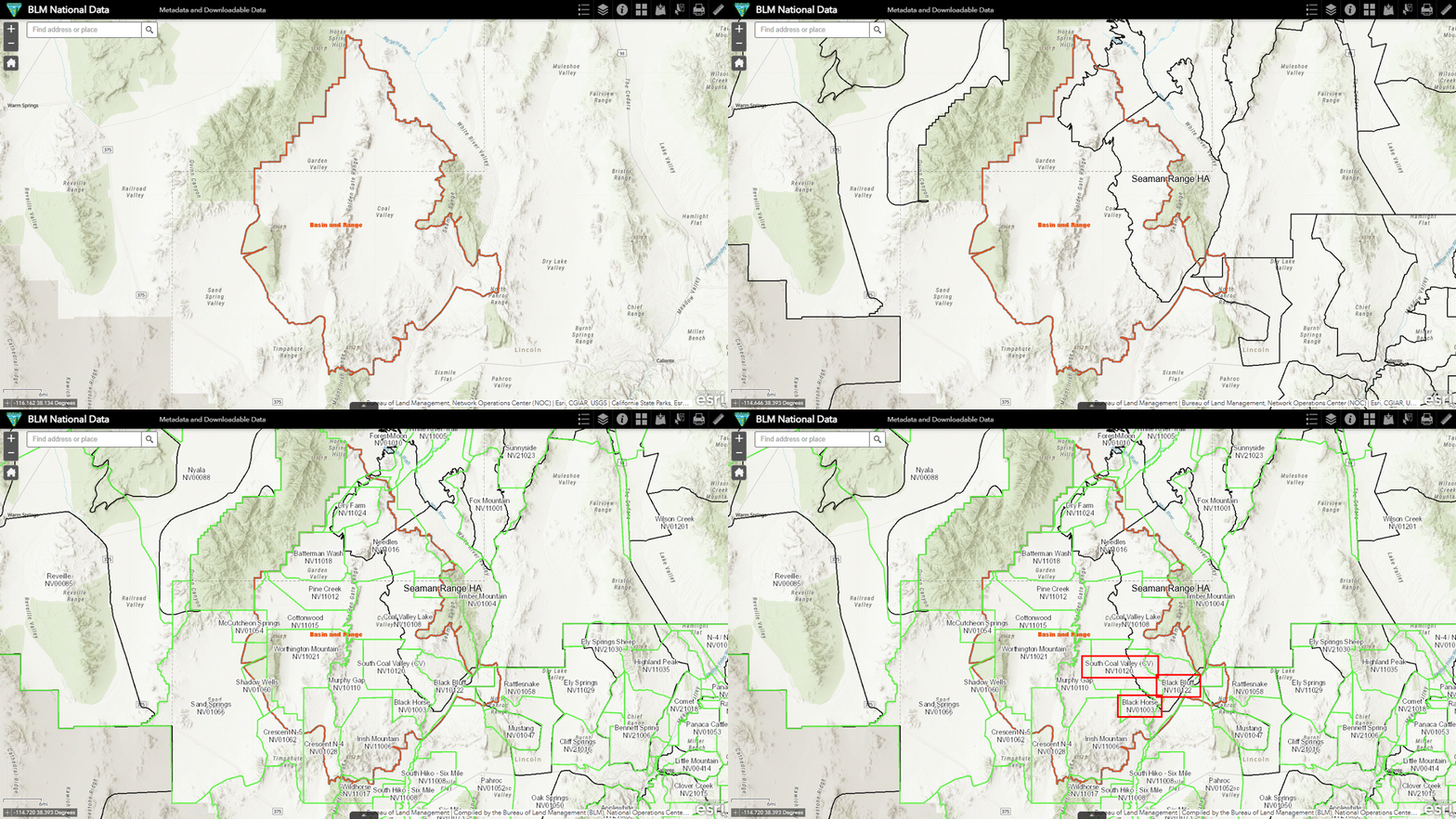
The HA is unfit for wild horses, supposedly, but well-suited for livestock.

RELATED: BLM to Remove All Remaining Horses from West Douglas HA.

BLM, MHF Part Ways, TIP Ending

The agency will not renew its partnership with the Mustang Heritage Foundation for FY 2024, according to a story dated September 8 by Horse Network.

All animals currently in the Trainer Incentive Program must be placed into private care no later than September 30 or be returned to the BLM by October 1.

The decision follows an announcement last month to spend more taxpayer money on fertility control pesticides, to the delight of the wild horse advocates.

If those efforts succeed, there won’t be any more mustangs to adopt.

RELATED: BLM Awards $1 Million for Wild Horse Protection?

Dust-Up in the Desert Reviewed

Was it truly a presentation of opposing viewpoints or simply a dispute about fine points between two factions of the same coalition?

Three reports have hit the wires in the last 24 hours:

Hansen wants the horses removed with helicopters and Beckstead wants them removed with ovary-killing pesticides.

Are wild horses overpopulated in Nevada?  Yes, there are more animals than allowed by plan.

Are there more horses than the land can support?  No, most of the resources in their lawful homes have been assigned to privately owned livestock.  If you confine the ranchers to their (multi-million dollar) base properties in a year-round off season, and expect them to pay the going rate to feed their animals, there would be plenty of food and water for the horses.

As of this morning, video of the debate has not been posted to the AWA YouTube channel.

RELATED: Dust-Up in the Desert Set for September 7.

PSA 12-07-19

BLM Publishes Clan Alpine Final Planning Documents

The FONSI, DR and EA were copied to the project folder yesterday.

The Carson City District Manager selected Alternative 1 in the EA, the Proposed Action, authorizing forcible removal of excess animals to achieve low AML, sex ratio skewing in favor of males and treatment of mares with immunocontraceptive pesticides over a ten-year period.

The decision, effective immediately, does not mean a roundup is imminent.

Refer to Table 3 in the EA for a summary of the alternatives.  Section 2.2.2 looks at the Proposed Action in detail.

The new plan aligns with three goals of rangeland management:

  • Pest control
  • Resource enforcement
  • Rancher protection

Forage allocations and management priorities are determined by the land-use plans, not wild horse gather decisions.

RELATED: Clan Alpine Decision Published?

AML-1

Identity of High Desert Strategies Revealed

The group received almost half of the $1 million awarded by the BLM in August to manage and protect wild horses and burros.

The nonprofit is a collaboration between the BLM and ranchers, according to a story dated September 8 by the Malheur Enterprise.

These stewards of the public lands are poisoning mares with GonaCon Equine in four Oregon HMAs, indicated in the first part of the August 28 roundup schedule for nonmotorized removals.

RELATED: BLM Awards $1 Million for Wild Horse Protection?

Virginia Range Darting Update for August 2023

The Campaign Against America’s Wild Horses, a leader in nonmotorized removal, said in the August update that 116 mares received 116 doses of PZP during the month, 27 given as a primer and 89 as a booster.  If you can’t access the document, click here.

Over the life of the program, 1,940 mares have received 8,027 doses of the pesticide.

The report will be submitted to the Nevada Department of Agriculture.

If it was written by a stockgrower’s association, farm bureau or cattlemen’s group, there’d be few if any changes.

Of the 158 foals born this year in the primary target zone, a record low, 74 have died.

The causes of death were not discussed but predation is likely a factor.

As usual, the advocates are silent about the long-term population goal and how many horses they intend to eradicate, as well as herd demographics.  What does the sex ratio look like nowadays?

There is no mention of sterility and the growing risk thereof.

The current population is thought to be 3,559, including 395 listed as missing.

RELATED: CAAWH Publishes Virginia Range Darting Resources.

Pesticide Pushers 07-17-23

Clan Alpine Decision Published?

A BLM news release dated September 7 said the DR and Final EA had been posted to the project folder but, as of this morning, your host can’t find them.

Curiously, an HMAP from the early 1990s was copied to the folder, ratifying livestock use in the HMA and demonstrating compliance with the RMP.  Go to page 7 in the pdf.

Some advocates believe HMAPs are the answer to wild horse problems.

RELATED: Clan Alpine Pest Control Plan Out for Public Review.

Foal-Free Friday, Fundamental Transformation Edition

The Campaign Against America’s Wild Horses, a leader in nonmotorized removal, said in a news flash posted by Lucky Three Ranch that the Cedar Mountain mustangs will never have to face the helicopters again, thanks to a new BLM grant.

This will be accomplished by turning the HMA into an HTA, a place where the mares are gradually poisoned with PZP, a restricted-use pesticide.

The project brings together diverse stakeholders, according to the announcement, including the Utah BLM, one of the permittees and CAAWH.

Except there’s no diversity in that group—it’s the Love Triangle!

With shared goals of humanely managing the Cedar Mountain horses, stewarding their habitat and eventually eliminating helicopter roundups, it’s “a model for collaboration in the wild horse conservation space.”

RELATED: Foal-Free Friday, Removal by Pesticides Edition.

Working Together for a Horse-Free Future 12-21-22

West Douglas Roundup, Day 7

The incident started on September 1.

Eleven horses were taken on Day 6, followed by 12 on Day 5, bringing the total to 116.

The goal is 122.

A stallion with an infected abscess was put down on Day 6 and another stallion with lameness was euthanized on Day 7, boosting the total number of deaths to four and the death rate to 3.4%.

To date, 85 horses have been shipped and none have escaped, leaving 27 unaccounted-for animals.

Foals represented 18.1% of the horses captured.

Of the adults, 54.7% were male and 45.3% were female.

Operations will likely conclude this week.

RELATED: West Douglas Roundup, Day 5.

West Douglas HA with Allotments 08-28-23

What Is a Herd Treatment Area?

As envisioned by the Campaign Against America’s Wild Horses, it’s a place where

  • Advocates poison cherished/beloved/innocent mares with ovary-killing pesticides
  • Ranchers receive most of the food and water
  • Donors pay for the destruction

Forget about HMAs and managing principally for wild horses, those ideas are as old and irrelevant as the Ten Commandments.

RELATED: If You Repeat a Lie Long Enough, People Will Believe It.

For Your Innocent Ants and Roaches 10-23-22

Owyhee Roundups in Progress?

A report by KIVI News says operations began today in the Black Mountain HTA* with one foal lost but, as of this evening, results have not been posted to the gather page.

In an effort to protect genetic viability, the BLM will reintroduce 38 mares treated with ovary-killing pesticides, according to the story.

Yep, you heard it here first.

*Herd Treatment Area.

RELATED: Owyhee Roundups Announced.

UPDATE: The gather page indicates 24 horses captured on Day 1, with 23 shipped, none released and one dead due to a broken neck.

Winners of 2023 Stewardship Awards Announced

The bureaucrats and ranchers will be slobbering over each other today in a luncheon hosted by the Public Lands Council.

The event is part of the 2023 PLC Annual Meeting.

The winners of the Rangeland Stewardship Award, Permittee Category, divided the Apex Slope Allotment into ten pastures and implemented grazing practices better adapted to changing conditions and pasture rotations based on rangeland health, according to a BLM news release dated September 5.

Although the work contributed to improved watershed function, wildlife habitat, forage diversity and habitat resilience, the Allotment Master Report puts it in the Improve category, failure to meet standards for rangeland health.

The allotment offers 622 active AUMs on 12,953 public acres, or 48 AUMs per year per thousand public acres, equivalent to four wild horses per thousand public acres.

These same individuals insist that public lands in the western U.S. can only support one wild horse per thousand acres (27,000 animals on 27 million acres).

The winners of the Rangeland Innovation Award, Permittee Category, have used holistic resource management for over thirty years, consistently adjusting livestock numbers to changes in climatic and vegetative conditions, and have implemented temporary non-renewable grazing suited for positive resource conditions, higher precipitation years and increased biomass.

The allotment, not named in the announcement but determined through RAS, is MT04903-HRM, managed by the Billings Field Office.

The Allotment Master Report puts it in the Maintain category, meeting standards for rangeland health.

The allotment offers a whopping 1,752 active AUMs on 6,734 public acres, or 260 AUMs per year per thousand public acres, equivalent to over 21 wild horses per thousand public acres!

It’s a gold mine.

And how much does the BLM collect in royalties?  Five cents on the dollar or less.

Like Cinderella, some advocates, especially those affiliated with the Campaign Against America’s Wild Horses, a leader in nonmotorized removal, yearn to attend an event like this and be respected and admired by the cattlemen and their allies.

Perhaps they will.

They might be invited guests.

RELATED: Winners of 2022 Stewardship Awards Announced.

West Douglas Roundup, Day 5

The incident started on September 1.

Sixteen horses were taken on Day 4, followed by 12 on Day 5, bringing the total to 93.

The goal is 122.

None have escaped, 40 have been shipped and two were put down for preexisting conditions, leaving 51 unaccounted-for animals.

The death rate is 2.2%.

Foals represented 19.4% of the horses captured.

Of the adults, 53.3% were male and 46.7% were female.

Operations will likely conclude this week.

The HA, unfit for wild horses, supposedly, is managed principally for livestock, in defiance of the original statute.

RELATED: West Douglas Roundup, Day 3.

West Douglas HA with Allotments 08-28-23

The Man Won’t Burn this Year at Burning Man?

The playa is now a mudhole, thanks to storms that rolled through starting on Friday.

Normally the problem is dust.

Nevada is the driest state in the nation so three months’ worth of rain in the valley may amount to an inch or less.

Most precipitation occurs in the mountains, with snowmelt feeding creeks and ponds.

Exodus starts today at noon local time, with “Leave No Trace” difficult to achieve.

The event occurs every summer on BLM land northeast of Gerlach.

The reporter in Wadsworth may be standing along State Route 447, the hopping-off point from I-80.

Curiously, the bonfire, if it occurs, will be watched by thousands of climate alarmists as it spews greenhouse gasses and particulates into the air.

Pilots, Panels and Pesticides: A New Plan to Protect Permittees

Pilots to push the horses into the traps, stitched together with pipe panels, where some break their necks.

Ovary-killing pesticides to reverse population growth.

Public lands managed primarily for permitted grazing.

This is not business as usual, it’s catch-treat-release.

Herd management areas are now herd treatment areas, with stagnant or dwindling populations, thanks to the pioneering work of the wild horse advocates.

RELATED: Catch-Treat-Release, Misuse of GonaCon, Roll Out at Reveille.

Working Together for a Horse-Free Future 12-21-22