If East and West Castle Creek Were a Wild Horse Area

They would have an AML of 1,438 and a stocking rate of 7.4 wild horses per thousand public acres.

The allotments, located west of Bruneau, ID, offer a combined 17,251 active AUMs on 195,240 public acres, according to the Allotment Master Report.

The bureaucrats and ranchers claim that public lands in the western U.S. can only support one wild horse per thousand acres (27,000 animals on 27 million acres).

The advocates bolster the narrative with their darting programs.

If it was an HMA, the AML would be around 200 and 1,238 wild horses would be consigned to off-range holding because of permitted grazing.

RELATED: The Allotments Tell the Story: They’re Lying, All of Them.

East and West Castle Creek Allotments 03-24-24

Codewords for Nonmotorized Removal (of Wild Horses)

The advocates are constantly shifting their vocabulary to keep you in the dark.

Like the bureaucrats, their goal never changes: Ranching superiority in the lawful homes of wild horses, sometimes referred to as achieving and maintaining AMLs.

To fulfill this purpose, they set up PZP darting programs and recruit dummies like you to carry them out.

Euphemisms for the process include:

  • In-the-wild management
  • On-range management
  • Humane management

They all mean the same thing: Sterilizing the mares with ovary-killing pesticides, leading to the destruction of entire herds in just five years.

RELATED: Understanding Advocatespeak.

If Battle Creek Was a Wild Horse Area

It would have an AML of 974 and a stocking rate of 7.6 wild horses per thousand public acres.

The allotment, located west of Bruneau, ID, offers 11,682 active AUMs on 127,954 public acres, according to the Allotment Master Report.

The bureaucrats and ranchers claim that public lands in the western U.S. can only support one wild horse per thousand acres (27,000 animals on 27 million acres).

The advocates prop up the fairy tale with their darting programs.

If it was an HMA, the AML would be around 130 and 844 wild horses would be consigned to off-range holding because of permitted grazing.

Almost 98% of the AUMs go to J.R. Simplot.

RELATED: The Allotments Tell the Story: They’re Lying, All of Them.

Battle Creek Allotment 03-23-24

Foal-Free Friday, Holier Than Thou Edition

Who’s the greater threat to wild horses?  A grifter who sends letters to county wildlife boards seeking their removal from public lands or a real estate agent who’s taking them off the range with ovary-killing pesticides?

That’s the underlying issue in the latest installment of “Wild Horse Tales,” written by a PZP darter and appearing on page 18 of the March edition of Horse Tales.

You will not question the advocates.  You will not doubt their authority.

They are the old guard, allies of the ranchers, leaders of the blind.

RELATED: Foal-Free Friday, Confessing Your Loyalties Edition.

If Big Desert Sheep Was a Wild Horse Area

It would have an AML of 2,492 and a stocking rate of 11.1 wild horses per thousand public acres.

The allotment offers 29,899 active AUMs on 224,268 public acres adjacent to Craters of the Moon National Park, according to the Allotment Master Report.

The bureaucrats and ranchers insist that public lands in the western U.S. can only support one wild horse per thousand acres (27,000 animals on 27 million acres).

The advocates ratify the narrative through their darting programs.

If it was an HMA, the AML would be around 225 and 2,267 wild horses would be consigned to off-range holding because of permitted grazing.

RELATED: The Allotments Tell the Story: They’re Lying, All of Them.

Big Desert Sheep Allotment 03-21-24

McGee Mountain Roundup, Day 3

The incident started on March 18.  Results through March 20:

  • Scope: McGee Mountain HMA
  • Target: Burros
  • Type: Planned
  • Method: Bait
  • Goals: Gather 22, remove 22
  • Captured: 11, up from 3 on Day 1
  • Shipped: None
  • Released: None
  • Deaths: None
  • Average daily take: 3.7
  • Unaccounted-for animals: 11

The figures above are based on the daily reports.

Youngsters represented 9.1% of the animals gathered.

Of the adults, 20% were male and 80% were female.

The HMA is smaller than the HA.  The area is subject to permitted grazing.

  • Forage liberated to date: 66 AUMs per year
  • Water liberated to date: 55 gallons per day

The roundup supports three tenets of rangeland management.

RELATED: McGee Mountain Roundup in Progress.

McGee Mountain HMA with Allotments 03-13-24

If Indian Creek Was a Wild Horse Area

It would have an AML of 710 and a stocking rate of three wild horses per thousand public acres.

The allotment offers 8,518 active AUMs on 234,680 public acres adjacent to Canyonlands National Park, according to the Allotment Master Report.

The bureaucrats and ranchers tell us that public lands in the western U.S. can only support one wild horse per thousand acres (27,000 animals on 27 million acres).

The advocates indicate their agreement through their darting programs.

If it was an HMA, the AML would be around 235 and 475 wild horses would be consigned to off-range holding because of permitted grazing.

The Nature Conservancy receives all of the authorized forage in the allotment, on which it runs cattle, probably in connection with Dugout Ranch.

RELATED: The Allotments Tell the Story: They’re Lying, All of Them.

Indian Creek Allotment 03-20-24

Price of Hay Defies Gravity

The feed store collected $34 per bale today for alfalfa-grass mix, 20 bales minimum, no change from December.

The single-bale price was $35.

Three years ago the price was $19.

A horse would need around five bales per month, putting the cost at $170 per AUM.

At that rate, you’ll burn through your $1,000 adoption incentive in six months.

Ranchers pay $1.35 per AUM on public lands.

RELATED: Price of Hay Unchanged, Still Too High.

Two Men Admit Guilt in Deaths of SoCal Wild Burros

The incident occurred north of Yermo, CA in November 2021 and does not appear to be related to the loss of the Clark Mountain burros, investigation of which continues.

Three animals were killed according to a DOJ news release.

The pleas include one felony count of possession of an unregistered short-barreled rifle and one misdemeanor count of maliciously causing the death of a burro on public lands.

They face up to ten years in federal prison for the firearm charges and up to one year in federal prison for the burro deaths.

Sentencing was set for July 8.

RTF: Surgical Sterilization Bad, Chemical Sterilization Good

The advocates are united in their love for on-range management, which is the same as humane management, which is a codeword for nonmotorized removal.

Thus, on-range management means off the range.

Their attitude toward wild horses differs little from that of the ranchers, evident in a news release dated March 18 by Return to Normal (Before WHB Act).

No surprises, though.  They signed onto the “Path Forward,” a 2019 plan for ranching superiority in the lawful homes of wild horses, sometimes referred to as achieving and maintaining AMLs.

RELATED: Mass Sterilization OK if Done with PZP.

Mass Sterilization OK if Done with PZP

The Campaign Against America’s Wild Horses would never let the BLM get away with it, according to a news flash dated March 14, but they’ll do it as often as possible.

Getting Rid of Wild Horses Is Our Job 10-14-23

The idea was floated in a FY25 budget proposal, supposedly, but a link to the document was not provided.

Sterilization undermines genetic viability but also disrupts natural behaviors essential for the survival of wild herds.

Curiously, the nonprofit, a leader in nonmotorized removal, runs a sterilization program on the Virginia Range, now in its fifth year, while the Salt River Wild Horse Darting Group, a partner organization, does the same in the Tonto National Forest.

PZP tricks the immune system into attacking the ovaries.

It’s a pesticide, not a vaccine.

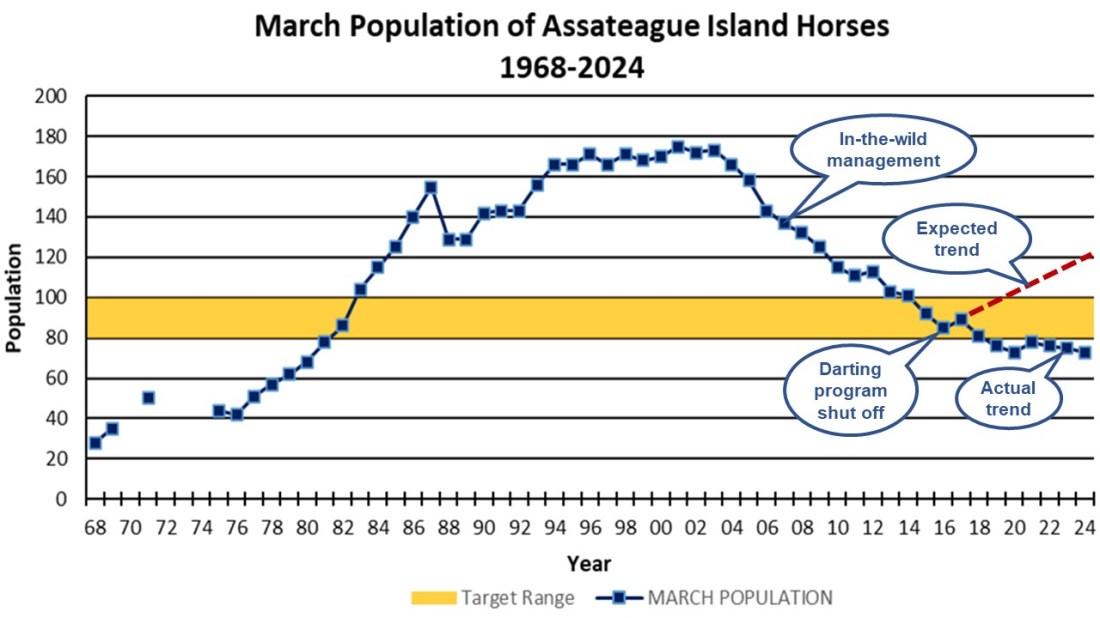
It’s not reversible.  The sperm-blocking theory doesn’t correlate with the observed facts, such as the flat-lining of the herd on Assateague Island.

Damage begins with the first injection, leading to sterility in five years.  Such animals are said to be “self-boosting.”

CAAWH said it “will deploy all necessary resources to prevent any mass permanent sterilization plan from becoming law” (but will actively solicit such arrangements through cooperative agreements).

Pesticide Pushers 07-17-23

If Mineral Range Was a Wild Horse Area

It would have an AML of 985 and a stocking rate of 7.9 wild horses per thousand public acres.

The allotment offers 11,830 active AUMs on 124,924 public acres in western Utah, according to the Allotment Master Report.

The bureaucrats and ranchers claim that public lands in the western U.S. can only support one wild horse per thousand acres (27,000 animals on 27 million acres).

The advocates give their concurrence through their darting programs.

If it was an HMA, the AML would be around 125 and 860 wild horses would be consigned to off-range holding because of permitted grazing.

RELATED: The Allotments Tell the Story: They’re Lying, All of Them.

Mineral Range Allotment 03-17-24

Maybe Today Should Be National Forage Day

Today might be a good opportunity to share some green beer with friends and tell them about resource mismanagement in areas identified for wild horses.

For example, on the Beaty Butte Allotment, which coincides roughly with the Beaty Butte HMA in southern Oregon, ranchers receive 26,166 AUMs on 506,985 public acres.

The horses receive 3,000 AUMs.

The AML is 250, compared to a True AML of 2,430, and 2,180 wild horses have been consigned to off-range holding because of permitted grazing.

The advocates tell you the answer is to end wild horse reproduction, not animal agriculture, because they’re in cahoots with the bureaucrats and ranchers.

Spring Grass 03-17-24

If Big Springs Was a Wild Horse Area

It would have an AML of 1,463 and a stocking rate of 7.8 wild horses per thousand public acres.

The allotment offers 17,556 active AUMs on 187,743 public acres in southwestern Idaho, according to the Allotment Master Report.

The bureaucrats and ranchers tell us that public lands in the western U.S. can only support one wild horse per thousand acres (27,000 animals on 27 million acres).

The advocates indicate their agreement through their darting programs.

If it was an HMA, the AML would be around 190 and 1,273 wild horses would be consigned to off-range holding because of permitted grazing.

RELATED: The Allotments Tell the Story: They’re Lying, All of Them.

Big Springs Allotment 03-16-24

CAAWH Promotes Unlawful Use of Pesticides

On March 8 their representative agreed there is a population problem in Nevada and told the Board of Wildlife Commissioners the answer is PZP.

Unfortunately, darting wild horses that are overpopulated, interfere with animal agriculture or pose safety hazards to motorists is not authorized by the EPA and constitutes unlawful use of the pesticide.

Read the label for yourself.

RELATED: Test Your Knowledge of RUPs.

If Salmon River Was a Wild Horse Area

It would have an AML of 2,275 and a stocking rate of 8.2 wild horses per thousand public acres.

The allotment offers 27,304 active AUMs on 278,157 public acres north of Wells, NV, according to the Allotment Master Report.

The bureaucrats and ranchers claim that public lands in the western U.S. can only support one wild horse per thousand acres (27,000 animals on 27 million acres).

The advocates give their assent through their darting programs.

If it was an HMA, the AML would be around 275 and 2,000 wild horses would be consigned to off-range holding because of permitted grazing.

RELATED: The Allotments Tell the Story: They’re Lying, All of Them.

Salmon River Allotment 03-15-15