Exploring AIA Wild Horse Data

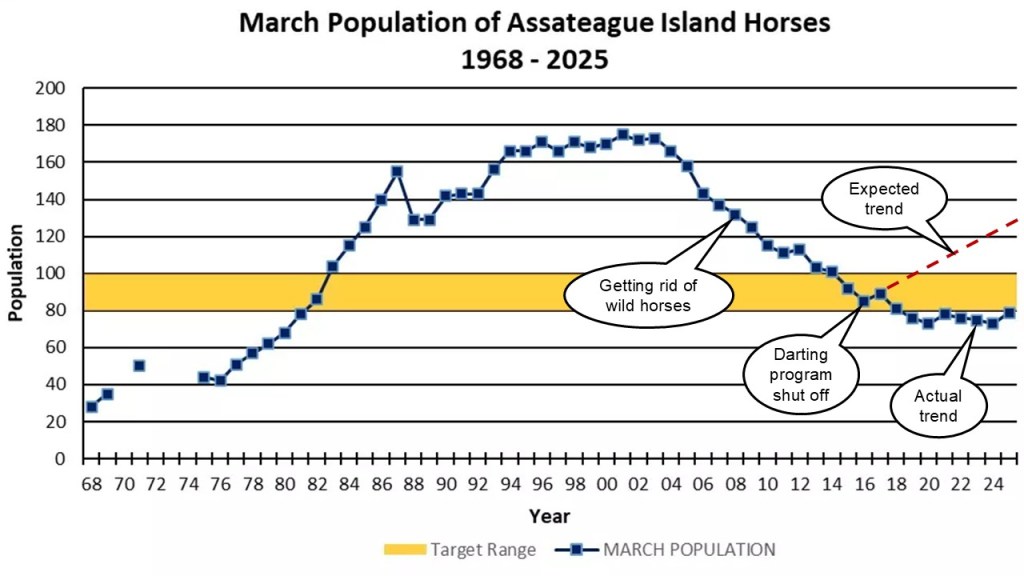
The database at the Assateague Island Alliance horse page puts the current population at 78.

The filtering option gives the following breakdown:

  • Stallions – 22
  • Mares – 34
  • Colts – 11
  • Fillies – 11

The island was a proving ground for mass sterilization with PZP.

The darting program was shut off in 2016 and since then the population has gone sideways, proving that the pesticide is not reversible as the advocates claim.

A few years ago they pointed to the island as a paragon of wild horse management but now that the results are public, they’ve lost interest.

They know you know they’ve been lying.

Note the abnormal sex ratio—1.5 mares for every stallion—a well-known side effect the advocates dismiss as “mares living longer.”

RELATED: Assateague Herd Grows Slightly.
► Get the truth about wild horses and the wild horse advocates at westernhorsewatchers.com.

BLM Approves Lincoln County Public Lands Sale

Some of the parcels are in areas identified for wild horses.

The news release, dated October 16 but not published until yesterday due to the partial government shutdown, said the date of sale will be announced separately along with details such as the location and fair market value of each parcel.

A draft environmental assessment was not issued for public review.  The project jumped from scoping to decision in six months.

RELATED: Scoping Begins for Lincoln County Public Lands Sale.

► Get the truth about wild horses and the wild horse advocates at westernhorsewatchers.com.

If Wild Horses Had Principal Use of Mustang

The BLM recently authorized the drilling of a water well in the allotment, which borders the Silver King HMA.

The news release gave few details about the project.

The allotment master report puts it in the Improve category, suggesting that your stewards of the public lands are not taking their responsibilities seriously.

Note that there are more AUMs in the suspended column than active.

The Mustang permittees receive 1,134 active AUMs on 23,877 public acres, equivalent to 95 wild horses or four wild horses per thousand public acres.

Your faithful public servants claim that public lands in the western U.S. can only support one wild horse per thousand acres (25,600 animals on 25.6 million acres according to the last page of the 2025 population dataset).

The advocates support the narrative with their darting programs.

If the allotment was an HMA, the AML would be 24 and 71 wild horses would be consigned to off-range holding because of permitted grazing.

The area would be held to a small fraction of carrying capacity to accommodate large numbers of cattle or sheep, placed there by high-net-worth individuals who pay almost nothing for the resources they consume and the services rendered on their behalf by the government.

BLM allotments in Nevada support livestock equivalent to 173,144 wild horses on 40,194,360 public acres, or 4.3 wild horses per thousand public acres.

Wild horses can be placed on public lands not identified for their use by acquiring base properties associated with grazing allotments and flipping the preference to horses.

RELATED: The Allotments Tell the Story: They’re Lying, All of Them.

► Get the truth about wild horses and the wild horse advocates at westernhorsewatchers.com.

Trump Nominates Pearce for BLM Director

A November 5 article by The Hill suggests that he’s not on board with the ruinous carbon-is-a-pollutant-men-can-be-women-and-water-flows-uphill agenda.

The choice must be confirmed by the Senate.

The BLM leadership page indicates that Bill Groffy currently serves as acting director.

The position of Division Chief for the Wild Horse and Burro Program is filled internally and not subject to Senate confirmation.

RELATED: Sgamma Nomination Withdrawn.

► Get the truth about wild horses and the wild horse advocates at westernhorsewatchers.com.

Bullfrog Emergency Roundup?

Yesterday the BLM news site populated with announcements dating back to the second day of the partial government shutdown.

An October 6 news release indicated that bait-trap removal of 250 burros would begin on or about October 7.

The incident would not be open to public observation.

Captured animals would be taken to the Axtell off-range corrals.

As of today, there are no links for roundups in FY26 at the Nevada gather page.

The HMA surrounds the town of Beatty.

RELATED: Bullfrog Off-the-Record Roundup Starts Today?

► Get the truth about wild horses and the wild horse advocates at westernhorsewatchers.com.

Mustang Monday

At Spring Creek Basin HMA with Lynn Northrup.

References to “TJ” correspond to TJ Holmes, the head pesticide-pusher in charge who’s managing the herd to extinction.

The 2025 population dataset indicated 78 horses in the HMA, a bit short of the 150 to 200 animals needed for genetic diversity (refer to 4.4.6.3 in H-4700-1).

If you deduct the number of mares ruined by Holmes, the breeding population is likely in the single digits, completely inadequate for long-term viability.

That’s what the advocates bring to the table.

► Get the truth about wild horses and the wild horse advocates at westernhorsewatchers.com.

Protecting the Tonto Ranchers

The people of Arizona made clear nine years ago that they wanted approximately 450 wild horses living in freedom at the Salt River.

Today, the population is somewhere around 280 thanks to the mass sterilization program inflicted on the herd by the Salt River Wild Horse Darting Group in cooperation with the Campaign Against America’s Wild Horses.

The best course of action would be to start a special fund to acquire a base property tied to one or more allotments in the Tonto National Forest, flip the preference to horses, and move the herd there.

But the advocates won’t do it because it might be taken as an affront by their allies and idols—the public-lands ranchers.

RELATED: Salt River Darting Program by the Numbers.

Get the truth about wild horses and the wild horse advocates at westernhorsewatchers.com.

New Life at Salt River?

His mom probably has a faulty immune system.

The advocates rely on predators to take out any foals that slip through their mass sterilization program.

When that happens they’ll put on a big show to make you think they’re saddened by the loss.

It’s all fake.  They hate foals.

They’re far more interested in driving the numbers down with ovary-killing pesticides and winning the approval of the bureaucrats and ranchers.

RELATED: From Compensatory Reproduction to No Reproduction.

Forage Availability in the Wyoming Checkerboard

Three allotments in Pathfinder’s Stewart Creek Unit offer a combined 2,288 active AUMs on 21,183 public acres, equivalent to 191 wild horses or nine wild horses per thousand public acres.

Refer to Bell Springs, Jawbone and Larson Knolls in the report for Stewart Creek allotments managed by the Rawlins Field Office.

Your faithful public servants claim that public lands in the western U.S. can only support one wild horse per thousand acres (25,600 animals on 25.6 million acres according to the last page of the 2025 population dataset).

The advocates, defeated a long time ago and now in the tank for the ranchers, bolster the narrative with their darting programs.

RELATED: WYWHIP Carries Water for Pathfinder Ranches.

WYWHIP Carries Water for Pathfinder Ranches

If you plot the outline of the Stewart Creek Unit on a map of the allotments, you’ll find that it overlaps Turkey Track, Rawlins Draw, Whiskey Peak, Arapahoe Creek, Stewart Creek, Larson Knolls, Jawbone and Bell Springs.

Turkey Track, not labeled, is in the northeast corner.  Click on image to enlarge.

STEWART CREEK GRAZING ASSOCIATION appears in a first-pass review of the allotment master reports at RAS.

The operator information report gives three authorizations for SCGA:

  • 4900602 – JAWBONE, BELL SPRINGS, LARSON KNOLLS and STEWART CREEK (in the Rawlins Field Office)
  • 4900388 – ARAPAHOE CREEK (Lander Field Office)
  • 4900649 – RAWLINS DRAW, TURKEY TRACK, NORTH WILLOW CREEK, WHISKEY PEAK and COOPER CREEK (Lander Field Office)

Western Horse Watchers was unable to find North Willow Creek and Cooper Creek on the map but their namesakes are inside the blue boundary.

The allotment master report for Lander indicates that SCGA holds all of the active AUMs in Rawlins Draw, Turkey Track, North Willow Creek and Cooper Creek, suggesting that it’s a legal entity owned or controlled by Pathfinder Ranches.

SCGA holds all of the active AUMs in Bell Springs, Jawbone and Larson Knolls according to the report for Rawlins.

In the Stewart Creek Allotment, where the Wyoming Wild Horse Improvement Project poisons the mares with PZP, SCGA holds 60% of the active AUMs, suggesting that WYWHIP co-founder Christie Chapman cares far more about ranching interests, especially those of Pathfinder, than she does about wild horses.

RELATED: Pathfinder’s Stewart Creek Unit Clashes with Red Desert Horses.

Pathfinder’s Stewart Creek Unit Clashes with Red Desert Horses

The map supplied with the listing shows the ranch with a red border.

Deeded acreage, which secures grazing preference on public lands, is black.

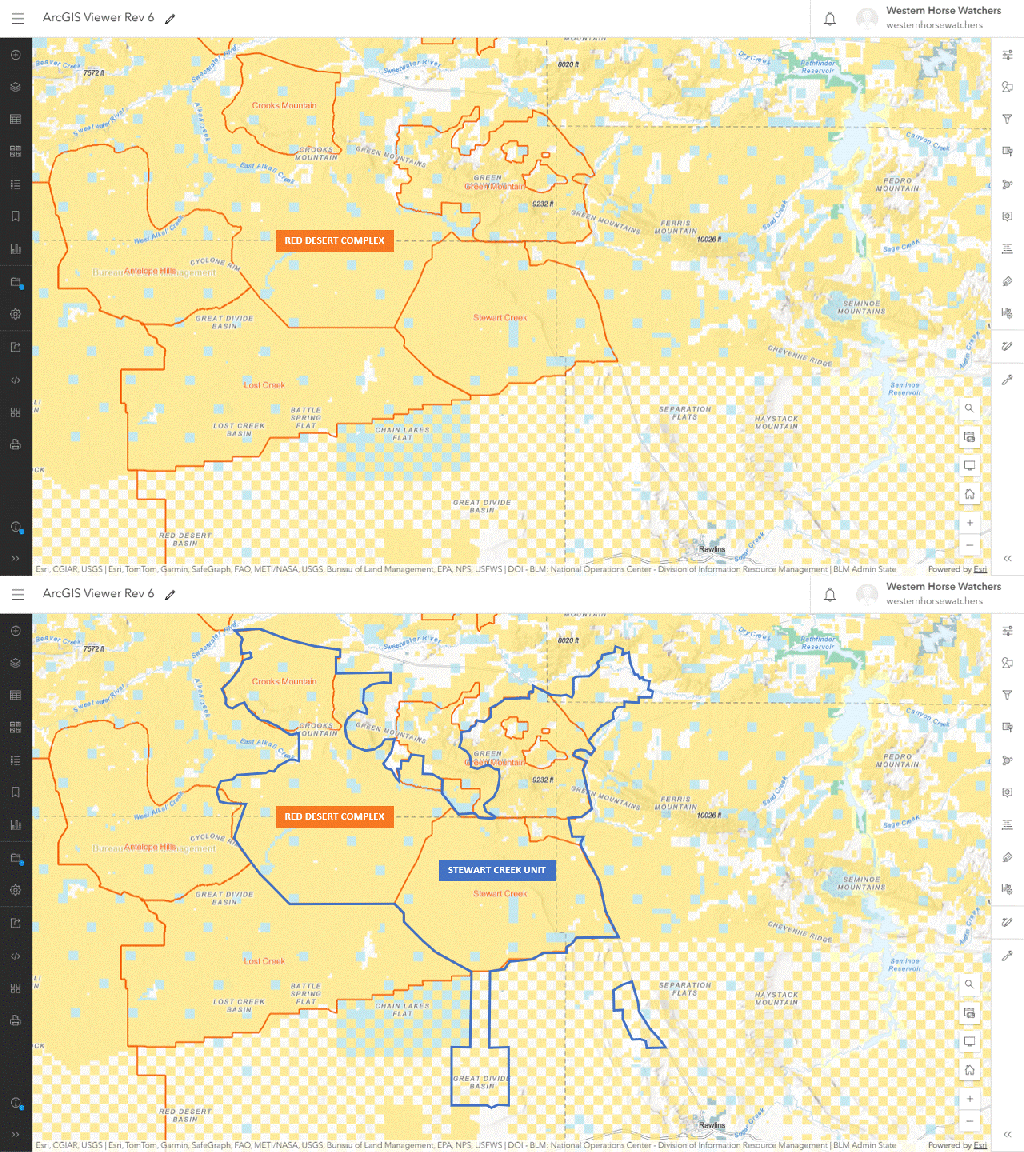
If you plot the ranch outline on a map of the HMAs, you’ll find it overlaps all of Crooks Mountain and Stewart Creek, and most of Green Mountain.

A small portion extends into the checkerboard near Rawlins.

Click on image to enlarge.

RELATED: Wyoming’s Pathfinder Ranches Changing Hands.

Foal-Free Friday, Reserves for Preserves Edition

You’d think the advocates would have special funds devoted to the purchase of base properties, so wild horses could be placed on public lands at the expense of privately owned livestock.

Instead, they use your donations to buy pesticides, so they can beat the horse populations down in favor of livestock.

They are frauds and don’t deserve a penny of your support.

RELATED: Foal-Free Friday, Toxic Relationships Edition.

Wyoming’s Pathfinder Ranches Changing Hands

The listing indicates it’s under contract, with an asking price of $79.5 million.

The operation consists of twelve ranches organized into four units:

  • Two Crosses
    • 180,061 total acres
      • 39,034 deeded
      • 25,228 state
      • 115,799 BLM
      • 3.0 BLM acres per deeded acre
    • 37,909 AUMs
      • Equivalent to 3,159 wild horses
      • Stocking rate would be 27.3 wild horses per thousand BLM acres
  • Beulah Belle
    • 98,357 total acres
      • 23,146 deeded
      • 7,962 state
      • 67,248 BLM
      • 2.9 BLM acres per deeded acre
    • 19,810 AUMs
      • Equivalent to 1,651 wild horses
      • Stocking rate would be 24.6 wild horses per thousand BLM acres
  • Stewart Creek
    • 569,053 total acres
      • 22,470 deeded
      • 8,999 state
      • 537,584 BLM
      • 23.9 BLM acres per deeded acre
    • 23,734 AUMs
      • Equivalent to 1,978 wild horses
      • Stocking rate would be 3.7 wild horses per thousand BLM acres
  • Wooden Rifle
    • 68,606 total acres
      • 14,537 deeded
      • 6,797 state
      • 47,272 BLM
      • 3.3 BLM acres per deeded acre
    • 8,991 AUMs
      • Equivalent to 749 wild horses
      • Stocking rate would be 15.8 wild horses per thousand BLM acres

Your faithful public servants claim that public lands in the western U.S. can only support one wild horse per thousand BLM acres.

Stewart Creek, the unit with the best land ratio but lowest stocking rate, overlaps three of the five HMAs in the Red Desert Complex.  Not disclosed by the agent.

If the operation was repurposed as a refuge, it would support 7,500 wild horses, saving taxpayers an estimated $13.7 million per year and paying for itself in six years.

The project would likely face stiff opposition from ranchers, farm bureaus and stock grower’s associations.

Wild horses can be placed on public lands not identified for their use by acquiring base properties associated with grazing allotments and flipping the preference to horses.

RELATED: Key Indicators for New Wild Horse Preserves.

Maybell Base Property Offered for $6 Million

Snake River Land & Cattle covers 38,899 total acres, including 5,675 deeded acres and 33,224 BLM acres according to the agent’s listing.

The map puts the deeded acreage inside the Douglas-Sawmill Allotment, a few miles south of the Sand Wash Basin HMA.

The ranch lies within a game management unit so not only will you get pushback from ranchers in trying to flip the preference to horses but from hunters as well.

The allotment master report shows one pasture, so it may operate as a general use area shared by three permittees.

Livestock owned by the other two would remain.

The active AUMs are probably wrong and may be off by a factor of ten.

One of the bullet points in the listing says the ranch receives 743 AUMs, equivalent to 62 wild horses.

The land ratio is good, almost six public acres per deeded acre.

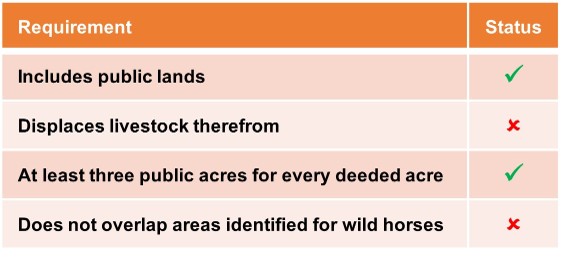
But the allotment overlaps the Douglas Mountain HA according to the ArcGIS viewer, so the ranch meets two out of four requirements for a refuge.

You don’t have to spend millions of dollars on a base property to get wild horses back on these public lands.  You just need to rid the bureaucracy of ranchers and ranching sympathizers and overturn the planning process that zeroed out the HMA.

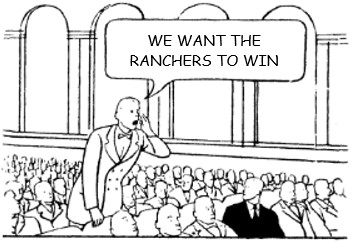
Don’t expect any help from the advocates.  They want the ranchers to win.

RELATED: Key Indicators for New Wild Horse Preserves.