Picacho Roundup, Day 38

The incident started on August 24.  Results have been sporadic, typical for bait trap removal.

The sidebar at the gather page shows 101 burros captured and 101 shipped through September 30.

The daily reports yield 100 captured and 119 shipped.

No deaths were reported.

The capture total includes 71 jacks, 22 jennies and 7 foals.

Youngsters represented 7% of the animals gathered.

Of the adults, 76% were male and 24% were female.

The location of the trap site was not given.

Two areas on the California side of the Colorado River are targeted.

RELATED: Picacho Roundup in Progress.

Pichaco Burro Removal 08-22-23

Alamo Roundup, Day 71

The incident started on July 19.  Results have been sporadic, typical for bait trap removal.

The sidebar at the gather page shows 85 burros captured and 85 shipped through September 27.

The daily reports yield 87 captured and 83 shipped, with four missing in action.

No deaths were reported.

The capture total includes 75 jacks, 10 jennies and two foals.

Youngsters represented 2.3% of the animals gathered.

Of the adults, 88.2% were male and 11.8% were female.

The HMA is subject to permitted grazing.

The comment period for the new pest control plan closes on October 11.

RELATED: Alamo Roundup in Progress.

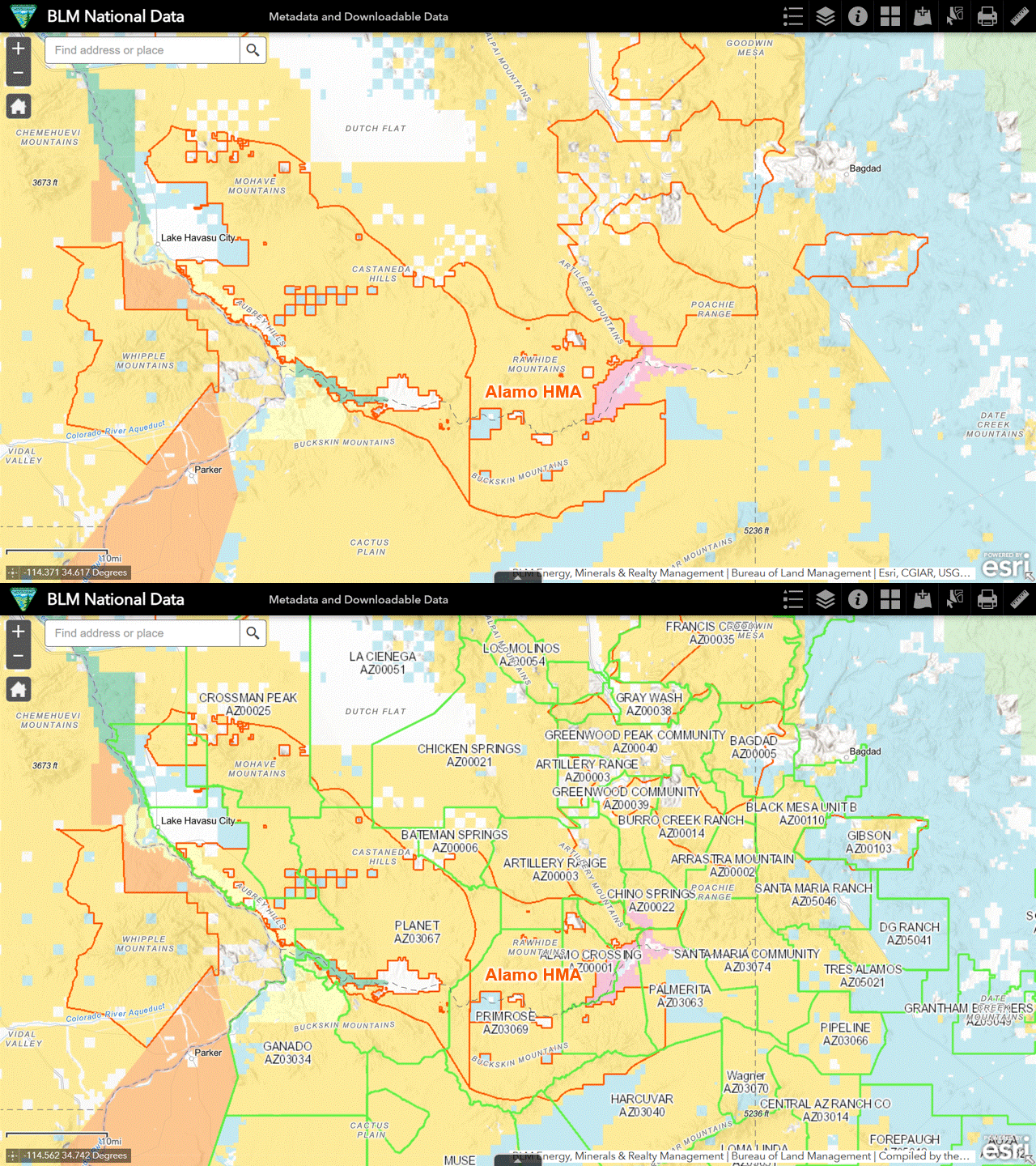
Alamo HMA Map with Allotments 06-06-23

New State Law Threatens Reche Canyon Burros?

SB 371, signed on September 1 by California Governor Gavin Newsom, allows an officer or employee of a local animal control agency, or a nonprofit organization that contracts with a county to provide services to undomesticated burros, to

  • Remove an undomesticated burro that strays onto private land
  • Remove an undomesticated burro that strays onto a public roadway
  • Provide medical care to undomesticated burros, including euthanasia
  • Relocate an undomesticated burro to an appropriate facility or private adopter

The bill gives the local animal control agency the sole discretion to declare the burros unfit for return to the range and to deem them fit for re-release to an appropriate facility or private adopter.

An undomesticated burro is a burro that has not been tamed or domesticated for a period of three years after its capture and is not protected by the federal government under the Wild Free-Roaming Horses and Burros Act.

New Cattle Guard to Contain Little Book Cliffs Horses?

The new guard will tie into an existing fence to deter wild horses from moving from the WHR onto other grazing allotments, according to the project description.

The CX, signed on September 22, says the 16-foot guard will be installed on the V2/10 dirt road open to all modes of transportation.

The road has no movement restriction, allowing wild horses to leave the WHR.

The National Data Viewer puts it in the Red Rock Allotment, between the WHR and Redrock Point.  Click on map to open in new tab.

By the time the horses reach the device, they will be far off the reservation.

The CX was copied to the project folder on October 6.  There were no opportunities for public comment.

RELATED: The Sad Story of Sweetheart and Boone.

Little Book Cliffs Cattle Guard 10-07-23

Calico Roundup, Day 5

The incident began on October 1.  Results through October 5:

The figures above are based on the daily reports, not the totals posted by the BLM.

The location of the trap site on Days 4 and 5 was not given.

Body condition scores ranged from 3 to 4 on both days.

Three horses were put down on Day 4 because of injuries and infections, followed by two more on Day 5.

The death rate is 2.8%.

The capture total includes 81 stallions, 115 mares and 16 foals.

Youngsters represented 7.5% of the animals gathered, suggesting that the herd is growing at a rate of two to three percent per year.

Of the adults, 41.3% were male and 58.7% were female.

Approximately 85% of the captured mares have been shipped, with only 4% of the captured stallions, consistent with a plan to skew the sex ratio in favor of males.

The HMAs and surrounding lands are subject to permitted grazing.

*According to advocates.

Surprise-Calico HAs and HMAs with Allotments 09-17-23

Day 5 ended with 60 unaccounted-for animals.

Mares returned to the Complex will be treated with GonaCon Equine, a fertility control pesticide.

Other statistics:

  • Forage liberated to date: 2,172 AUMs per year
  • Water liberated to date: 1,810 gallons per day
  • Forage assigned to livestock: Undetermined
  • Horses displaced from area by permitted grazing: Undetermined
  • True AML: Undetermined
  • Stocking rate at new AML: Undetermined
  • Horses removed because of drilling and mining: Ask the advocates

You can have your wild horse and burro program as long as it doesn’t interfere with the grazing program.

RELATED: Calico Roundup, Day 3.

Advocates Bawling about Loss of Frost?

How many of them spend their free time poisoning the Virginia Range mares with Zonastat-H or provide material support to those who do?

Where’s the justice for the hundreds of foals that should be there but aren’t?

Tracy “You need to manage the numbers to fit what’s available for the horses” Wilson, defeatist, pesticide pusher and ranching sympathizer with the Campaign Against America’s Wild Horses, appears at 1:34.

CAAWH, a leader in nonmotorized removal, operates the VR darting program.

RELATED: Advocates Protest as VR Stallion Killer Appears in Court.

Foal-Free Friday, Safer in Town than on the Range Edition

As the advocates push their darting effort into Fernly, NV, northeast corner of the Virginia Range, the horses may spend more time in town where they can’t be hunted without homeowner approval.

The bureaucrats and ranchers now realize that the advocates are as eager to get rid of wild horses as they are, and nobody complains when it’s done with pesticides.

RELATED: Foal-Free Friday, Learning about Horses Edition.

Advocates Protest as VR Stallion Killer Appears in Court

“Justice for Frost” was the theme today in Dayton as the suspect faced charges of malicious killing of a wild horse and torturing, overdriving, injuring or abandoning animals, according to a story by KTVN News of Reno.

Tracy Wilson, defeatist and pesticide pusher for the Campaign Against America’s Wild Horses, coordinator of the Virginia Range darting program, told the reporter “We really want to see this prosecuted to the full extent of the law.”

Wilson and her band of merrymen are getting rid of hundreds of Virginia Range mustangs every year with Zonastat-H, an ovary-killing pesticide, and nobody’s pushing for their arrest.

RELATED: Man Arrested for Killing Virginia Range Stallion.

Calico Roundup, Day 3

The incident began on October 1.  Results through October 3:

The figures above are based on the daily reports, not the totals posted by the BLM.

The location of the trap site on Days 2 and 3 was not given.

A mare was euthanized for a pre-existing injury on Day 3.

The death rate is 0.7%.

The capture total includes 51 stallions, 80 mares and 13 foals.

Youngsters represented 9.0% of the animals gathered.

Of the adults, 38.9% were male and 61.1% were female.

Approximately 78% of the adults shipped were female, while 100% of those released were male, suggesting that the contractor is skewing the sex ratio in favor of stallions.

The HMAs and surrounding lands are subject to permitted grazing.

*According to advocates.

Surprise-Calico HAs and HMAs with Allotments 09-17-23

Day 3 ended with 49 unaccounted-for animals.

Mares returned to the Complex will be treated with GonaCon Equine, a fertility control pesticide.

Other statistics:

  • Forage liberated to date: 1,356 AUMs per year
  • Water liberated to date: 1,130 gallons per day
  • Forage assigned to livestock: Undetermined
  • Horses displaced from area by permitted grazing: Undetermined
  • True AML: Undetermined
  • Stocking rate at new AML: Undetermined
  • Horses removed because of drilling and mining: Ask the advocates

Overpopulation means more horses than allowed by plan, not necessarily more horses than the land can support.

RELATED: Calico Roundup in Progress.

More Conflicts of Interest at WHBAB?

A keyword search of the Operator Information Report for Nevada turned up five instances of “Higbee,” all with addresses in Alamo.

  • EDWIN E HIGBEE, JR, Authorization 2705030
  • HIGBEE CHILDREN’S TRUST, Authorization 2705033
  • VARLIN S HIGBEE, Authorization 2700038
  • VAUGHN M HIGBEE, Authorization 2703324
  • HIGBEE BROTHERS, Authorization 2705122

Varlin Higbee, third permittee on the list, was recently appointed to the WHBAB representing livestock management organizations.  He joins Tammy Pearson, a permittee from Minersville, UT, who was seated in early 2021.

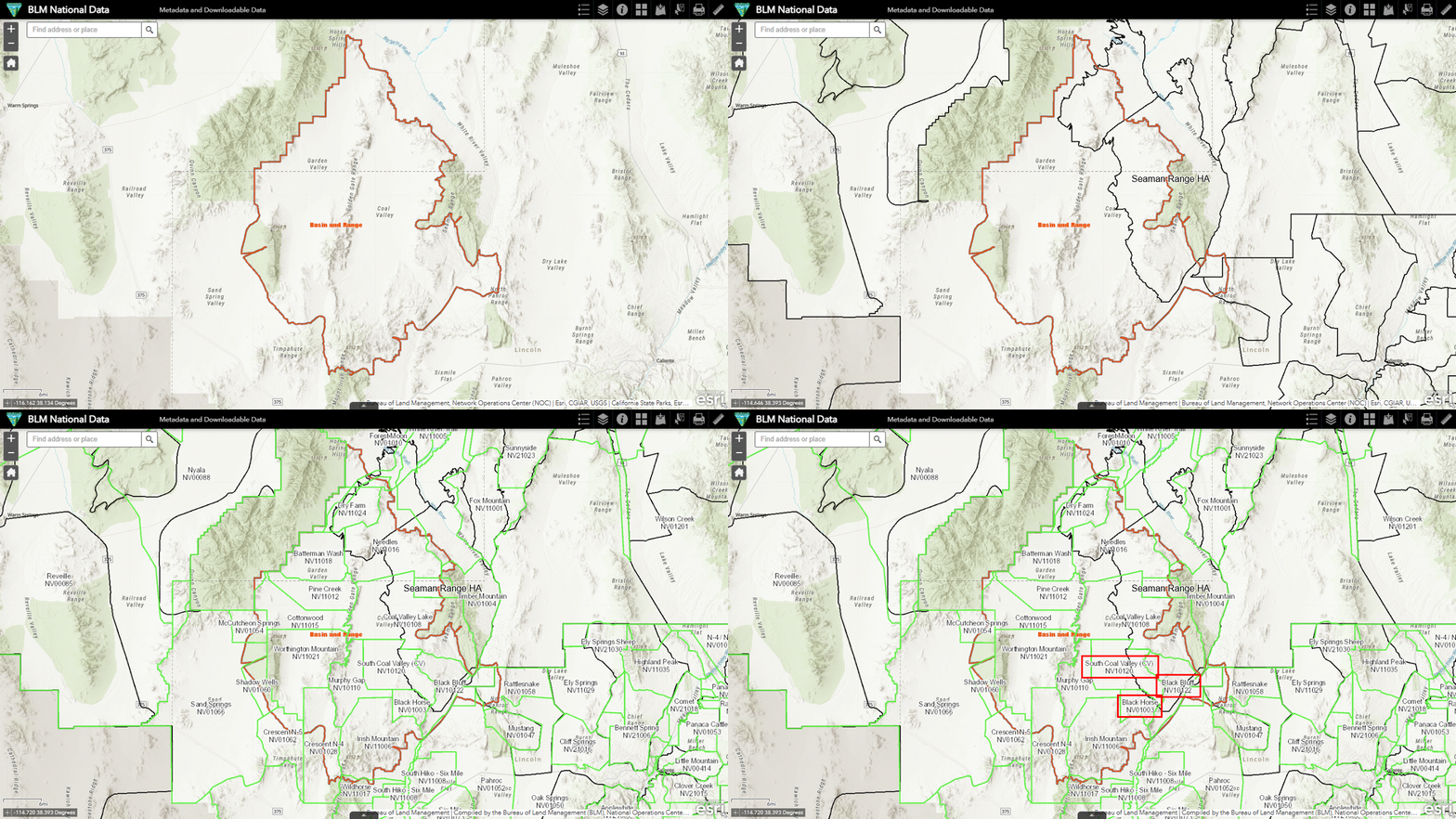
The Allotment Information Report ties Authorization #2700038 to three allotments in the Basin and Range National Monument:

  • South Coal Valley
  • Black Bluff
  • Black Horse

The Allotment Master Report puts all three in the Custodial category, condition unknown.

Allotments are usually placed in Custodial if public lands represent less than 10% of the total acreage and/or 10% of the available forage.

In this case, public lands provide all of the acreage and all of the forage.

The National Data Viewer indicates that most of Black Bluff lies within the Seaman Range HA, the lawful home of wild horses, along with the eastern third of South Coal Valley.  Click on map to open in new tab.

Higbee shares the allotments with others, including relatives, so his personal financial interests and those of his family will likely outweigh any concern for wild horses.

RELATED: WHBAB Vacancies Filled.

Higbee Allotments 10-04-23

Another WHBAB Nomination Cycle Begins

With three openings filled last week, the BLM and USFS seek candidates representing natural resource management, public interest (with special knowledge of equine behavior) and wild horse and burro research, according to yesterday’s news release.

The positions become vacant on January 11.

The WHBAB advises both agencies on the management and protection of free-roaming horses and burros on public lands.

Ideally, nominees will support three principles associated therewith:

  • Pest control
  • Resource enforcement
  • Rancher protection

Nominations will be accepted through November 6.

Socialist Media Update for September 2023

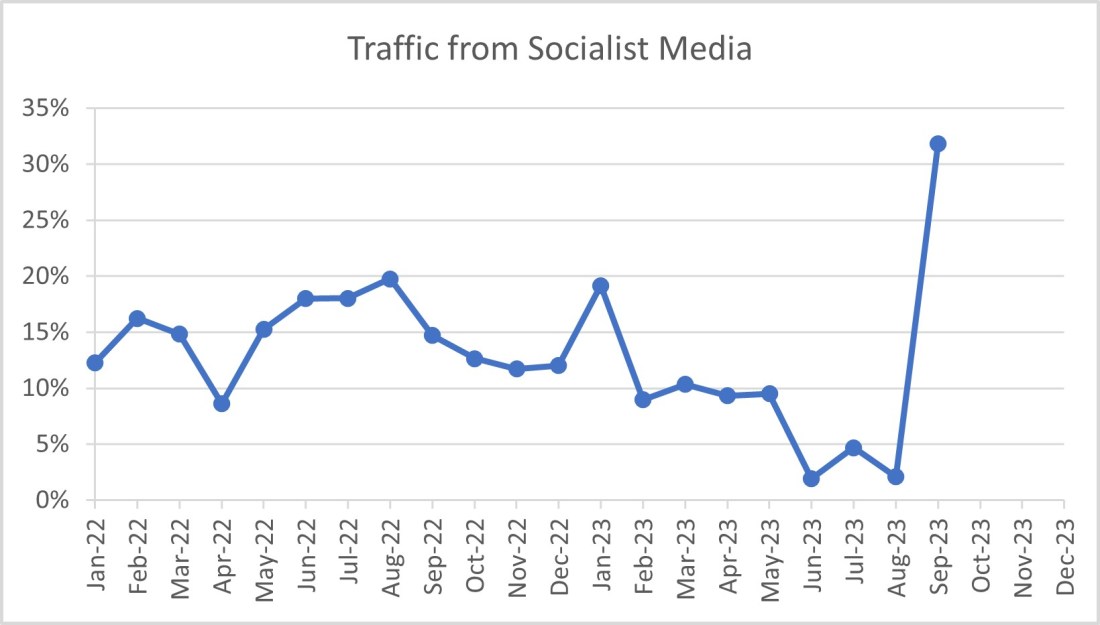
Traffic from Facebook jumped unexpectedly last month due to a post about the carrying capacity of the North Lander Complex.

The report enjoyed an international audience, with most views occurring during the first week, followed by a few hits each day for the balance of the month.

The advocates generally avoid such discussions because they’re not compatible with their fertility control narrative.

WordPress no longer reports traffic from X (Twitter).

RELATED: Socialist Media Update for August 2023.

Traffic from Socialist Media September 2023 10-02-23

Desatoya Roundup Cut Short?

The incident ran from September 25 through September 30, with 59 horses captured, 12 shipped, 26 released and one dead.

The capture and removal goals were 122 and 24, respectively.

There were 20 unaccounted-for animals.

The death rate was 1.7%.

The capture total included 14 stallions, 39 mares and 6 foals.

Youngsters represented 10.2% of the animals gathered, consistent with a herd growth rate of 5% per year.

Land managers often use growth rates of fifteen to twenty percent per year to predict herd sizes and management actions.

Of the adults, 26.4% were male and 73.6% were female, outside the expected range of variation of a simple random process with p-bar = .5 and n = 53 adults.

How to Compute p-chart Limits 02-10-22

Put differently, the percentages of stallions and mares don’t look like they came from a population with 50% males / 50% females.

Abnormal sex ratios are commonly found in herds treated with Zonastat-H, a fertility control pesticide favored by most wild horse advocates.

But the BLM has been treating the Desatoya mares with GonaCon Equine, a fertility control pesticide that may act as a sterilant.

The gather page says 33 mares were treated and 12 were released.

If the mare that died on Day 5 had been treated before the injury occurred, 20 mares could still be in the pen awaiting a second dose, which must be given at least 90 days after the first according to the 2017 labeling amendment.

Gonacon 90-Day Requirement 07-01-23

A shorter interval would constitute unlawful use of the pesticide.

The roundup was billed as catch-treat-release.

The HMA is managed primarily for animal agriculture.

RELATED: Desatoya Roundup Announced.

Desatoya HA and HMA with Allotments 09-18-23

Surprise Roundup Over

The incident concluded today, with 484 horses captured, 468 shipped, none released and 16 dead.

Fifteen burros were also taken but their disposition was not given.

The capture total included 200 stallions, 232 mares and 52 foals.

Youngsters represented 10.7% of the horses captured, consistent with a herd growth rate of 6% per year.

Of the adults, 46.3% were male and 53.7% were female.

Three HMAs were affected.

Some mares will be treated with GonaCon Equine and returned to the area.

The Complex is subject to permitted grazing.

RELATED: BLM Announces Surprise-Calico Wild Horse Roundups.

FY24 Roundup Schedule Posted

The upper section covers nonmotorized removals, the domain of the advocates.

The lower section covers motorized removals, usually carried out by legacy contractors.

The new plan supports three tenets of rangeland management:

  • Pest control
  • Resource enforcement
  • Rancher protection

The action kicks off October 1 at Bordo Atravesado in New Mexico.

The largest removal will occur at the East Pershing Complex near Winnemucca, NV, which consists of three HMAs and four HAs.

The last big roundup of FY23 is set to begin today at the Calico Complex.

Foal-Free Friday, Learning about Horses Edition

The real estate agent and PZP darter in the Minden/Gardnerville area suggests in the September edition of Horse Tales that you drive into desert to observe wild horses in their natural habitat if you are serious about riding or training.

But how far would you have to go and what area would you choose to find a herd that hasn’t been altered or ruined by the advocates?

Signs that you’ve entered the wrong area:

  • Barren mares
  • Confused stallions
  • Shrinking herds
  • Injuries and infections
  • Abnormal sex ratios
  • Increasing death rates
  • Tiny breeding populations
  • Loss of genetic diversity
  • Sterility
  • Acclimation to people
  • Prevalence of livestock

If you find the right herd and are patient, you’ll realize the advocates are full of crap and that they’re working not in the best interests of the horses, but of their enemies.

RELATED: Foal-Free Friday, They’re Vaccines not Pesticides Edition.

Pesticide Patrol 08-16-23

Man Arrested for Killing Virginia Range Stallion

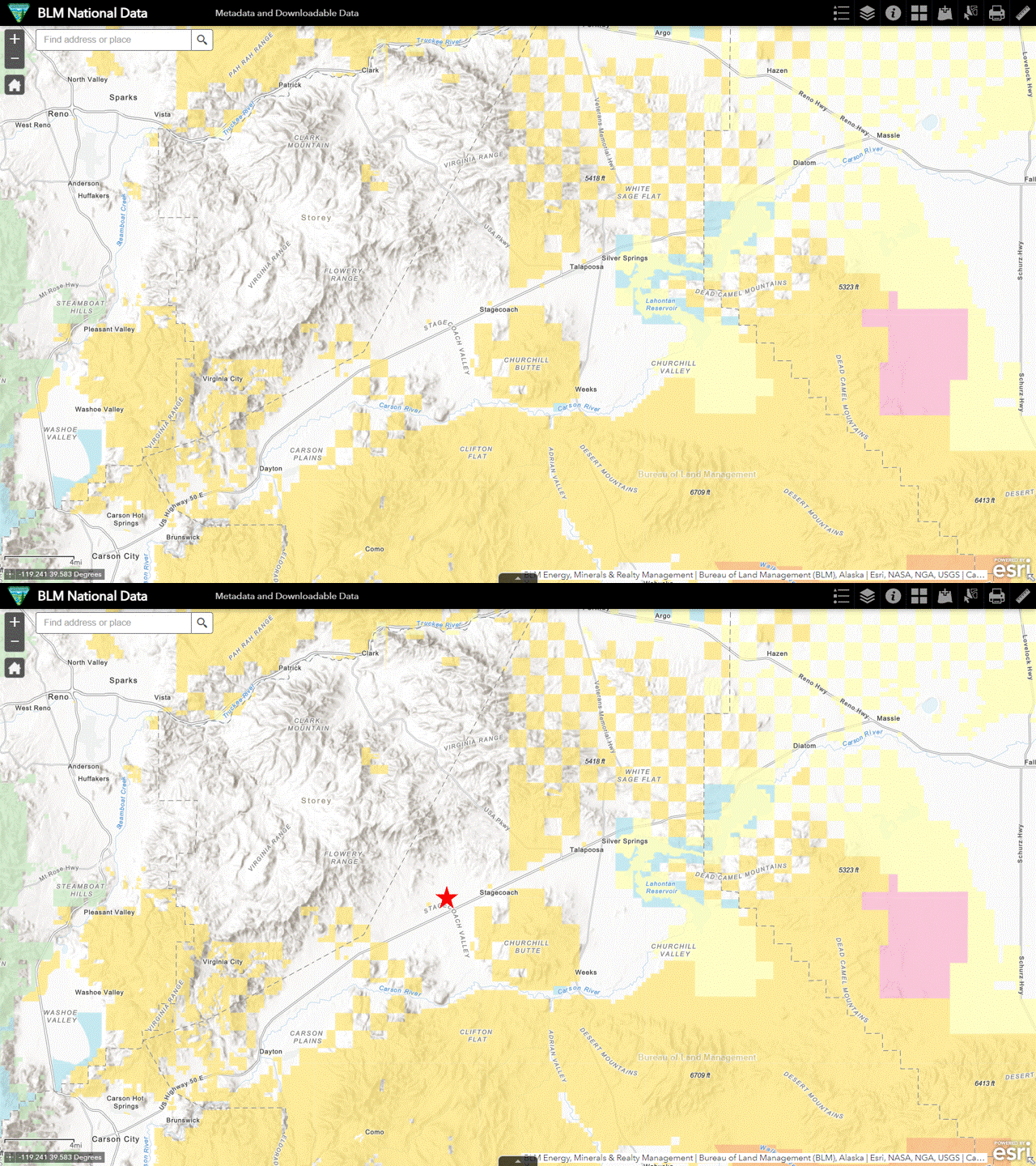
The incident occurred on Iroquois Trail in Stagecoach, NV, according to a story dated September 28 by KOLO News of Reno.

The animal was shot with a crossbow.

The suspect was charged with unlawful and malicious killing of a wild horse.

Advocates with the Campaign Against America’s Wild Horses are getting rid of hundreds of Virginia Range mustangs every year with Zonastat-H, a restricted-use pesticide on the same EPA list as toxic chemicals.

Who’s the greater threat to wild horses?

Virginia Range Stallion Killed 09-28-23

Surprise Roundup, Day 9

The incident began on September 18.  Results through September 26:

  • Scope: High Rock, Fox Hog, Wall Canyon HMAs
  • Purpose: Pest control, resource enforcement, rancher protection
  • Target: Horses
  • Type: Planned
  • Method: Helicopter
  • Category: Cruel and costly*
  • Better way: Poison mares with ovary-killing pesticides*
  • Captured: 381, up from 325 on Day 7 (does not include 15 burros taken on Day 6)
  • Average daily take: 42.3
  • Capture goal: 494
  • Removal goal: 404
  • Returned: None
  • Deaths: 14, up from 13 on Day 7
  • Shipped: 177, up from 96 on Day 7

The figures above are based on the daily reports, not the totals posted by the BLM.

The sidebar at the gather page says 331 horses shipped.

Trapping occurred outside Fox Hog on Day 9.  The location for Day 8 was not given.

A mare was put down on Day 8 because of a leg injury.

The death rate is 3.7%.

The capture total includes 162 stallions, 180 mares and 39 foals.

Youngsters represented 10.2% of the animals gathered, consistent with a growth rate of 5% per year.

Of the adults, 47.4% were male and 52.6% were female.

Body condition scores ranged from 4 to 5.

The HMAs and surrounding lands are subject to permitted grazing.

*According to advocates.

Surprise-Calico HAs and HMAs with Allotments 09-17-23

Day 9 ended with 190 unaccounted-for animals, a figure affected by the discrepancy in animals shipped.

Mares returned to the Complex will be treated with GonaCon Equine, a fertility control pesticide.

Other statistics:

  • Forage liberated to date: 4,572 AUMs per year
  • Water liberated to date: 3,810 gallons per day
  • Forage assigned to livestock: Undetermined
  • Horses displaced from area by permitted grazing: Undetermined
  • True AML: Undetermined
  • Stocking rate at new AML: Undetermined
  • Horses removed because of drilling and mining: Ask the advocates

Overpopulation means more horses than allowed by plan, not necessarily more horses than the land can support.

There’s plenty of food and water in the Complex but most of the resources have been devoted to animal agriculture.

RELATED: Surprise Roundup, Day 7.