Triple B Roundup, Day 3

The incident started on November 2.  Results through November 4:

  • Scope: Triple B Complex
  • Target: Wild horses
  • AML: 889
  • Pre-gather population: 3,335
  • True AML: 4,551
  • Type: Planned
  • Method: Helicopter
  • Category: Cruel and costly (according to advocates)
  • Better way: Sterilize mares with PZP (according to advocates)
  • Capture goal: 2,255
  • Removal goal: 2,155
  • Captured: 243, up from 81 on Day 1
  • Shipped: 165, up from zero on Day 1
  • Released: None
  • Deaths: 1, no change from Day 1
  • Average daily take: 81.0
  • Unaccounted-for animals: 77
  • Snippet from statute: It is the policy of Congress that wild free-roaming horses and burros shall be protected from capture, branding, harassment, or death
  • Snippet from manual: To protect wild horses and burros from unauthorized capture, branding, harassment or death

The figures above are based on the daily reports.

The Day 3 report indicates 122 horses shipped but the breakdown yields 120.

The death rate is 0.4%.

The capture total includes 83 stallions, 105 mares and 55 foals.

Youngsters represented 22.6% of the animals gathered.

Of the adults, 44.1% were male and 55.9% were female.

Body condition scores were not given.

The location of the trap site was not disclosed.

Three HMAs are affected.

The roundup supports three tenets of rangeland management.

Up to 50 mares will be treated with GonaCon Equine and released back to the range with up to 50 stallions.

The number of doses and the interval between treatments were not specified, leaving open the possibility that the Complex will become another GonaCon crime scene.

RELATED: Triple B Roundup in Progress.

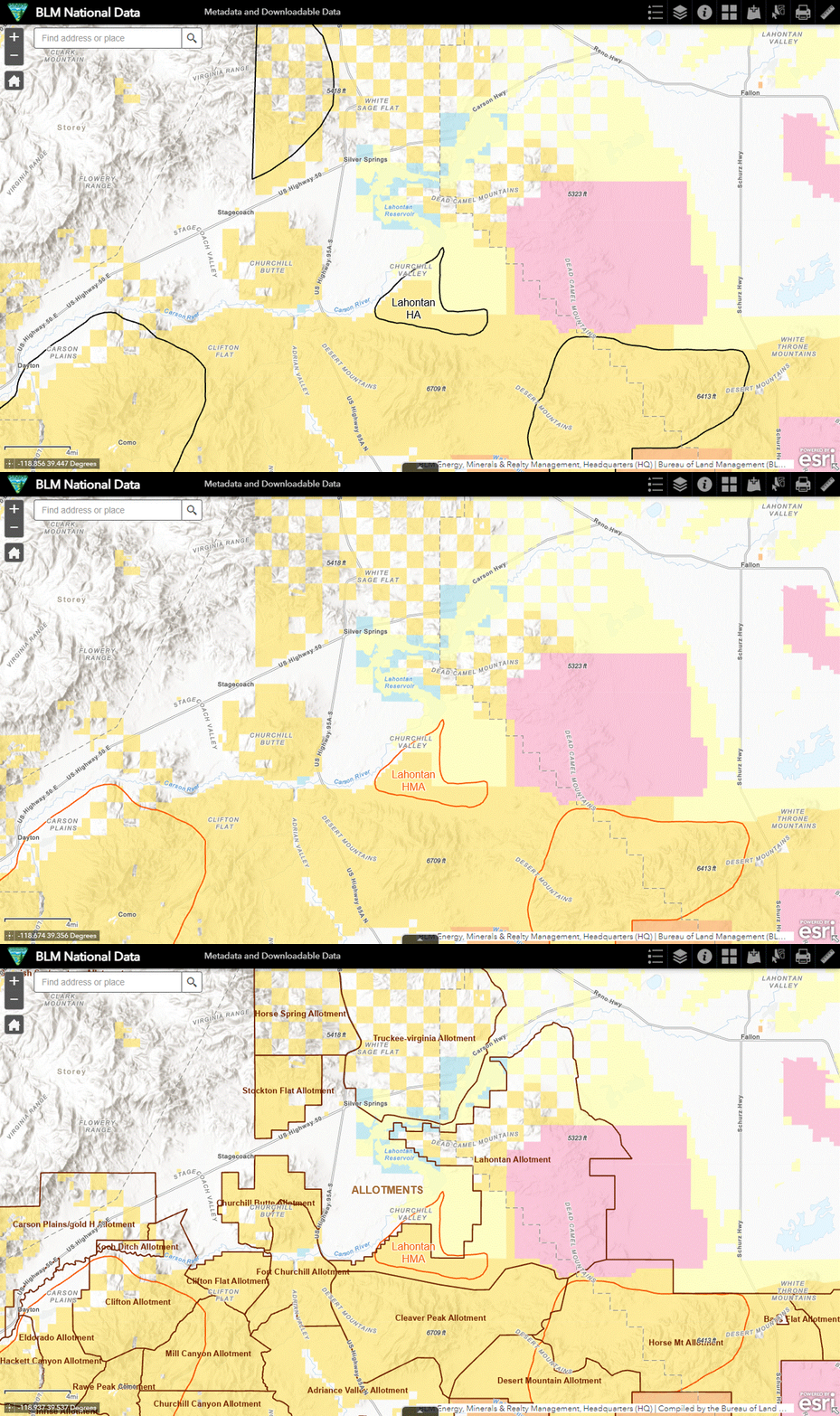
Triple B Complex with Allotments 11-04-24

How Many Wild Horses Can Jakes Wash HA Support?

Identified for wild horses but managed principally for livestock, Jakes Wash covers 153,662 public acres 12 miles west of Ely, NV.  It’s part of the Pancake Complex.

Table 5 in the Draft EA for the new HMAP gives the percentage of four overlapping allotments inside the HA.

The Allotment Master Report provides management status, acreage and active AUMs.

Jakes Wash Forage Calcs 11-05-24

Livestock receive an estimated 10,003 AUMs inside the HA, assuming the resource is evenly distributed across the allotments, enough to sustain 834 wild horses.

The stocking rate would be 5.4 wild horses per thousand public acres.

Our faithful public servants tell us that public lands in the western U.S. can only support one wild horses per thousand public acres.

How many wild horses will be allowed in the HA when the new HMAP is complete?

None.  The AML will still be zero and the land will be managed principally for livestock.

The horses will be viewed as pests and pest control measures will be applied as needed.

The advocates would have you believe that most wild horse problems can be traced to lack of HMAPs.

RELATED: If Wild Horses Had Principal Use of Tom Plain, Indian Jake, et al.

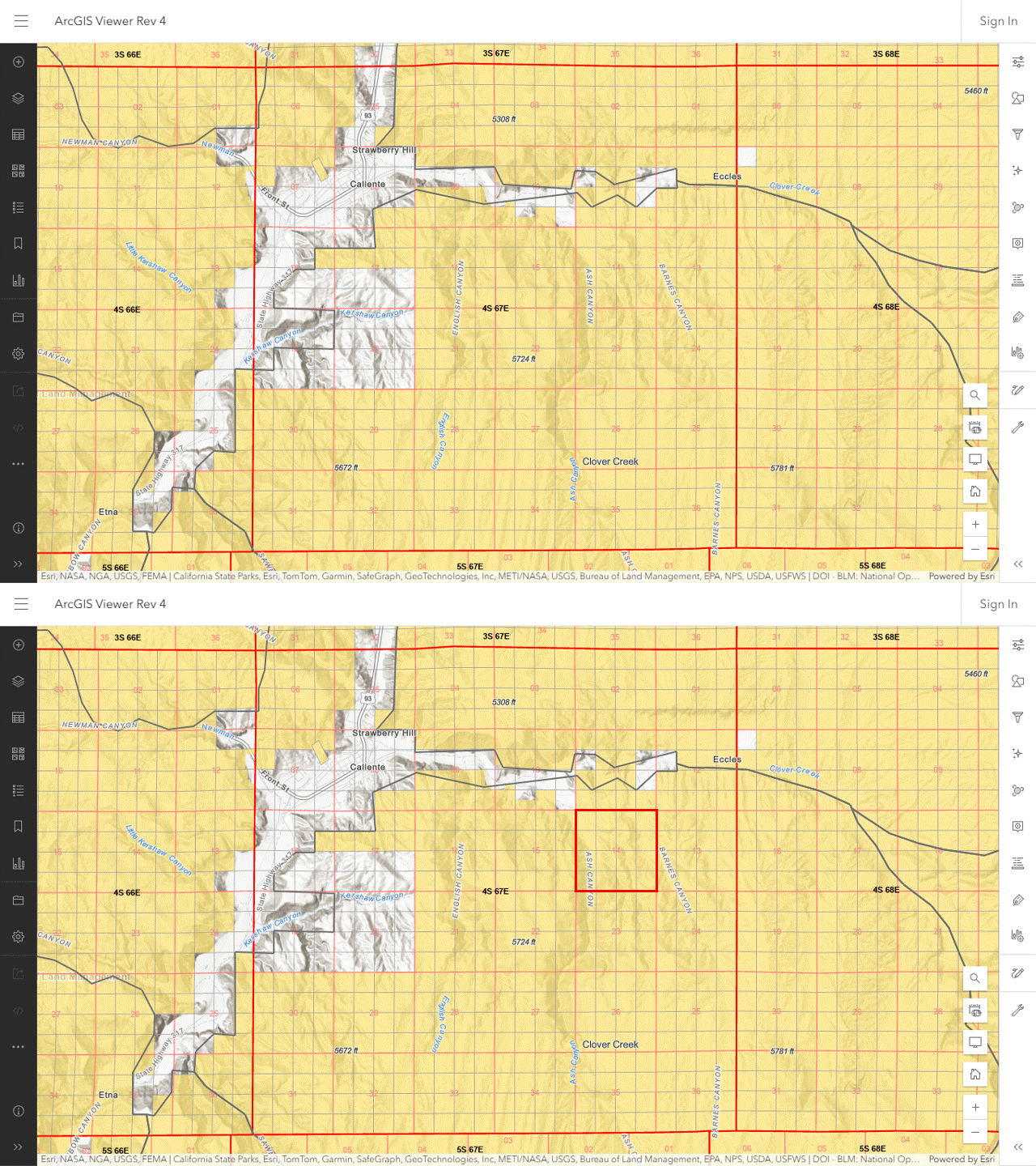
Jakes Wash HA with Allotments 11-04-24

If Wild Horses Had Principal Use of Tom Plain, Indian Jake, et al

The allotments overlap the Jakes Wash HA in eastern Nevada, part of the Pancake Complex.  Refer to Section 3.7 of the Draft EA for the new HMAP.

The forage assigned to horses is zero.

How many wild horses could live there?

The Allotment Master Report provides management status, acreage and active AUMs.

Jakes Wash Allotment Calcs 11-04-24

The Jakes Unit Trail passes through the area according to the National Data Viewer but this has been ignored.

The allotments offer 15,722 active AUMs on 202,421 public acres.

Approximately 60% of the land is in the Improve category.

Using the principle of forage interchangeability, the True AML would be 1,310, the number of horses the land could support if it was managed principally for them as specified in the original statute.

The stocking rate would be 6.5 wild horses per thousand public acres.

Why is this important?

Your faithful public servants claim that public lands in the western U.S. can only support one wild horse per thousand acres (27,000 animals on 27 million acres).

The advocates bolster the narrative with their darting programs.

If the allotments were an HMA, the AML would be 202 and 1,108 horses would be consigned to off-range holding because of permitted grazing.

BLM allotments in Nevada carry livestock equivalent to 173,144 wild horses on 40,194,360 public acres, or 4.3 wild horses per thousand public acres.

Wild horses can be placed on public lands not identified for their use by acquiring base properties associated with grazing allotments and flipping the preference to horses, as American Prairie did for bison in Montana.

RELATED: The Allotments Tell the Story: They’re Lying, All of Them.

Jakes Wash HA with Allotments 11-04-24

What’s Next for Sands Basin, Four Mile Wild Horses?

They’re not going back on the range anytime soon according to the following report by KIVI News.

Now that they’re off the range, your faithful public servants are taking the opportunity to treat the mares with GonaCon Equine.

Some horses will be held back for adoption.

You wouldn’t want the poor ranchers to suffer, right?

The reporter did not indicate if two doses would be given 30 days apart, typical for the BLM, which would constitute unlawful use of the pesticide.

RELATED: Open House for Sands Basin, Four Mile Horses This Saturday.

Devil’s Garden Roundup, Day 5

The incident started on October 28.  Results through November 1:

  • Location: Devil’s Garden Plateau WHT
  • AML: 402
  • Pre-gather population: Between 651 and 998
  • Target: Horses
  • Type: Planned
  • Method: Helicopter and bait
  • Goals: Capture 500, remove 500
  • Category: Cruel and costly (according to advocates)
  • Better way: Sterilize mares with PZP (according to advocates)
  • Captured: 73
  • Shipped: Unknown
  • Released: Unknown
  • Deaths: None
  • Average daily take: 14.6
  • Unaccounted-for animals: Unknown

There is no breakdown of capture total.

The percentage of foals cannot be determined.

The ratio of males to females is unknown.

The location of the trap site was not disclosed.

Body conditions scores have been averaging 5, an indication that the horses are not starving and the herd has not exceeded the ability of the land to sustain it.

The roundup will achieve a thriving ecological balance and multiple-use relationship on public lands, codewords for ranching superiority in the lawful home of wild horses.

RELATED: Devil’s Garden Roundup, Day 3.

Thriving Ecological Balance-3

Trout Creek Base Property Available for $3.45 Million

Situated in southern Oregon along the Nevada border, Cottonwood Ranch lies in the western foothills of the Trout Creek Mountains.

The property covers 1,027 deeded acres with grazing preference on the Sandhills Allotment.

The listing refers to the East and West Sandhills Allotments but RAS and the National Data Viewer refer only to the Sandhills Allotment.

The Allotment Master Report puts it in the Maintain category with 2,294 active AUMs on 12,462 public acres.

The NDV shows two parcels with a combined acreage of 18,146.

Western Horse Watchers asked the Burns office about the discrepancy on October 28 but as of today has received no reply.

The Authorization Use Report shows a small allowance for horse grazing.

A buyer could ask the BLM to flip the remaining AUMs to horses and extend the grazing season to 12 months as Wild Horse Refuge did in Colorado.

That resource would support 2,294 ÷ 12 = 191 wild horses.

The land ratio is good, roughly 1,000 deeded acres give access to somewhere between 12,000 and 18,000 public acres.

At Mustang Monument in Nevada, 14,000 deeded acres secured access to over 500,000 public acres but the BLM did not flip the preference to horses as originally planned.

Sandhills Allotment Map 10-28-24

Devil’s Garden Roundup, Day 3

The incident started on October 28.  Results through October 30:

  • Location: Devil’s Garden Plateau WHT
  • AML: 402
  • Pre-gather population: Between 651 and 998
  • Target: Horses
  • Type: Planned
  • Method: Helicopter
  • Goals: Capture 500, remove 500
  • Category: Cruel and costly (according to advocates)
  • Better way: Sterilize mares with PZP (according to advocates)
  • Captured: 49
  • Shipped: Unknown
  • Released: Unknown
  • Deaths: None
  • Average daily take: 16.3
  • Unaccounted-for animals: Unknown

Figures for Day 2 were not provided.

The percentage of foals cannot be determined.

The ratio of males to females is unknown.

The roundup supports three tenets of rangeland management.

RELATED: Devil’s Garden Roundup Begins.

EA for Pancake HMAP Out for Public Review

Like the Antelope-Triple B HMAP, the project provides more evidence that the advocates are ill-informed about wild horses.

The overriding objective of the new plan is to maintain a thriving ecological balance and multiple-use relationship in the Complex, codewords for ranching superiority in the lawful homes of wild horses.  Refer to Appendix XIII of the Draft EA.

Alternative A, the Proposed Action, would implement the plan, putting these techniques into practice:

  • Forcible removal to low AML
  • Application of fertility control (PZP, Gonacon, IUDs)
  • Skewing of sex ratios (60% males / 40% females)

Comments, due by November 29, can be emailed to the address in the news release.

RELATED: Scoping Begins for Pancake HMAP.

Thriving Ecological Balance-3

Murderer’s Creek DNA Out for Public Review

The project folder now contains a draft DNA which asserts that existing planning documents fully cover bait-trap removal of 350 to 400 wild horses from a herd of 659 in and around the JMA.

Livestock grazing will be deferred for two years in pastures with a high percentage of burned area to allow vegetation to recover.

The map suggests that about 40% of the JMA was affected.

Comments will be accepted through November 5.

RELATED: Murderer’s Creek Emergency Roundup Pending?

Plan for Mustang Monument

The project would convert all but the portion of the Spruce Allotment west of Highway 93 to a nonreproducing wild horse ecosanctuary, including 93% of the Spruce-Pequop HMA, 27% of the Goshute HMA and 14% of the Antelope Valley HMA, according to an undated scoping brief.

Portions of the HMAs not in the sanctuary would be evaluated to determine their ability to sustain wild horse populations with reduced acreage and water resources.

When the carrying capacity of the Spruce Allotment was determined in the early 1990s, AUMs were set aside for wild horse and wildlife.  The analysis assumed that the majority of AUMs in the allotment would be utilized by cattle, whereas in the proposed sanctuary there would be no AUM consumption by livestock.

Western Horse Watchers refers to such changes as flipping the grazing preference to horses, the second step after acquiring the base property tied to said allotment.

Forage in the Spruce Allotment was split between the previous permittee, who retained 57 AUMs in the portion on the west side of the highway and Mustang Monument received 10,908 active AUMs and 2,458 suspended AUMs on the east side.

This is apparent today in the allotment master report.

The suspended AUMs require a carrying capacity analysis to determine if they are available before they can be made active.

When Elko County ranchers heard about the plan the battle lines were drawn.

The sanctuary would function like an ORP, except most of the acreage would be public, and up to three breeding populations would be lost.

Western Horse Watchers has been unable to find the project ePlanning.

The status of the NEPA review is unknown.

RELATED: Purpose of Mustang Monument?

Spruce Allotment with Sanctuary 10-27-24

Purpose of Mustang Monument?

The proposal for a wild horse ecosanctuary was submitted by Saving America’s Mustangs in response to a 2011 BLM solicitation, according to a 2012 news release.

The facility would include 14,000 deeded acres that serve as the base property for the 534,000-acre Spruce Allotment.

Up to 900 federally owned wild horses would graze thereon, for a stocking rate of 1.7 animals per thousand public acres.

A 2012 notice in the Federal Register indicated that the agency intended to prepare an EIS and RMP amendment for the project which would “reduce and potentially eliminate livestock grazing within the portion of the Spruce Allotment east of Highway 93.”

RELATED: Where Is Mustang Monument?

Spruce Allotment with HMAs 10-26-24

Where Is Mustang Monument?

It’s about 30 miles south of Wells, NV on the east side of Highway 93.

The National Data Viewer puts it in the Snow Water Lake Allotment.

The Elko County Assessor indicates it’s APN 008-080-001, owned by Tommy LLC, a legal entity controlled by Madeleine Pickens and probably named after one of her dogs.

The Operator Information Report at RAS ties Mustang Monument to these allotments:

  • 2704016 – SPRUCE GRAZING ASSOCIATION LLC – SPRUCE
  • 2703859 – SAVING AMERICA’S MUSTANGS – SNOW WATER LAKE, WARM CREEK

The Allotment Master Report gives management status, acreage and active AUMs.

The Authorization Use Report gives livestock types and season of use.

Pickens acquired base properties tied to these allotments and offered to take wild horses out of BLM pens and put them back on public lands previously designated for livestock.

Initially the BLM agreed but later reneged.

RELATED: Yes to American Prairie, No to Mustang Monument.

Where Is Mustang Monument 10-25-24

Murderer’s Creek Emergency Roundup Pending?

The BLM opened a new project in ePlanning today to assess NEPA adequacy.

No documents have been posted.

The description says the Rail Ridge Fire burned almost 70% of the BLM-managed lands in the HMA, which correspond to about 32% of the total (Forest Service has 68%).

The fire is 92% contained as of today.

The National Data Viewer indicates the BLM lands are subject to permitted grazing.

The Western Watersheds map gives the status of Forest Service lands.

Murderers Creek HMA with Allotments 10-24-24

Advocates Let Currituck Stallion Die Naturally?

He had been removed from the beach and given his condition, they decided the best thing to do was to let him pass slowly and peacefully according to an October 23 report by WITN News.

The size of the herd is unknown.

Wild horse advocates are known for their opposition to nature’s way.

Better Way 10-25-23

RELATED: Advocates Monitor Currituck Stallion, Kill Currituck Mare.

UPDATE: A story by the Augusta Free Press says they euthanized him.