Carter Reservoir EA Out for Public Review

A new project was opened in ePlanning yesterday and a preliminary environmental assessment was copied to the folder with other supporting documents.

The scoping phase was apparently skipped.

The project covers the Carter Reservoir HMA, Coppersmith HMA and Buckhorn HMA on the northern CA-NV border.

Alternative 1, the Proposed Action, features forcible removal, fertility control and sex ratio skewing.  Refer to Section 2.2.3 in the EA.

As in the Kiger-Riddle EA, the discussion of GonaCon Equine on page 49 (50 in pdf) refers to outdated registrations: “GonaCon-Equine is approved for use by authorized federal, state, tribal, public, and private personnel, for application to wild and feral equids in the United States (EPA, 2013; 2015).”

The 2017 amendment, which increased the interval between treatments from 30 days to 90 days, is ignored.

The BLM news release said the current population is at least 700 wild horses, compared to a combined AML of 195.

The HMAs do not appear on the FY25 roundup schedule.

They are subject to permitted grazing.

The new plan supports three tenets of rangeland management.

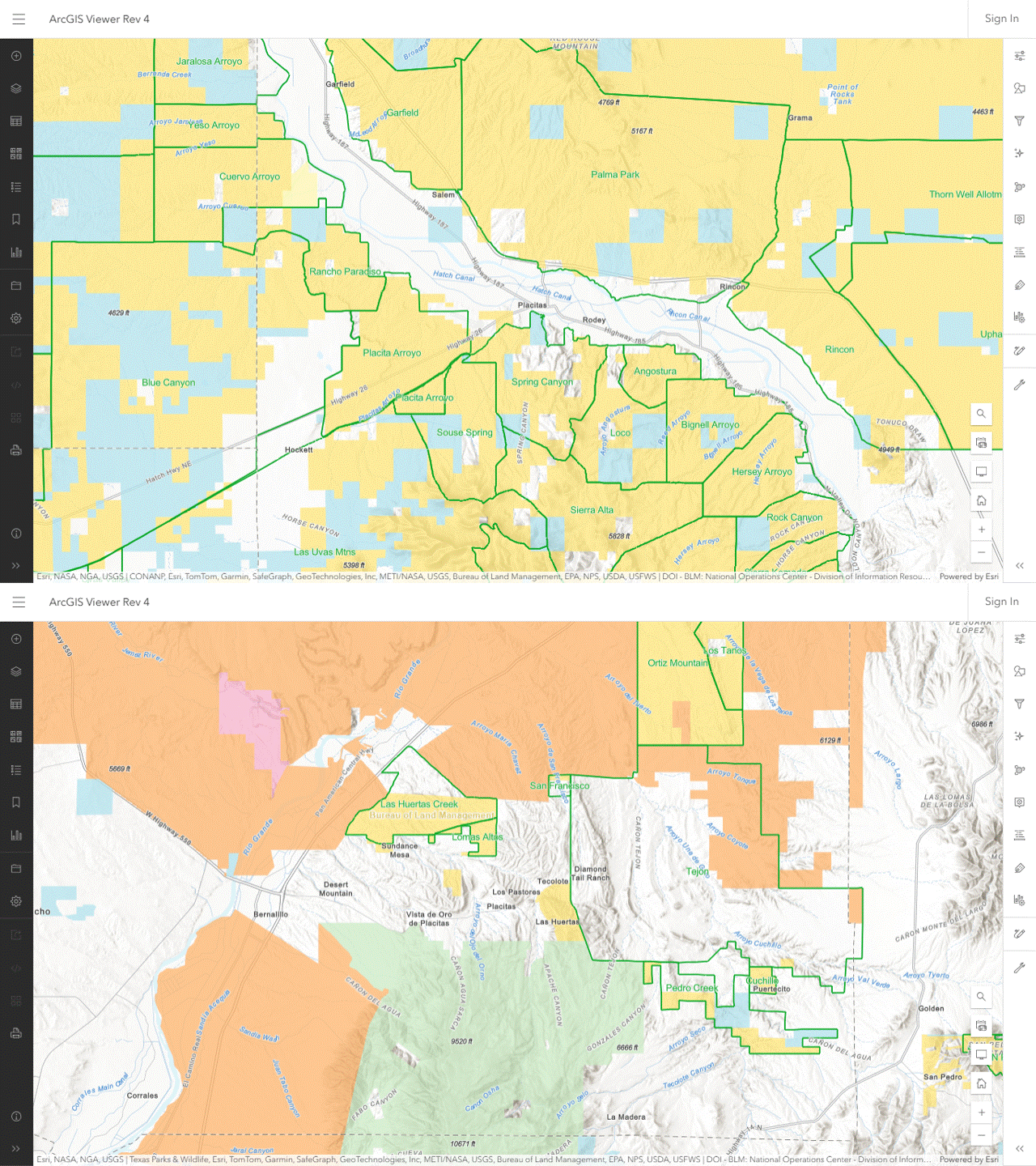
Carter Reservoir HMAs with Allotments 10-23-24

How Many Wild Horses Can the Triple B Complex Support?

Table 12 in the Antelope-Triple B Management Evaluation identifies the allotments that overlap the Complex.

The Allotment Master Report at RAS gives management status, public acres and active AUMs by field office (Bristlecone | Wells).

Triple B Allotment Calcs 10-23-24

Approximately 90% of the allotment acreage is in the Improve category.

The allotments, which include territory outside the Complex, support livestock equivalent to 6,533 wild horses.

The forage assigned to livestock inside the Complex is estimated to be 44,758 AUMs per year, assuming it’s evenly distributed across the allotments.

That resource would support 3,730 wild horses, on top of the 821 allowed by plan, for a True AML of 4,551.

The pre-gather population is well within this range.

The BLM spends around $6.8 million per year to care for 3,730 wild horses in off-range holding so it can collect about $60,000 per year from the Triple B permittees.

Nobody in the private sector would do that.

BLM allotments in Nevada support livestock equivalent to 173,144 wild horses on 40,194,360 public acres.

RELATED: Triple B Roundup Announced.

Triple B Roundup Announced

The incident will begin on or about November 1 according to a BLM news release.

The capture and removal goals are 2,255 and 2,155, respectively.

The pre-gather population is thought to be 3,319.

The number of horses allowed by plan is 821.

The Complex includes the Maverick-Medicine HMA, Triple B HMA and a portion of the Antelope Valley HMA west of Highway 93.

A helicopter will push the horses into the trap and operations will be open to public observation.

Animals identified for removal will be taken to the off-range corrals at Palomino Valley and Indian Lakes in Fallon.

Up to 50 mares will be treated with GonaCon Equine, a fertility control pesticide, and returned with 50 stallions to the range.

The Complex is subject to permitted grazing.

Allotments are now indicated with brown borders in the National Data Viewer.

RELATED: Scoping Begins for Antelope-Triple B HMAP.

Triple B Complex 10-21-24

Little Book Cliffs Mare Dies in Temporary Holding

She was one of two mares held for fertility treatment before being returned to the HMA.

A report by The Grand Junction Daily Sentinel said she spooked and hit her head on a pipe panel during feeding.

She received an initial dose of GonaCon Equine and the contractors were following the CAWP according to the story.

A second dose was to be given after 30 days, which would violate the 90-day interval of the 2017 labeling amendment.

The other mare was treated with PZP and returned to the range.

The BLM has not updated the figures at the gather page, which should indicate 140 horses captured, 98 shipped, 38 released and four dead, for a net removal of 102.

RELATED: Little Book Cliffs Roundup Over.

Foal-Free Friday, Miracles and Wonders Edition

The real estate agent, PZP evangelist and disciple of the Campaign Against America’s Wild Horses is back with the good news of nonmotorized removal in the October issue of Horse Tales.  Go to “Wild Horse Tales” on page 7.

“All we see with PZP is mares who do not get in foal.”

It’s a miracle drug—for those who are willfully blind.

She and her fellow travelers don’t see the abnormal sex ratios.

They don’t see the onset of sterility.

They don’t see the injuries and injection site reactions.

VR Darting Injury 09-15-21

They’re blind to the tiny breeding populations and loss of genetic diversity.

And they damn sure don’t see the government-sanctioned livestock occupying the lawful homes of wild horses.

You cannot give sight to these people.

Blind Leading the Blind 10-17-24

They are phonies, allies of the bureaucrats and ranchers, and don’t deserve a penny of your financial support.

RELATED: Foal-Free Friday, Divide and Conquer Edition.

Little Book Cliffs Roundup Over

Figures for September 19 have been added to the gather page.

The previous update said it was complete with 59 unaccounted-for animals.

The final tally indicated 140 horses captured, 98 shipped, 37 released and three dead, with two unaccounted for.

The capture and removal goals were 140 and 120 respectively.

The death rate was 2.1%.

The average daily take was 15.6.

The capture total included 37 stallions, 82 mares and 21 foals.

Youngsters represented 15% of the animals gathered, consistent with a herd growth rate of 10% per year.

Of the adults, 31.1% were male and 68.9% were female, outside the expected range of variation from a random process centered at 50% males / 50% females.

Abnormal sex ratios are common in herds treated with Zonastat-H.

Two horses remain in holding for fertility treatments, to be returned to the HMA at an unspecified date.

RELATED: Little Book Cliffs Roundup Set for Next Week.

Sand Wash Roundup Ends Early

The incident concluded today with ten horses captured, ten shipped, none released and no deaths.

The capture and removal goals were 60 and 45 according to the latest schedule.

There were no unaccounted-for animals.

The capture total included three stallions, six mares and one foal.

The operation liberated 120 AUMs per year, a disappointment to the permittees.

RELATED: Sand Wash Bait Trap Removal Set for Mid-August.

Scoping Begins for Antelope-Triple B HMAP

Comments, due by November 14, can be mailed to the Bristlecone Field Office or emailed to the address in today’s news release.

A management evaluation report has been copied to the project folder in ePlanning.

The new plan will support the BLM’s mission to manage healthy wild horses on healthy public lands.

The HMAP would sanction the use of population growth suppression (fertility control pesticides), castration of stallions and sex ratio skewing according to a statement on page 23 of the report (24 in the pdf).

Gather operations would utilize helicopters and bait trapping were feasible.

A remark on page 19 tells you what the HMAP won’t do: “Livestock grazing is administered through the regulations at 43 C.F.R. Part 4100 and must be consistent with multiple use allocations set forth in RMPs.  Changes to livestock grazing cannot be made with a wild horse management decision.”

This project is a wild horse management decision.

RELATED: HMAP for Antelope and Triple B Complexes in the Works?

Twin Peaks Roundup Over

The incident concluded on October 11 with 949 horses captured, 906 shipped, 39 released and four dead.

There were no unaccounted-for animals.

Ten mules and one burro were picked up on the last day and released.

The capture and removal goals were 940 and 870 respectively.

The death rate was 0.4%.

The average daily take was 86.3.

The door on a trailer came open during transport on October 3 and nine horses fell out.

The capture total included 343 stallions, 434 mares and 172 foals.

Youngsters represented 18.1% of the animals gathered, consistent with a herd growth rate of 13% per year.

Of the adults, 44.1% were male and 55.9% were female, outside the expected range of variation from a random process centered at 50% males / 50% females.

The October 7 schedule indicates that up to 30 mares will be treated with GonaCon Equine and returned to the HMA.

If they receive two doses, which is common in roundups, they would not be released for at least 90 days, the minimum interval between treatments.

Anything less constitutes unlawful use of the pesticide.

The roundup liberated 10,920 AUMs per year, giving new hope to the permittees.

RELATED: Twin Peaks Roundup Announced.

Foal-Free Friday, Divide and Conquer Edition

The table on page 3 of the September update for the Virginia Range darting program shows how the advocates have set their priorities.

Areas with hit rates of four or more are shown in orange while areas of six or more have been marked red.

Virginia Range Darting Calcs Sep 2024 10-09-24

Mares in the red zone are probably toast, never again to bear fruit, and those in the orange zone are well on their way.

If the advocates can put enough of the mares in the red zone the herd will implode.

Mass Sterilization and Motorized Removal 08-10-24

RELATED: Foal-Free Friday, Good News and Bad News Edition.

HMAP for Antelope and Triple B Complexes in the Works?

A new project was opened in ePlanning today but no documents were posted.

The description says the new plan will guide future management of the Complexes and the wild horses within.

Is it a response to a protest in Reno?

Contrary to what the advocates say, HMAPs ratify and reinforce existing management plans, which put ranching interests far above those of the horses.

RELATED: Advocates Not Ill-Informed on Subject of Wild Horses?

Twin Peaks Roundup, Day 9

The incident started on October 1.  Results through October 9:

  • Scope: Twin Peaks HMA
  • Target: Wild horses
  • AML: 758 horses (and 116 burros)
  • Pre-gather population: 1,800 horses (and 140 burros)
  • True AML: 2,992
  • Type: Planned
  • Method: Helicopter
  • Category: Cruel and costly (according to advocates)
  • Better way: Snuff out new life with pesticide-laced darts (according to advocates)
  • Capture goal: 940
  • Removal goal: 870
  • Captured: 731, up from 621 on Day 7
  • Shipped: 688, up from 578 on Day 7
  • Released: 39, up from 1 on Day 7
  • Deaths: 4, no change from Day 7
  • Average daily take: 81.2
  • Unaccounted-for animals: None
  • Snippet from statute: It is the policy of Congress that wild free-roaming horses and burros shall be protected from capture, branding, harassment, or death
  • Snippet from manual: To protect wild horses and burros from unauthorized capture, branding, harassment or death

The figures above are based on the daily reports.

No horses were caught on Day 9.  The trap was moved to Honey Lake, outside the HMA.

The death rate is 0.5%.

The sidebar says one horse released despite the incident on Day 3 when nine fell out of a trailer and the return of 38 stallions on Day 9.

The capture total includes 269 stallions, 327 mares and 135 foals.

Youngsters represented 18.5% of the animals gathered, consistent with a herd growth rate of 13% per year.

Of the adults, 45.1% were male and 54.9% were female, no indication of an abnormal sex ratio.

Body condition scores ranged from 3 to 4 on Day 8.

The number of animals removed depends on the number released.  Up to 30 mares will be treated with GonaCon Equine and be returned to the range with up to 42 stallions according to the FY25 schedule.

The roundup supports three tenets of rangeland management.  Resources liberated to date:

  • Forage: 8,304 AUMs per year
  • Water: 6,920 gallons per day

RELATED: Twin Peaks Roundup, Day 7.

Twin Peaks HMA with Allotments 09-13-24