At the Salt River with Mark Storto.
The image at 0:45 tells you why there are no foals.

Western Horse Watchers Association
Exposing the Hypocrisy, Lies and Incompetence of the Wild Horse Advocates
On the range
The event runs from 9 AM to noon according to the BLM news release.
The privately owned facility gained media attention earlier this year when burros taken in the Canyonlands roundup died while in custody.
The facilities report indicates that 921 burros and 1,119 horses were present as of June 22.
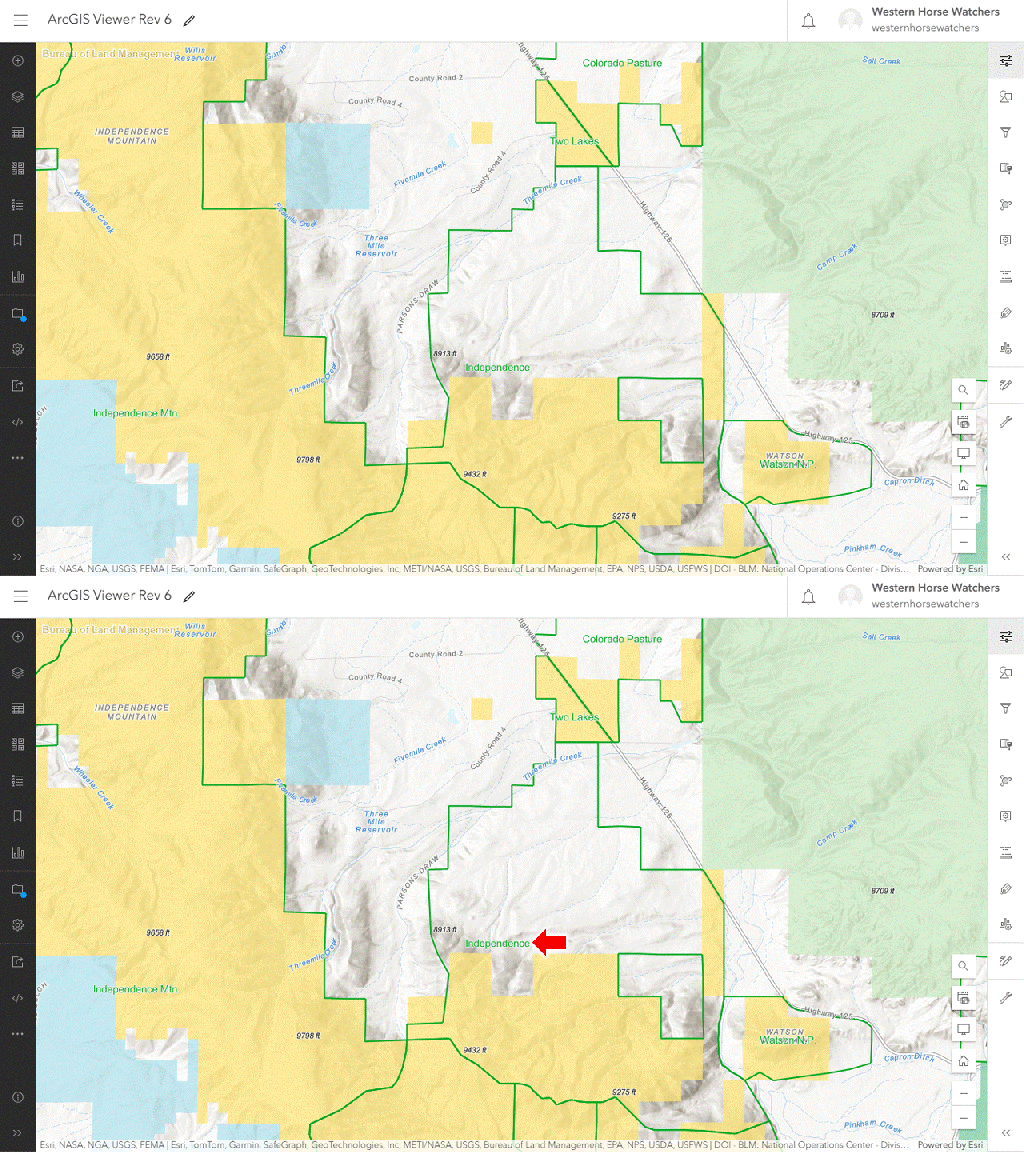
The allotment is on the east side of Independence Mountain in northern Colorado.
The Allotment Master Report puts it in the Custodial category, condition unknown.
The permittee receives 809 active AUMs on 2,610 public acres. equivalent to 67 wild horses, or 25.7 wild horses per thousand public acres.
Your faithful public servants claim that public lands in the western U.S. can only support one wild horse per thousand acres (25,500 animals on 25.6 million acres).
The advocates, allies of the bureaucrats and ranchers, bolster the narrative with their darting programs.
The allotment is too small to be an HMA but if it was, the AML would be 3 and 64 wild horses would be consigned to off-range holding because of permitted grazing.
BLM allotments in the state support livestock equivalent to 49,546 wild horses on 7,448,367 public acres, or 6.7 wild horses per thousand public acres.
Wild horses can be placed on public lands not identified for their use by acquiring base properties associated with grazing allotments and flipping the preference to horses.
RELATED: The Allotments Tell the Story: They’re Lying, All of Them.
The advocates are trying to sell mass sterilization as a humane alternative to motorized removal.
On the Virginia Range, they’re using PZP to shrink the herd by 80% because 10% of their land has been identified for development.

The stated reason is habitat loss but the real reason is to bring the herd in line with the carrying capacity narrative on public lands: No more than one or two wild horses per thousand acres.
Instead of acting as guardians of wild horses, the advocates have thrown in with their enemies.
The inevitable result is extermination.

Apparently not.
A keyword search of a BLM blog post about the May 6 hearing yielded these results:
Some individuals argued for greater use of fertility control, which the agency recognizes as an important management tool for slowing population growth but not for reducing wild horse and burro overpopulation.
An area is said to be overpopulated when the herd exceeds the low end of AML but is far from the carrying capacity of the land.
RELATED: Motorized Removal Hearing Set for May 6.
Muddy Creek and Piute Mountain have been added to emergency/nuisance section of the July 1 update but Kiger and Riddle Mountain have been removed from 4Q25.
Investigators determined that it died from a gunshot wound.
A $7,000 reward has been offered according to a BLM news release.
The nonprofit pledging $5,000 routinely shoots mares with pesticide-laced darts.
The incident will begin on July 10 according to the news release.
The capture and removal goals are 150 each.
The current population is thought to exceed 400.
Horses will be pushed into the trap by a helicopter.
Operations will be open to public observation.
Captured animals will be taken to the Axtell off-range corrals.
There are no plans to treat any of the mares with fertility control pesticides and return them to the range.
A link to the gather page was not given.
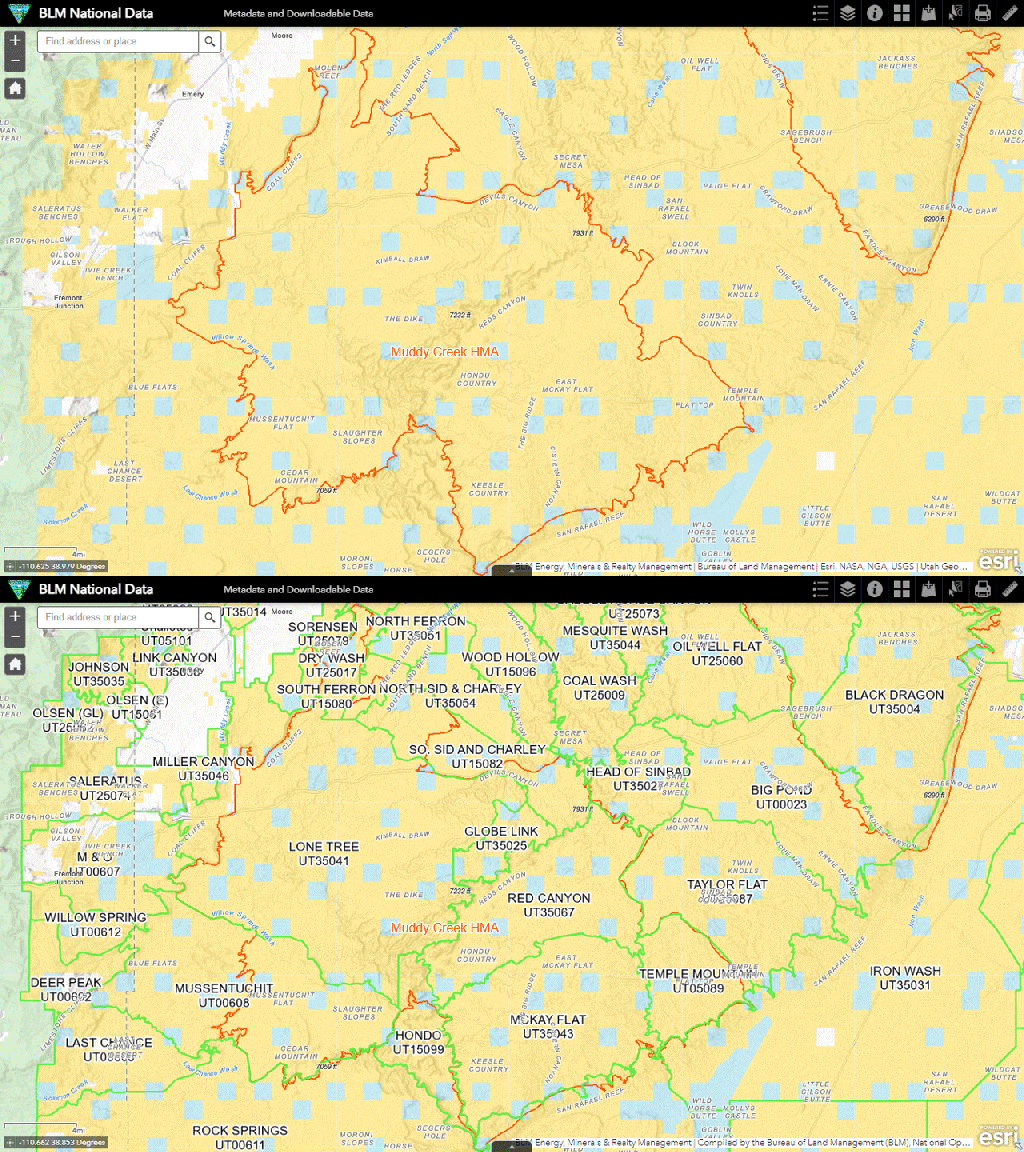
The HMA is subject to permitted grazing.
The announcement did not indicate if the grazing season would be curtailed and if any AUMs would be moved from active to suspended as a result of the drought.
RELATED: Muddy Creek Emergency Roundup Complete.
On the Virginia Range with Art.
The incident started on June 9. Results through June 26:
The figures above are based on the daily reports.
The Day 14 results have not been corrected but are probably 18/21/4, not 10/8/2 as shown at the gather page.

The death rate is 0.2%.
The capture total includes 241 jacks, 178 jennies and 25 foals.
Youngsters represented 5.6% of the animals gathered.
Of the adults, 57.5% were male and 42.5% were female.
The location of the trap site is not known.
The name of the contractor was not provided.
Sixty jennies have been treated with PZP although the June 3 schedule indicates the pesticide of choice was GonaCon Equine.
Given that no animals have been released, they will likely receive a second dose.
RELATED: More Three Rivers Confusion.

Little Snake Land & Livestock Company was selected in 2018 for an outcome-based demonstration project.
The operator information report at RAS associated the ranch with two authorizations, 0500302 and 0504960.
The allotment information report tied the authorizations to four allotments, all in the Little Snake Field Office:
The news release said the project involved an authorization with three allotments, so it’s probably 0504960.
Horse Draw is northeast of the Sand Wash Basin HMA and other three are east of Horse Draw.
The allotment master report provides management status, acreage and active AUMs.

The allotments support livestock equivalent to 177 wild horses on 16,984 public acres, or 10.4 wild horses per thousand public acres.
Your faithful public servants claim that public lands in the western U.S. can only support one wild horse per thousand acres (25,500 animals on 25.6 million acres).

A BLM public affairs specialist told Western Horse Watchers yesterday that the contractor captured 40 horses on June 26.
As of today, no reports have been posted to the Utah gather page.
RELATED: Muddy Creek Emergency Roundup Announced.
The order affects public lands northeast of Gerlach, NV from July 24 to October 5.
A map was included with the news release.
Black Rock City runs from August 24 to September 1 this year.

Results for Days 9 to 15 were not posted until yesterday.
Results for Days 4, 5 and 8 were edited.
The report for Day 14 says 43 animals captured, but the breakdown says 10 jacks, 8 jennies and 2 foals.
The gather page says 350 animals captured but the daily reports yield 327.
The discrepancy is probably in the Day 14 results.
Only adults have been shipped.
The designated pesticide is GonaCon Equine according to the June 3 schedule but the contractor treated 20 jennies with PZP on Day 13 and 20 more on Day 15.
No animals have been released, suggesting that booster doses are pending.
A burro was dispatched on Day 14 for a pre-existing condition but no details were given.
The location of the trap site was not disclosed.
Three HMAs are affected.
RELATED: Three Rivers Confusion.
On the Virginia Range, where wild horses are fast disappearing from the American scene, with Jeff Martinez.
Housing was not mentioned in the June 20 article.
A link to the offending material was not provided so you can’t be sure what they’re whining about.
But you get the impression that the federal government will be selling off vast amounts of public lands with few if any limitations if an amendment to the budget reconciliation bill drafted by the Senate Energy and Natural Resources Committee becomes law.
The story may be related to a section in a bill titled “MANDATORY DISPOSAL OF BUREAU OF LAND MANAGEMENT LAND AND NATIONAL FOREST SYSTEM LAND FOR HOUSING,” which starts on page 30.
It was linked to a news release dated June 11.
The measure calls for the disposal of not less than 0.50 percent and not more than 0.75 percent of Bureau of Land Management land and not less than 0.50 percent and not more than 0.75 percent of National Forest System land.
Said lands are to be suitable for residential housing, have access to existing infrastructure and are adjacent to developed areas.
Large parcels in remote areas, such as the Fifteenmile HA and overlapping allotments, would not be nominated for sale.
Small islands of public lands that can’t be accessed without crossing private property are likely candidates.
For example, APN 004-251-06, just inside the Storey County line and slightly north of the Jumbo Allotment, is in a developed area on the Virginia Range.
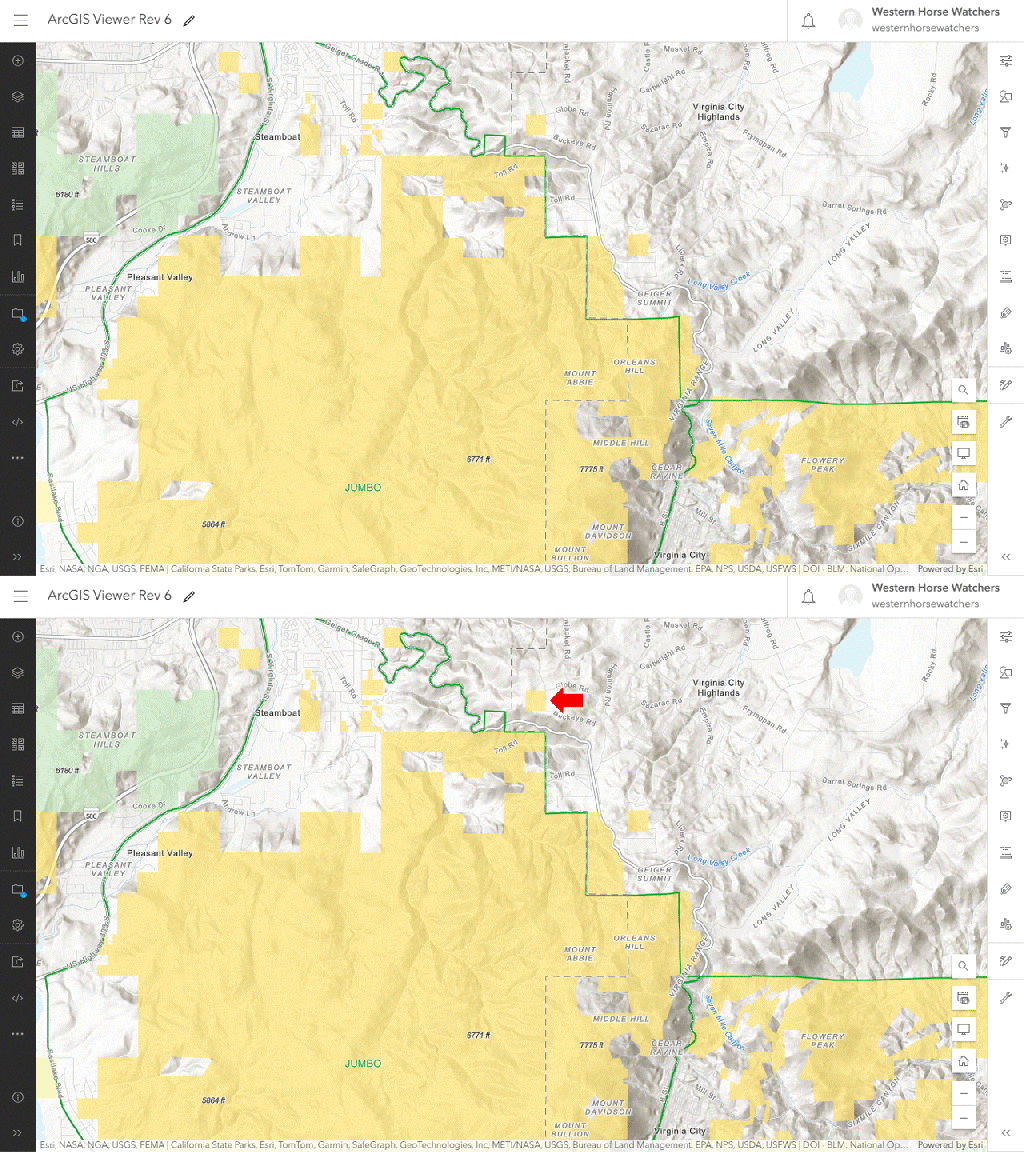
It’s designated as a single-family residence but owned by the BLM.
The 40-acre parcel has a seasonal pond, is mostly level, and power lines are about a half mile away.
Would probably fetch around $200,000.
Federally protected lands are not eligible for sale.
Unfortunately, the list of protected lands on page 31 does not include areas identified for wild horses and burros.

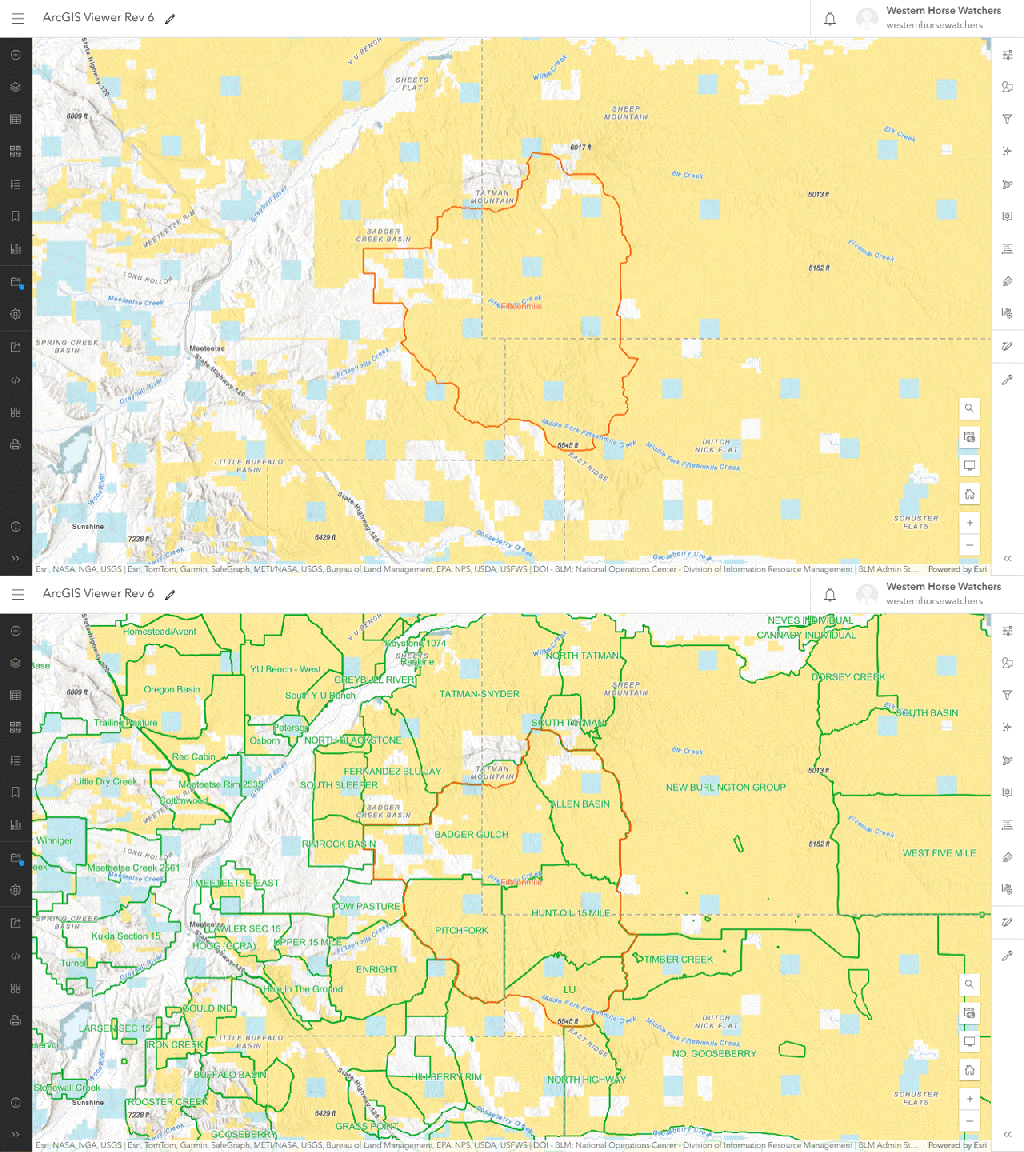
The allotment lies mostly within the Fifteenmile HA but outside the HMA, as shown in the ArcGIS Viewer.
The Allotment Master Report puts it in the Improve category, another indication that your stewards of the public lands have not been taking their responsibilities seriously.
The permittees receive 6,207 active AUMs on 94,000 public acres.
If the area was designated for wild horses, how many could live there?
The forage assigned to livestock is equivalent to 517 wild horses, or 5.5 wild horses per thousand public acres.
Your faithful public servants claim that public lands in the western U.S. can only support one wild horse per thousand acres (25,500 animals on 25.6 million acres).
The advocates, defeated a long time ago, reinforce the narrative with their darting programs.
If the allotment was an HMA, the AML would be 94 and 423 wild horses would be consigned to off-range holding because of permitted grazing.
BLM allotments in Wyoming support livestock equivalent to 158,425 wild horses on 17,312,214 public acres, or 9.2 wild horses per thousand public acres.
Wild horses can be placed on public lands not identified for their use by acquiring base properties associated with grazing allotments and flipping the preference to horses.
RELATED: The Allotments Tell the Story: They’re Lying, All of Them.

The Draft DNA asserts that a 2019 EA fully covers the removal of wild horses later this year and constitutes BLM’s compliance with the requirements of the NEPA.
The EA indicates on page 21 (page 24 in the pdf) that five allotments overlap the HMA.
The Allotment Master Report gives management status, acreage and active AUMs.
The EA does not give the percentage of public lands inside the HMA but those numbers can be estimated from the ArcGIS Viewer.
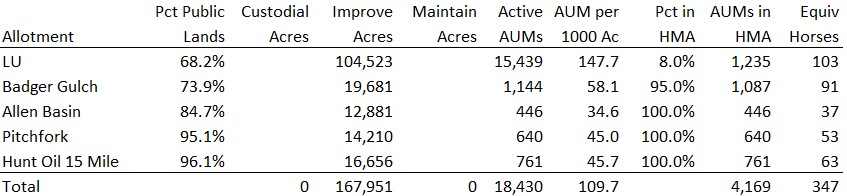
The allotments offer a weighted average 109.7 AUMs per thousand public acres, equivalent to 9.1 wild horses per thousand public acres.
Your faithful public servants claim that public lands in the western U.S. can only support one wild horse per thousand acres (25,500 animals on 25.6 million acres).
The HMA covers 68,607 public acres and has an AML of 230 according to the 2025 population dataset.
The HMA supports livestock equivalent to 347 wild horses, so the True AML would be 230 + 347 = 577.
The stocking rate would be 8.4 wild horses per thousand public acres.
RELATED: Fifteenmile DNA Out for Review, No Announcement.
Refer to this news release by the Riverside County Sheriff’s Office.

