On Assateague Island with Assateague Memories.
Category: Range
On the range
Foal-Free Friday, Indulging Their Obsession Edition
What advocate wouldn’t drool at the sight of a G2 X-Caliber darting rifle?
These weapons help ranchers prosper in the lawful homes of wild horses.
RELATED: Foal-Free Friday, Pesticides on Parade Edition.
Devil’s Garden Roundup Resumes
The gather page shows 17 horses trapped since January 18, bringing the total to 358.
Buffalo Hills Update
The roundup concluded on November 23 with 138 horses captured, 32 shipped, 50 released and four dead.
Thirty-three burros were caught and shipped.
On the final day, 57 mares were treated with GonaCon Equine and five were released.
The gather page indicates that one of the mares in temporary holding died of colic on December 6, bringing the death count to five.
The page also indicates that the survivors were treated and released on December 23, which does not match the agency’s response to a public comment in the DNA.

Western Horse Watchers has been unable to find a registration update at the EPA web site, so the 30-day interval is probably not valid and the HMA has become the latest GonaCon crime scene.
RELATED: BLM Not Following GonaCon Treatment Plan at Buffalo Hills.
Who Will Benefit from Beaty Butte Water Improvements?
Wild horses and livestock congregate at Lick Spring in the Beaty Butte Allotment, resulting in compacted soil and reduced native vegetation.
The BLM developed a solution with input from the Beaty Butte Grazing Association.
The Proposed Action, discussed in Section 2.2 of the EA, would run an underground water line eastward from the spring, which is on private land, to two new troughs.
Map 1 in Appendix E shows the arrangement.
The map gives the township, range and sections, so the project area can be found in the NDV by turning on the PLSS layer.
The EA did not indicate if the animals would still be able to access the spring and who would monitor the system when livestock are not present.
The comment period ends today.
The EA was copied to the project folder in ePlanning with an unsigned FONSI.
The HMA lies within the allotment and includes the spring.
BLM Kills Job Posting for Carson City WHB Specialist
The application period had been extended but now it says JOB CANCELLED, perhaps an early indication that federal government is under new management with a focus on cost cutting.
RELATED: BLM Seeks WHB Specialist.
NPS Seeks Volunteers for Cape Lookout Pony Patrol
The successful candidates will raise visitor awareness and compliance with rules for interacting with wild horses at Shackleford Banks and Rachel Carson Reserve according to a January 21 news release.
Last year volunteers conducted 254 patrols and contacted over 3,800 visitors.
You must be at least 18 years old and able to walk in an environment consisting of sandy terrain, extreme sun, heat, humidity, wind and bugs.
Murderer’s Creek Roundup, Day 53
The incident started on November 29. Results through January 20:
- Scope: Murderer’s Creek HMA, WHT
- Target: Wild horses
- AML: 140
- Pre-gather population: 650
- True AML: TBD
- Type: Emergency
- Method: Bait
- Capture goal: 350 – 400
- Removal goal: 350 – 400
- Captured: 285, up from 239 on Day 45
- Shipped: 274, up from 206 on Day 45
- Released: None
- Deaths: 5, up from 4 on Day 45
- Average daily take: 5.3
- Unaccounted-for animals: 45
- Snippet from statute: It is the policy of Congress that wild free-roaming horses and burros shall be protected from capture, branding, harassment, or death
- Snippet from manual: To protect wild horses and burros from unauthorized capture, branding, harassment or death
The figures above are based on the daily reports.
A stallion died of a head injury on Day 49. The death rate is 1.8%.
The capture total includes 96 stallions, 118 mares and 71 foals. The gather page says 95/119/71.
Youngsters represented 24.9% of the animals gathered, consistent with a herd growth rate of 20% per year. The Rule of 72 says the herd size would double in 3.6 years.
Of the adults, 44.9% were male and 55.1% were female, no indication of an abnormal sex ratio in the population at large.
Body condition scores were not given.
The location of the trap site was not disclosed.
The name of the contractor was not provided.
There are no plans to treat any of the mares with fertility control pesticides and return them to the range.
No decisions have made regarding the long-term disposition of horses, which means they could be treated or altered in off range holding, including the stallions.
The status of livestock grazing in the burned area is not known.
RELATED: Murderer’s Creek Roundup, Day 45.
Mustang Monday
In the Spring Mountains with Clint Cobra.
If Wild Horses Had Principal Use of the Hammond Allotments
They’ve been idle for ten years, more or less, and they’re no longer in RAS.
But the BLM just released a Draft EIS for public review and the previous forage allocations are discussed in Section 1.1. Table 1-1 gives the public acres.
- Hammond – 473 active AUMs, 11,048 public acres
- Mud Creek – 590 active AUMs, 8.206 public acres
- Hardie Summer – 408 active AUMs, 6,006 public acres
- Hammond FFR – 32 active AUMs, 1,159 public acres
A 2023 land health assessment determined that the available forage in Hammond is north of 1,700 but that finding has been ignored.
No forage has been assigned to wild horses in these parcels.
How many could live there?
The allotments offer a combined 1,503 active AUMs on 26,419 public acres, equivalent to 125 wild horses, or 4.7 animals per thousand public acres.
Why is this important?
Your faithful public servants claim that public lands in the western U.S. can only support one wild horse per thousand acres (27,000 animals on 27 million acres).
The advocates give their assent through their darting programs. Like the ranchers, they want you to think that the herds must stay within AML if they are to survive.
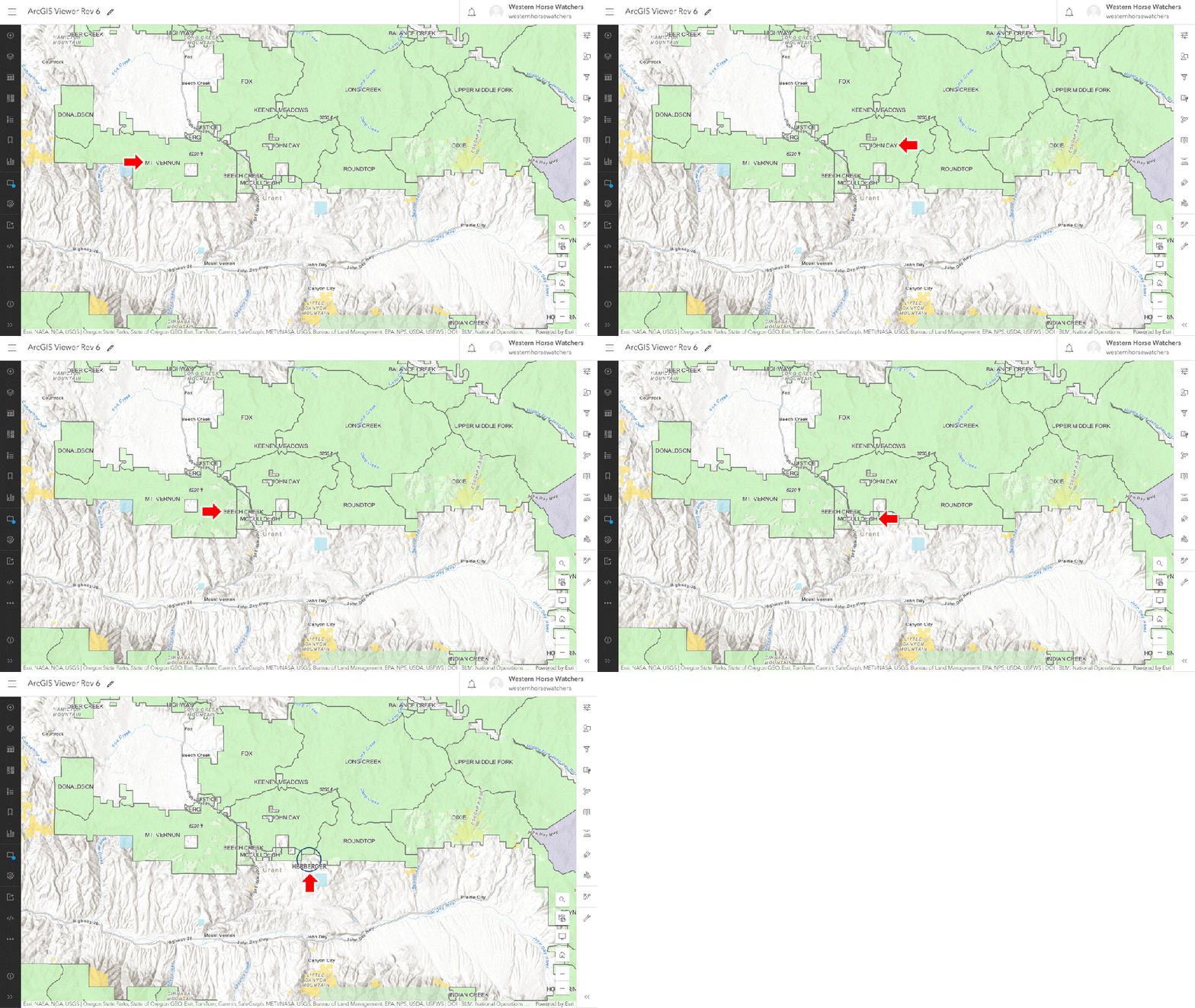
If the allotments were merged into an HMA, the AML would be 26 and 99 horses would be consigned to off-range holding because of permitted grazing.
BLM allotments in Oregon support livestock equivalent to 87,934 wild horses on 13,130,302 public acres, or 6.7 wild horses per thousand public acres.
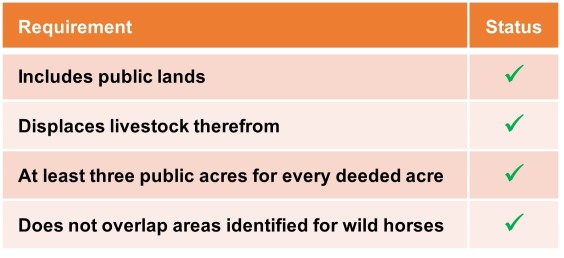
Wild horses can be placed on public lands not identified for their use by acquiring base properties associated with grazing allotments and flipping the preference to horses.

RELATED: The Allotments Tell the Story: They’re Lying, All of Them.
Foal-Free Friday, Pesticides on Parade Edition
The fertility control fanatics took an early lead in public comments at the January 7 WHBAB meeting, as Suzanne Roy of the Campaign Against America’s Wild Horses set the tone with her declaration of loyalty to the public-lands ranchers.
In this video, her subordinates prove that the nonprofit is obsessed with pesticides, wants to replace motorized removal with mass sterilization, and is positioning itself to become the go-to contractor for wild horse “management.”
They are turncoats, sellouts, and don’t deserve a penny of your support.
RELATED: Foal-Free Friday, Speed of Light Edition.
Devil’s Garden Roundup Resumes Next Week?
The incident will continue on January 21 according to a report by Sierra Daily News.
The last update by the Forest Service put the capture total at 341.
RELATED: Devil’s Garden Roundup Over?
BLM Putting Hammond Allotments Back in Play?
The January 8 news release said there is a high level of interest in the project, probably because the former permittees were among Oregon’s most infamous ranchers.
Over the past ten years livestock grazing on the Bridge Creek allotments has been limited by legal action and political interference, as discussed in a 2021 article by Oregon Public Broadcasting.
The case led to an armed standoff at the Malheur National Wildlife Refuge in 2016, which resulted in the death of an Arizona rancher who had joined the occupation.
A Notice of Recission, which ended a 2020 project aimed at grazing reauthorization, indicated that the BLM had apportioned forage within the Hammond, Hammond FFR, Mud Creek and Hardie Summer allotments and issued a ten-year grazing permit with allotment management plans to Hammond Ranches, Inc.
The decision was overturned and returned to the BLM for additional consideration, resulting in a new project.
The Draft EIS indicates that permitted grazing has not occurred since 2014 and the grazing preference has not been attached to a base property since the decision to not renew the permit.
The project description says the BLM will consider ten-year grazing permits for up to three applicants and approval of four management plans that outline seasonal grazing systems, grazing utilization thresholds, monitoring and range developments.
A virtual public meeting will be held on February 13 at 5 PM Pacific time.
Comments on the EIS will be accepted through February 21.
RELATED: Hammonds Lose Grazing Permit.
Murderer’s Creek Roundup, Day 45
The incident started on November 29. Results through January 12:
- Scope: Murderer’s Creek HMA, WHT
- Target: Wild horses
- AML: 140
- Pre-gather population: 650
- True AML: TBD
- Type: Emergency
- Method: Bait
- Capture goal: 350 – 400
- Removal goal: 350 – 400
- Captured: 239, up from 210 on Day 39
- Shipped: 206, up from 186 on Day 39
- Released: None
- Deaths: 4, no change from Day 39
- Average daily take: 5.3
- Unaccounted-for animals: 29
- Snippet from statute: It is the policy of Congress that wild free-roaming horses and burros shall be protected from capture, branding, harassment, or death
- Snippet from manual: To protect wild horses and burros from unauthorized capture, branding, harassment or death
The figures above are based on the daily reports.
The death rate is 1.7%.
The capture total includes 83 stallions, 97 mares and 59 foals. The gather page says 82/98/59.
Youngsters represented 24.7% of the animals gathered, consistent with a herd growth rate of 19% per year. The Rule of 72 says the herd size will double in 3.8 years.
Of the adults, 46.1% were male and 53.9% were female, no indication of an abnormal sex ratio in the population at large.
Body condition scores were not given.
The location of the trap site was not disclosed.
The name of the contractor was not provided.
There are no plans to treat any of the mares with fertility control pesticides and return them to the range.
No decisions have made regarding the long-term disposition of horses, which means they could be treated or altered in off range holding, including the stallions.
The status of livestock grazing in the burned area is not known.
RELATED: Murderer’s Creek Roundup, Day 39.
What Happened to the Fish Creek Foals?
The roundup ending in January 2021 yielded 18.2% foals. The page does not indicate how many mares were treated with PZP-22 and returned to the HMA.
The roundup ending in January 2025 produced 1.5% foals. Twenty-three mares were treated with PZP and released.
If the pattern continues, the herd will vanish. A birth rate of five to six percent is needed to keep up with deaths.
At last week’s WHBAB meeting, the executive director of the Campaign Against America’s Wild Horses said the roundup would not be necessary if the BLM had accepted her proposal to snuff out new life with fertility control.
The plan was rejected so why is the foal count so low?
RELATED: Fish Creek Roundup Over.

Oatman from the Air
It’s in the Black Mountain HMA, an area identified for wild burros.
Mustang Monday
In Death Valley with GEORGE G.
Fish Creek Roundup Over
The incident concluded today with 194 horses captured, 144 shipped, 50 released and no deaths, for a net removal of 144.
There were no unaccounted-for animals.
The capture and removal goals were 196 and 144, respectively.
The average daily take for the six-day event was 32.2.
The capture total included 91 stallions, 100 mares and three foals.
Youngsters represented 1.5% of the animals gathered, too small to sustain herd growth.
Of the adults, 47.6% were male and 52.4% were female, no indication of an abnormal sex ratio in the population at large.
Mares returned to the HMA were treated with PZP.
The roundup liberated 1,728 AUMs per year, giving new hope to the Fish Creek permittees.
RELATED: Fish Creek Roundup Announced.
UPDATE: The BLM news release does not acknowledge the dearth of foals.
Suspect Identified in Shooting of Lake Mead Burro
A tip regarding the regarding the hunting and killing of the animal led investigators to video of two persons driving on public lands, gesturing toward wildlife, cattle and burros, according to a report by KLAS News.
A warrant has been issued for the arrest of a man from California.
The other person was not named.
Lake Mead runs between the Gold Butte, Muddy Mountains and Black Mountain HMAs, all managed for wild burros.
Fish Creek Roundup, Day 5
The incident started on January 6. Results through January 10:
- Scope: Fish Creek HMA
- Target: Wild horses
- AML: 180
- Pre-gather population: 245
- True AML: 440
- Type: Planned
- Method: Helicopter
- Category: Cruel and costly (according to advocates)
- Better way: Sterilize mares with PZP (according to advocates)
- Capture goal: 196
- Removal goal: 144
- Captured: 194, up from 123 on Day 3
- Shipped: 112, up from 39 on Day 3
- Released: 50, up from zero on Day 3
- Deaths: None
- Average daily take: 38.8
- Unaccounted-for animals: 32
- Snippet from statute: It is the policy of Congress that wild free-roaming horses and burros shall be protected from capture, branding, harassment, or death
- Snippet from manual: To protect wild horses and burros from unauthorized capture, branding, harassment or death
The figures above are based on the daily reports.
The capture total includes 91 stallions, 100 mares and 3 foals.
Youngsters represented 1.5% of the animals gathered, much lower than expected and too small to support herd growth.
Of the adults, 47.6% were male and 52.4% were female, no indication of an abnormal sex ratio in the population at large.
Body condition scores were not given.
The location of the trap site was not disclosed.
On Day 5, 23 mares treated with PZP were returned to the range with 27 stallions.
The roundup supports three tenets of rangeland management.
Resources liberated to date:
- Forage: 1,728 AUMs per year
- Water: 1,440 gallons per day
RELATED: Fish Creek Roundup, Day 3.