Three Wild Horses Found Dead Near Minersville

The incident occurred in Beaver County, Tammy Pearson’s stomping ground (Beaver County commissioner, public-lands rancher and member of the WHBAB).

The BLM news release said they were found northwest of the Minersville Reservoir on the Mineral Range Mountains.

That puts them in the Minersville #2 Allotment or the south end of the Mineral Range Allotment.

The agency has offered a $5,000 reward for information leading to the arrest and conviction of the person(s) responsible.

The nearest HMA is Frisco, about 25 miles to the northwest (not visible in map).

Mineral Range with Allotments 01-06-25

Court Sides with Forest Service in Big Summit Appeal

The U.S. Court of Appeals for the Ninth Circuit has affirmed the district court’s ruling granting summary judgment for the U.S. Forest Service in its decision to approve the Ochoco Herd Management Plan.

The court rejected all of the plaintiffs’ claims according to the January 3 ruling, allowing the plan to go forward.

The agency is currently renovating a facility near Prineville that will house wild horses removed from the WHT.

Although the case cited the availability of winter forage as the limiting factor in setting the AML, there was no discussion of the forage assigned to livestock in the Reservoir Allotment, which overlaps most of the WHT.

RELATED: Ninth Circuit Hears Arguments in Big Summit Appeal.

Big Summit WHT Map 11-19-22

Murderer’s Creek Roundup, Day 35

The incident started on November 29.  Results through January 2:

  • Scope: Murderer’s Creek HMA, WHT
  • Target: Wild horses
  • AML: 140
  • Pre-gather population: 650
  • True AML: TBD
  • Type: Emergency
  • Method: Bait
  • Capture goal: 350 – 400
  • Removal goal: 350 – 400
  • Captured: 193, up from 190 on Day 31
  • Shipped: 186, up from 168 on Day 31
  • Released: None
  • Deaths: 4, no change from Day 31
  • Average daily take: 5.5
  • Unaccounted-for animals: 3
  • Snippet from statute: It is the policy of Congress that wild free-roaming horses and burros shall be protected from capture, branding, harassment, or death
  • Snippet from manual: To protect wild horses and burros from unauthorized capture, branding, harassment or death

No reports were given for Days 33 and 34.

The death rate is 2.1%.

The capture total includes 66 stallions, 84 mares and 43 foals.

Youngsters represented 22.3% of the animals gathered, consistent with a herd growth rate of 17% per year.  The Rule of 72 says the herd size will double in 4.2 years.

Of the adults, 44.0% were male and 56.0% were female, no indication of an abnormal sex ratio in the population at large.

Body condition scores were not given.

The location of the trap site was not disclosed.

The name of the contractor was not provided.

There are no plans to treat any of the mares with fertility control pesticides and return them to the range.

No decisions have made regarding the long-term disposition of horses, which means they could be treated or altered in off range holding, including the stallions.

The status of livestock grazing in the burned area is not known.

RELATED: Murderer’s Creek Roundup, Day 31.

Murderers Creek HMA with Allotments 10-24-24

Moffat County Base Property Available for $14.4 Million

Sevens Ranch offers 17,666 deeded acres intermixed with 49,557 acres of BLM and State lands for a total of 67,223, according to the listing.

The map indicates it has preference on the Disappointment and Cedar Springs Draw allotments.

The Allotment Master Report puts both in the Improve category but shows no active AUMs on either, contrary to the agent’s description.

The allotment dataset posted last April shows 1,610 active AUMs on 22,304 public acres for Disappointment and 2,758 active AUMs on 20,161 public acres for Cedar Springs Draw, equivalent to 364 wild horses on 42,465 public acres, or 8.6 wild horses per thousand public acres.  (Our faithful public servants tell us that public lands in the western U.S. can only support one wild horse per thousand public acres.)

Buyers should ask the Little Snake Field Office about the AUM discrepancy.

The ranch might be a candidate for Colorado’s new wild horse preserve.

Sevens Ranch Scorecard 01-01-25

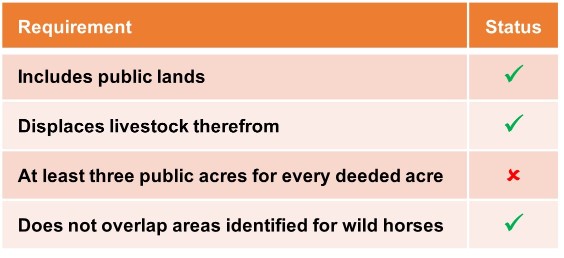
The land ratio is 2.8 public acres for every deeded acre, so it’s close.

Wild horses can be placed on public lands not identified for their use by acquiring private property associated with grazing allotments and flipping the preference to horses as Wild Horse Refuge did at Rio Ro Mo Ranch.

Sevens Ranch Allotments 01-01-25

Murderer’s Creek Roundup, Day 31

The incident started on November 29.  Results through December 29:

  • Scope: Murderer’s Creek HMA, WHT
  • Target: Wild horses
  • AML: 140
  • Pre-gather population: 650
  • True AML: TBD
  • Type: Emergency
  • Method: Bait
  • Capture goal: 350 – 400
  • Removal goal: 350 – 400
  • Captured: 190, up from 183 on Day 25
  • Shipped: 168, no change from Day 25
  • Released: None
  • Deaths: 4, no change from Day 25
  • Average daily take: 6.1
  • Unaccounted-for animals: 18
  • Snippet from statute: It is the policy of Congress that wild free-roaming horses and burros shall be protected from capture, branding, harassment, or death
  • Snippet from manual: To protect wild horses and burros from unauthorized capture, branding, harassment or death

No reports were given for Days 26 through 30.

The death rate is 2.1%.

The capture total includes 66 stallions, 82 mares and 42 foals.

Youngsters represented 22.1% of the animals gathered, consistent with a herd growth rate of 17% per year.  The Rule of 72 says the herd size will double in 4.2 years.

Of the adults, 44.6% were male and 55.4% were female, no indication of an abnormal sex ratio.

Body condition scores were not given.

The location of the trap site was not disclosed.

The name of the contractor was not provided.

There are no plans to treat any of the mares with fertility control pesticides and return them to the range.

No decisions have made regarding the long-term disposition of horses, which means they could be treated or altered in off range holding, including the stallions.

The status of livestock grazing in the burned area is not known.

RELATED: Murderer’s Creek Roundup, Day 25.

Murderers Creek HMA with Allotments 10-24-24

Walden Base Property Available for $13.5 Million

Double R Ranch covers 3,676 deeded acres with grazing privileges on 9,570 acres of BLM land and 640 acres of state land according to the listing.

The deeded acreage includes 2,350 acres of irrigated hay meadows and 908 acres of irrigated and sub-irrigated pastures.

The map suggests it has preference on the Playa, Verner East, Peterson Ridge West, Tointon and Fish Hatchery allotments.

RAS ties them to authorization #0500505, which also includes Headquarters, Verner West and Beaver Creek.

The Allotment Master Report indicates they offer a combined 852 active AUMs on 9,401 public acres, equivalent to 71 wild horses or 7.6 wild horses per thousand public acres.

Hay production may allow the numbers to go higher.

The ranch might be a candidate for Colorado’s wild horse preserve.

RELATED: Criteria for Colorado’s New Wild Horse Preserve.

Double R Ranch Allotments 12-30-24

Criteria for Colorado’s New Wild Horse Preserve

Base properties would be the ideal candidates.

  • Must include public lands
  • Must displace livestock therefrom
  • Each deeded acre should control at least three public acres
  • Doesn’t overlap areas identified for wild horses

The need for a state preserve was identified by the Colorado Wild Horse Working Group earlier this year.  Refer to their Year One Report for more information.

RELATED: Colorado Wild Horse Working Group Releases Year One Report.

Murderer’s Creek Roundup, Day 25

The incident started on November 29.  Results through December 23:

  • Scope: Murderer’s Creek HMA, WHT
  • Target: Wild horses
  • AML: 140
  • Pre-gather population: 650
  • True AML: TBD
  • Type: Emergency
  • Method: Bait
  • Capture goal: 350 – 400
  • Removal goal: 350 – 400
  • Captured: 183, up from 166 on Day 21
  • Shipped: 168, up from 129 on Day 21
  • Released: None
  • Deaths: 4, no change from Day 21
  • Average daily take: 7.3
  • Unaccounted-for animals: 11
  • Snippet from statute: It is the policy of Congress that wild free-roaming horses and burros shall be protected from capture, branding, harassment, or death
  • Snippet from manual: To protect wild horses and burros from unauthorized capture, branding, harassment or death

The figures above are based on the daily reports.

The death rate is 2.2%.

The capture total includes 63 stallions, 79 mares and 41 foals.

Youngsters represented 22.4% of the animals gathered, consistent with a herd growth rate of 17% per year.  The Rule of 72 says the herd size will double in 4.2 years.

Of the adults, 44.4% were male and 55.6% were female, no indication of an abnormal sex ratio.

Body condition scores were not given.

The location of the trap site was not disclosed.

The name of the contractor was not provided.

There are no plans to treat any of the mares with fertility control pesticides and return them to the range.

No decisions have made regarding the long-term disposition of horses, which means they could be treated or altered in off range holding, including the stallions.

The status of livestock grazing in the burned area is not known.

RELATED: Murderer’s Creek Roundup, Day 21.

Murderers Creek HMA with Allotments 10-24-24

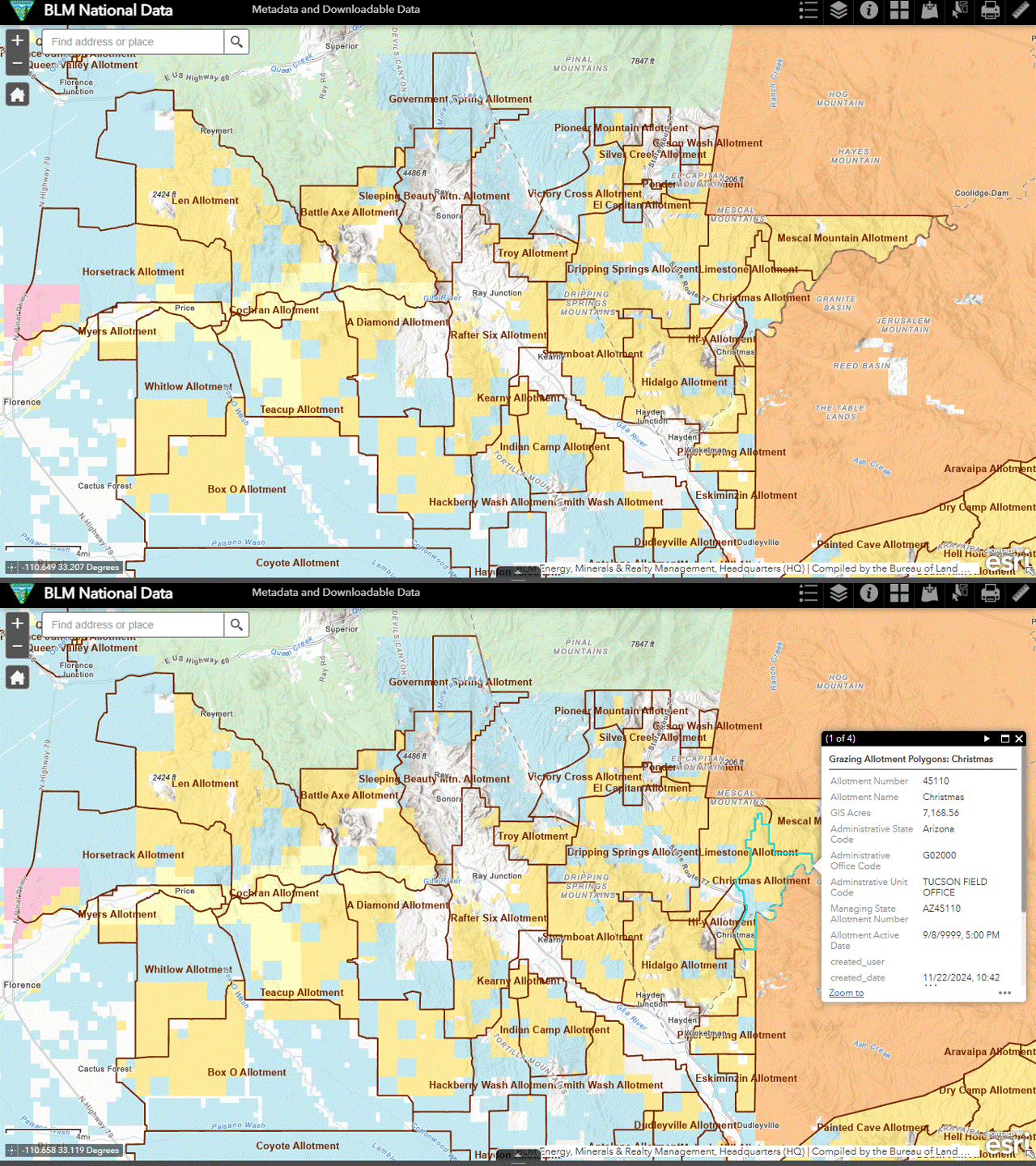
If Wild Horses Had Principal Use of Christmas

The allotment, located about 40 miles east of Florence, AZ, offers 496 active AUMs on 5,690 public acres according to the Allotment Master Report.

The forage assigned to horses is zero.

How many wild horses could live there?

Using the principle of forage interchangeability, the True AML would be 496 ÷ 12 = 41, the number of horses the land could support if it was managed principally for them as specified in the original statute.

The stocking rate would be 41 ÷ (5,690 ÷ 1,000) = 7.2 wild horses per thousand public acres.

Why is this important?

The bureaucrats and ranchers tell us that public lands in the western U.S. can only support one wild horse per thousand acres (27,000 animals on 27 million acres).

The advocates reinforce the narrative with their darting programs.

If the allotment was an HMA, the AML would be 6 and 35 horses would be consigned to off-range holding because of permitted grazing.

BLM allotments in Arizona carry livestock equivalent to 53,662 wild horses on 10,090,546 public acres, or 5.3 wild horses per thousand public acres.

Wild horses can be placed on public lands not identified for their use by acquiring base properties associated with grazing allotments and flipping the preference to horses, as American Prairie did for bison in Montana.

RELATED: The Allotments Tell the Story: They’re Lying, All of Them.

Christmas Allotment 12-25-24

La Junta Base Property Available for $10.6 Million

Purgatory Basin Ranch covers 12,502 deeded acres in southeastern Colorado, with grazing preference on the 8,127-acre Higbee Allotment in the Comanche National Grasslands, according to the listing.

There is also a 640-acre state lease and 320-acre private lease.

The 2024 AOIs suggest the allotment offers 1,301 AUMs per year, equivalent to 13.3 wild horses per thousand acres.

The bureaucrats tell us that public lands in the western U.S. can only support one wild horse per thousand acres.

The state charges $16.25 per AUM, according to the 2024 invoice, twelve times more than the Forest Service.

The land ratio is low.  You must purchase 12,502 deeded acres to access 8,127 public acres.

There are no HMAs or WHTs in the area.

Wild horses can be placed on public lands not identified for their use by acquiring base properties associated therewith and flipping the preference to horses.

Equivalent Horses and Stocking Rates for Allotments

Consider the Eighteen Mile Allotment, located within the Little Colorado HMA, which offers 18,994 active AUMs on 228,494 public acres according to the Allotment Master Report.

A simple way to compare the management of the HMA with the management of the allotment is with these relationships:

Equivalent horses = Active AUMs ÷ 12

Equivalent stocking rateActive AUMs ÷ 12 ÷ (Public acres ÷ 1,000)

The allotment, a subset of the HMA, supports livestock equivalent to 1,583 wild horses.

Equivalent horses = 18,994 ÷ 12 = 1,583

The HMA, consisting of 525,421 public acres according to the 2024 population dataset, can only sustain 100 wild horses.

The allotment carries livestock equivalent to 6.9 wild horses per thousand public acres.

Equivalent stocking rate = 18,994 ÷ 12 ÷ (228,494 ÷ 1,000) = 6.9

The HMA can only sustain 0.2 wild horses per thousand public acres.

Stocking rate = 100 ÷ (525,421 ÷ 1,000) = 0.2

Land that can only support 0.2 wild horses per thousand public acres supports livestock equivalent to 6.9 wild horses per thousand public acres.

You cannot have more than 100 wild horses in the entire HMA but you can have livestock equivalent to 1,583 wild horses in an area corresponding to 43% of it.

How is this possible?

They’re lying.

They tell us that public lands in the western U.S. can only support one wild horse per thousand acres (27,000 animals on 27 million acres).

The advocates bolster the narrative with their HMAPs and darting programs.

They want the ranchers to win.

The allotment accounts for 1,583 wild horses in off-range holding.

The roundups and stockpiling of wild animals in government feedlots are symptoms of resource mismanagement, not inadequate carrying capacity.

The problem is man made.

RELATED: Thriving Ecological Imbalance at Little Colorado HMA.

Eighteen Mile Allotment 12-21-24

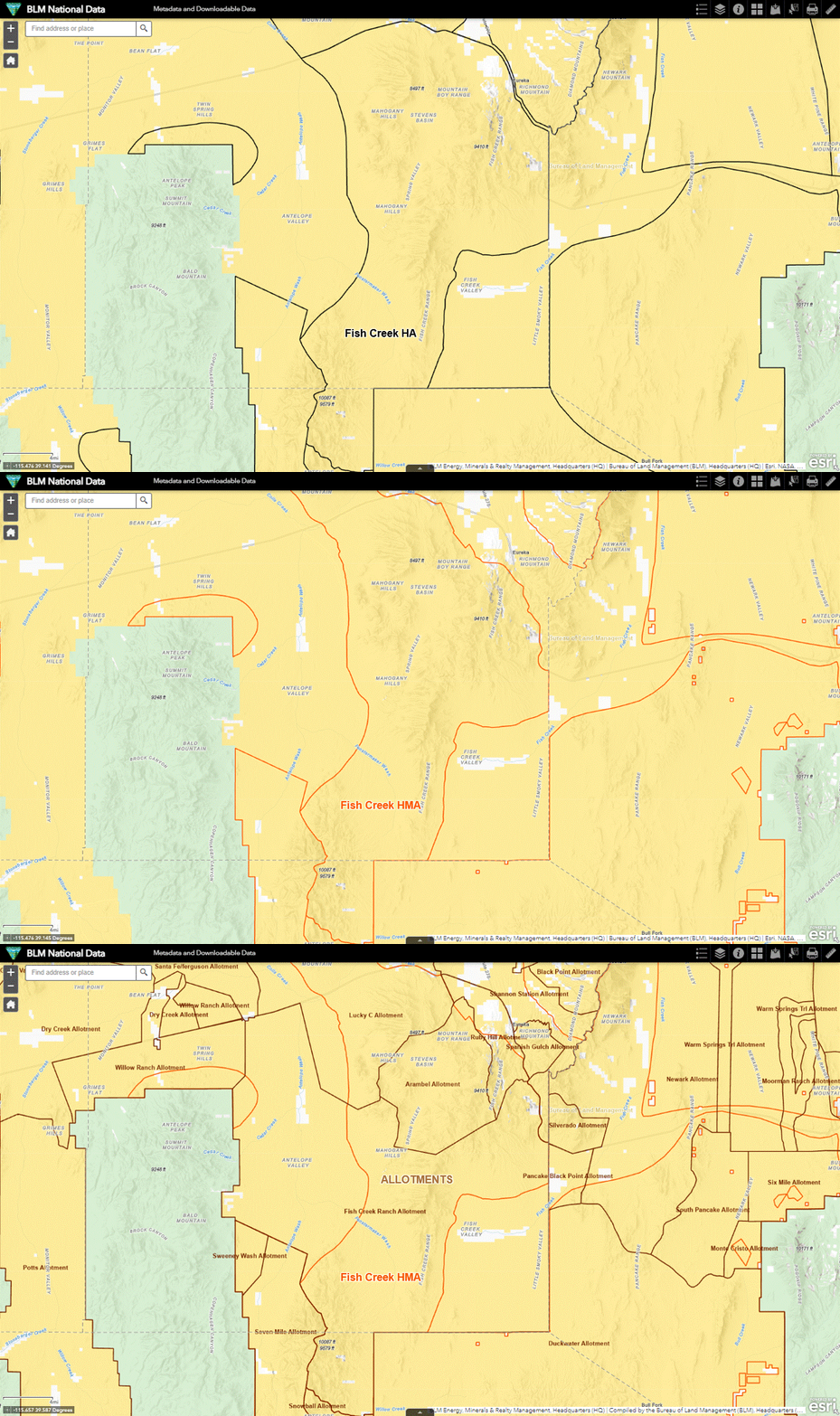
Fish Creek Roundup Announced

The incident will begin on or about January 6 according to the news release.

A helicopter will push the horses into a trap and operations will be open to public observation, conditions permitting.

The capture and removal goals are 196 and 144.

The pre-gather population is thought to be 245.

Up to 26 mares will be treated with PZP and be returned to the HMA with up to 26 stallions.

Animals identified for removal will be taken to the off-range corrals in Winnemucca.

A link to the gather stats and daily reports was not provided.

The roundup supports three tenets of rangeland management.

RELATED: Fish Creek Decision Issued.

Fish Creek HMA with Allotments 11-07-24

Murderer’s Creek Roundup, Day 21

The incident started on November 29.  Results through December 19:

  • Scope: Murderer’s Creek HMA, WHT
  • Target: Wild horses
  • AML: 140
  • Pre-gather population: 650
  • True AML: TBD
  • Type: Emergency
  • Method: Bait
  • Capture goal: 350 – 400
  • Removal goal: 350 – 400
  • Captured: 166, up from 144 on Day 17
  • Shipped: 129, no change from Day 17
  • Released: None
  • Deaths: 4, no change from Day 17
  • Average daily take: 7.9
  • Unaccounted-for animals: 33
  • Snippet from statute: It is the policy of Congress that wild free-roaming horses and burros shall be protected from capture, branding, harassment, or death
  • Snippet from manual: To protect wild horses and burros from unauthorized capture, branding, harassment or death

No report was given for Day 19.

The death rate is 2.4%.

The capture total includes 61 stallions, 69 mares and 36 foals.

Youngsters represented 21.7% of the animals gathered, consistent with a herd growth rate of 16% per year.  The Rule of 72 says the herd size will double in 4.5 years.

Of the adults, 46.9% were male and 53.1% were female, no indication of an abnormal sex ratio.

Body condition scores were not given.

The location of the trap site was not disclosed.

The name of the contractor was not provided.

There are no plans to treat any of the mares with fertility control pesticides and return them to the range.

No decisions have made regarding the long-term disposition of horses, which means they could be treated or altered in off range holding, including the stallions.

The status of livestock grazing in the burned area is not known.

RELATED: Murderer’s Creek Roundup, Day 17.

Murderers Creek HMA with Allotments 10-24-24