New Twist in Rock Springs RMP Amendments?

Ranchers in the Wyoming Checkerboard don’t want any wild horses on their land but want to graze as many of their animals as possible on the horses’ land.  Sound familiar?

Now, the largest private landowner in the area may be interested in selling its property to the state of Wyoming, according to a guest column appearing today in Horse Nation.

RELATED: The Other Rock Springs RMP Amendments.

The PZP Zealots Are Wrong

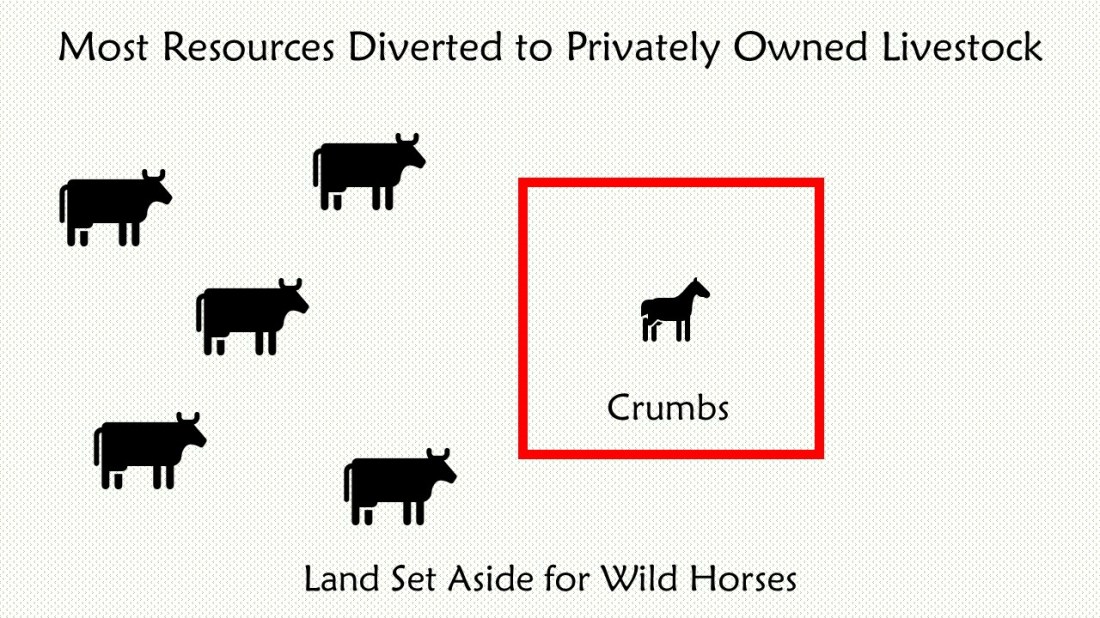
These figures show you why: Eighty five percent of the forage on 17 areas (representing about two dozen HMAs) goes to privately owned livestock.  Not only do they want the pattern to continue, they want to tip the scales further in the direction of the ranchers, by reversing the growth rate of the horses.

Why PZP Zealots Are Wrong A-1

Refer to the signatories of this unified statement from 2018.

Contraceptives are not the answer.  The problem is public-lands ranching.

RELATED: Hypothesis Revisited.

Comments Invited on Spring Creek EA

BLM announced today the start of a 30-day comment period on a draft environmental assessment for changes to wild horse management on the Spring Creek Basin HMA in southwestern Colorado.

Resources in the area can support up to 80 wild horses, according to Section 3.1.2 of the EA.  The current AML is 65.  The proposed action would increase the AML but limit herd growth rates to no more than ten percent per year.

Other management objectives involve age distribution, body condition, dispersion and genetic diversity, similar to the goals of the Pryor Mountains revamp.

Livestock grazing has been greatly reduced inside the HMA, a factor contributing to the AML increase.  Forage utilization outside the HMA was not discussed, probably because it’s outside the scope of the management plan.

The HMA is only slightly larger than the tiny Heber WHT and the new AML is only half the size recommended in Section 4.4.6.3 of the WHB Management Handbook.

The population target could be achieved by doubling the size of the HMA, which means taking back the land now designated as a Herd Area (see map in linked post below).

Comments can be submitted at this page.  Substantive only, please.

RELATED: Spring Creek Basin Management Plan to Be Updated.

The Other Rock Springs RMP Amendments

The closure of three HMAs in the Wyoming checkerboard, and downsizing of a fourth, will be accompanied by other changes, as BLM updates the resource management plan for the area.  The revamped plan will be released for public comments this spring, according to a report posted yesterday by the Casper Star Tribune.

This week marks the end of the comment period on an Environmental Impact Statement for changes to wild horse management in the Rock Springs area.

The existing management plan was only slightly biased against the horses.

Rock Springs Summary-4

RELATED: Elk Will Be Next After Rock Springs Horses Are Gone?

Fish Springs Horses Avoid Long-Term Holding

The mustangs captured last November have found new homes, according to a story in the February 10 edition of Horse Tales, a trade publication based in Gardnerville, NV.

One was adopted by an individual, some went to Skydog Sanctuary in Oregon and others went to the Freedom Reigns sanctuary in California.

A few will stay at the Bently Ranch in Gardnerville, not far from their home range.

Subscriptions to HT (print edition) are available for $25 per year.  Contact Sharon DeCarlo, editor and publisher, at 775-265-7137.

RELATED: Fish Springs Auction Ends Today.

Forest Service Reviewing Heber Comments

The next step in the process is to prepare an environmental assessment for the new management plan and release it for public comments, according to a report posted this morning by the White Mountain Independent of Show Low, AZ.

The EA should provide enough information to compute key management indicators for the tiny WHT, namely, stocking rates and resource allocations.

The Forest Service has not posted any news releases about the Heber wild horse shootings since January 17.

RELATED: Heber Comment Period Drawing to a Close.

PZP Zealot Helps McCullough Peaks Ranchers

She thinks she’s helping wild horses, according to a story posted yesterday by Oil City News of Casper, WY.

McCullough Peaks Darting-1

The management plan for the HMA assigns 5,772 AUMs per year to privately owned livestock (77%), compared to 1,680 AUMs per year for wild horses (23%), according to an environmental assessment from 2012.  Refer to Figure 2.  The AML is 140.

This is how you show your love for wild horses: Reduce their numbers with pesticides so they’ll fit into the tiny boxes the government has created for them, allowing most of their food to be sold to public-lands ranchers.

It’s not management at the minimum feasible level, per the statute, and it’s certainly not management principally for wild horses.

But it’s all the rage in many ‘advocacy’ groups nowadays.

RELATED: Partnership Benefits McCullough Peaks Ranchers.

Thriving Ecological Balance Rev 2

What Do Stocking Rates Tell You About HMAs?

As noted earlier this month, the stocking rate allowed by plan for the Spruce-Pequop HMA is a miniscule 0.3 wild horses per thousand acres, which is what you’d expect for an area where livestock receive almost nine times as much forage as the horses.

Does that pattern hold for other areas?  Would it be a reliable indicator of management priorities on lands set aside for wild horses?

Let’s add another column to the dataset used last month to test an assertion about the number of wild horses in long-term holding.  The new column is on the far right, wild horses per thousand acres.

Stocking Rate and Forage Allocation Data-1

Now, let’s plot the forage allocated to livestock as a function of the stocking rate.

All of the data points are in the upper third of the chart, meaning that none of the areas are managed primarily for horses.  Most of the data fall below the target stocking rate of one wild horse per thousand acres (across all HMAs).

The highest forage allocations to livestock occur at the lowest stocking rates for horses, the same pattern observed at Spruce-Pequop.  This is called an inverse relationship, denoted by a line with negative slope.

Stocking Rate and Forage Allocation Chart B-1

The line, known as the ‘least-squares fit,’ is of the form y = mx + b.

There are no outliers in the data (remote values in the y-space) and no influential observations (remote values in the x-space), but there could be an issue involving the scatter of the data around the line.

That problem might go away with more data.  But how many areas would you have to review to find larger numbers of horses (higher stocking rates) and permitted livestock grazing?

A few of the lower forage allocations to livestock appear at lower stocking rates, so the relationship is not ironclad.  But coming across stocking rates below 1.0 should prompt you to dig a little deeper to find out how bad things are for the horses.

PSA 12-15-19