
At Paynes Prairie State Park with Rambling Tim.
Category: Range
On the range
‘Hopeless’ Still in the Area
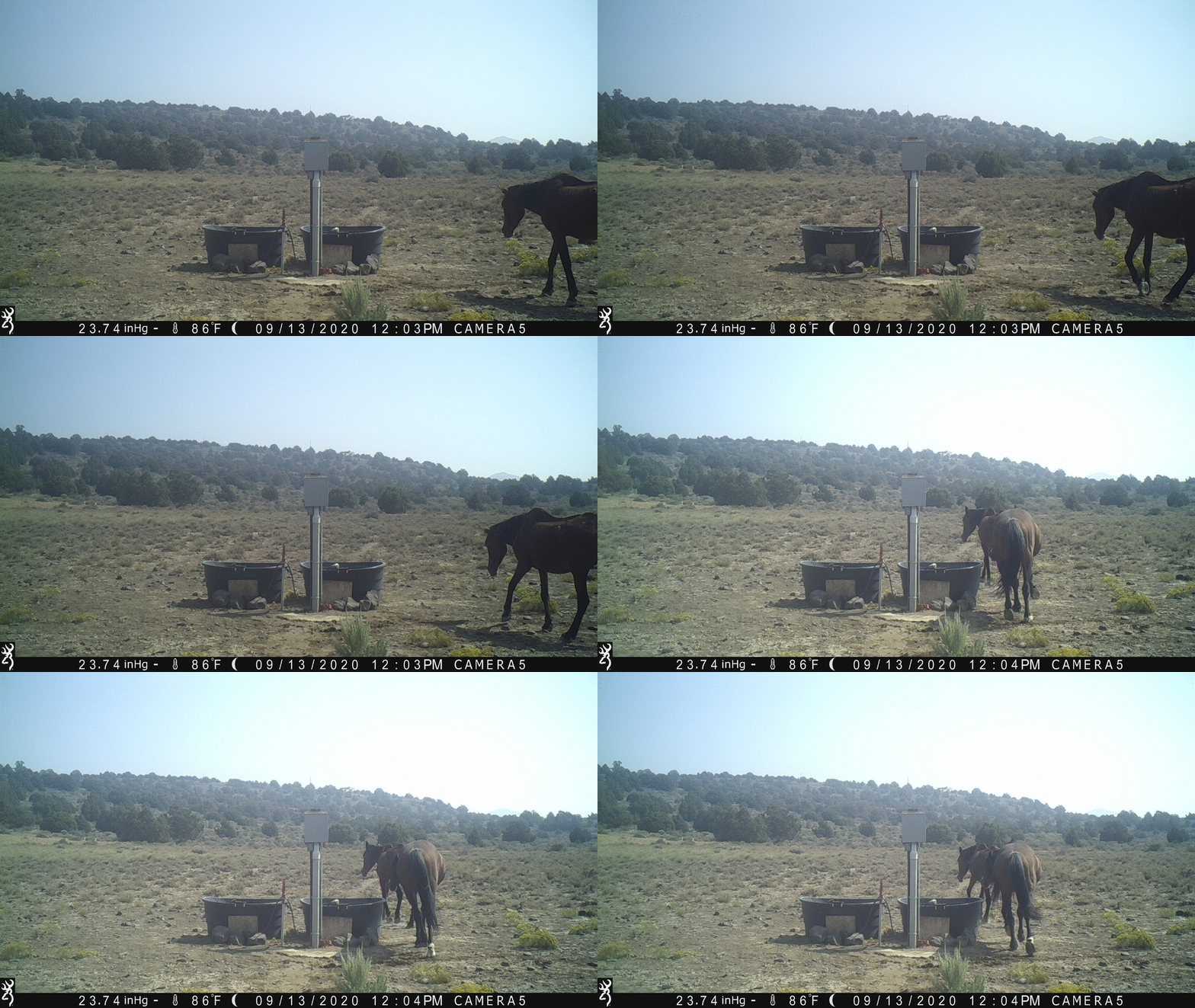
Catching up on trailcam photos. He comes in first on the right. He’d be put down on the spot if captured in a roundup, due to a hopeless prognosis for recovery.
RELATED: ‘Hopeless’ Returns to Water Tanks with Buddies.
Roundup Respite
Just a run-of-the-mill Saturday afternoon on the Virginia Range.

Red Desert Roundup Day 7
The incident started on October 10. Gather stats through October 16:
- Horses captured: 477
- Goal: 2,400
- Deaths: 1
- Returned: 24
- Shipped: 212
No activity on Day 5 due to weather. Foals accounted for 23% of the total. One death occurred today, Day 7, but no details were provided. It was classified as pre-existing.
The reports did not indicate the HMA(s) where the horses were captured. No details were given for the horses returned.
The imbalance is 240 horses. The contractor may be holding them on site.
RELATED: Red Desert Roundup Day 3.
Currituck Horses Threatened by Fishing Line?
A story posted today by AP News says that one had to be rescued for medical treatment after it was spotted eating fishing line like it was grass. Others got hooks tangled in their manes as well as the fur on their lower legs.
FREES Conference Last Week
A story by the Powell Tribune of Powell, WY says the Free Roaming Equids and Ecosystem Sustainability Network met last week in Cody to discuss wild horse overpopulation and its effects on wildlife and multiple use of public lands.
The meeting follows one held last year in Reno.
The group seeks healthy herds on healthy rangelands, according to the report, which means “achieve and maintain AMLs,” code words for “manage HMAs principally for cattle and sheep.”
Hypothesis Revisited, Again
The original statement went something like this: The number of wild horses and burros in off-range holding can be explained by the misappropriation of forage on just a few dozen HMAs.
How’s the theory holding up? Twelve more areas have been considered since the last report, they appear in the sidebar on the right titled ‘Short End of Stick.’
Data from those posts have been added to the original list, starting with the Big Summit WHT and ending with the Lost Creek HMA.
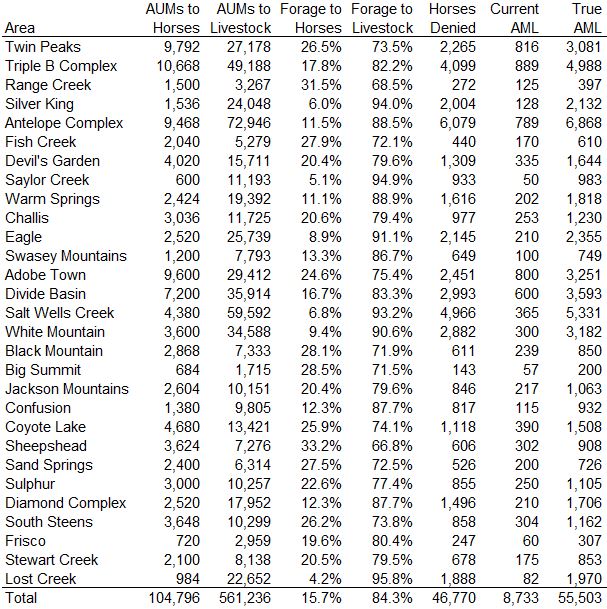
Some areas are managed for burros but the calculations are based on wild horses. If you want to know the number of burros displaced from an area by privately owned livestock, multiply the horses denied by two. Same for the AMLs.
For the areas considered so far, livestock receive about 84% of the authorized forage (excluding wildlife), with the balance going to horses. The total number of horses displaced from their home range is 46,770.
If you prefer a mix, you could say 45,000 horses + 2 × 1,770 burros = 48,540 wild horses and burros displaced from their home range, which is roughly equal to the number of horses and burros in off-range holding.
The theory has been validated.
The true AML of 55,503 is six times higher than the current AML of 8,733, slightly more than predicted by the Rule of 5.
Imagine what the true AML would be for all HMAs and WHTs!
The problem is not too many horses or not enough contraceptives. The problem is public-lands ranching.
RELATED: Hypothesis Revisited.

Paisley Desert Emergency Roundup in Progress
The incident started on October 11 with three deaths. No details were provided.
The daily reports indicate 138 horses captured and 134 shipped through October 12, but the cumulative totals show 158 and 134, respectively.
RELATED: Paisley Desert Emergency Roundup Starts This Weekend.
Mullen Fire Creeping Toward Deerwood Ranch?
The ‘Albany bulge’ has broken out to the north, bringing the fire closer to the suspected location of the off-range pasture (area labeled Middle Creek in the following map).
Yesterday’s fact sheet said a fire line has been established in the Middle Creek area between the fire and Centennial.
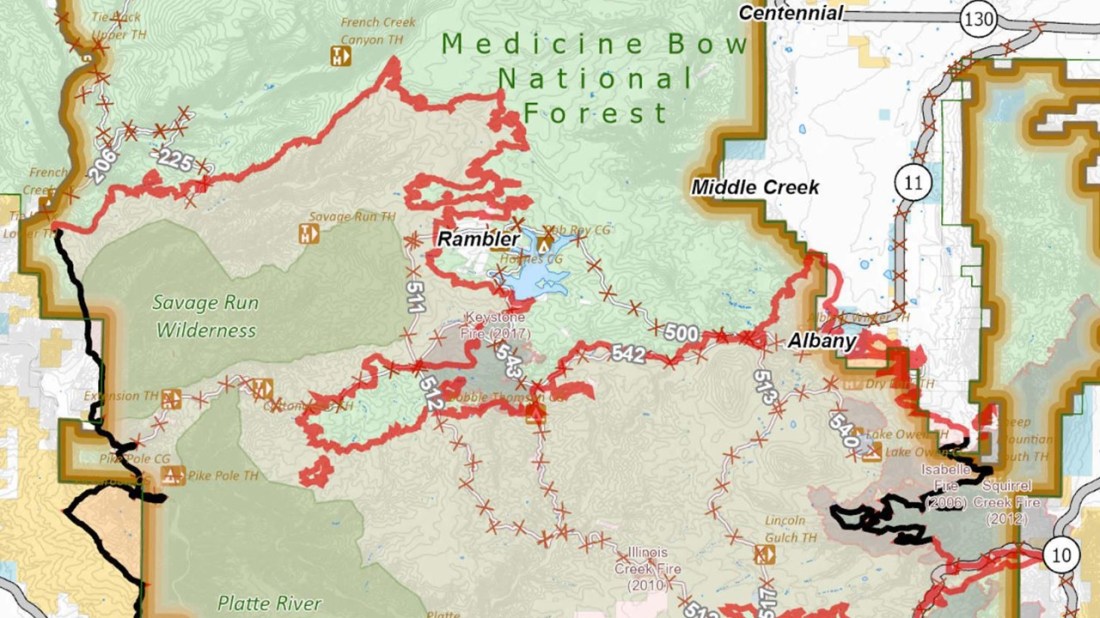
The fire has burned 176,000 acres since September 17 and is now 30% contained.
An email asking about the location of the ranch was never answered.
RELATED: Mullen Fire Moving East.
Saylor Creek Roundup Over
A month ago Western Horse Watchers was informed that the operation had concluded and that a news release was forthcoming.
The daily reports ended on August 24, with 104 horses removed. The goal was 81.
The HMA has been dethroned as the worst example of wild horse mismanagement in the ‘Short End of Stick’ series, replaced by Lost Creek, where the horses receive just four percent of the total authorized forage, instead of five percent at Saylor Creek.
RELATED: Status of Saylor Creek Roundup?

Wild Horses Chased by Street Sweeper and Water Truck?
Officials in Lyon County, NV are investigating a complaint that road department personnel harassed wild horses early Monday near Lahontan Street and US 95A in Silver Springs, according to a report posted yesterday by Carson Now.
Red Desert Roundup Day 3
The incident started on October 10. Gather stats through October 12:
- Horses captured: 196
- Goal: 2,400
- Deaths: 0
- Returned: 0
- Shipped: 79
No activity on Day 2 due to weather. Foals accounted for 26% of the total.
If the contractor is holding 117 horses on site then the numbers balance.
RELATED: Red Desert Gather in Progress.
Mustang Monday
On Sand Wash Basin HMA with Steve Hostetler.
Black Mountain Roundup Day 17
The incident started on September 23. Gather stats through October 9:
- Burros captured: 149
- Goal: 500
- Deaths: 1
- Returned: 0
- Shipped: 112
Foals accounted for 13.4% of the total.
The numbers balance if BLM staff are holding 36 burros on site.
RELATED: Black Mountain Roundup in Progress.
Red Desert Gather in Progress
Shackleford Late-Season Arrival
Foal #12 has been spotted on Shackleford Island, according to a story by OBX Today.
Lost Creek Horses Get Short End of Stick
Helicopters will be flying over the Lost Creek HMA, one of five HMAs in the Red Desert Complex, any day now. Their mission is to enforce the resource allocations of the Rawlins RMP.
The HMA covers 251,000 acres in central Wyoming and has an AML of 82. The horses require 984 AUMs per year and the stocking rate allowed by plan is 0.3 wild horses per thousand acres.
What do these numbers tell you about the way the HMA is managed? The fractional stocking rate may indicate large amounts of forage diverted to livestock.
The HMA intersects one allotment according to Map 2 in the Final EA for wild horse management actions in the Complex. The allotment extends into the Antelope Hills HMA but the EA does not provide the percentage in each.
Western Horse Watchers estimates that it’s one part in Antelope Hills and five parts in Lost Creek, or 83% in Lost Creek. The estimated size of the allotment is 251,000 ÷ .83 = 302,410 acres. Both HMAs are 100% subject to permitted grazing.
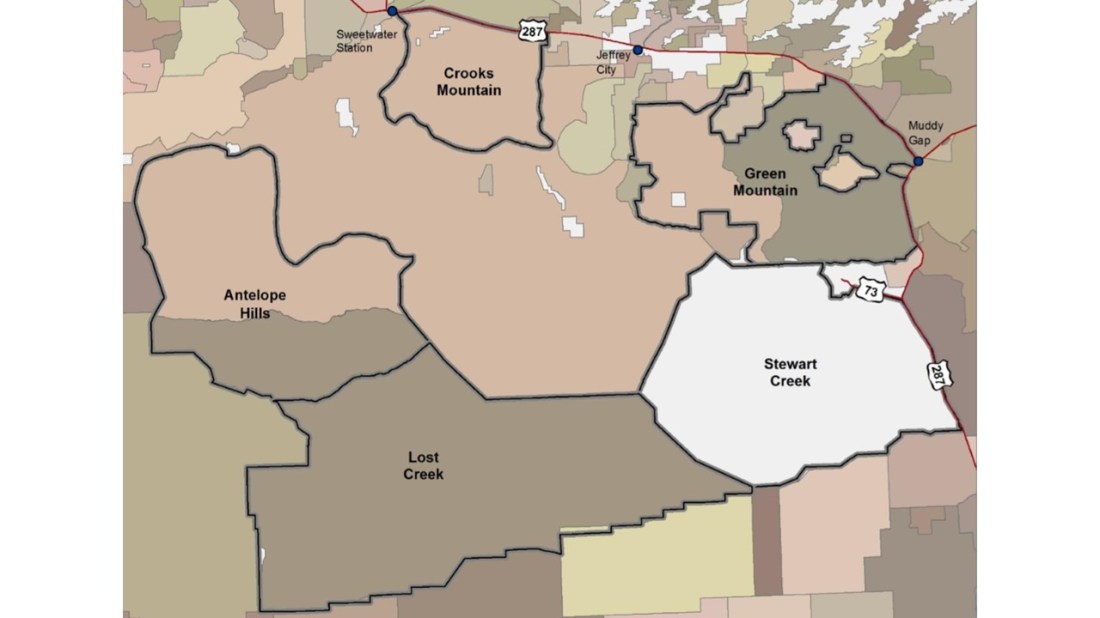
Table 5 in the EA provides the grazing season and permitted AUMs. Although cattle and sheep are allowed on the allotment, the calculations are based on cow/calf pairs only, for a direct comparison to wild horses. The resource requirements of cow/calf pairs and wild horses are said to be equivalent.

The forage available to livestock inside the HMA is .83 × 27,292 = 22,652 AUMs per year, assuming the resource is evenly distributed across the parcel.
The Cyclone Rim permittees would have to place 3,539 cow/calf pairs inside the HMA to graze off 22,652 AUMs in 6.4 months. The stocking rate allowed by plan is 3,539 ÷ 251,000 × 1,000 = 14.1 cow/calf pairs per thousand acres.
These management indicators are compared in the following charts.
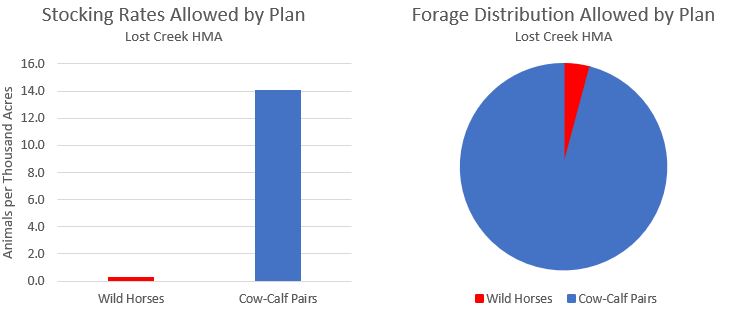
The HMA is managed primarily for livestock, with the horses receiving just four percent of the total authorized forage (excluding wildlife). The HMA doesn’t have a Herd Management Area Plan (HMAP) but if it did do you think you could revise it independently of the RMP?
The pre-gather population in the HMA, thought to be around 4X AML (per the news release for the Complex), would include 246 excess horses, so the need for a roundup, along with other population controls, is obvious.
However, the forage assigned to livestock would support an additional 1,888 horses, for a true AML of 1,970. There are no excess horses in the HMA, the roundup is not needed and there is no justification for a fertility control program.
Paisley Desert Emergency Roundup Starts This Weekend
BLM announced today that 750 wild horses will be removed from the Paisley Desert HMA, beginning on October 10, due to lack of water.
The operation will be carried out with helicopters, according to the news release, and will be open to public observation, except for horses found on private land.
The HMA covers 271,667 acres in central Oregon and has an AML of 150, for an aimed-at stocking rate of 0.6 wild horses per thousand acres.
As noted earlier this year, the fractional stocking rate may indicate large amounts of forage diverted to privately owned livestock.

An environmental assessment from 2009 indicates the HMA intersects four grazing allotments, with livestock receiving 10,151 AUMs per year, compared to 1,800 AUMs per year for the horses. Curiously, the HMA has a Herd Management Area Plan (HMAP).
The pre-gather population is thought to be around 1,050. The true AML is 996.
Captured animals will be taken to the off-range corrals in Hines, OR.
Gather stats and daily reports will be posted to this page.
Clark Mountain Roundup in Progress
BLM is removing 30 to 40 wild burros from the Clark Mountain HA and surrounding lands near the CA-NV border. The operation was not announced at the BLM news site and may be closed to public observation due to the method of capture.
The Decision Record was signed on August 10, subject to a 30-day appeal period.
The documents for the project were generating error messages earlier today but you can view the DR here. The area has no AML and is no longer managed for burros.
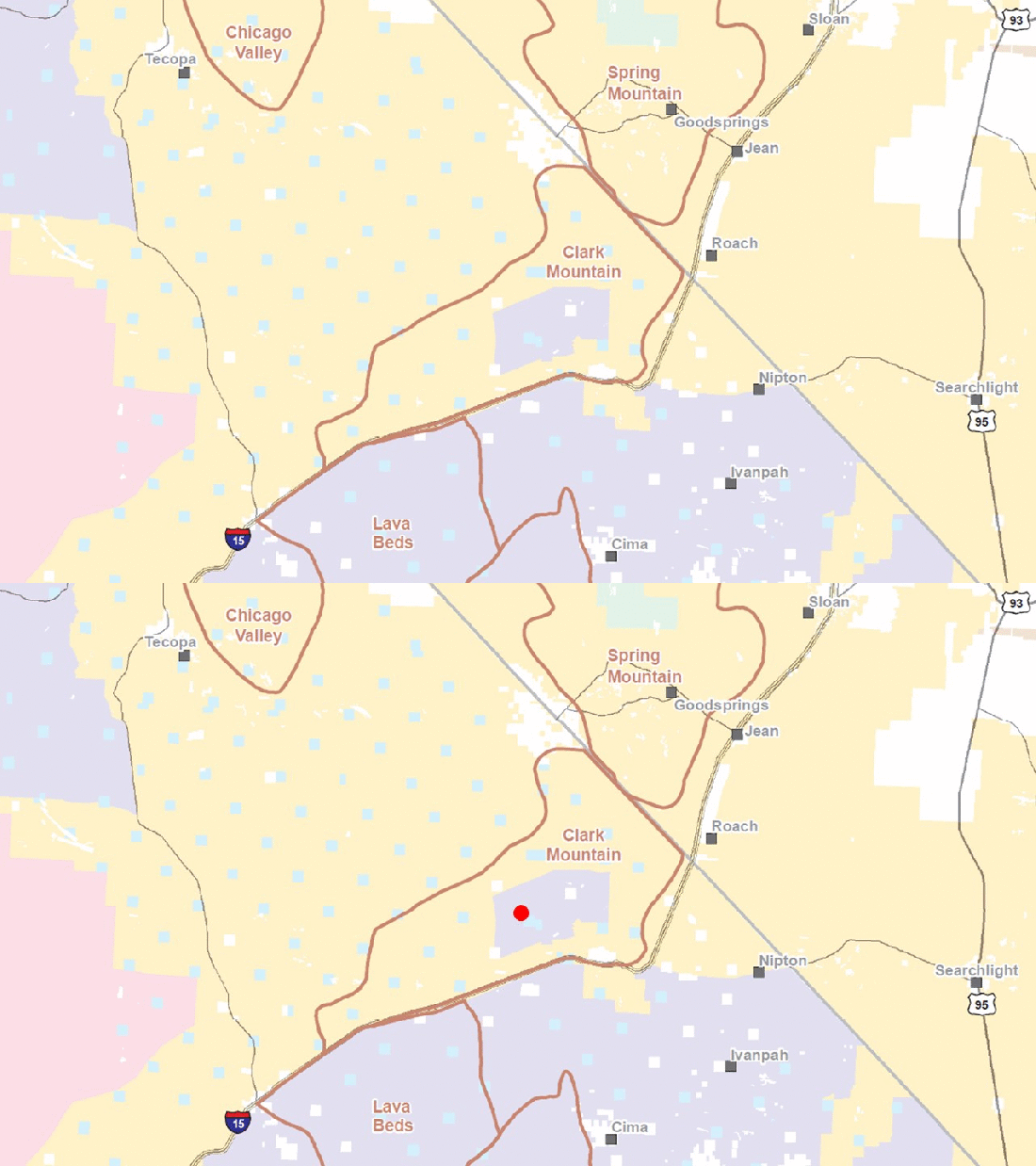
Gather stats were not found at the customary location and the destination of captured animals is not known.
The roundup follows the loss in 2019 of 46 burros who were gunned down. That case is still under investigation.
RELATED: No Arrests in Clark Mountain Burro Case.
Sand Wash Fatality Renews Push for Fencing
The loss of a popular stallion at Sand Wash Basin HMA over the weekend has prompted a meeting with the Colorado Department of Transportation to discuss fencing along Highway 318, according to a report posted this morning by Craig Press of Craig, CO.

