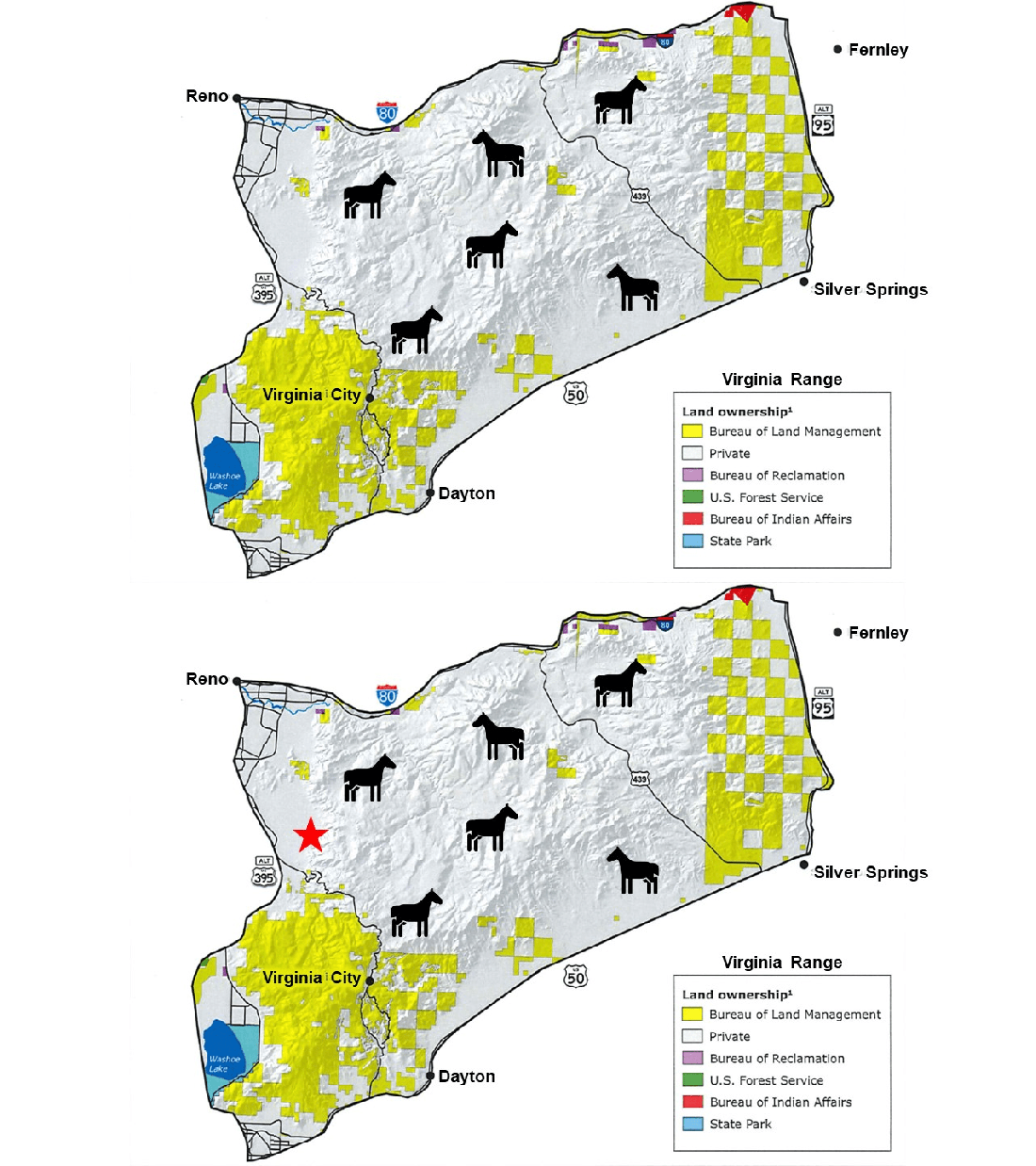
Status of Piceance Allotments?

Table 3-14 in an EA from 2011, incorporated by reference into the new EA for resource enforcement actions in the Piceance-East Douglas HMA, shows the four allotments that overlap the HMA.  The reference appears in Section 1.1.1 of the new EA.

The amount by which the allotments extend into the HMA is not known.

The Allotment Master report puts all four in the Improve category.

Livestock receive 6,935 AUMs per year on 166,888 acres, according to data from Tables 3-14 and 3-15 in the old EA, and wild horses receive 235 × 12 = 2,820 AUMs per year on 190,130 acres according to data in Section 1.1 of the new EA.

That’s 41.6 AUMs per year per thousand acres for livestock, compared to 14.8 AUMs per year per thousand acres for horses, reinforcing an observation made earlier that forage production tends to increase when land is designated for livestock.

In this case, by a factor of almost three.

RELATED: Decision Expected Next Week in Piceance-East Douglas EA?

Eagle Roundup Day 28

The incident began on January 6.  Gather stats through February 2:

  • Horses captured: 841, up from 767 on Day 26
  • Goal: 1,131
  • Returned: 0
  • Deaths: 22, up from 18 on Day 26
  • Shipped: 711, up from 628 on Day 26

Three deaths occurred on Day 27 and one on Day 28, all due to pre-existing conditions.

The overall death rate is 2.6%, up from 2.3% on Day 26.

One foal has been caught to date.  Roughly 46% of captured adults are male and 54% are female.  Some of the mares are probably within a few weeks of foaling.  Some may have foaled in the off-range corrals.

Body condition scores are not known.

The location of current operations is not known.  Three HMAs are involved in the roundup.

The number of unaccounted-for animals is 108, down from 121 on Day 26.

Some of the mares will be treated with contraceptives and returned to the range but no such activity has been reported.  Some may receive GPS radio transmitters.

Data quality continues to be good.

RELATED: Eagle Roundup Day 26.

Decision Expected Next Week in Piceance-East Douglas EA?

So says the writer of a story appearing this morning in the The Daily Sentinel of Grand Junction, CO.  The decision likely involves a plan for resource enforcement actions in the Piceance-East Douglas HMA, NEPA project DOI-BLM-CO-N050-2020-0056-EA.

The comment period for the Draft EA closed on December 23, according to a BLM news release dated November 23.

Western Horse Watchers did not see the announcement.  It may have been posted late but backdated to November 23, burying it in old news.  This has happened before.

The HMA covers 190,130 acres in northwestern Colorado and has an AML of 235, for an aimed-at stocking rate of 1.2 wild horses per thousand acres.

Piceance HMA Map 02-03-21

The EA indicates in Section 5.1 (page 30 in the pdf) that “The predominant land uses within the PEDHMA are livestock grazing, energy development, and dispersed recreation including hunting,” but provides no data for the allotments, grazing seasons and active AUMs.

That would have been a substantive comment.  Resource allocations and management priorities in the HMA are unknown.  Is it managed primarily for livestock?  Who knows.

Note that protection of wild horses is not one of the predominant uses.

Status of Silver King Allotments?

Table 3.3 in the Final EA for resource enforcement actions shows the eight allotments that intersect the HMA.

Western Horse Watchers was unable to find the Ely Spring Sheep allotment in RAS, although it appears on Map I of the EA (page 9 in the pdf).  Ely Springs can be found in RAS but the acreage doesn’t match Table 3.3 so it was omitted.

Of the remaining allotments, five are managed by the Caliente Field Office and two by the Bristlecone Field Office.

The Caliente report shows one allotment in the Maintain category, two allotments in the Improve category and two in the Custodial category.

With most of the acreage coming from public lands, and all of the forage, Western Horse Watchers is unable to explain how those two allotments qualify as Custodial, in view of the 10% rule.

The category masks their condition.

The Bristlecone report classifies one allotment as Maintain and one as Custodial.

Same question for the allotment designated Custodial.

A category for blaming substandard conditions on wild horses and burros doesn’t exist.

RELATED: Another Silver King Roundup Starts This Week.

Another Roundup in the Works at TRNP?

The next incident could occur in April, according to a report posted today by KX News of Bismarck, ND.  The roundup planned for last year was cancelled.

The original wild horses of TRNP, thought to be descendants of Sitting Bull’s horses, were removed from the area 20+ years ago.

The following video shows some of the effects of darting mares with contraceptives, which are safe and effective according to their adherents.

RELATED: TRNP ‘Culls’ Adopted, Horses of the Badlands.

Another Silver King Roundup Starts This Week

BLM said today that 283 wild horses will be gathered from the Silver King HMA, starting on or about February 5, due to overpopulation.  Up to 25 mares will be treated with contraceptives and returned to the range, for a removal target of 258.

The operation will be carried out with helicopters, according to the news release, and will be open to public observation.

The last roundup ended in late 2018, with 996 horses removed.

The HMA covers 606,000 acres in eastern Nevada and has an AML of 128, for an aimed-at stocking rate of 0.2 wild horses per thousand acres.  Refer to Table 1 in the Final EA for resource enforcement actions in the HMA.

The target stocking rate across all HMAs is one wild horse per thousand acres.

As previously discussed, fractional stocking rates may indicate large amounts of forage diverted to privately owned livestock.

Silver King HMA Map

The HMA intersects eight allotments, per Table 3.3 in the EA, with five of them offering year-round grazing.  The Wilson Creek and Geyser Ranch allotments overlap the Eagle HMA to the east.

Cattle and sheep receive an estimated 24,000 AUMs per year inside the HMA, with just 1,500 AUMs per year assigned to the horses.  The HMA is managed almost exclusively for livestock.

The forage allocated to livestock would support an additional 2,000 wild horses, for a True AML of 2,128.  The current population of 343 wild horses is well within that range, making the roundup and fertility control program unnecessary.

Captured animals will be taken to the off-range corrals at Palomino Valley.

Gather stats and daily reports will be posted to this page.

RELATED: Silver King Horses Get Short End of Stick.

Eagle Roundup Day 26

The incident began on January 6.  Gather stats through January 31:

  • Horses captured: 767, up from 702 on Day 23
  • Goal: 1,131
  • Returned: 0
  • Deaths: 18, up from 15 on Day 23
  • Shipped: 628, up from 544 on Day 23

No gather activity was reported on Days 24 and 25.

One death occurred on Day 24 and two more on Day 26, all attributed to pre-existing conditions.  The overall death rate is 2.3%, up from 2.1% on Day 23.

One foal has been caught to date.  Roughly 45% of captured adults are male and 55% are female.  Some of the mares are probably within a few weeks of foaling.  Some may have foaled in the off-range corrals.

Body condition scores are not known.

The location of current operations is not known.  Three HMAs are involved in the roundup.

The number of unaccounted-for animals is 121, down from 143 on Day 23.

Some of the mares will be treated with contraceptives and returned to the range but no such activity has been reported.  Some may receive GPS radio transmitters.

Data quality on this roundup has been good.

RELATED: Eagle Roundup Day 23.

EIS for Rock Springs RMP Amendments Turns 1 Today

The document was released for review and comments a year ago today.  If the project is approved, it will rank among the greatest losses to America’s wild horses.

The proposed action, Alternative D in the EIS, will effect these changes:

  • The Rock Springs Field Office portion of the Adobe Town HMA will become an HA and be managed for zero wild horses.  In the Rawlins Field Office portion, all checkerboard land and the area north of the existing Corson Springs southern allotment boundary will become an HA and be managed for zero wild horses.  The remainder of the HMA will be managed for an AML of 259 – 536.
  • The Divide Basin HMA will become an HA and be managed for zero wild horses
  • The Salt Wells Creek HMA will become an HA and be managed for zero wild horses
  • The White Mountain HMA will become an HA and be managed for zero wild horses

Resources allocated to the horses may be reassigned to wildlife or livestock.

The following image is based on a map in the executive summary in the EIS.  The project area is in southwestern Wyoming.

Rock Springs RMP Amendment Map 01-31-21

Grazing allotments in the Rock Springs Field Office are shown in this map.  Table 3-2 in the EIS shows the allotments that overlap the HMAs.

The allotment master report for the RSFO has 80 listings, including 34 allotments in the Improve category, 17 in the Maintain category and 29 in the Custodial category.

The Rock Springs allotment, in the Maintain category, intersects three of the HMAs.

The largest permit holder, from an AUM viewpoint, is the Rock Springs Grazing Association, instigator of the project.  Refer to the executive summary for details.

The terms of the RSGA consent decree and Alternative D in the EIS are not identical.

UPDATE: References to ‘EA’ in this post have been replaced with ‘EIS.’

RELATED: Rock Springs RMP Recap, Allotment Categories Explained.

2021 Grazing Fee Announced

The 2021 fee has been set at $1.35 per AUM for the 2021 grazing season, same as last year, according to a BLM news release issued today.  The grazing season on public lands runs from March 1 through February 28.

An AUM represents the forage consumed in one month by a cow/calf pair, one wild horse, two wild burros or five sheep.  Forage allocations are often specified in resource management plans.

The new fee corresponds to about 5% of the going rate on private lands.

The method of calculation can be found in Section 1905 of the Public Rangelands Improvement Act, 43 USC 37, one of the rancher-friendly statutes that weakened the WHB Act.

RELATED: Grazing Fee Unchanged in 2020.

Eagle Roundup Day 23

The incident began on January 6.  Gather stats through January 28:

  • Horses captured: 702, up from 627 on Day 21
  • Goal: 1,131
  • Returned: 0
  • Deaths: 15, up from 11 on Day 21
  • Shipped: 544, up from 502 on Day 21

No gather activity was reported on Day 22.

One death occurred on Day 22 as a result of the roundup and three horses were put down on Day 23 due to pre-existing conditions.  The overall death rate is 2.1%.

One foal has been caught to date.  Roughly 45% of captured adults are male and 55% are female.  Some of the mares are probably within a few weeks of foaling.  Some may have foaled in the off-range corrals.

Body condition scores are not known.

The HMA of origin was not reported.  Three HMAs are involved in the roundup.

The number of unaccounted-for animals is 143.

Some of the mares will be treated with contraceptives and returned to the range but no such activity has been reported.  Some may receive GPS radio transmitters.

Data quality on this roundup has been good.

RELATED: Eagle Roundup Day 21.

Condition of Chokecherry and Mount Elinor Allotments?

Eight allotments intersect the two HMAs from Utah involved in the Eagle roundup, Chokecherry and Mount Elinor.

The Allotment Master report for the one administered by the Caliente Field Office in Nevada says it’s in the Improve category.

The report for the seven allotments administered by the Cedar City Field Office in Utah shows four in the Improve category, two in the Maintain category and one in the Custodial category.

At Government Wells, the Custodial allotment, public lands represent 87% of the area and at least 77% of the active AUMs.  Western Horse Watchers is unable to explain how it qualifies for that category in view of the 10% rule.

RELATED: Condition of Eagle Allotments?

Condition of Eagle Allotments?

Of the eight allotments that intersect the Eagle HMA, currently subject to a roundup, four are in the Custodial category—condition unknown.  The other four are in the Improve category.

Allotment names and grazing seasons can be found in Table 3.2 of the Final EA for resource enforcement actions in the Complex.  Four of them offer year-round grazing.

The Allotment Master report shows little if any state or private lands in the Custodial allotments, so Western Horse Watchers is not sure how the 10% rule applies.  All of the active AUMs are tied to public (federal) lands.

Curiously, 51% of the allotments administered by the Caliente Field Office have been placed into that category.  Their condition is known only to BLM insiders.

UPDATE: Nine allotments are involved, not eight.  The Allotment Master report for the ninth puts it in the Improve category, bringing the total to five.  Permittees include the Blue Diamond Oil Corporation and Southern Nevada Water Authority.

RELATED: Allotment Categories Explained.

Caliente FO Allotments 01-28-21

Eagle Roundup Day 21

The incident began on January 6.  Gather stats through January 26:

  • Horses captured: 627, up from 612 on Day 19
  • Goal: 1,131
  • Returned: 0
  • Deaths: 11, same as Day 19
  • Shipped: 502, same as Day 19

No activity was reported on Day 20.  Operations may have moved to another area.

No deaths were reported on Day 21.

One foal has been caught to date.  Roughly 45% of captured adults are male and 55% are female.  Some of the mares are probably within a few weeks of foaling.  Some may have foaled in the off-range corrals.

Body condition scores are not known.

The HMA of origin was not reported.  Three HMAs are involved in the roundup.

The number of unaccounted-for animals is 114.

Some of the mares will be treated with contraceptives and returned to the range but no such activity has been reported.  Some may receive GPS radio transmitters.

RELATED: Eagle Roundup Day 19.

Saylor Creek HMA Tells Story of America’s Wild Horses

The WHB Act charges the BLM with “maintain(ing) a thriving ecological balance among wild horse populations, wildlife, livestock and vegetation to protect the range from the deterioration associated with overpopulation,” according to a story published this morning by the Idaho Statesman.

The article was developed around recent events at the Saylor Creek HMA.

The Secretaries of Interior and Agriculture have primary responsibility for the WHB Act, now referred to as 16 USC 30, not the BLM.

Search the statute (CTRL+F) for keywords such as ‘balance’ or ‘livestock.’  See if you can find the statement above.

Try searching for ‘thriving ecological balance among wild horse populations, wildlife, livestock.’  It’s not in there.

The idea of managing HMAs and WHTs primarily for livestock comes from federal regulations, created by unelected bureaucrats, not the people’s representatives, presumably at the behest of the public-lands ranchers.

An estimated 95% of the authorized forage at Saylor Creek, neglecting wildlife, has been consigned to the ranchers.  They pay around five cents on the dollar for the resource, compared to the going rate on rented pastures.

Not much of an offset to the tens of millions of dollars the government spends each year to make life better for the ranchers, especially on land set aside for the horses.

As for the rest of the western U.S., the land can only support 27,000 wild horses and burros because most of the resources have been diverted to public-lands ranchers.

You only need to read a few of the ‘Short End of Stick’ reports to see that.

Velma understood the problem, but sadly, many of today’s ‘advocacy’ groups do not.

They want to shrink the herds by shooting the mares with contraceptive darts, instead of pushing back against the ranchers.

The ranchers like the idea of cutting herd sizes, but in a more timely fashion.

That’s where the ‘Path Forward’ comes in.

RELATED: IRRC Expands Propaganda.

Thriving Ecological Balance-3

Pinging the Eagle Wild Horses

Personnel from the United States Geological Survey will braid radio transmitters into the tails of wild horses captured during the 2021 Eagle roundup, according to NEPA project DOI-BLM-NV-L030-2021-0008-CX.

The project was approved as a categorical exclusion with no supporting documentation.

Presumably, the horses will be returned to their home range, along with those treated with contraceptives.  As of today, no such activity has been reported at the gather page.