Community College Moving Ahead with Wild Horse Program

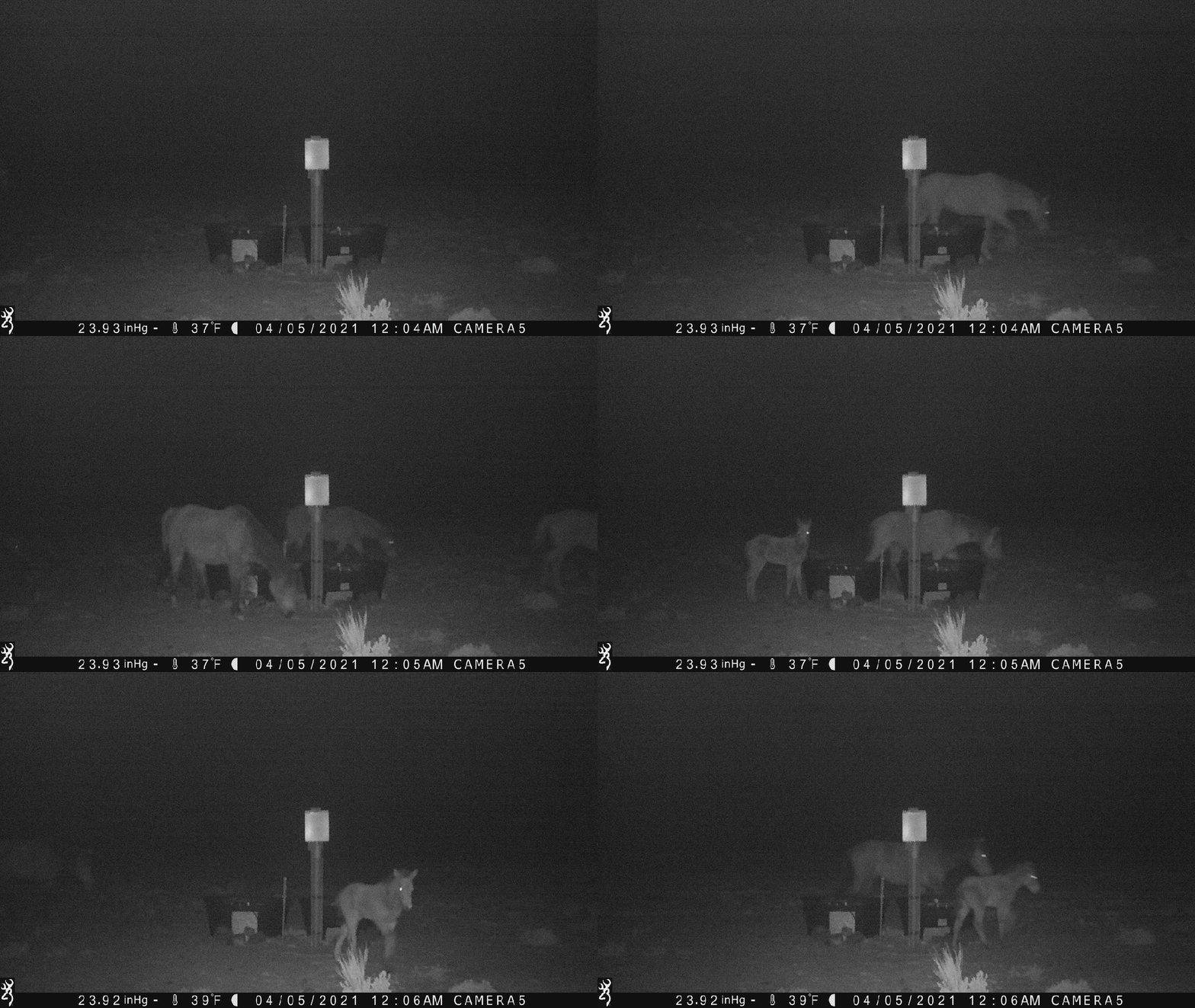
A report by the Quay County Sun of Tucumcari, NM says the Forest Service has pledged $40,000 for a new program at Mesalands Community College aimed at adopting out excess horses from the Jicarilla WHT.

The program would start with four to five animals, set to arrive in August.

The WHT is subject to permitted livestock grazing and has an AML of 50 to 105.

Resource allocations are not known.

RELATED: Community College to Foster Jicarilla Wild Horses.

Allotment Status in Montana

The Allotment Information report in RAS for all districts and field offices in Montana yielded 5,320 unique rows after removing 265 duplicates.  The duplicates corresponded to allotments with more than one permit.

The breakdown by category shows a majority with custodial status.

  • Improve: 723
  • Maintain: 1,775
  • Custodial: 2,818
  • Unclassified: 4

About 14% of the allotments are in the Improve category.

The breakdown by acreage shows over half of the land in the Maintain category:

  • Improve: 2,792,183
  • Maintain: 4,376,902
  • Custodial: 1,026,768
  • Unclassified: 28,487

Roughly 34% of the acreage does not meet standards for rangeland health.

The condition of the custodial allotments is not known.

Privately owned livestock can access over eight million acres of BLM lands in the state, compared to 27,000 acres for wild horses.

The status of allotments managed by the Forest Service is unknown.

RELATED: Status of Allotments in California.

Nevada Legislature to Consider SJR3 This Week

A hearing by the Senate Committee on Natural Resources is set for March 23, according to a report by The Sierra Nevada Ally, a non-profit based in Reno.

The resolution urges Congress to provide funding for reducing wild horse and burro populations in the state to appropriate management levels.

A search for key terms yielded these results:

  • Horse – 7 occurrences
  • Horses – 22
  • Burro – 6
  • Burros – 22
  • Wildlife – 7
  • Drilling – 0
  • Mining – 0
  • Oil – 0
  • Gas – 0
  • Mineral – 0
  • Livestock – 5
  • Public lands – 6
  • Multiple use – 2
  • Path Forward – 1
  • Fertility inhibitors – 2
  • Ecological balance – 6

What might be the driving force behind the resolution?  Who drafted it?

How many of these terms can you find in the original WHB Act?

RELATED: Livestock Grazing in Nevada, Status of Allotments in Nevada.

Thriving Ecological Balance-3

Status of Allotments in California

The Allotment Information report in RAS for all districts and field offices in California yielded 659 unique rows after filtering out 110 duplicates.  The duplicates corresponded to allotments with more than one permit.

The breakdown by category shows about half with custodial status:

  • Improve: 163
  • Maintain: 174
  • Custodial: 318
  • Unclassified: 4

About one fourth of the allotments are in the Improve category.

Roughly 62% of the land does not meet standards for rangeland health, according to the breakdown by public acres:

  • Improve: 3,642,971
  • Maintain: 1,800,170
  • Custodial: 463,542
  • Unclassified: 1,972

For every acre in the Maintain category, there are two acres in the Improve category.

The condition of the Custodial allotments is not known.

Privately owned livestock can access six million acres of BLM lands in the state, compared to two million acres for wild horses and burros.

The condition of allotments managed by the Forest Service is unknown.

RELATED: Allotment Status in Arizona.

Estimating the True AML for All Wild Horse Areas in the West

The ‘Short End of Stick’ reports have considered 34 areas to date.  Some of them are complexes, consisting of several HMAs, so let’s round the number to 40.  Approximately 50,000 wild horses have been displaced from those areas by privately owned livestock.

There are roughly 200 HMAs and WHTs not managed principally for wild horses and burros.  For simplicity, let’s assume they’re all inhabited by horses.

If 50,000 horses were displaced from 40 of the 200 areas, and the same relationship exists in the other 160 areas, then the total number of horses displaced in all areas would be 250,000.

The True AML would be equal to the current AML plus the total number of horses displaced, i.e., 27,000 + 250,000 = 277,000, ten times higher than the current AML.

The current wild horse population is said to be around 100,000, well within this range.

The new stocking rate would be 277,000 ÷ 27,000,000 × 1,000 = 10.3 horses per thousand acres, in line with the stocking rate on the Virginia Range (before the fertility controllers started their war on the horses).

The miniscule AML of 27,000 reflects current management priorities on western rangelands.

Data from the Short End of Stick reports show 16% of the forage going to the horses, with the balance going to livestock, on lands set aside for the horses.

RELATED: Hypothesis Confirmed.

Hypothesis Confirmed

A BLM report from last August shows 46,492 wild horses and 1,359 wild burros in off-range holding.

These animals require 46,492 × 12 + (1,359 ÷ 2) × 12 = 566,058 AUMs per year.

The original claim was that the number of wild horses and burros in short-term and long-term holding can be explained by the misappropriation of forage on just a few dozen HMAs.

Data from the ‘Short End of Stick’ reports, representing about three dozen HMAs, are summarized below.

The forage diverted to livestock, 630,497 AUMs per year, could easily support all of the animals in off-range holding, equivalent to 52,541 horses, for a True AML of 62,582.

What would the True AML look like if this analysis was carried out on all of the HMAs and WHTs?  Only four of them are managed principally for wild horses and burros.

Hypothesis Confirmed 03-20-21

The WHB program is nothing more than a grazing program ancillary, designed to give ranchers unfettered access to cheap feed on America’s public lands.

How many of these animals could be returned to their home range if drilling and mining were stopped?  A few dozen?

This one of the reasons why fertility control programs are wrong and the ‘advocacy’ groups that promote them should be avoided.  They shift resources to the ranchers by getting rid of the horses.

RELATED: Hypothesis Revisited, Again.

Allotment Status in Arizona

The Allotment Information report in RAS for all districts and field offices in Arizona yielded 824 unique rows after filtering out 36 duplicates.  The duplicates corresponded to allotments with more than one permit.

The breakdown by category shows a majority with custodial status.

  • Improve: 203
  • Maintain: 183
  • Custodial: 435
  • Unclassified: 3

With 25% of the allotments in the Improve category, you might conclude that grazing lands in Arizona are in fairly good shape.

The breakdown by acreage shows a greater disparity:

  • Improve: 5,103,211
  • Maintain: 3,507,113
  • Custodial: 2,748,535
  • Unclassified: 119,374

Roughly 44% of the land does not meet standards for rangeland health.  For every acre in the Maintain category, there are 1.5 acres in the Improve category.

The condition of the custodial allotments is not known.

Privately owned livestock can access over 11 million acres of BLM lands in the state, compared to 1.5 million acres for wild horses and burros.

The status of allotments managed by the Forest Service is unknown.

RELATED: Status of Allotments in Nevada.

Comments Invited on Draft EA for SoCal Burro Removals

BLM announced yesterday the beginning of a 30-day comment period for wild burro management actions in the Centennial, Panamint and Slate Range HAs over a ten-year timeframe.

The Proposed Action, discussed in Section 2.0 of the EA, will remove all burros from the project area.  The current population is thought to be around 939 animals.

Wild horses are found in Centennial but are not included in the project scope.

The HAs cover about 1.7 million acres on the east side of Highway 395, adjacent to Death Valley National Park, site of another burro removal project.

The maps in Appendix B show the general arrangement.

The number of burros allowed by plan is zero, along with the target stocking rates.

The Allotment Information report in RAS shows other mandated uses of public lands in the Ridgecrest Field Office.  Remarks on pages 15 and 16 of the EA indicate that grazing allotments exist in Centennial and Slate Range but not in Panamint.

Comments will be accepted until April 15.

Status of Allotments in Nevada

The Allotment Information report in RAS for all districts and field offices in Nevada yielded 781 unique rows after filtering out 317 duplicates.  The duplicates corresponded to allotments with more than one permit.

The breakdown across the three defined categories is fairly even:

  • Improve: 264
  • Maintain: 262
  • Custodial: 223
  • Unclassified: 32

With 34% of the allotments in the Improve category, you might conclude that rangeland health in Nevada is not that bad.

However, the breakdown by public acreage tells a different story:

  • Improve: 27,101,387
  • Maintain: 8,969,671
  • Custodial: 4,798,196
  • Unclassified: 1,060,381

Roughly 65% of the land does not meet standards for rangeland health.  For every acre in the Maintain category, you have three acres in the Improve category.  The condition of the custodial allotments is not known.

Privately owned livestock can access 42 million acres of BLM lands in the state, compared to 15 million acres for wild horses and burros.

Western Horse Watchers has not been able to find a reporting system for allotments managed by the Forest Service.

RELATED: Allotment Status in Colorado.

Haaland to Head Interior

She was confirmed by a narrow 51-40 vote, according to a report by AP News.

Her responsibilities will include wild horses and burros living on public lands managed by the BLM.

The Secretary of Agriculture is responsible for wild horses and burros living on lands managed by the Forest Service.

In the original WHB Act, Congress placed the welfare of these animals in the hands of these two individuals.

RELATED: Senate to Confirm Haaland?