Unlawful to Feed or Water Virginia Range Mustangs?

The herd falls under NRS 569 according to the presentation by NDA at the August 26 Washoe County Board of Commissioners meeting.

Slide 5 says it’s illegal to feed or water the horses.

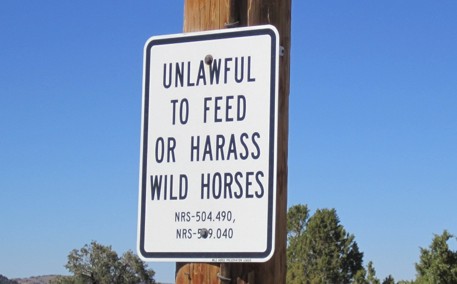
NRS 569.040 says it’s illegal to feed them.

Signs posted in the area refer to feeding and harassing but not watering.

The warning may apply to herds protected by the WHB Act, which does not include the Virginia Range “estrays.”

RELATED: NDA Gives Virginia Range Fencing Update.

Chincoteague Herd Produces One More Foal in 2025?

A palomino filly has been added to the list of foals by DSC Photography, boosting this year’s birth record to 102.

She was first seen on August 26.

The Saltwater Cowboys have turned the island into a puppy mill for wild horses by skewing the sex ratio in favor of females, lifting revenues from auctions into record territory as well.

RELATED: Chincoteague Herd Sets New Birth Record.

Do You Think There’s a Wild Horse Population Problem?

The Campaign Against America’s Wild Horses does, as stated in an undated solicitation for volunteers on Mobilize, a site for community organizers and other left-wing kooks.

There are more horses than allowed by plan but not more than the land can support.

The problem is the way your public lands are managed.

RELATED: AMLs Don’t Indicate Genetic Diversity or Carrying Capacity.

Top Producer in Chincoteague Herd This Year?

It’s not Ajax, Riptide or Thunderbolt.  It’s Twist.

Those four guys accounted for 36% of this year’s foal crop.

NameFoals produced
Twist12
Ajax8
Riptide8
Thunderbolt8

Refer to this spreadsheet for a complete breakdown.

A public relations officer with the Chincoteague Fire Company told Western Horse Watchers on August 19 that the herd consisted of 23 males and 126 females.

The advocates cannot comprehend foal production.  Like the legacy contractors, they are experts at herd reduction.

RELATED: Chincoteague Herd Sets New Birth Record.

Foal-Free Friday, the Company You Keep Edition

Consider these remarks from the Lahontan Comment Summary:

ItemComment
95Agree with herd size reduction
98Want horse levels at AML
114Recommend the use of fertility control
116Adjust the sex ratio to 70/30 males/females

They were submitted by the Nevada Department of Agriculture during the NEPA review of a wild horse gather plan.

They’re pretty much what you’d expect from a government agency whose job is to promote agriculture, which includes permitted grazing.

What you may not realize is that the Campaign Against America’s Wild Horses provides fertility control services to NDA, supporting its mission.

This speaks volumes about the attitudes and allegiances of the nonprofit.

RELATED: Foal-Free Friday, Playing the Long Game Edition.

Maverick-Medicine Emergency Roundup Over

The incident concluded on August 16 with 210 horses captured, 199 shipped, none released and 11 dead.

The daily reports indicate 198 shipped, leaving one unaccounted-for animal.

The capture and removal goals were 215 each.

The gather page was updated with information about deaths.

Ten horses were “euthanized due to poor body condition with no prognosis for improvement.”

A colt was found dead at a temporary holding facility due to unknown causes.

The death rate was 5.2%.

The capture total includes 94 stallions, 85 mares and 31 foals.

Foals represented 14.8% of the animals gathered.

Of the adults, 52.5% were male and 47.5% were female.

There were no plans to treat any of the mares with fertility control pesticides and return them to the range.

The roundup liberated 2,520 AUMs per year.

The effect of dry conditions on livestock grazing was not disclosed.

RELATED: Maverick-Medicine Emergency Roundup Starts August 8.

BLM Paying Advocates to Ruin Cedar Mountain Mares

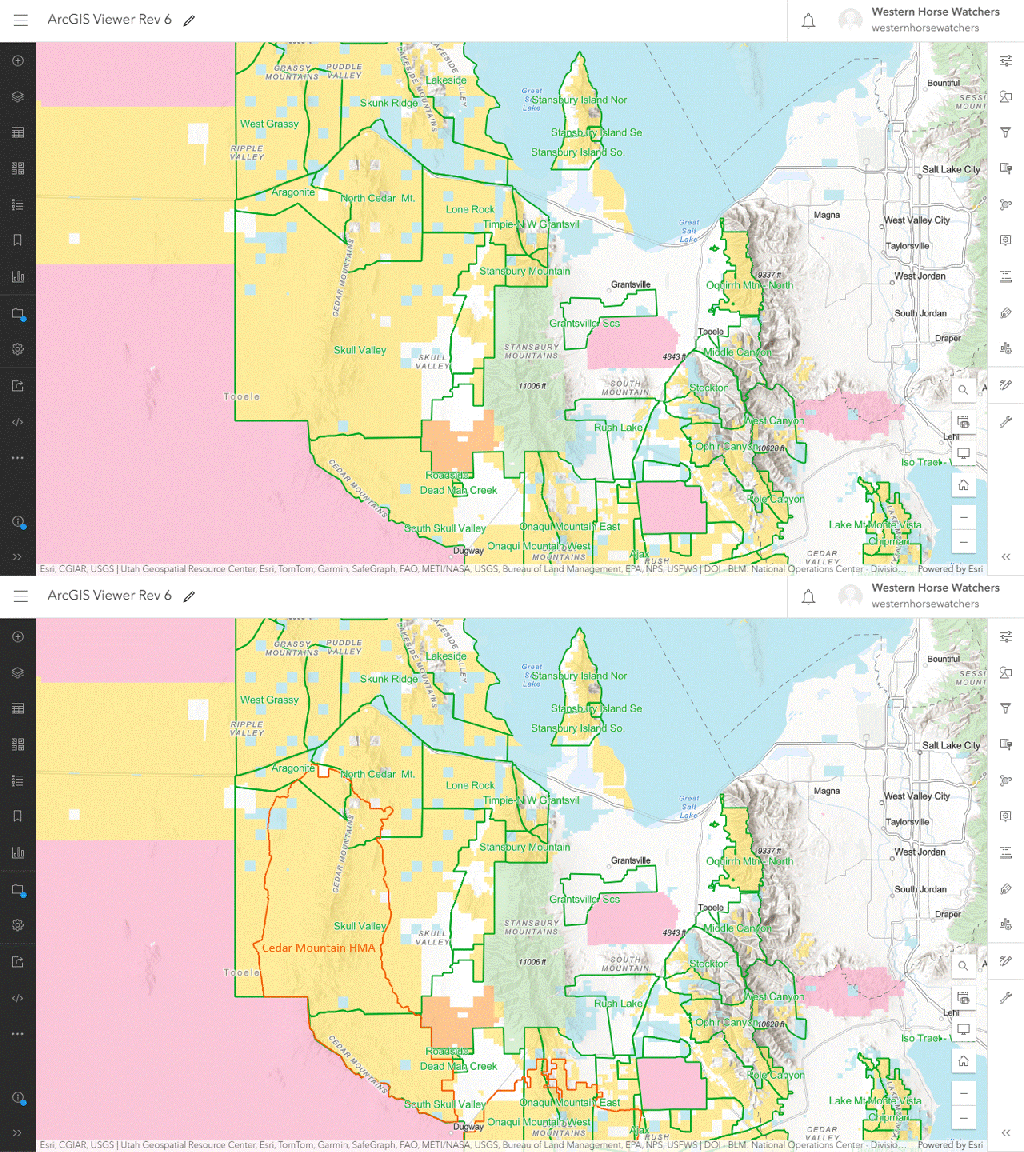
The HMA, located west of Salt Lake City, lies mostly within the Skull Valley and South Skull Valley allotments.

The allotment master report puts both in the Improve category.

Together they offer 20,719 active AUMs on 330,757 public acres, equivalent to 5.2 wild horses per thousand public acres.

As for the HMA, the management plan allows 390 wild horses on 204,674 public acres, or 1.9 wild horses per thousand public acres.

Therefore, it should be able to support (1.9 + 5.2) × 204,674 ÷ 1,000 = 1,453 wild horses, meaning that 1,453 – 390 = 1,063 wild horses have been consigned to off-range holding because of permitted grazing.

What are the advocates doing about this?

Beating the horse numbers down with ovary-killing pesticides.

A report by USA Spending indicates that the Campaign Against America’s Wild Horses has received $173,975 for the service, out of $217,549 authorized.

The August 5 schedule indicates 20 mares treated at Cedar Mountain.  If that’s on an annual basis, then 40 mares will be treated over the two-year life of the project, which works out to over $5,000 per head.

Would you say that’s a wise use of taxpayer money?

RELATED: It’s a Conservation Program, Not a Sterilization Program.

Maverick-Medicine Emergency Roundup, Day 5

The incident started on August 11.  Results through August 15:

  • Scope: Maverick-Medicine HMA, Wood Hills
  • Target: Horses
  • AML: 276
  • Pre-gather population: Not given
  • Type: Emergency
  • Method: Bait (August 5 schedule says helicopter)
  • Category: Unnecessary (according to advocates)
  • Better way: Sterilize the mares with PZP (according to advocates)
  • Capture goal: 215
  • Removal goal: 215
  • Captured: 210. up from 171 on Day 3
  • Shipped: None
  • Released: None
  • Deaths: 11, up from 8 on Day 3
  • Average daily take: 42.0
  • Unaccounted-for animals: 199
  • Snippet from statute: It is the policy of Congress that wild free-roaming horses and burros shall be protected from capture, branding, harassment, or death
  • Snippet from manual: To protect wild horses and burros from unauthorized capture, branding, harassment or death

The figures above are based on the daily reports.

Results for Day 5 were not posted until today.  The gather page says it’s over but not with 199 unaccounted-for animals.

Two horses died on Day 4, followed by one on Day 5, lifting the death rate to 5.2%.

The capture total includes 94 stallions, 85 mares and 31 foals.

Youngsters represented 14.8% of the animals gathered.

Of the adults, 52.5% were male and 47.5% were female.

The location of the trap site is not known.

The name of the contractor was not given.

There are no plans to treat any of the mares with fertility control pesticides and return them to the range.

Both areas are subject to permitted grazing.  Resources liberated to date:

  • Forage: 2,520 AUMs per year
  • Water: 2,100 gallons per day

The AML for Wood Hills is zero.

RELATED: Maverick-Medicine Emergency Roundup, Day 3.