Cost of Hay Dropped Slightly!

The price of a bale of alfalfa-grass mix on August 5 was $34, twenty bales minimum, compared to $36 in July.

But it’s still up 79% since July 2021, before Bidenomics, when the price was $19.

The single-bale price was $35.

The average horse would need five bales per month, putting the cost at $170 per AUM.

The poor ranchers, with their multi-million-dollar base properties, are forced to pay $1.35 per AUM.

RELATED: How to Double the Value of Your Truck.

BLM Reviewing Data Collection Requirements for WHB Adoption

An announcement dated July 19 in the Federal Register seeks public input on new, proposed, revised and continuing collections of information from those who wish to adopt, purchase, foster or train wild horses or burros.

The agency collects information from individuals to determine (1) if applicants are qualified to adopt or purchase wild horses and burros, (2) whether or not to authorize an adopter or purchaser to maintain more than four wild horses and burros, (3) whether or not to grant requests for replacement animals or refunds, and (4) whether or not to terminate a private maintenance and care agreement.

Your remarks should address these issues:

  • Whether the collection of information is necessary for the proper performance of the functions of the agency and whether the information will have practical utility
  • The accuracy of the agency’s estimate of the burden of information collection, including the validity of the methodology and assumptions used
  • Ways to enhance the quality, utility and clarity of the information to be collected
  • How to minimize the burden of information collection on those who are to respond, including the use of automated, electronic, mechanical or other forms of technology

Written and electronic comments will be accepted through September 18.

Do Wild Horses Eat More Than Domestic Horses?

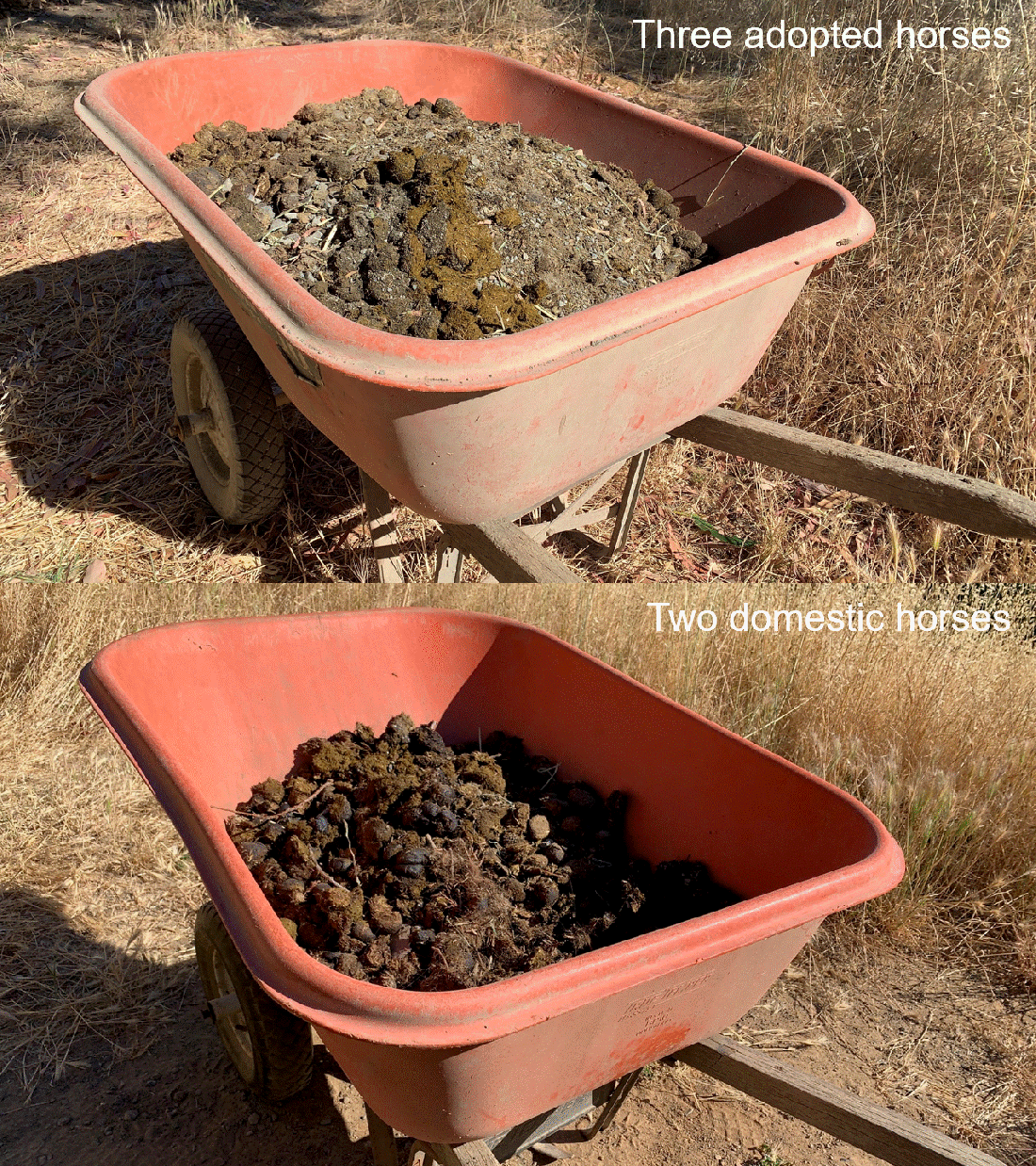
Your host buys twenty bales of alfalfa-grass mix every four weeks, allocated as follows:

  • Seven bales for two domestic horses
  • Thirteen bales for three adopted horses

The domestic horses consume 3.5 bales each over the four-week period.

The adopted horses consume 4.3 bales each during the same period.

This has been the pattern for several years.

Experience indicates that wild horses need about 25% more hay than domestic horses, which means they poop more than domestic horses.

These guys also receive grain in the evening, hay is not the only component in their diet.

They are not ridden or expected to do any work.

Call them pets if you’d like.

RELATED: No Relief in Cost of Feed.

In-Person Adoptions Suspended at Wheatland Corrals

Low placement rates, compared those of online adoptions, prompted the change, according to a news release dated June 8.

The feedlot covers 200 acres in southeastern Wyoming and can house up to 3,500 wild horses and burros, while privately owned cattle and sheep are dispersed at much lower rates on lands set aside for the horses and burros.

There’s nothing in the statute that says AMLs must be small relative to the available resources.

They could correspond to 100% of the authorized forage, neglecting the small amounts assigned to wildlife.

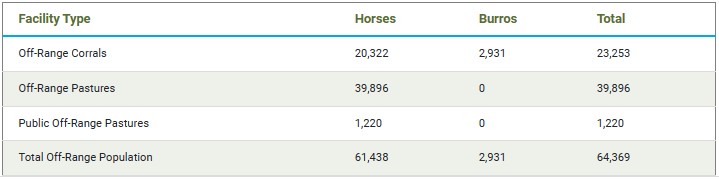
But the government chooses to manage HMAs primarily for livestock, and that’s why there are almost as many wild horses and burros in off-range holding as on the range.

The advocates, defeated a long time ago, snuff out new life with their fertility control pesticides, giving the ranchers exactly what they want.

They are buffoons, no longer deserving of your financial support.

RELATED: Adoptions Resume at Wheatland Off-Range Corrals.

Thriving Ecological Balance-3

BLM to Extend Gray Horse ORP Contract?

A new project has been created in ePlanning but no documents have been posted.

The facility provides long-term care and maintenance for up to 2,750 excess animals on a 26,894-acre off-range pasture located on privately lands in Osage County, OK.

The March 2023 Off-Range Facilities Report indicates two such pastures, East and West, with capacities of 1,735 mares and 1,015 geldings, respectively.

Wild horses are removed from their lawful homes on public lands in the western U.S. and sent to these places to die, because most of their food has been assigned to privately owned livestock.

“Excess animals” means more horses than allowed by plan, not more horses than the land can support.

Chigley ORP Contract Extended

A new project was created this week in ePlanning and a Final DNA has been copied to the documents folder.

There are no opportunities for public comment.

The Proposed Action will continue an existing contract with the Chigley Off-Range Pasture to provide long-term care and maintenance for up to 500 excess animals on a 3,662-acre off-range pasture located on privately owned land in Murray County, OK.

Terms of the agreement were not provided, including duration and rates.

The DNA stated that the agency’s obligation to develop and maintain land use plans is limited to public land and interests in public land, which does not extend to animals, such as wild horses and burros.

The WHB Program Office has authorized periodic increases in the population of up to a 10% to accommodate occasional shipments of excess animals to the facility, which has a capacity of 608 mares according to the March 2023 Off-Range Facilities Report.

No Relief in Cost of Feed

The one-horse pony’s economic policies are not working for horse owners, or anybody else for that matter, America’s enemies excepted.

The price of a bale of alfalfa-grass mix was $36 yesterday, 20 bales minimum, putting the cost of feed at $180 per AUM.

The average horse would need about five bales per month.

The price was $19 per bale in July 2021.

Other items on the ticket:

  • Layena Crumbles, 50-pound sack, $29 each
  • Strategy Healthy Edge, 50-pound sack, $35 each
  • Rice bran pellets, nonstabilized, 50-pound sack, $32 each
  • Alfalfa pellets, 50-pound sack, $27 each
  • Sales tax, $93

The drive-out price was $1,184.  Two years ago, the total would have been around $550.

On public lands, forage sells for $1.35 per AUM, meaning the ranchers are paying less than a penny on the dollar to graze their livestock.

They are further subsidized by taxpayer-funded programs such as the wild horse and burro program, which keeps the pests in check, at least in theory.

The nonprofits have assumed a larger role in the process, poisoning the mares and jennies with restricted-use pesticides, and they want you to pay for that too.

RELATED: No Relief in Hay Prices

Momma in Barn 03-05-22