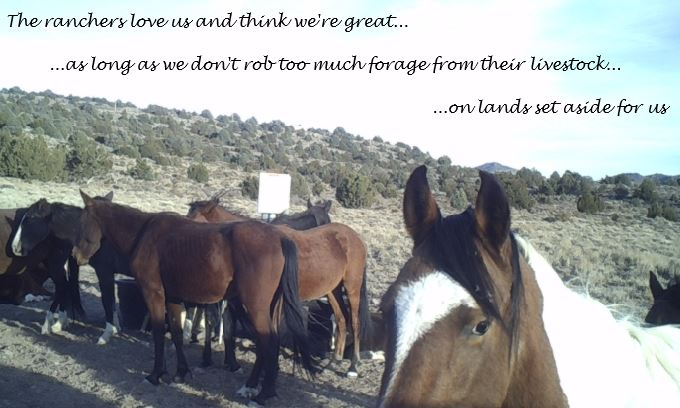
Illinois Sanctuary Finds Homes for ‘Excess’ Wild Horses

Refer to this story, published today by St. Louis Public Radio, an NPR affiliate (and probable conduit of Marxist propaganda).  Includes audio.

While the efforts of the owners are commendable, they are too late, too far downstream in the process.  They guarantee more horses will be removed from western rangelands, because they focus on symptoms, not on causes.

This is also true for the PZP zealots, who think shooting wild mares in the ass with contraceptives is the answer.  It is not.  It is capitulation to the anti-horse agenda, assent to the wild horse narrative.

Advocacy must be aimed at keeping these animals on the range.

That means pushing back against the public-lands ranchers and those at the BLM and Forest Service who coddle them.  Same for land managers at the state level.

‘Lunatic Farmer’ Longs for Horsemeat Dinner

Refer to his blog post dated 12/26/18 about the wild horse ‘problem’ on western rangelands.  Opposing comments are not allowed so they are presented here:

Sir, the symptoms you describe are the result of a strong connection to agriculture and the rural lifestyle.

Many of the wild horses and burros now wasting away in long-term holding got there because of livestock and public-lands ranching.

The agency charged with the care of those animals has steadily given more and more of their land (set aside for them by the WHB Act of 1971) to the ranchers and other commercial interests, while gradually reducing the number of horses and burros allowed to live in the remaining areas.

The figures you cited are correct.  BLM says the land, 27 million acres in ten western states, can only support 27,000 wild horses and burros.  That works out to one animal per thousand acres, almost nothing.

The same agency allows ten to twenty times as many cow/calf pairs on western rangelands, depending on the area.  In some cases it’s the same territory set aside for the horses!

You may wish to view this aerial footage from SE Oregon: https://youtu.be/zFofShEuZJk.  What do you see at 3:06?  At 3:36?  Which species is in the majority?

Twenty seven thousand has nothing to do with the carrying capacity of the land.  It only represents the forage loss the ranchers, and their allies at the BLM, are willing to tolerate.

By the way, the fossil record shows that horses are a native species in North America.  They died off around 12,000 years ago and were reintroduced by Spanish explorers, as you noted.

Keep in mind that many of the horses and burros roam on the harsh landscape of the Great Basin.  They have not destroyed their habitat, that’s what the high desert looks like.  Here’s an example: https://www.youtube.com/watch?v=HOzB6ltmZ20.

It’s What the Authorities Want

Fox News has picked up on a report coming out of Arizona about dry conditions and feeding of the Salt River horses.  It’s old news but a chance to push the overpopulation narrative and ‘benefits’ of PZP darting.

That the horses live on Forest Service land that might be subject to, or impacted by, permitted livestock grazing was not considered.

The original story is presented in this YouTube video by 12 News in Phoenix.

Never question the land-use policies of government.

RELATED: Volunteers Still Feeding Salt River Horses.

Arab-Israeli Conflict Plays Out on Western Rangelands

Introducing the players…

Israeli Occupiers – Wild horses and burros.

Disputed Territory – Land set aside in 1971 for wild horses and burros.

Poor Downtrodden Palestinians – The public-lands ranchers.

State Sponsors of Terror – BLM and USFS.

Terrorist Organizations – Contractors who fly the helicopters and set the traps.

Palestinian Sympathizers – Groups that want the occupiers driven out.

Most of the Palestinians believe the Israelis have no right to exist.  The sympathizers hold conferences and try to influence public policy in their favor.

Liberals typically back the Palestinians, conservatives usually support the Israelis.

Raby Replacing Ruhs as BLM State Director in Nevada

BLM announced last week that Jon Raby has been named to the position effective January, 2019.  He replaces John Ruhs, who vacated the office in February, 2018, according to a report dated 12/14/18 by the Las Vegas Sun.

Roughly half of the nation’s wild horses, and a fair percentage of wild burros, live in the state.

About one sixth of the AUMs offered nationwide by the BLM to public-lands ranchers are in Nevada, along with one fourth of the territory.

Wild Horses, Not So Much

In 2004, Congress designated December 13th as National Day of the Horse, to recognize the contribution of horses to the economy, history, and character of the United States.

That same year, they amended the WHB Act to allow sale without limitation of wild horses and burros more than 10 years old or those that have been offered unsuccessfully for adoption at least three times, a change that further weakened the protections of these animals, to the benefit of the public-lands ranchers.