Can Justice Ginsburg survive Trump’s second term? Almost certainly not.
Here’s the latest from AP News.
RELATED: It’s Not About the President, It’s About the Supreme Court.

Western Horse Watchers Association
Exposing the Hypocrisy, Lies and Incompetence of the Wild Horse Advocates
Opinion
Can Justice Ginsburg survive Trump’s second term? Almost certainly not.
Here’s the latest from AP News.
RELATED: It’s Not About the President, It’s About the Supreme Court.
A Forest Service ranger says he’s hopeful that cattle can return to their allotments in 2020, according to a report posted yesterday by the Elko Daily Free Press. The fire began August 17 last year and burned over 233,000 acres.
An interesting and valuable follow-up to the story would be to find out if livestock displaced from public lands had to be moved to (gasp) private pastures and if the owners had to pay (OMG) market rates to feed them.
From whom do you suppose these horses flee?
(a) Drillers
(b) Miners
(c) Loggers
(d) Campers
(e) Ranchers
Darters would be a correct answer but they were not a problem in Velma’s day.

In Section 3 of the original WHB Act, Congress ordered the Secretaries of Interior and Agriculture to balance the needs of horses and burros with those of wildlife, especially endangered species. There was no provision for domestic livestock.
Overpopulation was to be determined relative to wildlife in the affected area, not privately owned cattle and sheep.
The ranchers, realizing they had been cut out of the will, demanded changes from their political toadies, who gave them FLPMA, PRIA and a watered-down WHB Act.
Today, the ranchers have endorsed a plan that will reduce the number of free-roaming horses and burros to an ‘acceptable’ level, unrelated to the carrying capacity of the land.
Eighty percent of those animals will end up in off-range facilities and the remaining herds will be managed to extinction.
The Marr Plan is a step in the right direction but its scope is too small.
It’s time to get all the livestock off public lands and restore the Wild Horse and Burro Act to its original form.
Is the end drawing near for Justice Ginsburg?
If she dies while he’s in office, the entire liberal program—and one hundred years of ‘progress’—will be put at risk.
Therefore, he has to go. Either by outright removal or failure to win re-election in 2020.
He cannot be given the opportunity to nominate another justice, because liberals use the institution to drive their ruinous agenda. Roe and Obergefell are just two examples.
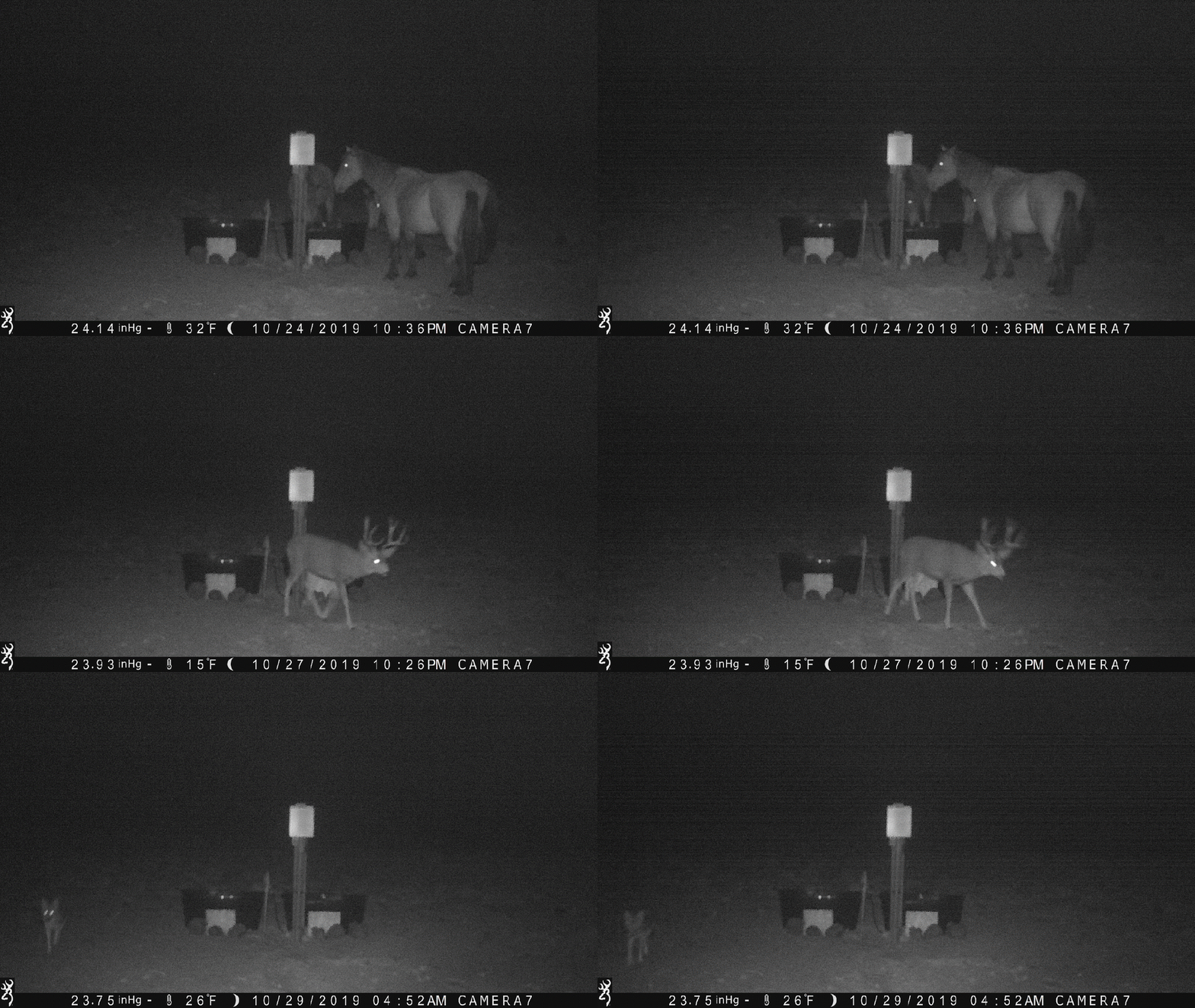
Now that the roundup is over and the horses are gone, the ranchers can enjoy more of what their allotments have to offer.
In just a few short months, thousands of cattle will be turned loose on an HMA that can only support 253 wild horses. You see, the numbers won’t work with just hundreds of cow/calf pairs—which is what you might guess for an area that recently achieved a thriving ecological balance.
Refer to Tables 2 and 3 in Appendix G of the Environmental Assessment for the HMA management plan.
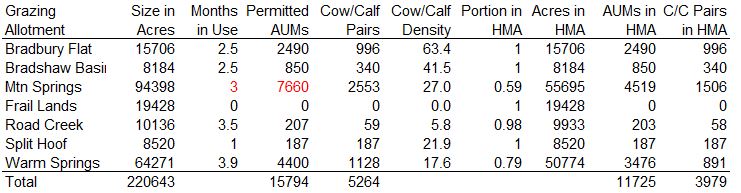
In the Bradbury Flat allotment, which covers 15,706 acres and is 100% inside in the HMA, 2,490 AUMs have been authorized on six pastures in a 2.5 month grazing season.
Livestock operators would have to place 996 cow/calf pairs on that parcel to consume that much forage in that amount of time. The animal density would be 63.4 cow/calf pairs per thousand acres!
The density allowed by plan for wild horses is 1.5 animals per thousand acres.
On Bradshaw Basin, also 100% inside the HMA, ranchers have access to 850 AUMs on 8,184 acres for 2.5 months. That translates to 340 cow/calf pairs on the allotment with a density of 41.5 cow/calf pairs per thousand acres.
The number of cow/calf pairs on the other allotments and the cow/calf densities can be found in the following table. The permitted forage for the Mountain Springs allotment was computed by difference, so the column total matched the figure given in Section 4.2.2 in the EA. The grazing season was not given so it was estimated.
The chart below shows the forage allowed by plan for horses and livestock on the HMA.
The map showing the allotment locations on the HMA could not be found (mentioned in Section 4.2.2 in the EA) so all of the acreage in the HMA was used in the livestock density calculation. If some of the land is not subject to livestock grazing, the overall cow/calf density would be higher.
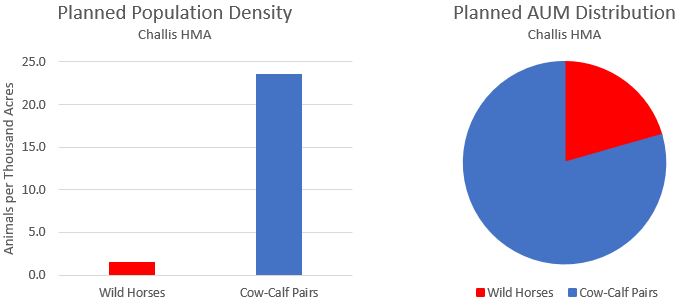
Now you know why over half the horses on the HMA had to be removed. By the time the ranchers get though, there’s almost nothing left for them.
Never mind that land was set aside for the horses. That was a long time ago.
UPDATE: If you add the numbers in the ‘Acres in HMA’ column, you get 168,240, which is very close to the size of the HMA stated in the EA (168,720 acres). Thus, all of the HMA is subject to livestock grazing, except for areas described as ‘Frail Lands.’
RELATED: Challis Roundup Ends.
If no mining companies signed on to the proposed WHB management plan, what other users of public lands endorsed it?
(a) Ranchers
(b) Loggers
(c) Hikers
(d) Campers
(e) All of the above
Answer: A
BONUS QUESTION: The WHB Act of 1971 was prompted by the killing and slaughter of wild horses on western rangelands by _______________.
RELATED: ‘Path Forward’ Quiz.
How many oil companies signed on to the ill-conceived management plan for wild horses and burros?
(a) One
(b) Four
(c) Seven
(d) Eleven
(e) None
Answer: E.
BONUS QUESTION: How many mining companies?
RELATED: ‘Path Forward’ Discussed.
The number of wild horses and burros in off-range corrals and long-term pastures (around 50,000) can be explained by the misappropriation of forage on just a few dozen HMAs.
The forage allocated to privately owned cattle and sheep on public lands in the western U.S., about nine million AUMs per year, would support at least 750,000 wild horses and burros, enough to empty all of those corrals and pastures fifteen times over.
You don’t have a horse problem on western rangelands, you have a ranching problem.
RELATED: Hypothesis, Subject to the Test of Future Experience.
Refer to the comments from 40:52 to 42:44 in this radio segment on the ‘Path Forward’ by KNPR of Las Vegas. The program host asks if there is a perfect model for managing wild horse populations.
The guest, a member of the Wild Horse and Burro Advisory Board and science advisor for Return to Freedom, pointed to Assateague as the gold standard (Maryland side of the island, ponies on the Virginia side are managed by the annual swim).
Seriously?
The size of the herd declined from 78 in November 2018 to 75 in November 2019, there is clear evidence of a problem with its sex ratio and genetic diversity may be inadequate.
And you’re holding that up as an example of success?
The only non-lethal option for on-range management of wild horses and burros in the American west is to end public-lands ranching and restore the WHB Act to its original form.
RELATED: ‘Path Forward’ Discussed.
Listen to the remarks from 42:45 to 43:51 in this radio segment on the ‘Path Forward’ by KNPR of Las Vegas. Yep, reduce horses to allow more vegetation [for the ranchers].
The ill-conceived management plan, which will remove 70% of America’s wild horses and burros from their home range and slow the growth of the remaining herds, was not created by two opposing groups—it was written by comrades in arms!
Wild horse advocates were barred from the process because they’re on the fringe and might try to undo four years of ‘progress.’
A few months ago the PZP zealots said darted mares become ‘self-boosting’ after five years. Now, they refer to mares ‘reactivating’ after five years. Listen to the remarks from 18:38 to 20:33 in this radio segment on the ‘Path Forward’ by KNPR of Las Vegas.
Folks, these are code words for sterilization.
The PZP zealots are on the same side of the debate as the public-lands ranchers, differing only in methodology.
Don’t give them a penny.

The number of wild horses and burros in off-range corrals and long-term pastures can be explained by the misappropriation of forage on just a few dozen HMAs.
Half of those animals can be accounted for by the misuse of forage on 13 HMAs.
The underlying premise of the ill-conceived WHB management plan is that public-lands ranching is a given, self-evident, unchanging.
It is not.
Who will prevail on western rangelands? Wild horses and burros or privately owned cattle and sheep?

The man-made power outages in California over the last few days have set a new low water mark for people living there.
Publicly, the governor opposes them. Privately, he and his Marxist travelers are fully on board with them.
If there are any regrets in his mind about the situation, it’s that the kill switch is still in PG&E’s hands, not his.
Refer to this AP report, posted today.
You don’t need that much money and that much time. You only need an executive order, effective Monday morning, ending public-lands ranching. The driver of the roundups, and the warehousing of captured animals, will be gone.
There is no ‘two-state solution’ on western rangelands. There is no ‘working together,’ not when the other party wants you wiped off the map.
It’s free-roaming horses or privately owned livestock. Take your pick.
In this video, Celeste Carlisle, RTF scientist and WHBAB member, speaks about wild horse fertility control at the Pathways 2019 Wildlife Conference in Estes Park, CO.
Discussion of the ‘Path Forward,’ to which RTF is a signatory, begins at 15:20.
Yes, they are getting hammered for it, and rightly so.
Wild horse preservationists were barred from the formulation, you see, because they are fringe groups—there would be no advancement in the discussion (16:32).
That’s what happens when you try to reconcile two incompatible views.
How can anyone look at the AUM distribution on lands set aside for the horses, such as in this post, and conclude that fertility control is the answer?
As reported yesterday, the forage allocated to domestic livestock in the Antelope Complex would support over 10,000 wild horses. The forage allocated to livestock on the Triple B Complex would support over 4,000 wild horses.
The problem is not uncontrolled reproduction, it is public-lands ranching.
RELATED: PZP Zealotry on a Global Scale.
Five areas were considered this week in a series of posts about the number of wild horses that have been displaced from public lands by privately owned livestock.
Yep, 8,127 wild horses have been denied a place on their home range by pro-ranching statutes and regulations of the federal government.
How many more HMAs would you have to look at to reach 50,000—the number of wild horses and burros languishing in off-range corrals and long-term pastures?
The government spends roughly $50 million every year to care for those animals, with the expectation of receiving just $12 million per year from the ranchers.
The ridiculous ‘Path Forward‘ will only make the situation worse.
There is no wild horse problem on western rangelands.
Public-lands ranching is rarely mentioned in news reports, such as this one, and most of allegations against the horses are aimed at getting them off the land—land that was set aside for them—so their food can be sold to the ranchers at fire-sale prices.
It’s a gravy train if ever there was one.
RELATED: Greatest Threat to Public Lands: Wild Horses and Burros.
A judge has ruled that the BLM cannot give itself power to decide which HMAs will be managed primarily for wild horses and burros, and that the ‘thriving ecological balance’ of the WHB Act refers to wildlife, not privately owned cattle and sheep. With livestock coming off the Twin Peaks HMA at the end of the grazing season, by how much can the AML be increased?
A. 2,265
B. 1,550
C. 925
D. 385
E. 95
Answer: A (27,178 ÷ 12).
That’s on top of the 758 wild horses currently allowed by plan.
Four years have passed since new rules went into effect regarding the labeling of range-fed beef. Consumers, angered by the way wild horses were being treated, refused to buy the product, putting the public-lands ranchers out of business, including those at Silver King HMA. With the livestock gone, by how much can the AML be increased?
A. 84
B. 313
C. 850
D. 1,645
E. 2,004
Answer: E (24,028 ÷ 12).
That would be in addition to the miniscule 128 wild horses already allowed by plan.
 Western Horse Watchers Association