Public-Lands Ranchers May Need More Forage?

A spokesman for the Public Lands Council said earlier this week before the Senate Committee on Energy and Natural Resources that “There may be a need for access to additional forage, including vacant allotments or other available allotments that were not grazed during the summer season.”

His testimony concerned the effects of COVID-19 on public-lands ranchers, according to a news release dated July 23.

He did not indicate where those underutilized allotments would be found but almost certainly could offer a few suggestions.

Western Horse Watchers was unable to find a statement in the organization’s news releases condemning the recent PZP Amendment to H.R. 7608, a spending bill for FY 2021 now under consideration in the House.

The amendment has the full support of AWHC.

RELATED: PLC Wants to Change Image of Public-Lands Ranching.

House Passes PZP Amendment to FY 2021 Spending Bill

Refer to this news release issued today by Animal Wellness Action.  The full bill will be considered by the House tomorrow.

The amendment requires the BLM to use $11 million from the FY 2021 WHB budget to apply PZP to wild horse herds.  It does nothing to stop the misappropriation of resources that’s forcing them off western rangelands.

The Senate will take up its own spending bill in the coming weeks or months.

RELATED: Swasey Wild Horse Fatality Justifies Contraceptives?

Comments on Saylor Creek Wild Horse Roundup

The stocking rate allowed by plan is 0.5 wild horses per thousand acres.  That should raise an eyebrow.  The plan assigns 95% of the authorized forage on the HMA, omitting wildlife, to livestock, with the balance to horses.

It’s one of the best examples of mismanagement in the WHB program.

The pre-gather population of 131 horses is 2.6 times above AML, yet it represents just 13% of the carrying capacity of the land.

Unlike Swasey, which reached its capacity, the HMA is not overpopulated, at least not with horses, so what’s driving the roundup?  What’s the rationale for contraceptives?

Could it be that the herd was approaching the minimum recommended size for genetic viability?  Or might it be the attitudes, loyalties and beliefs of those who wrote and approved the management plan?

RELATED: Saylor Creek Roundup Pending.

Thriving Ecological Balance-3

Swasey Wild Horse Fatality Justifies Contraceptives?

A press release issued today by AWA and AWHC, in the wake of a death yesterday during the Swasey wild horse roundup, calls for an $11 million expenditure in 2021 to dart wild horses with PZP.

They need better protection, according to the writers.

Contraceptives mean they won’t even be born—never to be harmed by roundups—a strategy that dovetails perfectly with approved plans to divert most of their food to privately owned livestock.

The announcement suggests that AWHC was the client behind the opinion piece that appeared in several publications on Friday.  Whose side are they on?

RELATED: Swasey Progress Report Day 4.

BLM Opinion Piece Acclaims ‘Path Forward,’ Ignores Livestock

“Now is the time to chart a bold new course for the management and protection of the horses and burros and prevent unnecessary degradation to their habitat,” according to the writer of a guest column appearing this evening in the Las Vegas Review Journal.

The current population of 95,000 wild horses and burros on BLM-managed public lands is more than three and a half times what the land can support [given the amount of resources we’ve diverted to privately owned livestock].

He forgot that part.

AWA Urges Lawmakers to Accept PZP for Wild Horses

Animal Wellness Action, a lobbying group in Washington D.C., said yesterday in an opinion piece published by the Pagosa Daily Post that “lawmakers have the opportunity to land on the right side of history – and the American taxpayer – by requiring BLM to implement PZP contraceptive in 2021.”

Never mind that the EPA was ordered to reconsider the registration of the pesticide earlier this year.

And you should ignore the Assateague census results that show its long-term effects on wild horse herds.

Lobbyists do as their clients require.  In this case, a photo of a wild horse roundup, provided by AWHC, was included.  Might they be the client?

That group has thrown in with the public-lands ranchers.  They’re using your hard earned donations to do the rancher’s dirty work, which is to ensure that seventy, eighty, ninety percent or more of authorized forage on lands set aside for wild horses goes to privately owned livestock.

Don’t pay attention to their words, pay attention to their deeds.

Thriving Ecological Balance-3

Swasey Progress Report Day 2

The daily reports indicate 253 wild horses captured as of July 16, with none returned to their home range and no deaths.

Body condition scores ranged from three to five(!) with a few twos.

Not exactly what you’d expect for an area that’s grossly overpopulated.

The fives tell the story: The horses are robbing too much forage from the poor ranchers.

The management plan for the HMA assigns six times more forage to privately owned livestock than horses.

RELATED: Swasey Wild Horse Roundup Starts This Week.

Currituck Horses at Great Risk?

Only 100 remain on the barrier island and “every single one lost is devastating to the genetic health and diversity,” said the herd manager in a report following last week’s choking incident.

She continued, “It’s hard enough to lose one to natural causes … but to lose one to something caused by humans and so easily avoided is just … I don’t even have a word for how bad that is.”

The greatest threat to these animals is not the tourists but the so-called advocates who stalk them with clipboards and darting rifles.

It’s bad when one dies but it’s okay if they’re never born.

You only need to look at Assateague Island (Maryland side) to see where this is going.

The PZP zealots have run that herd into the ground and they know it.

RELATED: Assateague Wild Horse Census Temporarily Halted?

Court Decides Two Wild Horse Cases in Favor of BLM

The Ninth Circuit Court of Appeals sided with the BLM in its analysis of the effects of releasing a limited number of geldings onto public lands as part of its wild horse management efforts, according to a news release issued today.

In another case, the Court reaffirmed the use of wild horse and burro management plans that cover ten-year periods.

The terms ‘livestock’ and ‘multiple use’ appear nowhere in the announcement, as if the horses and burros have full use of the resources in their home range and are now far beyond its ability to support them.

The problem is most of the resources have been diverted to privately owned livestock.

Roundups may be necessary when the capacity limit of an area is reached, as seen earlier today in the Sheepshead HMA, but they can’t be justified when the forage assigned to livestock could support all of the ‘excess’ horses in an area, and more, as seen last week at the Coyote Lake HMA.

A Lesson from Industrial Quality Control

One day the QC manager at a manufacturing plant said “Starting tomorrow we shall have no more defects.”

Nonsense!

You can’t achieve a desired result by exhorting the workers.

You have to study the system that produces the defects and fix those causes.  Off-spec materials, worn out machinery, inadequate training, outdated procedures, etc.

Workers can do nothing about those things.

Defects are downstream, the system is upstream.  The behavior of a system as a function of time is called a ‘process.’  A process takes certain inputs and delivers certain outputs, days, weeks or months later.

Process-1

A major-league hitter gets paid millions of dollars to turn out 70% defective work.

A stable process can turn out 100% defective results, day in and day out.

To solve problems, you have to look upstream and improve the process.

Another Documentary on Wild Horses in the Works?

Free-roaming horses on western rangelands.  Then the helicopters come.  Many people already know this.

What will be the point of the new film?  To break new ground by looking upstream in the wild horse management process?  Or will it be a rehash of the same old propaganda about overpopulation, no natural predators, etc?

Will it treat symptoms or identify causes?

Will it promote contraceptives, sanctuaries, adoption and training?  Who’s behind it?

Links in the video description point to socialist media except this one.  Comments are not allowed.

RELATED: Stop the [Causes of] Roundups!

Why Do Some Wild Horse Advocates Bash Oil Companies?

From page 97 in the Final EA for wild horse management actions at the Barren Valley Complex in southeast Oregon:

Q.  Can the EA disclose water usage of each oil and gas rig, wind turbine and geothermal plant; the number of acres designated for buildings/equipment associated with them; and their effects on sage-grouse, wildlife and wild horses?

A.  This issue is outside the scope of the analysis as there are no oil/gas rigs, wind turbines or geothermal plants within the vicinity of the HMA.

The EA actually considers three HMAs so perhaps the answer should say “within the vicinity of the Complex?”

Wind turbines make electricity from (OMG) wind.  Hydroelectric plants make electricity from falling water, which is clean, dependable and affordable but gets no traction in the media.  Wind turbines are better because they don’t chop up fish.

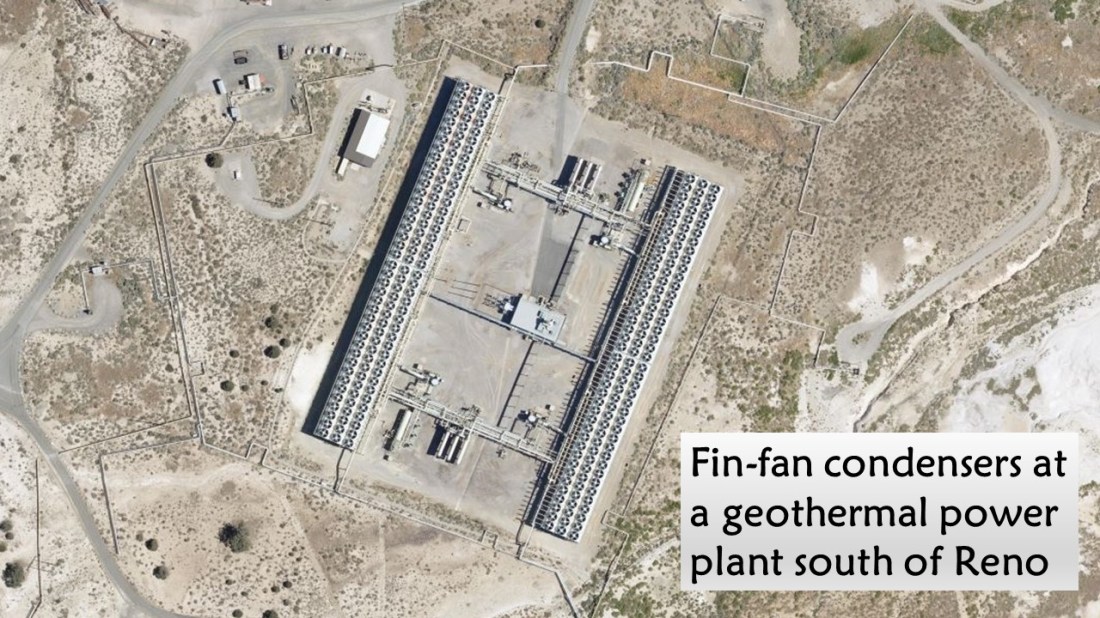
Geothermal plants might need water for cooling tower makeup, if they use water-cooled condensers.  Some of these plants use fin-fan condensers, which reject heat to the air.

These plants are often closed loop—whatever comes out of the ground as steam goes back in as condensate, but some water may be needed to make up for system losses.

Maybe we’ll take these people more seriously when they can provide an estimate of the number of wild horses that can be returned to the range if drilling was stopped.

The amount of land needed to set up drilling rigs is miniscule compared to the amount of land (and forage) devoured by public-lands ranching.

Fin-Fan Condensers-1

Montana Grazing Fees

A draft environmental assessment for livestock grazing on the Pumpkin Creek allotment shows average grazing fees of $12.92 per AUM on state-owned lands and $26.50 per AUM on private lands.  See page 26 in the EA (page 30 in the pdf).

The fee on BLM lands is $1.35 per AUM, about 5% of the going rate on private lands.

The government pays about $60 per AUM for wild horses in long-term holding.

The allotment is about 15 miles south of Miles City in the eastern part of the state, according to a news release issued yesterday.

Review of New WH Population Control Plan Almost Complete?

The plan was issued on May 8.  Congress had sixty days to review it.  That period ends tomorrow.  Legislators authorized $21 million in FY 2020 to implement the first part of the rancher-friendly ‘Path Forward’ but only after the BLM “submits a comprehensive and detailed plan for an aggressive, non-lethal population control strategy.”

RELATED: Strategy for Implementing ‘Path Forward’ Sent to Congress.

Stop the [Causes of] Roundups!

If you read environmental assessments for management actions on HMAs, you may have seen statements like this:

The elimination of livestock grazing in an area would require an amendment to the RMP.  Changes to grazing cannot be made through a wild horse gather decision.

Roundups, fertility control, sex ratio skewing and sterilization are products of a decision making process that determines the use of public lands.

Those decisions are influenced by other standards, such as the No Rancher Left Behind Act of 1976, as well as the beliefs and loyalties of those involved.

Adoptions, training programs and sanctuaries are too far downstream in the process to be of any use to the horses and burros still on the range.

They are symptoms, not causes.

How far upstream in the process would you have to go to bring about the desired change?  How often do Resource Management Plans come up for review?  What type of safeguards are protecting them?

RELATED: Stop the Roundups, Fertility Control is Better!

Thriving Ecological Balance-3

Public Meeting This Week for Aerial Roundups in Nevada

BLM said yesterday that the annual hearing for the use of aircraft and motor vehicles in managing wild horses and burros would be held in Battle Mountain June 25.

What if those attending said “We object.”  What would that accomplish?

Roundups are effects, not causes.  They are symptoms of the way public lands are managed.  If you want change, you have to go after the causes.

The announcement said the state’s wild horse and burro population currently exceeds 51,500 animals, with 12,811 animals allowed by plan.  Is that a problem?

The meeting should not be about what type of equipment is most effective in removing these animals from their home range, but why they are being removed from their home range and what can be done to stop it.

Thriving Ecological Balance-3