More Signs of Dry Conditions in Western U.S.

Communities served by the Colorado River and its artificial lakes may be facing a water shortage declaration, according to a report posted yesterday by AP News.

An observable effect of drought in the wild horse world might be a jump in emergency roundups, accompanied, perhaps, by AUM reductions in grazing allotments.

The author tries to link the situation to (man-made) climate change, a fake problem that started off as global cooling, which couldn’t be demonstrated, followed by a shift to global warming, also unproven, supplanted again by climate change so its adherents could play it both ways.

Frequently, the term appears with concerns of hotter temperatures, as in the story, suggesting that they still believe in the greenhouse effect and global warming.

Water vapor, belched into the atmosphere by industrial and commercial cooling towers, and also by evaporation from lakes, rivers and oceans, is a much more potent greenhouse gas than CO2 but you never hear about it!

RELATED: Dry Conditions in California Signal Trouble in Great Basin?

Distinguishing Between Cause and Effect

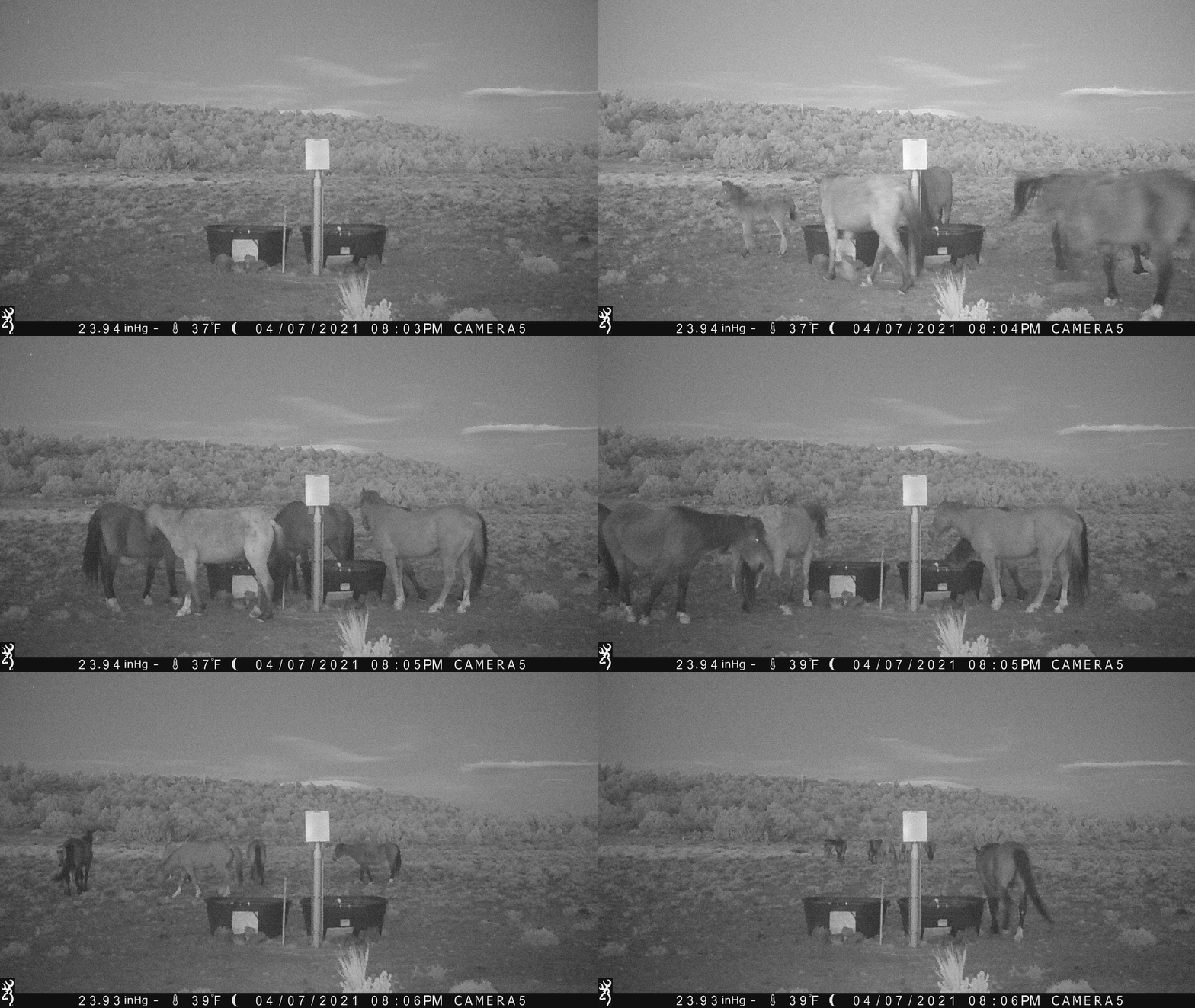
This scene at the Palomino Valley Off-Range Corrals, photographed yesterday, is a consequence of the resource management process, not a cause of it.

If you want to help America’s wild horses, look upstream in the management process, understand why they’re being removed from public lands and address those causes for a lasting solution.

RELATED: Many Foals at Palomino Valley Off-Range Corrals

Distinguishing Between Cause and Effect Enlarged 04-17-21

Life as Nature Intended

The presence of youngsters in this video represents a turning over of the genetic soil in the herd, some of whom—if they survive and can stay on the range—will start their own bands, continuing the process.

This characteristic, essential to herd viability and ruggedness, is dismissed by some of the ‘advocacy’ groups, who proudly interfere with breeding patterns.

Don’t give them a penny.

RELATED: Wild Horse Mesa Confirmed, Trajectory of a Fertility Control Program.

Riders Promote Adoption

Perhaps they mean well.  Maybe they’re shills for the public-lands ranchers.

Who knows.

What will be the condition of their horses when their journey is complete?

Do they understand that if livestock grazing was discontinued in a just a few dozen HMAs all wild horses could be removed from holding pens, not just 5,000?

If you want to help America’s wild horses, don’t focus on the horses.

Instead, look upstream in the management process, understand why they’re being removed from public lands and address those causes for a lasting solution.

RELATED: Haaland Urged to End Livestock Grazing in HMAs.

NCBA Responds to Coalition’s Letter About Livestock Grazing

The Executive Director of Natural Resources and the Public Lands Council said in a report dated April 13 by FarmProgress, an online news service, that “The path toward healthy horses, healthy rangelands, and healthy wildlife is championed by those who have been stewards of the land for generations—ranchers.”

Unfortunately, data from RAS show otherwise: Approximately 60% of BLM grazing land does not meet standards for rangeland health.

The letter calls for an end to livestock grazing on all “horse-occupied” HMAs, as if it didn’t occur on lands set aside for wild burros and included no data to support the claim that forage allocations “are severely biased against horse populations.”

Western Horse Watchers does not dispute the claim but believes the letter would have been more effective if submitted with some examples, such as the Little Colorado and Sand Wash Basin HMAs.

The letter also calls for a revamp of RMPs affecting such areas, which is essential, but may go nowhere without a court order.

Yesterday’s news release did not indicate if a similar request was sent to the Secretary of Agriculture regarding WHTs.

RELATED: Letter to Haaland Seeks Thriving Ecological Balance?

Letter to Haaland Seeks Thriving Ecological Balance?

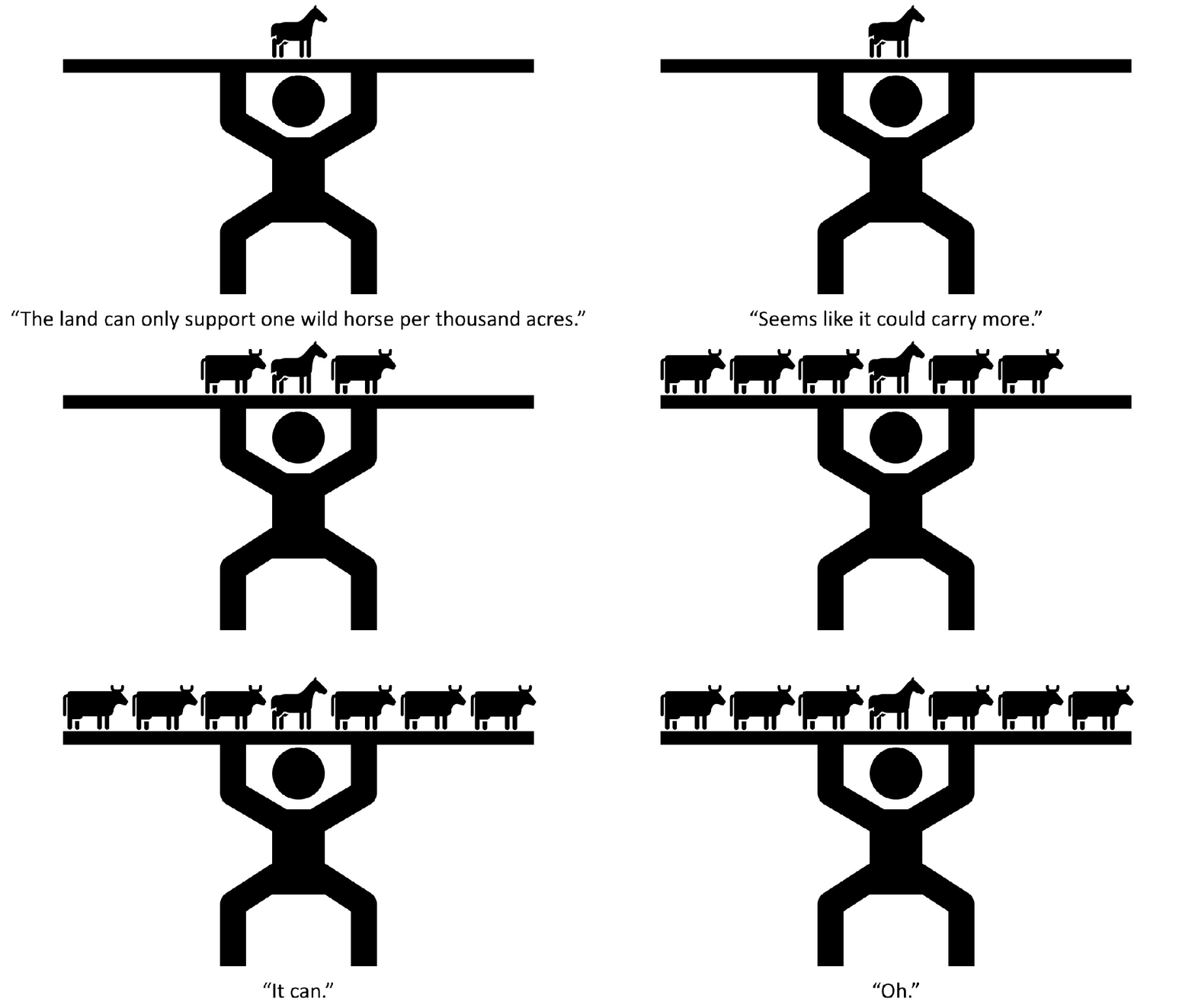
We already have that.  It means 80 to 95% of the authorized forage going to privately owned livestock on land set aside for wild horses and burros.

It’s the six-bedroom home where the horses can use up to one bedroom but in no case less than half a broom closet.

Why not seek the ‘principally but not exclusively’ concept of the original statute?

Curiously, the term appears nowhere in the letter.

RELATED: Haaland Urged to End Livestock Grazing in HMAs.

Thriving Ecological Balance-3

Marketing the Virginia Range Mustangs to Job Seekers?

They’re one of the perks at the Tahoe Reno Industrial Center, according to a story in today’s online edition of The New York Times.

But before you hit the Apply button on a job posting, know that the ‘advocacy’ groups, led by the Campaign Against America’s Wild Horses, are trying to get rid of them.

Although there are few if any cattle in the area, and most of the land is privately owned, the future of these animals may follow the course of the recent ‘trajectory’ post.

RELATED: Storey County Commissioners Oppose Autonomous Zone.

TRIC Sign-1

Ranchers Rebranding Agenda as Wildlife Conservation?

SJR3 is one example.  It’s not about livestock, according to one of its adherents, even though the term appears five times in the text and the rancher-friendly Path Forward was cited once.

The writer of an opinion piece appearing in today’s edition of The Salt Lake Tribune claims that loss of sagebrush habitat, which rural communities need for ranching, hunting and other recreation, can be attributed to invasive cheatgrass, encroaching juniper, wildfires and overabundant wild horses, among other things.

Therefore, to protect wildlife that inhabit those areas, we need to eliminate those things because they displace native grasses, consume them or destroy them.

Like SJR3, the goal is wildlife conservation.  The ranchers have little if any interest in these efforts and will not benefit from them.

The author did not indicate if the photo of the cut-down juniper tree, which had probably been there for several hundred years, was taken on a grazing allotment.

RELATED: Sagebrush Restoration Project Inching Ahead.

SJR3 Not Intended to Benefit Livestock Producers?

The resolution was drafted to benefit Nevada’s wildlands and wildlife, according to the writer of column posted today by The Sierra Nevada Ally of Reno, NV.

Let’s accept that as a true statement.

Now, suppose you were going to write it to help the public-lands ranchers.  What would you do differently?  What exactly would you change?

“The fact that there is a problem with livestock does not mean we should not try to solve the problem with overabundant horses.”

You don’t have too many horses, you have too little food.  Gathering to the low end of AML and suppressing population growth reflects that reality.

The author testified in favor of the measure at the March 23 hearing.  His presentation was questioned at the end of the public comments for omitting data on cattle.  Go to 5:25:40 in the video transcript of the meeting.

RELATED: AWHC Intervenes in SJR3?

AWHC Intervenes in SJR3?

An amendment to the resolution was proposed in a work session on April 1.  It was submitted by the American Wild Horse Campaign.  Video of the meeting has been linked to the SJR3 page on NELIS.

The amendment does not contest the management priorities on lands set aside for wild horses and burros in Nevada, illustrated in this morning’s commentary on the Desatoya HMA, nor the resource allocations arising therefrom.

Rather, it suggests an alternate method for getting rid of those animals, which will achieve the results desired by the SJR3 supporters but in a longer timeframe.

RELATED: SJR3 Stirs Up Wild Horse Debate in Nevada?

Thriving Ecological Balance at Desatoya HMA?

The management plan assigns 2,160 AUMs per year to wild horses at the upper end of the AML, per Section 1.2 of the Final EA for resource enforcement actions in the HMA.

Livestock receive 9,133 AUMs per year per Table 3-2 in the EA.  The forage available to livestock inside the HMA from the Porter Canyon allotment decreased from 6,352 AUMs per year in the Draft EA to 5,877 AUMs per year in the Final EA.

The total authorized forage in the HMA is 11,293 AUMs per year, neglecting wildlife.

That means the horses can consume up to 19% of their food.

The Proposed Action, authorized in yesterday’s Decision Record, will gather the HMA to the lower end of the AML and minimize growth rates thereafter with fertility controls and sex ratio skewing.

The remaining horses will need 1,524 AUMs per year, about 13% of the authorized forage, which is the long-term goal of the management plan.

Perhaps we should refer to it as a pest control plan, designed to protect the interests of the public-lands ranchers, not America’s wild horses.

The forage assigned to livestock would support an additional 761 horses for a True AML of 941.  The current population is thought to be around of 231.

If the HMA was managed principally for wild horses, per the original statute, there would be no need for a roundup or fertility control program.

RELATED: Desatoya Wild Horse Decision Record Signed.

What is WHIMS?

The Draft EA for the Sand Wash gather plan refers to it in a section about record keeping for wild horse fertility control programs (bottom of page 22 in the pdf).

A web search pointed to a site called ‘WHIMS Web (AWHC).’  It is not a ‘dot gov,’ which would signify government ownership.

The warning message says “Actual or attempted unauthorized use of this system will result in criminal and/or civil prosecution” and “WHIMS Web reserves the right to review, monitor, and record all activities on the system,” which are “subject to review by law enforcement officials.”

Good grief, what are they hiding?

If it’s a database for wild horse darting programs on public lands, why isn’t it in the public domain?