Virginia Range Darting Update for September 2023

The Campaign Against America’s Wild Horses indicated in the September update that 89 mares received 89 doses of Zonastat-H during the month, 26 given as a primer and 63 as a booster.  If you can’t access the document, click here.

Over the life of the program, 1,949 mares have received 8,116 doses of the pesticide.

The report will be submitted to the Nevada Department of Agriculture.

Of the 163 foals born this year in the primary target zone, 80 have died.

The causes of death were not discussed but predation is likely a factor.

As for the long-term population goal and how many horses they intend to eradicate, the advocates are silent.

No comments about herd demographics.

No discussion of sterility and the growing risk thereof.

The current population is thought to be 3,513 with 356 listed as missing, compared to 3,559 in August, including 395 listed as missing.

A goal for October is to maximize booster treatments, allowing for continued population reduction, equivalent to bait trap removal or helicopter roundups.

RELATED: Virginia Range Darting Update for August 2023.

Pesticide Pushers 07-17-23

Wild Horse Lobby Day Set for Next Week

Sponsored by the Save Our Wild Horses Coalition, participants will have an opportunity meet with lawmakers and urge them to support legislation that protects wild horses and burros.

Sounds great.

But terms in the news release such as humane treatment, living treasures and magnificent animals should raise suspicions.

Pesticides R Us 09-26-23

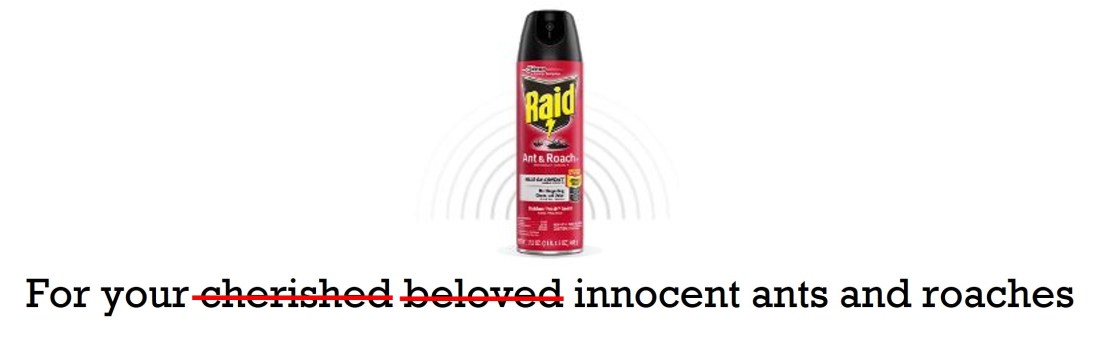
If the announcement referred to cherished/beloved/innocent wild horses, you could be sure their goal has little to do with protection and much to do with permitted grazing, to be achieved with fertility control programs, not helicopter roundups.

For Your Innocent Ants and Roaches 10-23-22

WHBAB Vacancies Filled

The Bureau of Land Management and U.S. Forest Service selected two new members and re-appointed a third, according to a news release dated September 29.

The two new members represent wildlife and livestock management organizations.

The Board advises both agencies on the management and protection of wild horses and burros on public lands.

With two of the nine seats occupied by permittees, you now have the equivalent of two Palestinian advisors setting policy direction toward Israel.

RELATED: WHBAB Nomination Update.

Let’s Play “Name that Nonprofit”

Who claimed on National Public Lands Day that the federal government is determined to shrink wild horse and burro populations even further while giving most of their land to commercial livestock, as it collaborates with the bureaucrats and ranchers to wipe out the herd at Cedar Mountain?

Let Us Fix Your Wild Horse Problem 02-18-23

Who’s working with ranching sympathizers at NDA to ruin the Virginia Range herd?

It’s the Campaign Against America’s Wild Horses, a leader in nonmotorized removal!

Pesticides R Us 09-26-23

RELATED: BLM Awards $1 Million for Wild Horse Protection?

Wild Horse Working Group Will Serve Ranchers Not Horses

A column posted this morning by The Daily Sentinel of Grand Junction, CO, a paper known for its anti-horse bias, claims a new era has dawned in wild horse management.

The term is always a euphemism for beating the populations down with helicopters and pesticides, even if it’s prefixed with “Humane,” so ranchers can access most of their food and water.

You thought things would be different at the state level?

The Wild Horse Working Group is sponsored by the Department of Agriculture, whose mission is to strengthen and advance Colorado agriculture!

A preliminary assessment might start with these questions:

  • How many RMPs will be revised in favor of the horses?
  • How many ranchers will be confined to their base properties?
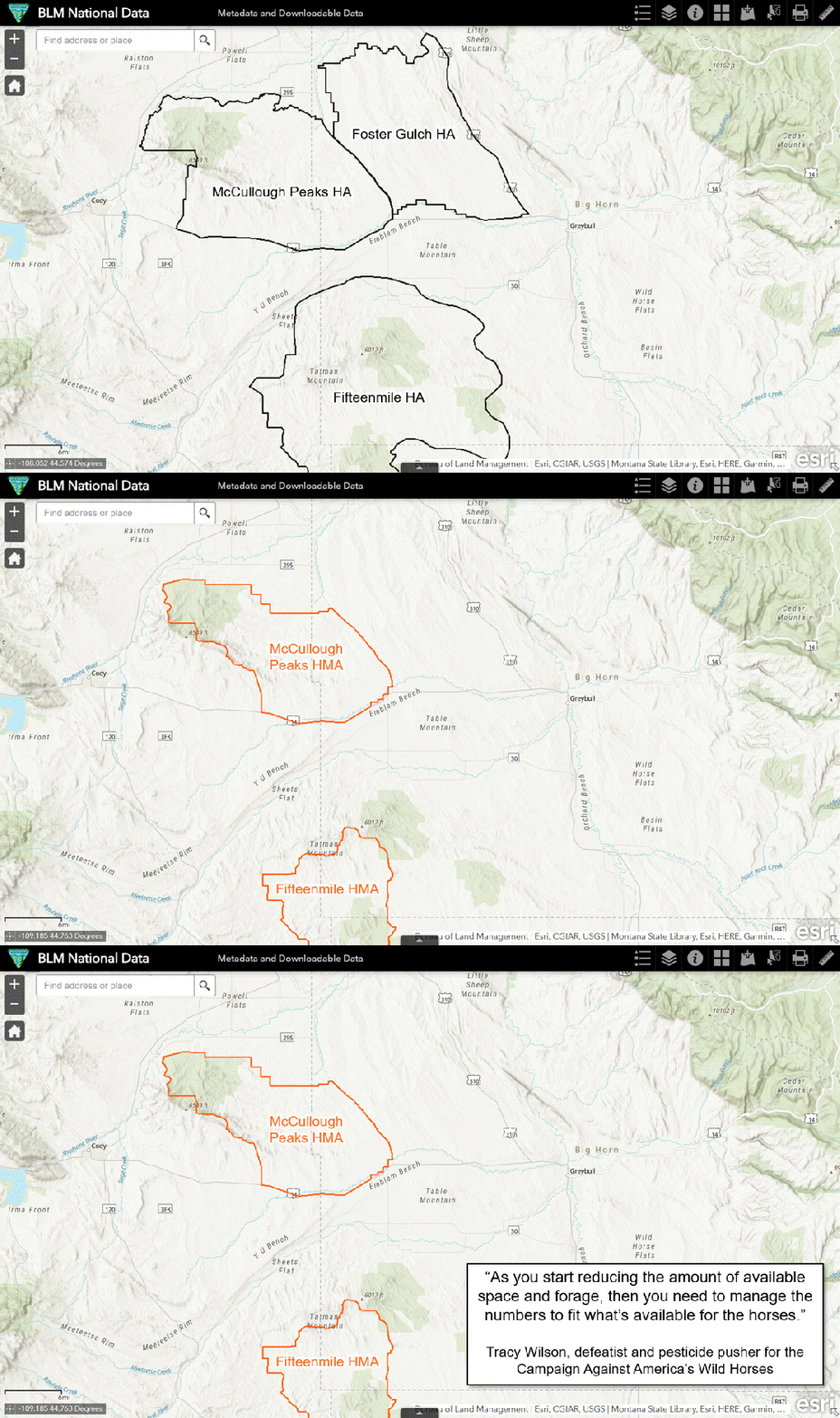
  • How many HAs will be returned to the horses?
  • How many HMAs will be managed principally for wild horses?
  • How many advocates will be investigated for unlawful use of pesticides?
  • How many contractors will be charged with abuse?

If the sponsors were truly interested in helping the horses, these questions would have nonzero answers.  They don’t.

RELATED: Colorado Wild Horse Project Helps Ranchers, Not Horses.

HMAs Freed from Grazing 05-23-21

FY23 Roundups in Review

Consider these two groups.  All were planned, all were carried out by helicopters.

Group 1

Group 2

The first group saw the advocates howling, videos of injured horses, ad hoc lawsuits and news reports about contractor mistreatment.

In the second group, the advocates were silent, with little if any media attention.

Why the difference?

Roundups in the second group were billed as catch-treat-release.

The advocates have their favorite poisons.

Some like Zonastat, others like Gonacon, but all agree that wild horses should be removed from their lawful homes with ovary-killing pesticides, not motorized equipment, even if motorized equipment is needed to apply the poisons!

RELATED: Bold Prediction for Fertility Control Solicitation.

Pesticide Pushers 07-13-23

New Regulation to Affect Wyoming Wild Horses

The proposed supplementary rule, which addresses public conduct, safety concerns involving exploding targets, flammable devices and target shooting, the possession or use of alcohol and the burning of wood pallets, among other things, would apply to all public lands in Wyoming, according to a notice appearing today in the Federal Register.

The last two provisions involve wild horses.  Accordingly,

15. You must not intentionally engage in any activity within any distance that disturbs, displaces, or otherwise interferes with the free unimpeded movement of wild horses.

16. You must not feed, water, or touch any wild horse.

Would #15 include the filming wild herds with drones, chasing them with manned aerial equipment or poisoning the mares with pesticide-laced darts?

The rule would not apply to federal, state, local and military employees or contractors acting within the scope of their official duties.

Only you.

Comments will be accepted through November 13.

Dust-Up in the Desert Reviewed

Was it truly a presentation of opposing viewpoints or simply a dispute about fine points between two factions of the same coalition?

Three reports have hit the wires in the last 24 hours:

Hansen wants the horses removed with helicopters and Beckstead wants them removed with ovary-killing pesticides.

Are wild horses overpopulated in Nevada?  Yes, there are more animals than allowed by plan.

Are there more horses than the land can support?  No, most of the resources in their lawful homes have been assigned to privately owned livestock.  If you confine the ranchers to their (multi-million dollar) base properties in a year-round off season, and expect them to pay the going rate to feed their animals, there would be plenty of food and water for the horses.

As of this morning, video of the debate has not been posted to the AWA YouTube channel.

RELATED: Dust-Up in the Desert Set for September 7.

PSA 12-07-19

Virginia Range Darting Update for August 2023

The Campaign Against America’s Wild Horses, a leader in nonmotorized removal, said in the August update that 116 mares received 116 doses of PZP during the month, 27 given as a primer and 89 as a booster.  If you can’t access the document, click here.

Over the life of the program, 1,940 mares have received 8,027 doses of the pesticide.

The report will be submitted to the Nevada Department of Agriculture.

If it was written by a stockgrower’s association, farm bureau or cattlemen’s group, there’d be few if any changes.

Of the 158 foals born this year in the primary target zone, a record low, 74 have died.

The causes of death were not discussed but predation is likely a factor.

As usual, the advocates are silent about the long-term population goal and how many horses they intend to eradicate, as well as herd demographics.  What does the sex ratio look like nowadays?

There is no mention of sterility and the growing risk thereof.

The current population is thought to be 3,559, including 395 listed as missing.

RELATED: CAAWH Publishes Virginia Range Darting Resources.

Pesticide Pushers 07-17-23

Foal-Free Friday, Fundamental Transformation Edition

The Campaign Against America’s Wild Horses, a leader in nonmotorized removal, said in a news flash posted by Lucky Three Ranch that the Cedar Mountain mustangs will never have to face the helicopters again, thanks to a new BLM grant.

This will be accomplished by turning the HMA into an HTA, a place where the mares are gradually poisoned with PZP, a restricted-use pesticide.

The project brings together diverse stakeholders, according to the announcement, including the Utah BLM, one of the permittees and CAAWH.

Except there’s no diversity in that group—it’s the Love Triangle!

With shared goals of humanely managing the Cedar Mountain horses, stewarding their habitat and eventually eliminating helicopter roundups, it’s “a model for collaboration in the wild horse conservation space.”

RELATED: Foal-Free Friday, Removal by Pesticides Edition.

Working Together for a Horse-Free Future 12-21-22

What Is a Herd Treatment Area?

As envisioned by the Campaign Against America’s Wild Horses, it’s a place where

  • Advocates poison cherished/beloved/innocent mares with ovary-killing pesticides
  • Ranchers receive most of the food and water
  • Donors pay for the destruction

Forget about HMAs and managing principally for wild horses, those ideas are as old and irrelevant as the Ten Commandments.

RELATED: If You Repeat a Lie Long Enough, People Will Believe It.

For Your Innocent Ants and Roaches 10-23-22

Winners of 2023 Stewardship Awards Announced

The bureaucrats and ranchers will be slobbering over each other today in a luncheon hosted by the Public Lands Council.

The event is part of the 2023 PLC Annual Meeting.

The winners of the Rangeland Stewardship Award, Permittee Category, divided the Apex Slope Allotment into ten pastures and implemented grazing practices better adapted to changing conditions and pasture rotations based on rangeland health, according to a BLM news release dated September 5.

Although the work contributed to improved watershed function, wildlife habitat, forage diversity and habitat resilience, the Allotment Master Report puts it in the Improve category, failure to meet standards for rangeland health.

The allotment offers 622 active AUMs on 12,953 public acres, or 48 AUMs per year per thousand public acres, equivalent to four wild horses per thousand public acres.

These same individuals insist that public lands in the western U.S. can only support one wild horse per thousand acres (27,000 animals on 27 million acres).

The winners of the Rangeland Innovation Award, Permittee Category, have used holistic resource management for over thirty years, consistently adjusting livestock numbers to changes in climatic and vegetative conditions, and have implemented temporary non-renewable grazing suited for positive resource conditions, higher precipitation years and increased biomass.

The allotment, not named in the announcement but determined through RAS, is MT04903-HRM, managed by the Billings Field Office.

The Allotment Master Report puts it in the Maintain category, meeting standards for rangeland health.

The allotment offers a whopping 1,752 active AUMs on 6,734 public acres, or 260 AUMs per year per thousand public acres, equivalent to over 21 wild horses per thousand public acres!

It’s a gold mine.

And how much does the BLM collect in royalties?  Five cents on the dollar or less.

Like Cinderella, some advocates, especially those affiliated with the Campaign Against America’s Wild Horses, a leader in nonmotorized removal, yearn to attend an event like this and be respected and admired by the cattlemen and their allies.

Perhaps they will.

They might be invited guests.

RELATED: Winners of 2022 Stewardship Awards Announced.

Pilots, Panels and Pesticides: A New Plan to Protect Permittees

Pilots to push the horses into the traps, stitched together with pipe panels, where some break their necks.

Ovary-killing pesticides to reverse population growth.

Public lands managed primarily for permitted grazing.

This is not business as usual, it’s catch-treat-release.

Herd management areas are now herd treatment areas, with stagnant or dwindling populations, thanks to the pioneering work of the wild horse advocates.

RELATED: Catch-Treat-Release, Misuse of GonaCon, Roll Out at Reveille.

Working Together for a Horse-Free Future 12-21-22

From Tolerance to Acceptance to Misuse and Abuse

Like helicopters, the fertility control pesticides are tools for boosting rancher prosperity, a goal of federal agencies charged with wild horse protection.

BLM3

This is why the helicopter ban is a ruse: It changes the way wild horse removals are carried out but does not stop them.

In a 2012 paper posted by the Billings School of PZP Darting and Public Deception, Jay Kirkpatrick, developer of the Montana Solution, speculated that “the greatest cause for opposition to PZP is the failure of advocacy groups to understand that there are really only two choices for wild horse management – roundups and removal or fertility control.  There are no other choices.”

He noted in his opening remarks that “oversight by The Humane Society of the United States assures that the vaccine is used only to slow reproduction and may not be used for the extermination of entire herds.  PZP is designed to bring about short-term infertility and is reversible, if not used beyond five consecutive years.  It reduces the need for gathers and preserves the original gene pool in each herd.”

All of this turned out to be false.

On Assateague Island, where the pesticide was applied for over twenty years, the herd has been ruined.

Trends in Assateague Population 04-27-23

On the Salt River and Virginia Range, advocates associated with the Campaign Against America’s Wild Horses are using the product to reverse population growth, not slow it.

They don’t follow EPA rules for its use.

A common violation is failure to wear the proper PPE.

FOAL Mixing PZP 01-18-22

In other areas, the advocates use the product to control horses that interfere or could interfere with animal agriculture, a purpose for which it was not approved.

In some cases, the justification is safety hazards to passing motorists, another illicit use.

The product label indicates PZP is intended for use on female wild horses and burros, privately or publicly owned, that are capable of doing environmental damage.  That’s it.

There are two other reasons why population suppression is necessary, or not necessary, depending on your point of view:

  • Habitat loss
  • Confiscation and reapportionment of resources

If you think more land should be taken from the horses and given to the ranchers, along with their food and water, you’ll demand greater use of pesticides and helicopters.

If you believe the trend is unacceptable, and want the land managed principally for the horses as specified in the original statute, you’ll oppose removal by any means.

RELATED: How the Advocates Respond to Habitat Loss.

How the Advocates Respond to Habitat Loss 07-23-23

Salt River Darting Program by the Numbers

If the initial population was 450 and the goal in ten years was 250, a six percent death rate and zero percent birth rate would be needed:

450 × (1 – .06) ^ 10 = 242

This is nonstop darting for ten years with 100% efficacy.  The mares will be sterile and the herd will be ruined, just like Assateague Island.

Another Salt River Darting Injury 08-24-23

On the bright side, the advocates may convince the bureaucrats and ranchers of their tenacity and ruthlessness, and the feasibility of nonmotorized removal, breaking the Cattoor monopoly.

RELATED: New Colt Slips Through Salt River Darting Program.

New Colt Slips Through Salt River Darting Program

The birth occurred in August but the advocates said nothing out respect for the horses, which they achieve by poisoning the mares with ovary-killing pesticides.

Now, they’re praying for a predator to fix the mistake, as they did for Mirabelle.

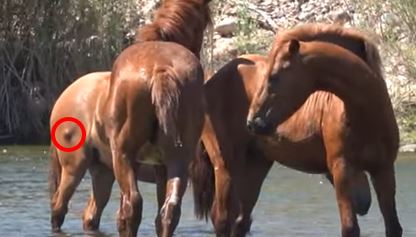
The article said his mom has been darted five times but did not say if that was a primer plus four boosters and if the injections had been given in consecutive years.

The threshold for sterility is usually taken as five consecutive years (primer plus five boosters).

Such animals are said to be “self-boosting,” a term in common use among the advocates.

What about the other mares that have been darted five times?  A herd of 400 plus should be producing more than two foals per year!

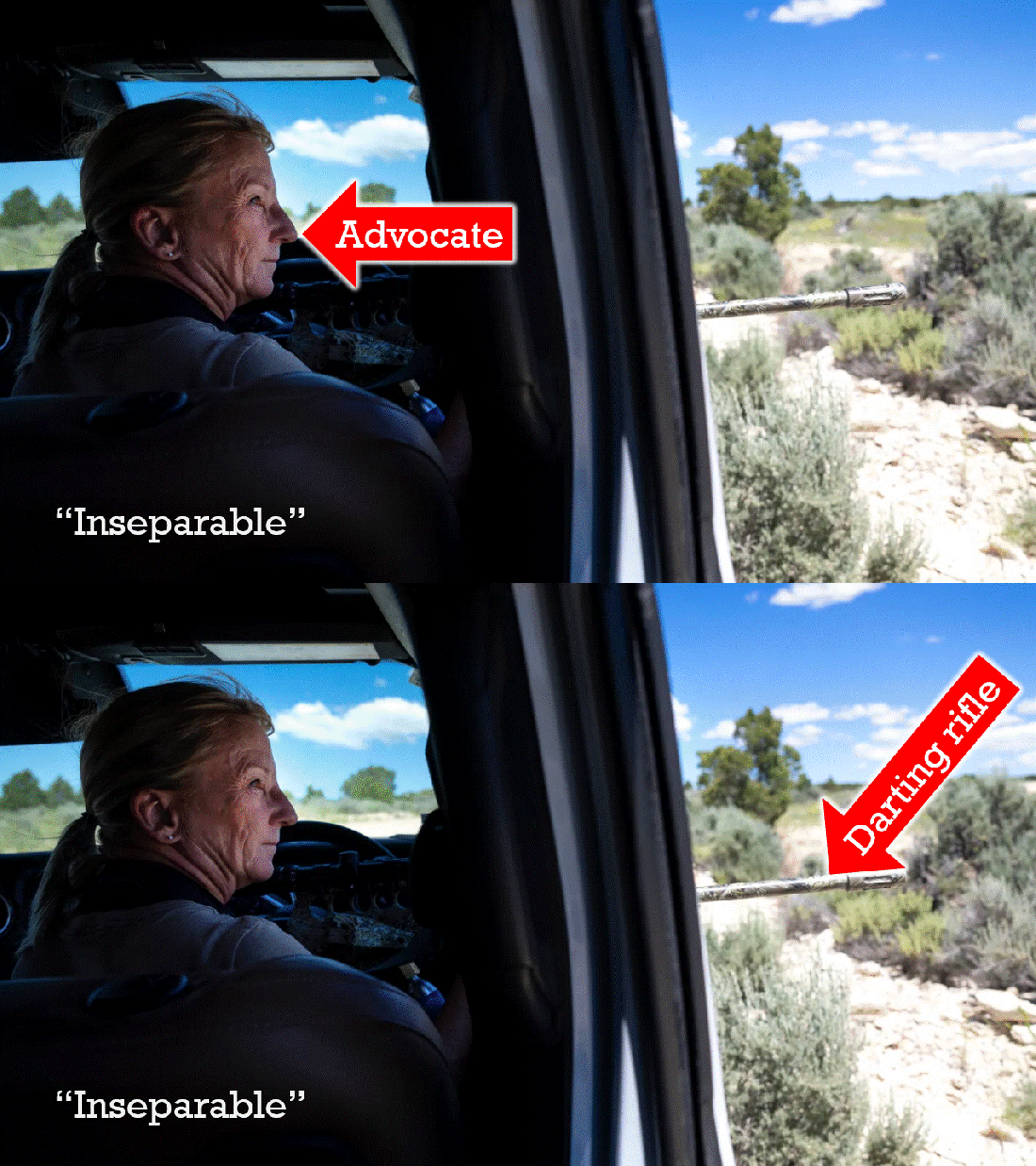
Truth is, the breeding population is nearly zero, thanks to Simone Netherlands and her band of merrymen.  Here she is in fine form, showing off her bona fides to other like-minded individuals:

Simone Neterlands with Darting Rifle 09-02-23

The writer did not dispute that PZP is a restricted-use pesticide.

You only need to look at the herd on Assateague Island to see where this is going.

There is no way these phony voices for wild horses can achieve the population reduction targets given to them by Arizona bureaucrats without sterilizing the mares.

The darting program skews the sex ratio in favor of females, exactly what they don’t want and don’t need.

They know this and they are pushing ahead full speed.

The same thing is happening on the Virginia Range, where their parent organization, the Campaign Against America’s Wild Horses, leads the effort.

RELATED: If You Repeat a Lie Long Enough, People Will Believe It.

Trends in Assateague Population 04-27-23