Virginia Range Darting Update for November 2023

The Campaign Against America’s Wild Horses, a leader in nonmotorized removal, indicated in the November report that 162 mares received 162 doses of Zonastat-H during the month, 31 given as a primer and 131 as a booster.

Over the life of the program, which began in 2019, 1,978 mares have received an astonishing 8,399 doses of the ovary-killing pesticide.

Of the 175 foals born this year in the primary target zone, 90 have died, in some cases with the aid of predators.

The current population is thought to be 3,479 with 350 horses listed as missing, compared to 3,498 with 338 listed as missing in October.

A goal for December is to “Continue to maximize booster treatments to mares across the Virginia Range to prevent pregnancies, allowing for continued population reduction.”

Better Way 10-25-23

Not discussed in the report:

  • Long-term population goal
  • Size of breeding population
  • Loss of genetic diversity
  • Herd demographics (average age of herd, sex ratio, percent foals)
  • Changes in death rates
  • Risk of sterility

The program is now in its fifth year and many of the mares are at the point of no return.

The report will be submitted to the Nevada Department of Agriculture.

The Virginia Range is subject to permitted grazing.

RELATED: Virginia Range Darting Update for October 2023.

Pesticide Pushers 07-17-23

How Much Private Land Do the Public-Lands Ranchers Control?

Nearly 120 million acres according to the Public Lands Council, with grazing privileges on more than 250 million acres managed by the USFS and BLM.

Consider the new off-range corrals north of Winnemucca.

If a private owner can care for 4,000 horses on 100 acres, the ranchers should be able to maintain 4.8 billion (4,800,000,000) cow/calf pairs on their deeded acreage.

There’s no need for permitted grazing!

Why do they want access to public lands?  Why do they view it as their birthright?

Profit, greed.  It’s a gravy train, a government giveaway.

They pay pennies on the dollar to feed their animals, compared to the Winnemucca corrals, which are subsidized by taxpayers.

Solution?  Confine the ranchers to their (multi-million-dollar) base properties, which they’re already doing, but make the off-season twelve months per year and let them pay the going rate to feed their animals.

As a result, AMLs can be increased and the landmass identified for wild horses and burros in 1971 (around 53 million acres) can be managed principally for them, as specified in the original statute.

RELATED: Winnemucca Base Property Hits Market for $11.2 Million.

AML-1

Let Giving Tuesday Become Defund the Advocates Day

They’re as phony as $3 bills!

The admission by FOAL earlier this week is just the latest revelation.

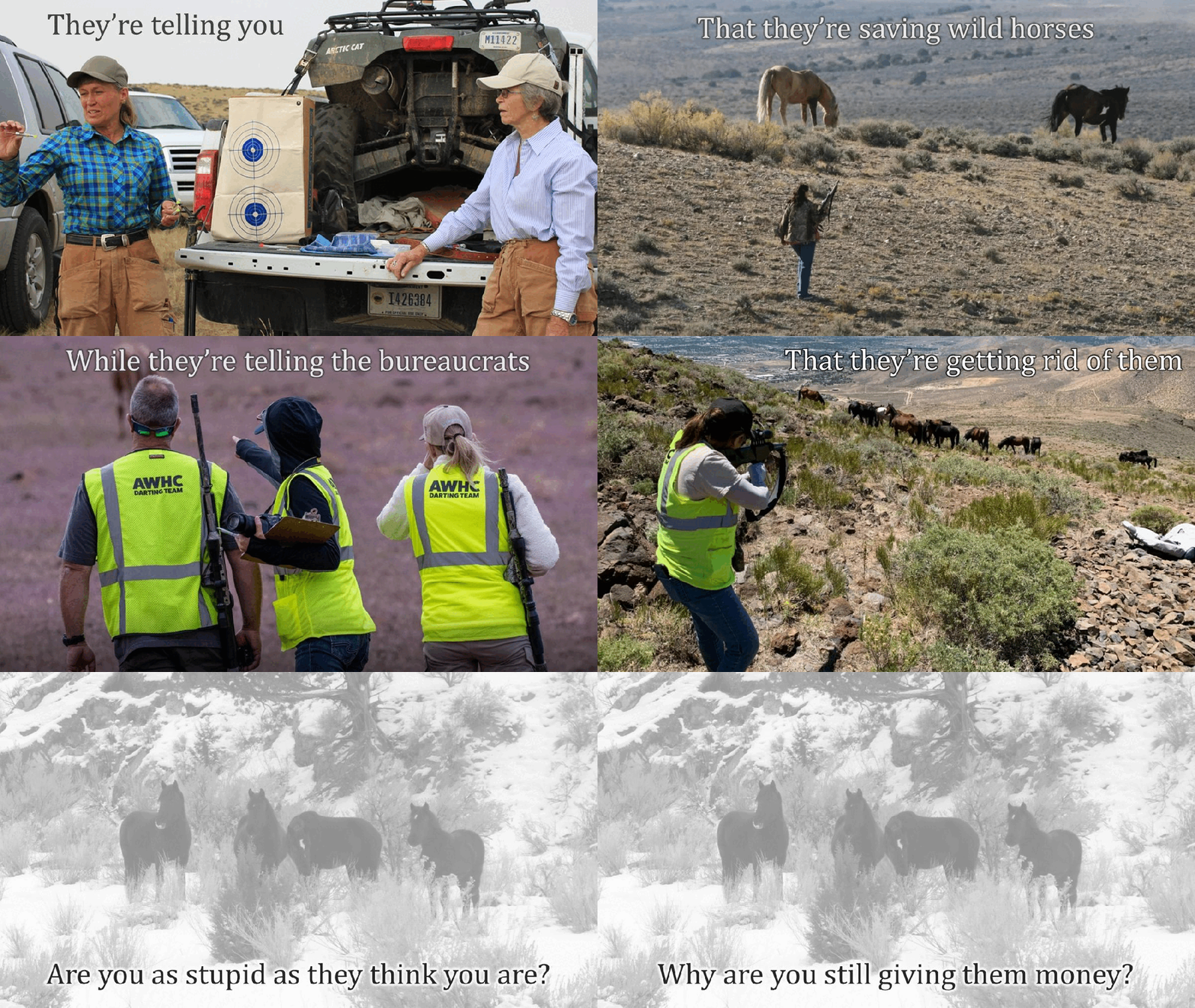
They’re telling you that they’re saving wild horses while they’re telling the bureaucrats that they’re getting rid of them.

Why support a bunch of liars, defeatists, pesticide pushers and ranching sympathizers?

Better Way 10-25-23

RELATED: Warning for Giving Tuesday.

Working Together for a Horse-Free Future 12-21-22

Foal-Free Friday, on the Verge of Collapse Edition

With the possibility of a harsh winter on an aging population, the prospects for the McCullough Peaks herd are not great.

But the advocates don’t see that as a problem, they see it as an achievement, an indication that their darting programs are far more effective in the long run than helicopter roundups.

The idea of fully contracepted herds dying off resonates with the American public, where declining moral standards make it an easy sell.

The concept explains why the population grew only 7.4% between 2010 and 2020, and why programs for the elderly, such as Social Security and Medicare, are going bust.

Not enough youngsters to hold up the lower end.

Thus, McCullough Peaks, and other areas where the advocates are snuffing out new life, are microcosms of leftist ideology and a nation that’s destroying itself.

RELATED: Foal-Free Friday, Praying for the Horses to Die Edition.

Advocates are the Predators 11-30-21

Hard Truths about TRNP Horses

The comment period closes tomorrow.

A story dated November 22 by AP News has been picked up by major news outlets.

The herd you see today is only an exhibit.  It has little if any historical significance.

The original wild horses of TRNP, thought to be descendants of Sitting Bull’s ponies, were removed by the Park Service.

Some were rescued by the Kuntz brothers and taken to their ranch near Linton.

They called them Nokotas.

Their story is told in the 2011 documentary “Nokota Heart,” available on YouTube.

Most of this is ignored in the current discussion.

Those who claim to be voices for the horses are as phony as $3 bills.

All the talk about genetic diversity and minimum herd size means nothing when you’re poisoning the mares with ovary-killing pesticides and driving the breeding populations into the single digits.

RELATED: Bold Prediction for Wild Horses at TRNP.

CAAWH Run by Lead Mares?

Their target audience is female, liberal and innumerate, apparently, most of whom are aborting, contracepting and sterilizing in their own lives and see the world not as it is but the way it should be according to their ideology.

Consider this remark from a November 10 news flash posted by Lucky Three Ranch:

In the West, wild horses travel in herds that typically consist of one or two stallions, a group of mares, and their offspring.  While the dominant stallion protects the herd and steps in when danger arises, the leader is usually a seasoned mare, often called the lead mare.

How many stallions and mares does Suzanne Roy have at her ranch?

If she actually had a family band in her care, uncut and undarted, she’d realize that stallions run the show and would never allow such statements to be sent to donors.

But truth is a handicap for these people.

They don’t care about wild horses.

They care about separating you from your money and using the proceeds to advance the ranching agenda.

And what about the offspring?  They are few and far between wherever the Campaign Against America’s Wild Horses is involved.

RELATED: How Wild Horse Advocacy Really Works.

Working Together for a Horse-Free Future 12-21-22

CAAWH Worried about Viability of McCullough Herd?

Removal of 41 horses, particularly young, reproductive-age animals, when combined with winter mortality, could create catastrophic consequences for the herd, according to a story posted today by the Cody Enterprise.

The group, a leader in nonmotorized removal, sent a letter to the BLM on November 1 offering money and staff to continue the darting program.

Getting Rid of Wild Horses Is Our Job 10-14-23

What would be the consequences if you sterilized most of the mares in a herd with your favorite pesticide?

That would be you, on the Virginia Range.

Seven of the McCullough mares have never given birth.

Because the advocates ruined them?  Only seven?

The article indicated the breeding population consisted of just 17 mares (plus a few stallions) but did not cite that as a problem or threat to long-term genetic viability!

RELATED: Advocates, Not BLM, Ruined McCullough Peaks Herd.

How Wild Horse Advocacy Really Works

The writer of the November 18 commentary in the Elko Daily Free Press about the way land and wild horse management really work stated:

There is an aspect of emotion that hangs over wild horse roundups.  Wild horse advocates openly profess to love wild horses.  The livestock industry, state agency officials, even a few badly biased scientific researchers, hate them.

The advocates say they love wild horses but their actions indicate otherwise.

There is love, however, among the players in the Love Triangle, for each other and for their common goal.

Donate 08-17-23

They’re poisoning the mares with ovary-killing pesticides, under the guise of protection and preservation, and they want you to pay for it.

RELATED: How the BLM Really Manages Land and Wild Horses.

Pesticide Patrol 08-16-23

How the BLM Really Manages Land and Wild Horses

The Elko Daily Free Press published a rebuttal today of a November 9 interview about the way the agency manages land and wild horses.

A distinction should be made between the leading consumers of resources on America’s public lands: Those who compete with wild horses and those who don’t.

Drillers and miners are not exploring for forage.  Wild horses don’t care about oil, gas, vanadium and uranium.

The conflict is with the public-lands ranchers.

A drill pad might occupy an acre or two and an open pit mine might require a few thousand acres, while permitted grazing devours entire HMAs and beyond.

As for economics, if the BLM pays $60 per AUM for a horse in long-term holding, as noted in the column, while collecting $1.35 per AUM from the permittee whose cow/calf pair replaced him, how can that ever be viewed as a wise use of the public lands?

RELATED: Helicopters Don’t Force Wild Horses to Do Anything?

Foal-Free Friday, Praying for the Horses to Die Edition

The advocates are so far gone and so hopelessly lost in their pesticide paradigm that they actually want the horses to die.

One example is McCullough Peaks, where the average age of the herd is increasing, along with the death rate, because few if any new foals are hitting the ground.

The older horses may not survive the winter, which the advocates anticipate and desire.

Anything to avoid motorized removal.  Anything to prove their darting programs are working.  Anything to keep the resources shifted in favor of the public-lands ranchers.

At the Virginia Range, where the Campaign Against America’s Wild Horses operates its flagship darting program, they’re driving the birth rate to zero and letting the herd die off.

They’re telling you that they’re saving the horses while they’re telling the bureaucrats that they’re getting rid of them.

Their affiliates in Arizona are doing the same thing to the Salt River herd, where a zero percent birth rate and six percent death rate will be needed for ten consecutive years to achieve the population target.

By then the mares will be sterile and the herd will be lost.

Ditto for the Virginia Range.

These groups should be banned from areas identified for wild horses.

RELATED: Foal-Free Friday, Snubbing the Wild Horse Advocates Edition.

Pesticides R Us Better Way 11-07-23

Fully Contracepted Herds Were Good Before They Were Bad

A year ago it’s what the advocates wanted for all wild horses, but now that the Park Service has proposed it for the horses at TRNP, they oppose it.

Actually, they still like the idea, but if you knew that they’d lose your financial support.

Kinda like the one-horse pony telling his voters they didn’t have to pay back their student loans.

The idea fizzled after the election.