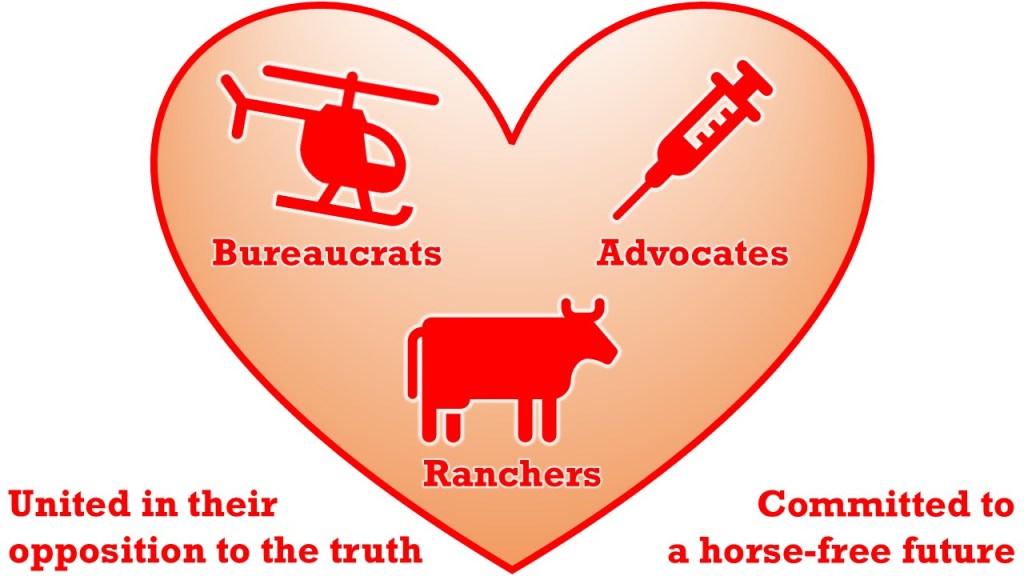
They rob too much forage from the most noble and deserving nonnative species on America’s public lands, placed there by high-net-worth individuals who pay almost nothing for the resource and the services rendered on their behalf by the government.
Put simply, they interfere with redistribution of wealth, a hallmark of liberalism.
It’s not “a war on wildlife, propping up special interests while ranchers and communities bear the brunt of unbalanced ecosystems and federal overreach” as stated in the commentary.
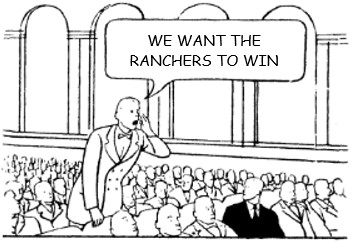
Ranchers are the special interest.
Then there’s the unsubstantiated claim that horse meat derived from public lands re-enters U.S. markets illegally from Mexico and Canada as a diluent of ground beef.
And the misallocation of water.
The guy’s as ill-informed about wild horses as the wild horse advocates.
Its affiliates page displays logos of trade groups representing meat and wool producers but none from the wild horse advocates.
Its policy statement acknowledges the support of some groups in developing the “Path Forward,” a 2019 plan for ranching superiority in the lawful homes of wild horses.
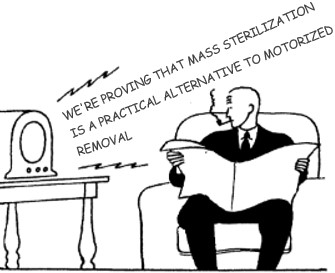
Since then other groups have stepped forward with projects that demonstrate the feasibility of mass sterilization as an alternative to motorized removal, notably at the Salt River and Virginia Range.
So why won’t PLC bring them on board and recognize their contributions to the ranching agenda?
Nowhere is it more evident than in the wild horse world.
Refer to this opinion piece in Compact for a survey of the situation.
It is still controversial, even in conservative circles, to say that there are too many women in a given field or that women in large numbers can transform institutions beyond recognition in ways that make them cease to function well.
The BLM must pay $4.78 per head per day for the contract extension, according to a report by The Colorado Sun, up from $4.45.
That works out to about $143 per AUM.
The agency receives $1.35 from ranchers for every AUM on public lands liberated by removal of wild horses therefrom, an irrational and unsustainable practice.
The advocates would solve the problem by poisoning the mares with ovary-killing pesticides, leaving everything for the ranchers.
The article said that alfalfa hay is higher in nutrients and more expensive than grass hay or alfalfa-grass mix, which is contrary to experience.
In this area alfalfa usually costs a few dollars less per bale than grass or mix, which explains why it’s a mainstay of diets in off-range corrals.
Some horses cannot adapt to the feed, which is not found in their lawful homes.
The Wild Horse and Burro Protection Act would phase out the use of helicopters and fixed-wing aircraft for rounding up free-roaming horses and burros, a practice that leads to population growth according to the advocates.
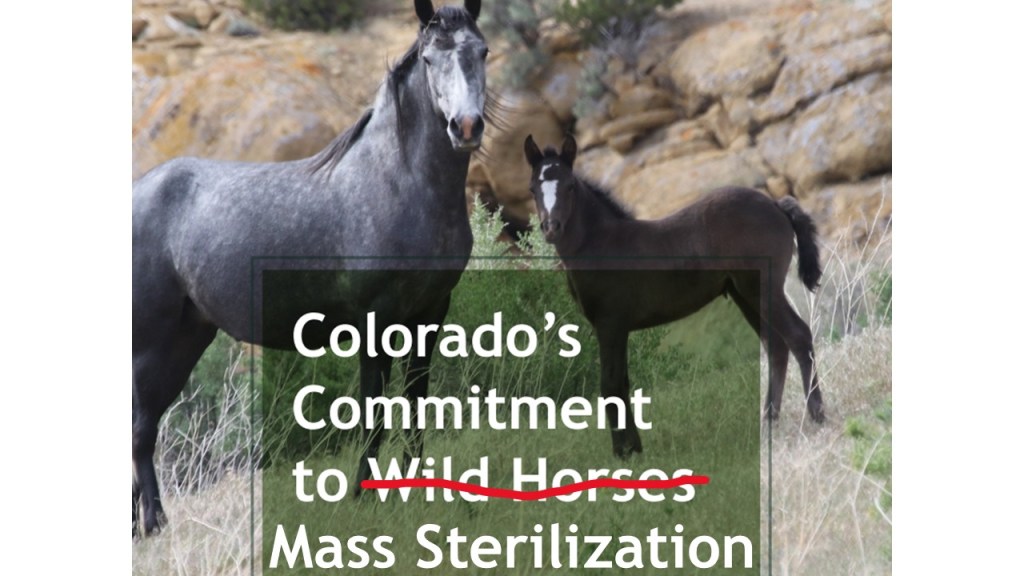
The alternative would likely be long-term use of immunocontraceptives, sometimes referred to as mass sterilization, a service they provide.
The bill would not link Appropriate Management Level, an undefined concept in the statute, to principal use.
The Decision Record authorizes Alternative A, the Proposed Action, discussed in section 2.4 of the Final EA.
Details of the new HMAP can be found in Appendix XIII.
No changes to AMLs or authorized AUMs
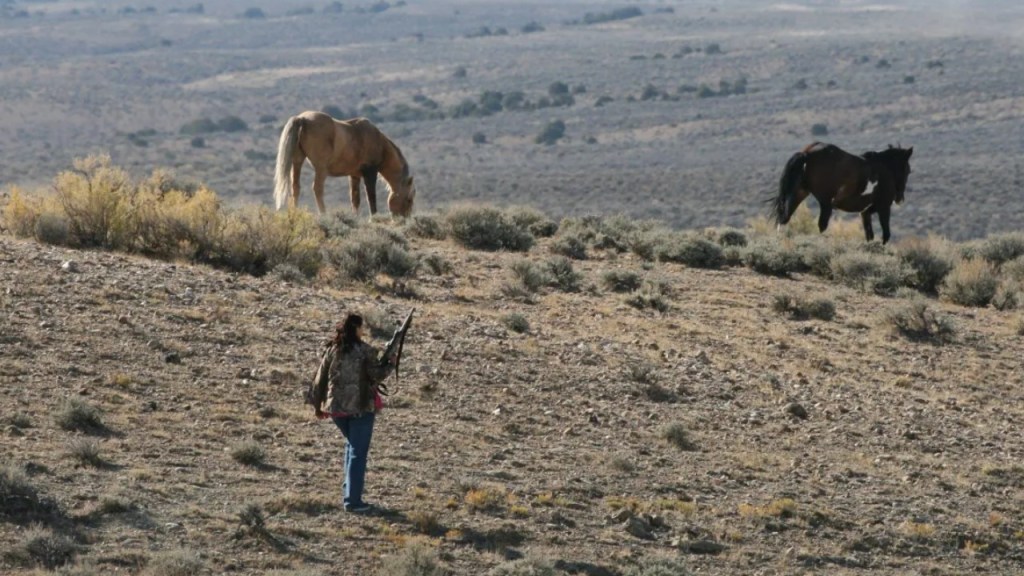
Forcible removal
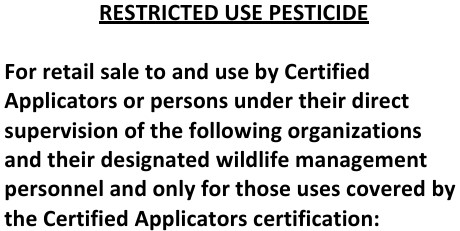
Application of fertility control pesticides
Skewing of sex ratios in favor of males
Monitoring of genetic diversity
Massive interference in natural order
Recall the rallying cry in the Nevada Current op-ed: “America’s wild horses have faced competition from livestock, unfair resource allocation, and shrinking habitat for generations.”
How does the new plan fix any of that?
It doesn’t. The only change the advocates want is more government spending on services they provide.
The Campaign Against America’s Wild Horses will serve cookies and hot cider on October 23 as they try to convince you that mass sterilization is a humane alternative to motorized removal.
How stupid do you have to be to believe anything from these phonies?
John Mack has left the group over disagreements with founder Jacquelyn Hughes as to how many horses should be removed from the Salt River herd according to a report by Phoenix New Times.
That shifts management responsibilities to Hughes for five years if AZDA was to select her proposal, which is not her style.
As a wild horse removal contractor, she wants to get in, get the job done and move on to the next opportunity.
By contrast, the Salt River advocates have stayed the course, which is necessary to sterilize the mares.
1. End the Roundups. “Halt helicopter roundups and stop funneling horses into holding facilities or auctions.” The goal is to end the removals not the roundups. Bait trapping and fertility control are alternate methods of removal.
2. Return Horses to the Wild. “Reintroduce horses and burros to their designated lands where they legally belong.” Not if they’re managed principally for livestock.
3. Herd Management Solutions. This one wrecks the whole program: “Work with experts, ranchers and advocates to implement responsible herd management practices that protect horses and respect ranching interests.” Resource management is a zero-sum game. What you give to the ranchers must be taken from the horses. This is why there so many in off-range holding. Not compatible with item 2.
4. Cut Costs and Save Taxpayer Money. “Replace costly confinement programs with humane, natural management that saves taxpayers hundreds of millions of dollars annually.” Probably a reference to fertility control, straight out of the advocates’ playbook.
5. Build Coalitions for Change. “Partner with leaders, advocates, and public voices…to bring national attention and action to the issue.” Enlarging the committee will not produce the required knowledge.