The memorandum of understanding, signed by both agencies, will strengthen coordination, cut bureaucratic red tape and deliver immediate, tangible support for America’s farmers and ranchers who rely on public lands.
“By working closely with American ranchers, we are enhancing communication, investing in innovation, and modernizing our approach to land management practices,” according to Secretary Burgum, “to deliver real results for the people who feed and sustain this country.”
Yep, if it wasn’t for them we’d all be vegans.
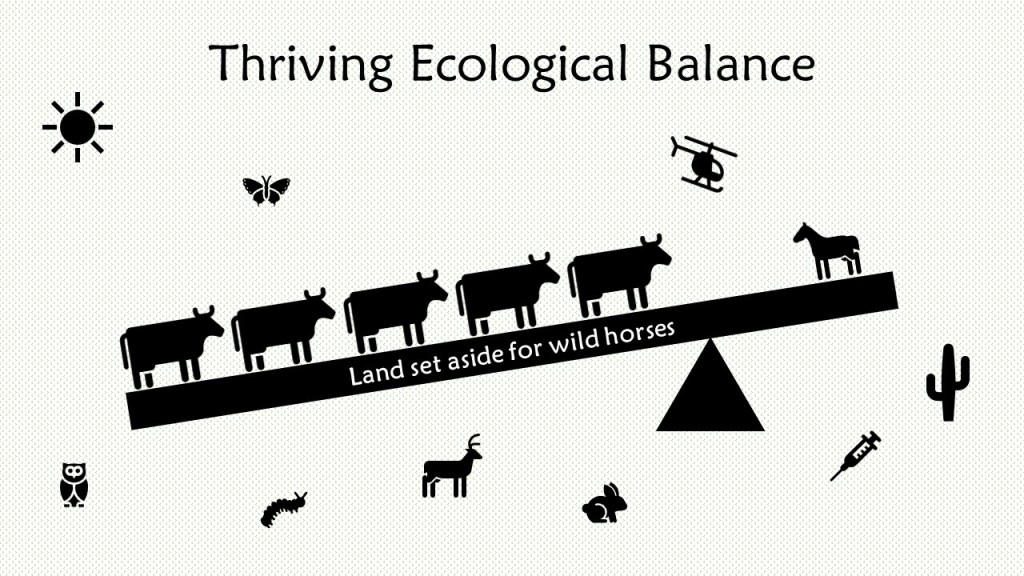
The aim of the grazing program is to ensure that high-net-worth individuals receive generous government benefits, often at the expense of America’s wild horses and burros, with no means testing and no expiration dates.
Yesterday the Agendas & Minutes page contained links to documents from three special meetings.
Today, it has links for March 12 only, minus the minutes.
Minutes from the September 18 special meeting put the herd size at 112 but did not indicate the number of males and females.
The number of self-boosting mares was not provided. (Refer to the AdvocateSpeak decoder if you don’t know what that means.)
The size of the breeding population was not provided.
The effect on genetic diversity was not discussed.
Healthy mares were not darted in 2025 due to questions about the long-term effects of PZP according to comments under Action 1K (bottom of page 12 in the pdf).
In an attempt to thwart a better understanding of how the pesticide works, protocols are in place to send the uterus—not the ovaries—of any deceased mares to researchers at the Science and Conservation Center for analysis (manufacturers of PZP).
The herd area is not suitable for wild horses but the allotment that contains most of it supports livestock equivalent to 962 wild horses.
The equivalent stocking rate in the allotment is 6.9 wild horses per thousand public acres, almost seven times higher than the rate that avoids rangeland degradation (one wild horse per thousand acres according to your faithful public servants).
If the bureaucrats and advocates held a lying contest, who would win?
The project started with the donation of a ten-acre parcel according to a story by The Journal of Cortez, CO.
It’s not a base property and doesn’t have grazing privileges on public lands.
The facility reflects a shift in the group’s priorities, from keeping wild horses on public lands to ownership of displaced animals and placing them into private care.
The ranchers couldn’t be happier.
Western Horse Watchers refers to the trend as the downward spiral in wild horse advocacy, characterized by acceptance of methods that were previously eschewed.
If a proposed refuge doesn’t include public lands and doesn’t displace livestock therefrom, it’s not worthy of your support.
2. Law of excluded middle: A ∪ Ac = S, everything is A or not A.
3. Law of contradiction: A ∩ Ac = ∅, nothing is A and not A.
Unfortunately, those are rules of thought. The material world need not conform.
Consider the West Douglas Herd Area in Colorado.
A BLM spokesman said it’s not suitable for wild horses according to an article about the new roundup schedule by The Colorado Sun.
A wildfire destroyed most of their food.
But the HA lies mostly within the Twin Buttes allotment, with a small portion in East Douglas Creek, and the allotment master report for Twin Buttes shows only nine percent of the authorized AUMs in the suspended column.
The active AUMs would support 962 wild horses.
Can a fire burn some of the forage and most of the forage?
Can the land be fit for wild horses and not fit for wild horses?
The bureaucrats would have you believe that. They’re as nutty as the advocates.
Proponents of eugenics claimed they were trying to improve genetic quality while critics said they were trying to preserve the position of dominant groups in the population.
A disproportionate number of those identified for sterilization were African American, Asian American and Native American women according to an article by Wikipedia.
The idea was to diminish those who were seen as unfit for society—the poor, the disabled, the mentally ill and persons of color.
The movement may have fallen out of favor but some practices, such as sterilization, have spread to America’s public lands.
We need to cleanse the range of certain undesirable elements that rob forage from livestock and return little if any economic benefit.
What you may not realize is that today’s eugenicists, like their predecessors, have a hidden agenda.
The bill would create a Colorado wild horse license plate, fees and compulsory donations notwithstanding.
The tags should feature an image of an advocate shooting a darting rifle, reflecting the state’s commitment to barren mares, shrinking herds, increasing death rates, abnormal sex ratios and loss of genetic diversity.
The field trip on Day 2 leads to the Onaqui Mountain HMA, where the advocates have added GonaCon to their darting repertoire, a practice they previously opposed, to beat the horse population down in favor of livestock.
Just another example of the downward spiral of wild horse advocacy.
Day 4 features presentations about rescues, sanctuaries, innovative programs and real pathways to getting horses into homes—exactly what the ranchers want.
Not to be discussed is the model employed by American Prairie and the Wild Horse Refuge: Owning or controlling private property tied to public lands and flipping the preference to horses.
The last roundup schedule of FY25 showed 16 darting programs, nine employing PZP, six using GonaCon and one based on both.
In the new schedule for FY26, the program at Little Book Cliffs has shifted to the mix, bring the total in that category to two.
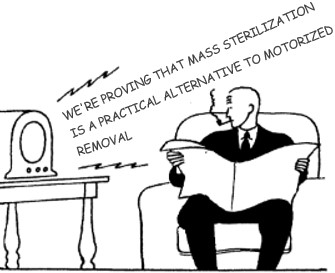
It’s a small change that reflects desperation of the advocates to remain relevant, keep their seat at the table and prove that fertility control is the preferred alternative to motorized removal.
Even if they resort to methods they previously opposed.
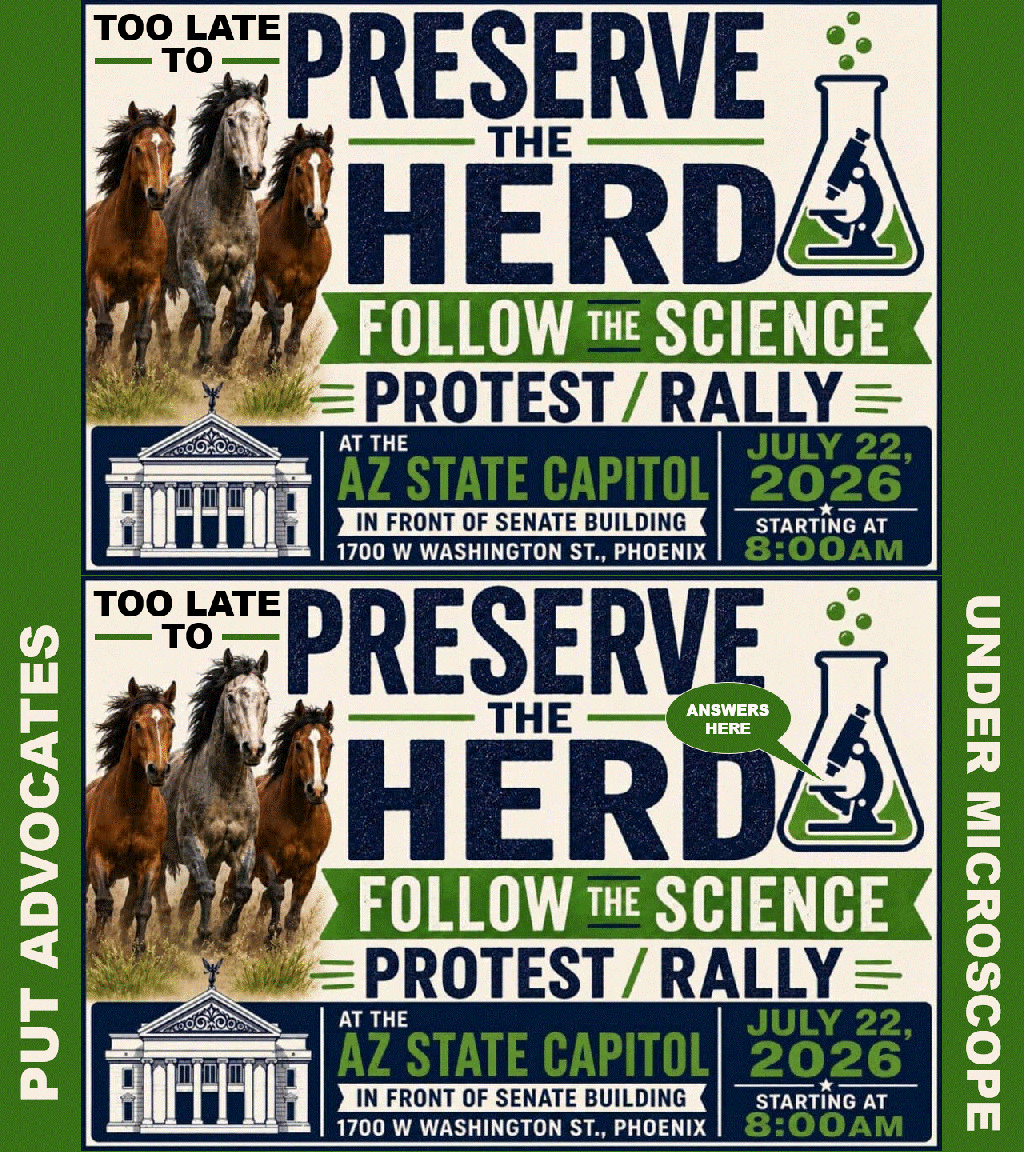
The move follows shifting attitudes in Arizona, where the advocates will supplement their mass sterilization program with motorized removal to hasten the decline of the Salt River herd, starting this summer.
The reality is the remnant staff at the Campaign Against America’s Wild Horses is still composed of defeatists, pesticide pushers and ranching sympathizers.
In recent years, Roy transformed the nonprofit into a ranching advocacy group, with heavy reliance on pesticides to achieve the government’s population goals, while the board looked the other way.
Not really.
Her bogus land trust is in an area where livestock are welcomed but horses are not.
The title of largest attempted eradication of wild horses belongs to her for the mass sterilization program on the Virginia Range.
A sigh of relief must have gone up at her departure.
Western Horse Watchers does not know who’s currently driving the bus and if the reduction-in-force is part of a restructuring and rededication to its original mission.
Key responsibilities include managing the executive director’s calendar, inbox triage, meeting preparation, follow-ups and travel logistics according to an undated job posting on Indeed.
Does that mean the executive director is suffering from mental illness or is in a state of cognitive decline?
The Campaign Against America’s Wild Horses and its partner organizations lead the nation in mass sterilization and undying service to the public lands ranchers.
An article by Courthouse News Service does not identify the appellants but they may be permittees on the Stone Cabin allotments.
The case centers around the definition of “immediate,” as in immediate removal of excess animals when overpopulation exists. Refer to §1333(b)(2) in 16 USC 30.