They Should Fear the Executions, Not the Roundups

Here are some of the headlines on Drudge.  The link about roundups pointed to a story on Mediaite.

Headlines on Drudge 10-14-24

There may be a few acute injuries and deaths as the traitors are taken into custody but nobody will be dispatched for pre-existing conditions, such as being America-hating liberals who supported our enemies and tried to destroy everything that’s right and good in this country.  We have a justice system for that.

Twin Peaks Roundup Day 7 10-07-24

Kiger-Riddle Management Plan Breaks with Tradition

Due to their popularity, horses captured in these roundups had a very high adoption rate, 100% in some cases.

For this reason the BLM did not apply population suppression in the HMAs, such as fertility control pesticides, sex ratio skewing and castration of stallions.

You won’t find any remarks about that at the HMA pages [Kiger | Riddle] but you can still see them at the 2015 gather page:

Kiger Population Control Statement 10-13-24

That has changed in the new plan, issued in July.

The Decision Record authorized Alternative A, the Proposed Action, discussed in Section 2.2 of the Final EA.

The option, titled “Remove Excess Wild Horses and Implement Intensive Fertility Control Management over a Ten-Year Period,” includes the use of Zonastat-H and GonaCon Equine—a practice that’s been avoided for many years.

More troubling, however, are the inconsistencies in the discussion of these pesticides, starting at the bottom of page 149 in the EA (156 in the pdf).

Like the Buffalo Hills EA, the citation for GonaCon Equine is out of date:

“The EPA required product label associated with the registration for ZonaStat-H is cited in the EA as EPA (2012).  That label states that ‘For maximum efficacy, ZonaStat-H is administered as an initial priming dose followed by a booster dose at least two weeks later.’  The EPA-required product label associated with the registration for GonaCon-Equine is cited in the EA as EPA (2013).  That label states that ‘If longer contraceptive effect is desired, a second vaccination may be given 30 or more days after the first injection or during the following year with no known adverse health effects to the vaccinated animal.’”

The registration was amended in 2015 and 2017.

In 2013 (and 2015) GonaCon was a restricted-use pesticide.  In 2017, that designation was dropped.

In 2013 the shortest interval between treatments was 30 days.  In 2017, the EPA increased it to 90 days.

Zonastat-H is still a restricted-use pesticide, meaning it’s not available for retail sale and you must be certified to apply it.  That’s why the advocates spend three days at the Billings School of PZP Darting and Public Deception.

The EA acknowledges the certification requirement on page 158 of the pdf: “In keeping with the EPA registration for ZonaStat-H (EPA 2012; reg. no. 86833 1), certification through the Science and Conservation Center in Billings, Montana is required to apply that vaccine to equids.”

But there is no such statement for GonaCon Equine, which should be there if they’re referring to the 2013 (or 2015) registrations!

The absence of that remark suggests they’re following the 2017 amendment but violating the 90-day interval between treatments.

Apparently, they want the 30-day interval of the old registrations and the certification-free policy of the new registration.

You can’t have it both ways!

These errors invalidate the EA in this writer’s opinion and the court should halt the roundups as the coalition requested.

RELATED: Coalition Tries to Block Kiger, Riddle Mountain Roundups.

Coalition Tries to Block Kiger, Riddle Mountain Roundups

The plaintiffs, consisting of the Oregon Wild Horse Organization, Central Oregon Wild Horse Coalition and Western Watersheds Project, argue that the BLM must demonstrate that wild horse removals will restore an ecological balance on public lands but failed to do so, according to an October 11 report by Capital Press.

The claim will likely not hold water once the court realizes that achieving a thriving ecological balance means ranchers accessing most of the food in the lawful homes of wild horses, a result the agency seeks consistently across ten western states.

The advocates, defeated a long time ago, underscore the philosophy with their darting programs.

The final planning documents covering the roundups were copied to the project folder on July 22 and they are on the October 7 schedule.

The wild horse and burro program is a grazing program ancillary, protecting ranchers by minimizing the pests and enforcing resource allocations already on the books.

Other such functions include predator control (mostly at the state level), wildfire recovery, sagebrush restoration and pinyon/juniper eradication.

RELATED: Pest Control Plan for Kiger and Riddle Mountain HMAs Stalled?

Thriving Ecological Balance-3

Virginia Range Darting Update for September 2024

The Campaign Against America’s Wild Horses, a leader in nonmotorized removal and staunch opponent of principal use, reported today that 91 mares received 93 doses of PZP during the month, 13 given as primers and 80 as boosters.

Over the life of the program, which began in 2019, the advocates have pummeled 2,064 mares with 9,860 doses of the pesticide, for an average of 4.8 doses per mare.

The epicenter of the program is in and around the Tahoe Reno Industrial Center, listed as USA Parkway in the page 3 chart.

Since the beginning of the year, 161 foals have been born and 54 died.

The current population is thought to be 3,501 with 299 horses listed as missing, compared to 3,515 with 302 horses listed as missing in August.

The population was 3,548 with 311 listed as missing in July and 3,521 with 302 listed as missing in June.

The Year 6 agreement with NDA has not been posted to the darting resources page.

The Year 5 summary has not been posted to the monthly reports page.

A goal for October is to maximize booster treatments so the herd will continue to shrink and to complete the training of newly certified darters.

Not discussed in the September update:

  • Long-term population goal
  • Number of viable mares
  • Size of breeding population
  • Loss of genetic diversity
  • Changes in death rate and sex ratio
  • Unlawful use of pesticides

The report will be submitted to the Nevada Department of Agriculture.

RELATED: Virginia Range Darting Update for August 2024.

Adjectives for Pests 12-01-23

Poisoning of Wild Horses No Longer Allowed?

You can’t poison their water holes per 18 USC 3 §47, a common practice before 1959.

Poisoning Wild Horses Outlawed 09-29-24

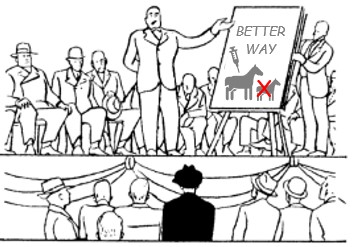
Today, the advocates poison the mares with Zonastat-H, a restricted-use pesticide that tricks their immune systems into attacking their ovaries.

Better Way 10-25-23

The ranchers are also involved, but they prefer GonaCon Equine.

Their methods may differ but their goal is the same: Ranching superiority in the lawful homes of wild horses.

RELATED: If You Want to Help the Ranchers Give Money to the Advocates.

FY25 Roundup Plan to Build on FY24 Successes?

It’s not about healthy horses on healthy rangelands as suggested in the September 26 blog post, it’s about ranching superiority in the lawful homes of wild horses, sometimes referred to as achieving and maintaining AMLs.

The advocates stopped playing for the home team years ago.  Today, they support the effort through their darting programs (first part of schedule).

Ranchers perform the task in Oregon.

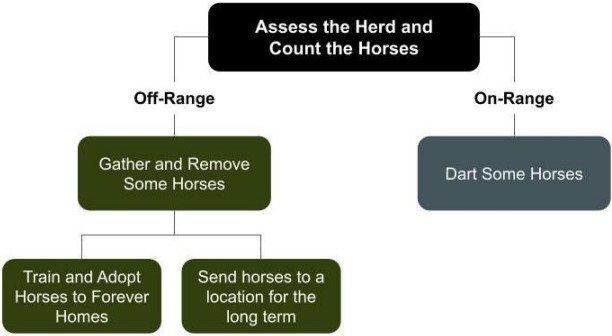
In herds where field-darting is not practical, the BLM will capture the animals, provide the treatment and return them to the range.  These incidents have been marked “CTR.”

The column did not indicate how much forage had been assigned to livestock in the areas targeted for removal, which would allow you to decide by calculation if they’re really overpopulated.

FY25 begins on October 1.

RELATED: FY25 Roundup Schedule Issued.

Working Together for a Horse-Free Future 12-21-22

Foal-Free Friday, Breaking the Addiction Edition

The advocates say that wild horse adopters should not receive cash incentives because they turn the process into a money-making venture, with some animals ending up in slaughter.

Similarly, the advocates should not be given financial support because it fuels their obsession with pesticides, primarily PZP.

Instead, they should be given vouchers for treatment at Betty Ford clinics or similar institutions, where they can be deprogrammed and educated in basic math, rational thought and intellectual integrity.

RELATED: Foal-Free Friday, Gaslighting Your Supporters Edition.

Sand Wash Advocates 01-17-22