Gonacongate: What Did They Know and When Did They Know It?

The case centers around the unlawful use of pesticides and falsification of government documents.

If BLM staff knew about the 2017 registration amendment, and recent EAs for wild horse roundups suggest they did, but referred to the 2013 and 2015 registrations because they better served their anti-horse agenda, that would constitute falsification of official government records.

The Kiger-Riddle management plan, published in July, is one example.

Initiated in early 2020, the project took over four years to complete.

The EA refers to the 2013 registration, according to which the product was a restricted-use pesticide requiring applicator certification, and the minimum interval between doses was 30 days.

But, unlike the discussion of PZP, the EA is silent about the certification requirement, which is consistent with the 2017 update.

The Pancake EA provides the same evidence.

In addition to dropping the RUP designation, the 2017 update increased the minimum interval between doses from 30 days to 90 days.

Yet the agency typically waits only 30 days to administer the booster, which constitutes unlawful use of the pesticide.

GonaCon Violation of Federal Law 08-05-23

The driver may be cost avoidance—the goal is to spend more of your budget on wild horse removals, not temporary holding of mares that will go back on the range and rob the poor ranchers of their birthright.

How many of the GonaCon darters at Piceance Mustangs and High Desert Strategies are certified applicators?  More evidence that our faithful public servants knew about the 2017 amendment but ignored the parts they didn’t like.

This is a matter for law enforcement.

The response to a comment in the Buffalo Hills DNA indicates they’re aware of the 2017 update but want to shrink the treatment window to 7 days.

GonaCon Comment Buffalo Hills DNA 11-08-24

Unfortunately for them, asking the EPA to change the registration does not absolve prior wrongdoing.

RELATED: Another Amendment to Gonacon Registration in the Works?

Advocates Send Currituck Mule to Beach in the Sky

Some headlines said he died, such as this one by WITN News, but he was killed by the advocates.

Seems like there’s a steady stream of negative results coming from areas where the advocates are involved.

The winner for 2024 will likely be the loss of 24 Virginia Range mustangs in a botched attempt to rescue them from a construction area in south Reno.

RELATED: Advocates Let Currituck Stallion Die Naturally?

Another Amendment to Gonacon Registration in the Works?

The Buffalo Hills DNA indicates the BLM has asked the EPA to revise the label, changing the interval between treatments from 90 days to 7 days.

This means that they know about, and probably knew about, the 2017 update, which increased the interval of the 2013 and 2015 registrations, which they usually cite in their planning documents, from 30 days to 90 days.

Moreover, mares captured in roundups typically receive two doses 30 days apart, which constitutes unlawful use of the pesticide.

GonaCon Violation of Federal Law 08-05-23

When will law enforcement get involved?

And what about the ranching sympathizers at Piceance Mustangs and High Desert Strategies who apply the product with the agency’s blessing?

Western Horse Watchers searched the EPA web site for “Gonacon” and did not find any recent updates for the equine version.

RELATED: An Incomplete History of GonaCon Equine.

Virginia Range Darting Update for October 2024

The Campaign Against America’s Wild Horses, a leader in nonmotorized removal and fierce opponent of principal use, reported today that 107 mares received 108 doses of PZP during the month, 19 given as primers and 89 as boosters.

Over the life of the program, which began in 2019, 2,068 mares have received 9,967 doses of the pesticide, for an average of 4.8 doses per mare.

The results fell 33 doses short of the 10,000-dose milestone predicted for October.

The epicenter of the program is in and around the Tahoe Reno Industrial Center, listed as USA Parkway in the page 3 chart.

Since the beginning of the year, 165 foals have been born and 66 died.

The current population is thought to be 3,465 with 294 horses listed as missing, compared to 3,501 with 299 horses listed as missing in September.

The population was 3,515 with 302 horses listed as missing in August and 3,548 with 311 listed as missing in July.

The Year 6 agreement with NDA has not been posted to the darting resources page.

The Year 5 summary has not been posted to the monthly reports page.

A goal for November is to maximize booster treatments so the herd will continue to shrink and to complete the training of newly certified darters.

Not discussed in the October update:

  • Long-term population goal
  • Number of viable mares
  • Size of breeding population
  • Loss of genetic diversity
  • Changes in death rate and sex ratio
  • Unlawful use of pesticides

The report will be submitted to the Nevada Department of Agriculture.

RELATED: Virginia Range Darting Update for September 2024.

Adjectives for Pests 12-01-23

Starting a Nonprofit That Actually Helps Wild Horses

Where would you get ideas for your business model?

Forget about the advocates.  They’re obsessed with pesticides and HMAPs.  They want the ranchers to win.

Sanctuaries help the bureaucrats move wild horses off the range.  They represent victory for the ranchers and failure for the horses.

Adoption and training free-up space in the off-range corrals so more wild horses can be removed from their lawful homes.  Another dead end.

Mustang Monument provides a few hints.

The project would end permitted grazing on the Spruce Allotment.  This is good, put it on the list of desired characteristics.

The land ratio is excellent, 14,000 deeded acres provide access to over 500,000 public acres.  Another item for the list.

Three HMAs were threatened.  Spruce-Pequop would probably be lost.  Unacceptable.

The new herd would consist of 900 nonreproducing animals.  Unacceptable if you’re trying to preserve the bloodlines for future generations.

American Prairie purchases base properties tied to public lands to achieve their conservation goals, a technique they call “leverage.”

The aim of the new nonprofit would be to displace privately owned cattle and sheep from America’s public lands by acquiring deeded acreage associated therewith and flipping the grazing preference to wild horses (or burros).

Highly leveraged properties, with land ratios of ten or more public acres for every private acre, are most desirable.

They should not overlap areas identified for wild horses and burros.

With the ranchers out of the picture, other techniques, such as the reintroduction of predators and self-managing herds, can be considered to promote genetic diversity while keeping the breeding populations in balance with their environment.

Socialist Media Update for October 2024

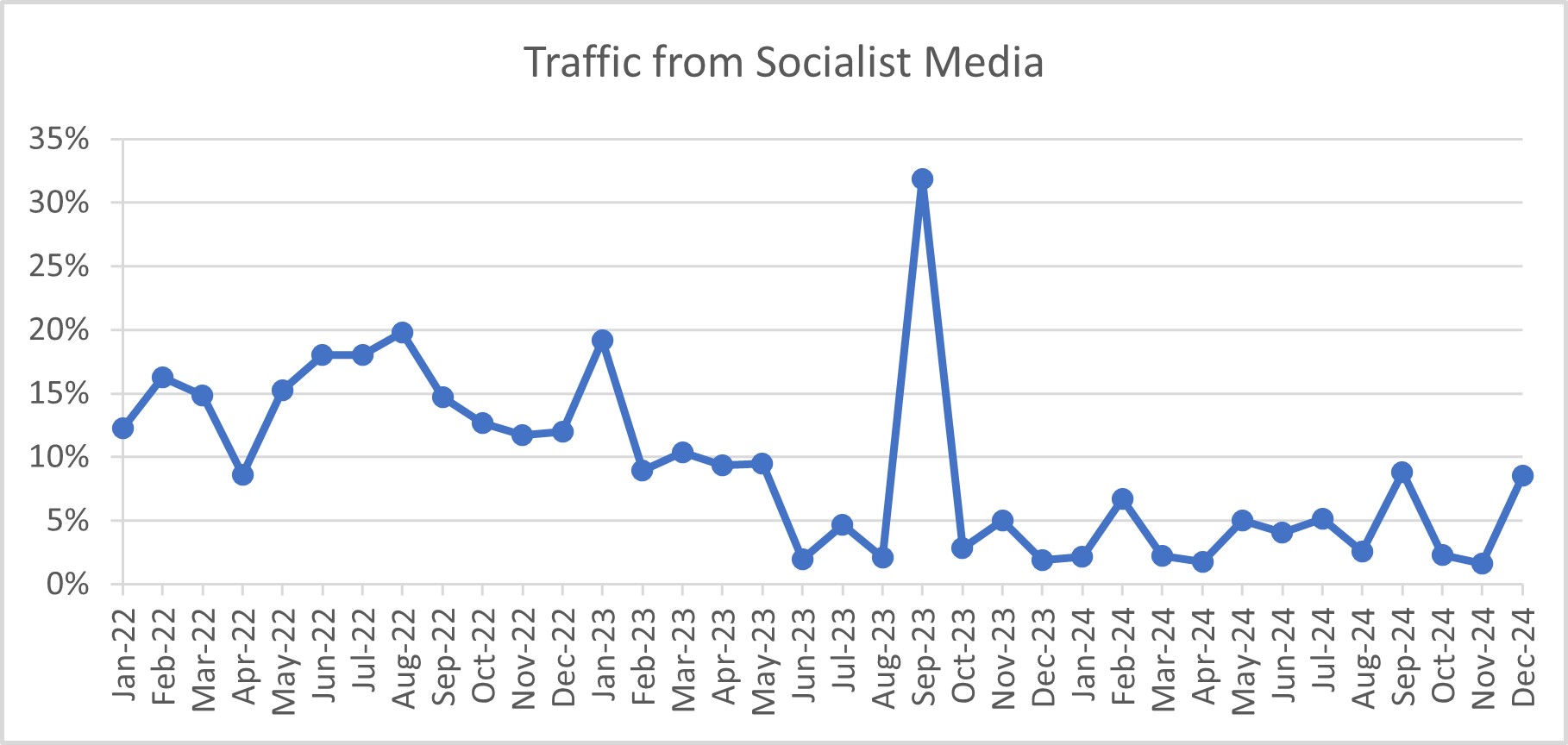
Traffic from Facebook and Twitter accounted for 2.3% of the total during the month, down considerably from the same period two years ago.

Except for a small blip on October 25, there was no traffic from Facebook after October 11.

Did you know the Triple B Complex can support 4,500 wild horses?

You didn’t hear that from the advocates.

Instead of defending the horses they defend the ranchers.

The aim of socialist media is to get you to vote for liberals.

RELATED: Socialist Media Update for September 2024.

Traffic from Socialist Media October 2024

Pancake EA Refers to Outdated GonaCon Registration

The discussion of PZP and Gonacon begins at the bottom of page 146 in the Draft EA.

References to the EPA registrations appear on page 147:

  • The EPA-required product label associated with the registration for ZonaStat-H is cited in the EA as EPA (2012)
  • The EPA-required product label associated with the registration for GonaCon-Equine is cited in the EA as EPA (2013)

In 2012 Zonastat-H (PZP) was a restricted-use pesticide.

It’s true today and explains why the advocates spend three days at the Billings School of PZP Darting and Public Deception.

The EA reiterates the policy on page 148: In keeping with the EPA registration for ZonaStat-H (EPA 2012; reg. no. 6833-1), certification through the Science and Conservation Center in Billings Montana is required to apply that vaccine to equids.

In 2013 GonaCon was an RUP.  There should be a similar remark about certification on page 148 or 149 but it’s not there.

The 30-day interval between doses on page 151 is consistent with the 2013 registration.

The RUP designation and certification requirement were dropped in 2017.

Like the Kiger-Riddle EA, the BLM appears to be crafting a plan based on an à la carte reading of the EPA registrations.

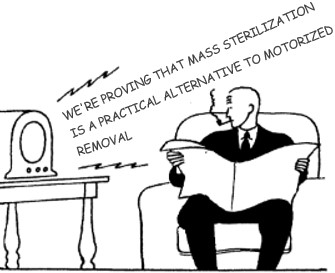
The advocates will likely dispute the claim on page 145 that contraception alone does not remove excess horses from an HMA’s population, as they are proving otherwise at the Salt River and Virginia Range.

Mass Sterilization and Motorized Removal 08-10-24

RELATED: EA for Pancake HMAP Out for Public Review.

Sand Wash Partners Protect Ranchers Not Wildlife

When wild horse populations are within AML, other wildlife thrive, according to a BLM article about the 2024 roundup.

In the case of Sand Wash Basin, you cannot have more than 362 wild horses in the HMA or the land will degrade, but you can have livestock equivalent to 1,402 wild horses in the same area.

Curiously, those animals escaped the writer’s attention.

The permanent bait trap and ever-present footprints of the PZP darters are constant reminders that the horses are not a priority in their lawful home.

RELATED: Sand Wash Roundup Ends Early.

Thriving Ecological Balance-3

How to Build Support for Triple B Roundup

Call a press conference.

Announce that you’ve decided to get rid of the herd with PZP.

A sigh of relief will go up from the advocates.

In a few days, letters and emails will arrive offering to dart the mares for free.

Better Way 10-25-23

After five years they will be sterile and with no new foals hitting the ground, the herd will vanish.

The advocates, led by the Campaign Against America’s Wild Horses, will point to the Salt River and Virginia Range as examples of what can be done.

Mass Sterilization and Motorized Removal 08-10-24

You just need to be patient and let them show their true colors.

RELATED: Triple B Roundup Announced.

Large-Scale Roundups Good for Wildlife?

The Wind River roundup took about 7,600 wild horses off the reservation in 2023 and 2024.

Their disposition, not discussed in a report by WyoFile, is unknown.  The writer said they were “trucked away.”  Probably to Mexico or Canada.

An aerial survey in late 2022 found 5,500 animals on one million acres.

A biologist with the U.S. Fish and Wildlife Service put the estimate at 9,000 or more, for a stocking rate of nine wild horses per thousand acres.

That is what they were trying to eradicate: An outlier that defied the carrying capacity narrative, namely, that western rangelands can only support one wild horse per thousand acres (27,000 animals on 27 million acres).

The Virginia Range in Nevada, another counterexample, had a stocking rate of at least ten wild horses per thousand acres before the advocates got involved.

The Campaign Against America’s Wild Horses, a leader in mass sterilization and staunch opponent of principal use, was tasked with erasing that evidence.

The author did not indicate who paid for the roundup and if the decision to get rid of the horses had been influenced by outside interests such as hunting and ranching.

Antelope-Triple B HMAP Proves Advocates Are Ill-Informed About Wild Horses

Go back and read the recommendations published in September by Save Our Wild Horses, an affiliate of Wild Horse Education.

Item 1: Initiate HMAPs promptly, with at least two started per district by year-end, as mandated by 43 CFR 4710.1 with a deadline of 1-year for completion.  Enforce strict adherence to HMAP requirements to maintain ethical, humane, and legal standards in wild horse management practices.

For the Antelope and Triple B Complexes, this means

  • Forcible removal from their lawful homes
  • Application of fertility control pesticides
  • Adjustment of sex ratios in favor of males
  • Castration of stallions
  • Acceptance of forage allocations

Speaking about their conference in Reno and the ideas flowing therefrom, the president and founder of Wild Horse Education said in a news release “We were also able to dispel the long standing myth that advocates are ill-educated on the subject and, hopefully, our words will be taken into thoughtful consideration.”

You betcha.

Even the casual observer now realizes that they want the ranchers to win.

RELATED: Scoping Begins for Antelope-Triple B HMAP.

Advocates Aren’t Political?

If you’re a normal American, yesterday was Columbus Day.

If you’re a liberal, it was Indigenous Peoples Day.

The Campaign Against America’s Wild Horses has bought into the propaganda and no better place to show it than on socialist media.

Columbus Day at CAAWH 10-15-24

Is Suzanne Roy, executive director of the nonprofit and staunch opponent of principal use, management at the minimum feasible level and nature’s way, ashamed to be white?

Better Way 10-25-23

Is she an apologist for white European migration and the good it wrought?

Why not go all Rachel Dolezal and comport yourself as a person of color, not necessarily female?

Better yet, start another nonprofit that actually serves a charitable purpose and leaves wild horses alone.

RELATED: What Charitable Purpose Do the Advocates Serve?

Pesticide Pushers 07-17-23