
Bad life for the horse.
Author: Western Horse Watchers
Wild Horses Found Dead in Arizona
The report has been on Drudge for two days. Did anybody test the water? Why couldn’t they move to other areas?
The Navajo Nation lies mostly in northeastern Arizona, extending into southern Utah and northwestern New Mexico.
Following the Pony Express
Horses in this video, posted in 2015 by Nutnfancy, are almost certainly from the Onaqui Mountain HMA. The route taken by the riders, from Simpson Springs to Fish Springs NWR to Callao to Gold Hill, is described in this page at Wild Horse Tourist.
Simpson Springs was one of the mail stations along the historic Pony Express Trail.
Today They Will Run for the Roses
Good times will be had by all…except the horses.
This is better. H/T Sandy Palen at Wild in the Pryors.
Gone Now
This video tells the story of the Sheldon horses in NW Nevada, former inhabitants of Sheldon National Wildlife Refuge. Rounded up a few years ago. The area is managed by the FWS, not the BLM, although a BLM contractor was involved in the gathers.
The size of the refuge is 574,000 acres, and at the time of the removals there were 800 horses and 90 burros roaming the land, for a stocking rate of 1.6 animals per thousand acres, almost twice the rate of your average HMA in Nevada.
The gathers themselves, sometimes difficult to watch, are an effect, not a cause. Instead of criticizing the contractor, question the basis on which they were justified. Does everything appear to be legit?
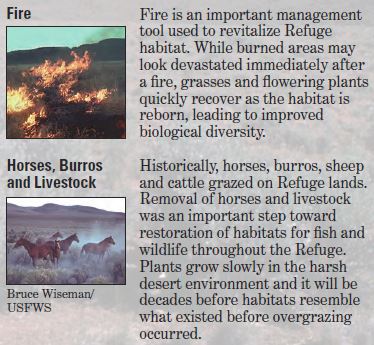
For example, this section of the SNWR brochure indicates that plants grow back quickly after a fire but grow slowly after grazing. Does that sound right? What happens to the risk of fire when you allow vegetation to grow unchecked?
These Women Don’t Fit the Narrative
What is a narrative? A story that explains why things are the way they are, or why the current situation is unacceptable and must be changed. The farther from the truth, the more outrageous, the better. Only fools believe the narrative.
Example: Black folks are victims of white oppression, they’re not responsible for their station in life and only the Democrat Party can save them. Standards must be lowered and concessions must be made. The Founding Fathers were aristocratic slave owners who crafted the Constitution to favor white people. The system must be changed.
That last statement, of course, was the goal all along, but it had to be justified (which is why you invent a narrative). Another example: Global warming. Goal: Massive government involvement in your life.
The narrative for WHB contains several elements, here’s one of them: They were simply turned loose or escaped from nearby ranches, no special significance.

Home Defense
If you’re in a rural area, you’ll want a means of defending yourself, your family, your livestock and your property (assuming you live in a state where it’s legal to do so).
Your arsenal should include some or all of the following, plus 5000 rounds of ammo (at least) and a working knowledge of said weapons and ammunition.
- Handgun with night sights and weapon light
- Shotgun, 18″ barrel, with mag extension, night sights, weapon light
- Semi-auto rifle configured for close quarters, 16″ barrel, weapon light, red dot sight
- Semi-auto rifle configured for medium range, 18″ barrel, magnified optic
- Bolt-action rifle for long range, 20 to 24″ barrel, magnified optic
A common handgun size is 9 mm. Ammo is usually plentiful and inexpensive. If you’re nostalgic for the Old West, get a Single Action Army (Colt .45).
The shotgun would likely fall into the tactical category, 12 gauge, with an assortment of rifled slugs and buckshot.
The 16″ semi-automatic rifle could be chambered in 5.56. Bulk ammo (55 and 62 grain) runs around 40 cents per round, match ammo (75 grain) costs about 90 cents per round.
The 18″ rifle would probably be chambered in .308. Match ammo (168 grain) costs about 90 cents per round. Like the 5.56, get extra mags and pre-load them.
The bolt action rifle can be also used for hunting. It can be chambered in .308 or something larger. Ammo may cost $1.00 to $2.00 per round. The optic should cost as much or more as the rifle.
You’ll also want eye and ear protection.
Basic safety rules for guns:
- Keep them in a safe (but accessible) place
- Always assume they’re loaded
- Don’t put your finger on the trigger until ready to fire
- Never point them at anything you wouldn’t want to destroy
- Know what’s in the background of your shot
There are many Youtube channels, many videos and many opinions out there so take some time to learn what’s right for you. A few examples:
And finally, The Nutnfancy Project, an all-around gear and adventure channel. He’s based in Utah, so you may even see a few wild horses in his videos.
Quick Tour of Virginia City
Aerial view of Virginia City posted to this FB page. Starts with some mining ruins, including hoisting works and tailings.
The view beginning at -1:37 is to the east, away from town, followed by a view to the west, towards town, with a snow-covered Mt. Davidson in the background (originally Sun Mountain).
St. Mary’s church appears at -1:11, followed by the Fourth Ward School at -1:06.
Next is the Silver Terrace Cemetery (NE part of town) at -0:57. The Silverland Inn is at the center of the frame at -0:32.
The view at -0:12 is to the north, showing some of the ‘alphabet’ streets. The main drag running through town is C Street. Mine owners and superintendents lived up the hill on A and B Streets while the rank-and-file lived in the lower part of town, D Street, E street, etc.
The Virginia Range mustangs occasionally pass through the area, as noted in this post.
H/T St. Mary’s in the Mountains.
What is Truth?
Today is May 1st, a ‘coming out’ day for Marxists everywhere.
What is PZP?
The common name is Porcine Zona Pellucida, a protein derived from pig ovaries which interferes with conception.
According to the EPA Pesticide Fact Sheet, it’s a tool for management of nuisance feral and wild horses and burros. The technical registrant is the Humane Society of the United States.
The substance is injected intramuscularly by hand-held syringe, syringe mounted on a jabstick or by syringe dart fired from a CO2 cartridge-powered projection system.
The goal is to have fewer of these little guys running around on the range. You have to wonder how anyone who agrees with this can be called a wild horse advocate.
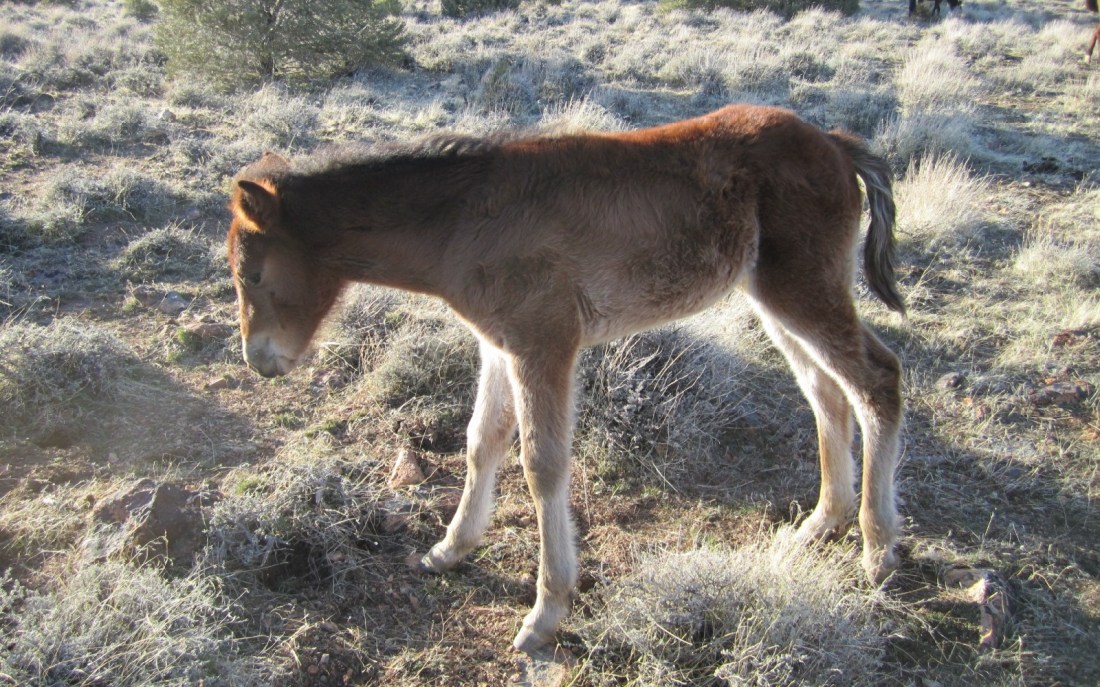
Mustang Monday
Nevada HMA Stocking Rates
The chart below shows the stocking rate in animals per thousand acres as a function of land area for HMAs in Nevada. Stocking rates are based on the upper values of the AMLs and include both horses and burros. The stocking rate for the Virginia Range (horses only) is based on a census in early 2018.
Three observations from the chart:
- Most stocking rates are less than 2 animals per thousand acres
- Stocking rates vary inversely with HMA size
- Stocking rates for large HMAs (above 500,000 acres) are basically constant
The average HMA in Nevada has 193,000 acres.
The HMA with the largest stocking rate is Fort Sage (formerly Fox Hog).
The largest HMAs are the Nevada Wild Horse Range and Triple B. The smallest is Fort Sage.
The average stocking rate for Nevada HMAs is 0.84 animals per thousand acres.

Hay Reserve
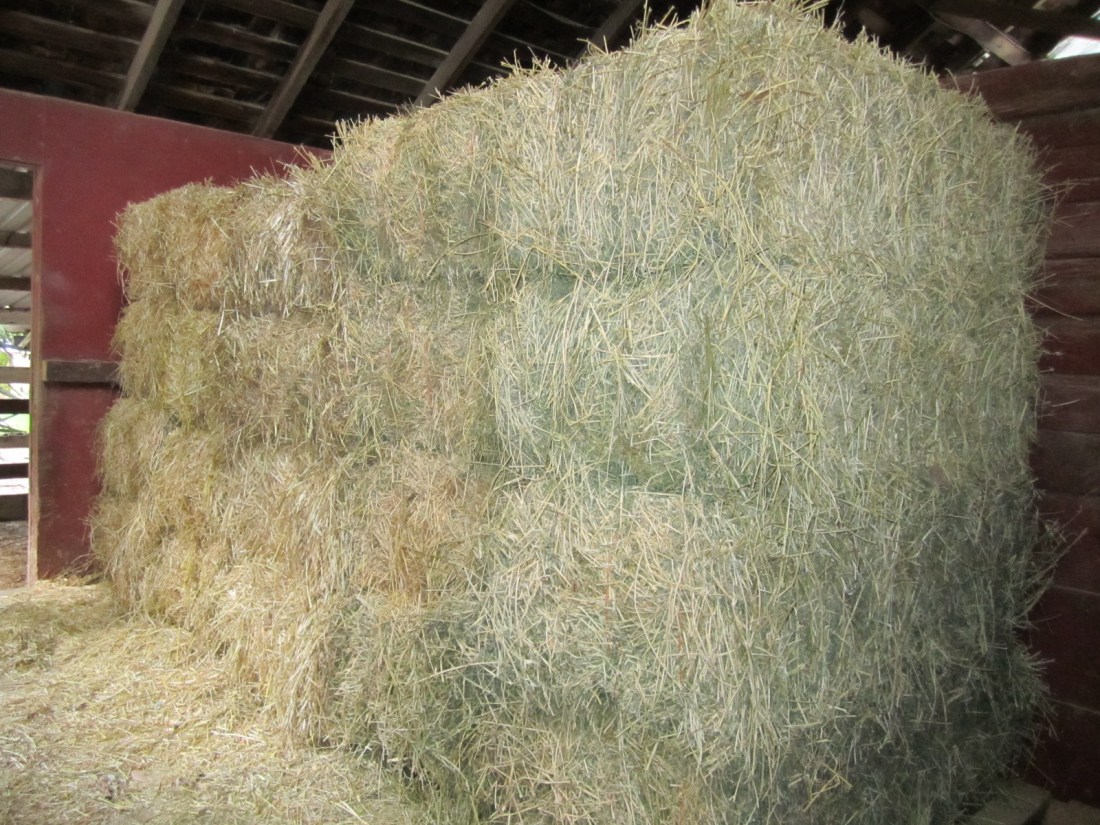
Your emergency preps should include hay for your horses, enough for a month. Keep it dry and away from sunlight.
Natural events, such as earthquakes, wildfires and hurricanes may force businesses to close for weeks. Transportation may be interrupted. Power and fuel may be in short supply.
Your back may go out, where you can’t even scoop poop, let alone stack hay. (You do stack your own hay, right?)
The quality of the hay may deteriorate over time, so after a period of six to twelve months, rotate it out with fresh bales. But always keep a one-month supply on hand and don’t touch it unless there’s an emergency.
Nevada HMA Population
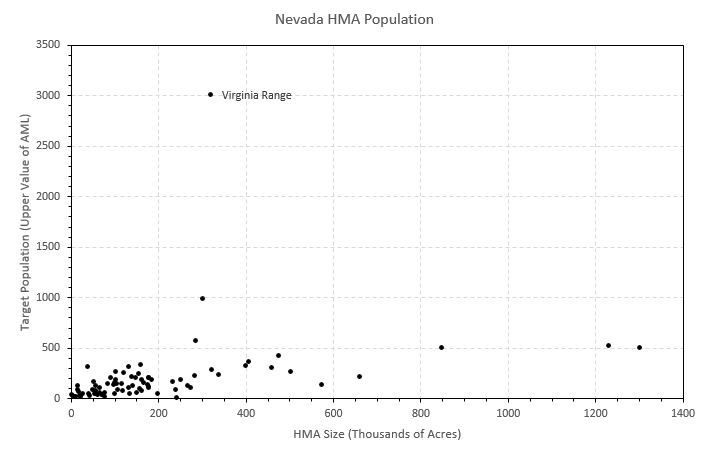
The chart below shows the population target for HMAs in Nevada as a function of HMA size.
Inspection of the chart yields three conclusions:
- Most of the HMAs are smaller than 200,000 acres in size
- Most of the AMLs are less than 500 animals
- AML varies with size but not linearly
Regarding that last point, HMAs with a size of 100,000 acres have an average AML of about 150 animals. If AML varied linearly with size, an HMA of 500,000 acres would have a population target of roughly 750 animals, which is not the case. Larger HMAs have a disproportionally low population target.
The Virginia Range, in the western part of the state, has been included for comparison (actual population, not a target, mostly private land). It does appear to be an outlier compared to the HMAs, with a disproportionally high number of animals for it’s size.
And no, the VR horses are not standing around on dry lots starving to death, as you can see in this video from 2016.
Forward Observer
Lone VR bay passing through the high country on 04-20-18.

Keeping a Safe Distance
You just drove two and a half hours to your favorite HMA. Or maybe you went for a hike on the Virginia Range. Just to your west, barely visible, you spot a band of wild horses.

As you’re watching, some of the horses drift closer, including a mare and foal. A yearling steps in first for a closer look. What should you do?

If you’re in a remote area, where the horses have little or no contact with people, this probably won’t happen. You’ll need a long lens. They’ll make sure you keep a safe distance.
What if you’re in a area where the horses are familiar with people? (Recall this example involving burros.)
Some folks say get out of there if approached by a wild horse. Good advice? Or bad lesson for the horse?
Look at the photo above. No high head, no ear pinning, no tail swishing. If you step back, if you move your feet, he wins. You just told the horse you’re lower.
If a horse approaches you respectfully, as in the case above, don’t yield to his pressure. Stand your ground. Push back if you have to. He’ll probably take a few sniffs and move on.
Backing away tells him he’s higher, which may encourage more boldness, more interactions with people. Bad lesson for the horse.
If a horse approaches you aggressively, pick up a rock, a stick, whatever you can get your hands on, and be ready to throw it. Raise your posture, look bigger. Use your voice. He’ll probably steer clear of you. Horses are comfort-seeking animals and don’t like confrontation.

Pain and Confusion
Round pens are great. Especially when you have multiple riders and long-shank bits. The horse goes left, he gets pressure. The horse goes right, he gets pressure. Turns to the inside, he gets pressure. Turns to the outside, more pressure. There is no right answer.
Let’s round up more of our wild ones and put them in programs like this.
Mustang Monday
When Horsemanship Mattered
Life in New York City, circa 1911, complete with poop in the streets.
Nobody was happier for the invention of the automobile than the horse.
H/T American Digest.
Stepping Stones
Which came first…legalized abortion or contraception? Contraception, in 1960.
Abortion, legalized in 1973, may have been the goal, but it had to be justified. Get the people accustomed to contraception. Observe that it sometimes fails. Then point to the need for abortion.
One hundred years ago, most people would have gasped at the idea of contraception.
Today, the idea is so widely accepted that it’s even applied to wild horses.
A few years from now, you’ll hear complaints that it’s too expensive, too difficult to administer and doesn’t provide a lasting solution (to the wild horse ‘problem’). An argument will be made that ‘excess’ animals must be sterilized or euthanized.
At that point, our wild ones will be finished, and you can thank the PZP zealots, most of whom are women.

