Nine Point Four

More evidence of overpopulation on the Virginia Range, an area with a stocking rate ten times higher than your average HMA in Nevada, 9.4 horses per thousand acres vs. 0.84 horses (plus a few burros) per thousand acres on HMAs.  Photo taken 04/15/18.

Critics argue that the range can’t support these numbers.

Don’t be fooled, they’re not trying to protect the land, they’re trying to protect a narrative.

IMG_5222

Principally But Not Exclusively

Public lands inhabited by wild horses and burros in 1971, when the WHB Act was signed into law, are devoted primarily to WHB, right?

Nope, not according to the BLM.  Only three areas in the western U.S. are managed principally for horses and one for burros.

Principally

Listen carefully to the remarks from 0:05:30 to 0:06:12 in the presentation by John Ruhs, State Director for BLM in Nevada, at this post.  The areas of interest, unnamed in the video, are (1) Pryor Mountains Wild Horse Range, (2) Nevada Wild Horse Range, (3) Little Bookcliffs Wild Horse Area and (4) Marietta Wild Burro Range.

Note that all four are listed as HMAs.  Little Bookcliffs is referred to as an Area, while the other three are called Ranges.

You have HMAs, you have Ranges, you have Areas.  HMAs can be upgraded to Ranges if the Director of the BLM so designates.  Only in such cases do the benefits of ‘principally but not exclusively’ apply.

Is that what Congress intended in 1971?

Stocking rates for these areas (based on upper values of AMLs):

  • Pryor Mountains WH Range: 317 acres per horse (3.2 horses per thousand acres)
  • Nevada WH Range: 2603 acres per horse (0.38 horses per thousand acres)
  • Little Bookcliffs WH Area: 240 acres per horse (4.2 horses per thousand acres)
  • Marietta WB Range: 620 acres per burro (1.6 burros per thousand acres)

The Nevada WH Range is part of Nellis Air Force Base.  Principal use is weapons development and flight training, no public access.

H/T Wild Horse Education.

Are There Any Wild Burros in Nevada?

Yep, you can find them here:

Managed for Burros Only

Managed for Horses and Burros

The stocking rate on some of these HMAs is so low that the probability of actually seeing a horse or burro is small.  Best chance might be on the Blue Wing Mountains and Warm Springs Canyon HMAs, with stocking rates of 3.6 and 2.2 animals per thousand acres respectively (based on the upper range of the AMLs).

In the burros-only category, Marietta Wild Burro Range is best, with a stocking rate of 1.6 animals per thousand acres.

In addition to the Marietta burros, this video gives you a nice view of the Nevada high desert.

Nevada HMA Stats

Roughly half of the wild horses and burros in the U.S. can be found in Nevada.  Here are some statistics for the state, developed from individual pages at the BLM web site.

  • Number of stand-alone HMAs: 80 (does not include Amargosa Valley, Ash Meadows and El Dorado Mountains, which are not managed as individual HMAs)
  • Total land: 15.4 million acres (mostly public, some private)
  • Total animals: 12,944 (mostly horses, some burros, using upper values of AMLs)
  • Stocking rate: 1192 acres per animal (0.84 animals per thousand acres)
  • Stocking rate at 3X AML: 397 acres per animal (2.5 animals per thousand acres)

The last figure is offered as an estimate of the current situation, as many of the HMAs have more animals than allowed by the upper value of their AMLs.

The Virginia Range, on the west side of the state and not a part of the BLM system, has a stocking rate of 106 acres per animal (9.4 animals per thousand acres, horses only, mostly private land).

Much of the state falls within the Great Basin, with elevations ranging from 4000 feet in the valleys to over 10,000 feet at some mountain peaks.  Annual rainfall varies from four to six inches at lower elevations to 12 to 16 inches in the mountains, making it the driest state in the nation.  Areas receiving less than 11 inches per year are considered desert.

It’s a harsh environment, but the horses and burros have adapted to it nicely.

IMG_4440

Freedom Restored

Video from 2012 showing the return of wild horses to Stone Cabin HMA.  Their crime?  They entered the country by birth.

The Stone Cabin Greys are noted for their change in color from black or bay when young, to grey, to white or almost white in adulthood.

The first wild horse gather was carried out at this HMA in 1975, under the watchful eye of Velma Johnston.  Helicopters and motor vehicles were not allowed at the time but were authorized a year later by the Federal Land Policy and Management Act.  Johnston died in 1977.

The Cost of Range-Fed Beef

It’s not $1.41 per animal unit month, the fee for grazing on public lands administered by the BLM in 2018.

Compare that to the cost of feeding a horse at your ranch.  One bale per week @ $20 per bale, plus some grain @ $20 per sack and you’re pushing $100 per AUM.

One AUM = one cow and calf = one horse = five sheep or goats for a month.

The cost to feed cattle on a ranch is probably less but it’s not $1.41 per AUM.  That explains why the ranchers want access to the HMAs.  There may be other benefits as well, such as the quality and taste of range-fed beef.  (That seems to be the case for free-range eggs, a topic for another post.)

What about the costs of gathers, fertility control, adoption programs, long-term holding and other activities associated with the downsizing of WHB on public lands?

Not to mention the unknown and unknowable costs of losing these icons of freedom, ruggedness and self-reliance.

Those must be added to the basic fee.

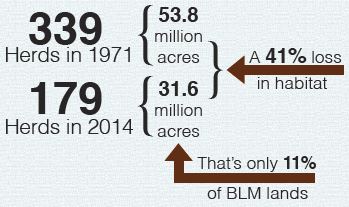
An infographic by The Cloud Foundation shows the numbers in 2014.
HMA_Land

In 2017, there were 177 HMAs in ten western states covering 26.9 million acres, with 73,000 animals on the range and 44,000 in long-term holding.  BLM spends roughly $50 million per year to care for the animals in holding.  Refer to the presentation by John Ruhs, State Director for BLM in Nevada, at this post.

You won’t be able to reverse the decline by voting for liberals.  They don’t like the idea of private property, they want Americans dependent on government.  In the case of ranching, that means more cattlemen earning a living off public lands, which means greater demand for the removal of WHB on HMAs.

The answer is self-reliance.  Ranchers working their own land.  Horses and burros running wild and free on public lands set aside for them in 1971.

Horse Trailer Overturns, 18 Democrat Votes Lost

On 04-07-18, a trailer carrying illegal aliens separated from a pickup truck and crashed on I-8 near Campo, CA, according to this report in The San Diego Union-Tribune.

Raw video posted at OnSceneTV.  The story leaves some unanswered questions though.

Did the driver have to use carrots to get them in the trailer?

Did anybody at the border check their Coggins?

Were they secured with trailer ties?

Wild Horses Are Not Wildlife

Wild horses and burros can be found on public lands not because of their role in the ecosystem, not because they’re an endangered species, but for their historical value.

That some lands were set aside in 1971 principally for WHB seems to have been overlooked by the central planners.  (The map at the bottom of this page shows just how far their tentacles reach.  Could this explain why there is growing demand for livestock grazing on HMAs?  The supply of land—for sale to ranching interests or anybody else—is too small?)

What characteristics come to mind when you think of the American West?

  • Homesteading
  • Farming
  • Travel by horse
  • Villainy
  • Frontier justice
  • Unspoiled beauty
  • Open space
  • Wilderness

What values did the settlers bring with them?

  • Liberty
  • Private property
  • Self-reliance (including self-defense)
  • Modesty
  • Privacy
  • Free speech
  • Religion
  • Marriage
  • Family
  • Belief in God

What if you have individuals in government who hate these ideas, who believe they’ve been poisoning the minds of the people for hundreds of years?

Consider the experience of the Chinese from the mid 1960s to mid 1970s, during the Cultural Revolution.  For communism to take root, the nation would have to break all ties with the past:

  • Traditional social practices such as weddings and funerals were suppressed
  • Books were burned and art objects were smashed
  • Temples and churches were closed and put to secular use
  • Customary ways of dress were eliminated
  • Visual evidences of old things were destroyed

Old ideas, old culture, old customs, old habits.

You can’t have the people thinking about their heritage and birthright when you have a fundamental transformation to accomplish.