WHB Population Explosion?

The BLM’s Wild Horse and Burro program is at a crossroads, according to an article posted today by the American Veterinary Medical Association.  The author claims that HMAs are overpopulated by 100 percent to 1,500 percent.

“There were 81,951 animals on 26.9 [million] acres of public rangelands and 44,730 animals in corrals or pastures as of mid-2018…

To give some perspective, the BLM says ideally 27,000 of these animals can live in balance with livestock and wildlife on public lands.”

This is another example of misuse of figures.  The aimed-at population of 27,000 animals and available land of 26.9 million acres pertain to HMAs only.  The observed population of 81,951 animals corresponds to all lands, including HMAs.  You can’t compare 81,951 to 27,000 and conclude wild horses and burros are overpopulated because they don’t have the same land-basis.

Note that the combined AML of 27,000 animals (horses and burros) and available land of 26.9 million acres yield a population density of one animal per thousand acres, just one twelfth (8.3%) of the density typically allowed for livestock.

AML_vs_Population-1

There are real problems and stated problems.  The stated problem is that wild horses are overpopulated on western rangelands.  The real problem is that they compete with livestock for forage, depriving public-lands ranchers and their overlords of benefits owed to them in exchange for their campaign contributions and political support.

What you see on the range is not private-sector capitalism.  The helicopters, the bait traps, the zeroing-out of HMAs and reductions of AMLs, the video propaganda and bogus news reports, all are the result of a special interest using the media and instrumentalities of government to achieve its agenda.  It needs to be broken up.

WHB Coming to Fort Worth

BLM will be offering 35 wild horses and burros for direct purchase at the Will Rogers Memorial Center September 7 & 8, according to a news release issued today.  These are in addition to the trained horses to be auctioned at the Extreme Mustang Makeover event at the same venue.

WHB posters will probably be available somewhere on site both days.

The new cash-and-carry rules are a godsend to horse lovers everywhere, as the waiting list has been long and people have been hanging on the fence for months just for a chance to adopt one or two of them.

IMG_5882

Are There Any Wild Horses Left in Utah?

The state has been ‘ground zero’ for wild horse gathers this year, with the Range Creek, Cedar Mountain, Four Mile, Bible Springs, Tilly Creek, Sulphur and Muddy Creek HMAs targeted for removals.  Next on the list is the Onaqui Mountain HMA.

An article posted today in the Odgen-based Standard-Examiner looks at a proposed roundup that would remove 84% of the horses.  Opposing viewpoints are considered.

“BLM does review range health when they renew grazing permits, but it’s true there are hundreds more cattle and thousands more sheep permitted than there are wild horses on the Onaqui.”

At what point do we start calling it collusion?

Benefits of Wild Horses

If you’re a numbers guy, this article in NorCal Fishing News, dated 08/26/18, will make you smile.  (Not sure how it got into a fishing report, might be a reprint of figures published elsewhere.)

The video below shows some vegetation on the side of a road in the Virginia Range near sunset on 08/24/18.

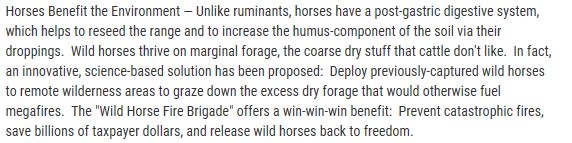
You might think somebody took a sickle to that brush but the work was done by wild horses.  Remaining stalks are about six inches tall, no trimmings to clean up.  It’s nature’s fire control regimen.

Benefits_of_Wild_Horses-1

See also this story in Markets Insider dated 08/23/18.

The article also stated that the BLM typically allows eight cow/calf pairs per square mile, equivalent to eight wild horses per square mile.  That yields a stocking rate for livestock of 12.5 animals per thousand acres, compared to an aimed-at population density of one animal per thousand acres for horses on BLM lands.

Who benefits from this arrangement?  Is this what Congress intended on lands set aside for wild horses and burros or is it a twisting and stretching of ‘multiple use’ by the BLM, on behalf of the livestock industry?  Is this the meaning of ‘thriving ecological balance?’

The figures at the end of the article hint at the idea of replacing AMLs with pie charts that show how resources are allocated among consumers on HMAs.

A Simple Experiment in Diversionary Watering

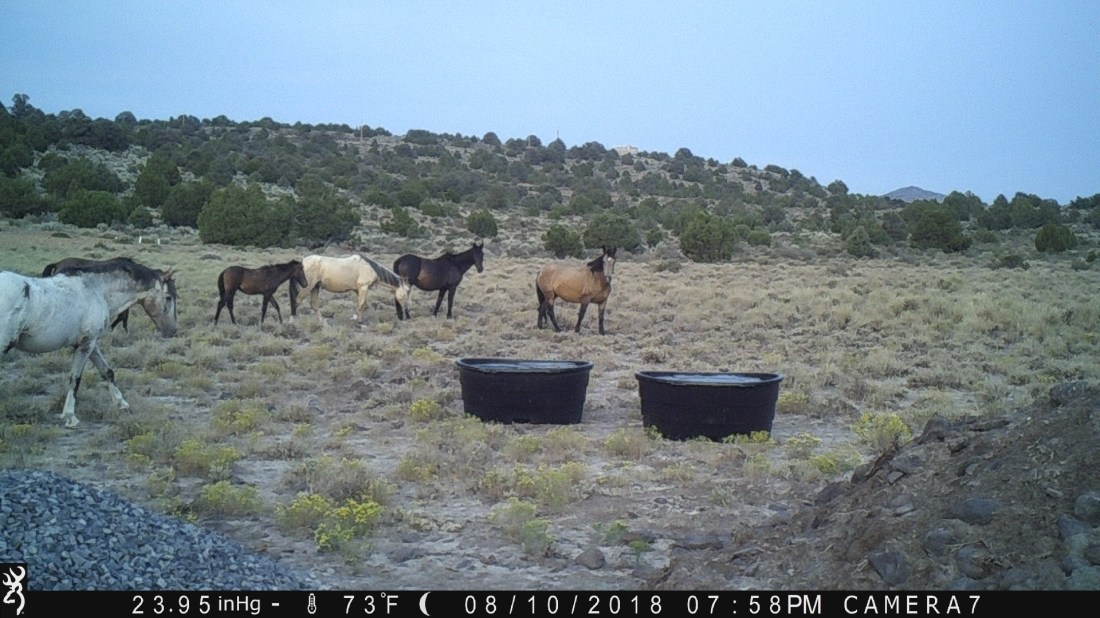
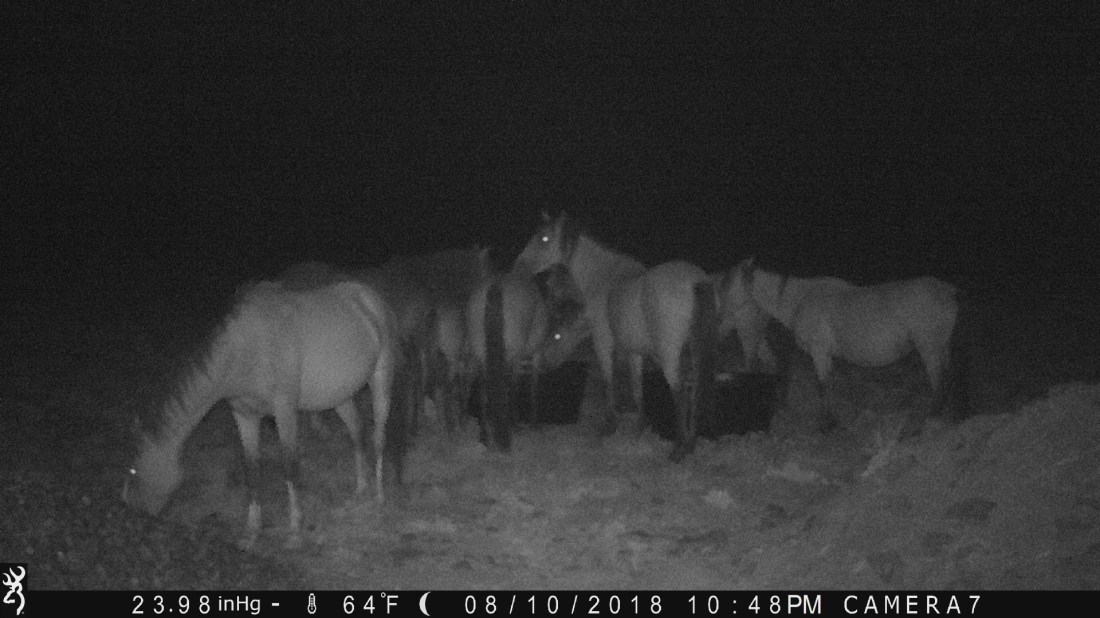
Trailcam hasn’t picked up any Virginia Range mustangs last few weeks, so I put out two stock tanks and filled them with water on 08/10/18.  They found them that evening!

The idea is to keep the horses up in the hills and away from populated areas.

Bait traps use the same concept.  Put out some food and water but enclose the area with a pipe panel fence and attach the gate to a trip wire.  See the video at this post.

IMG_7304-1

IMG_7317-1

Best Way to See the Pryor Mountains Horses

A detailed article posted recently in Just Horse Crazy provides some background on the Pryor Mountains Wild Horse Range, along with recommendations for viewing the horses.  It’s pretty much everything you need to know.  The drive into the mountains should not be attempted without a 4WD vehicle.

The PMWHR is one of just three areas in the western U.S. devoted primarily to wild horses.  It may become the subject of a gather in early September, although the BLM has not formally announced it.

RELATED: Pryor Mountain Horses.

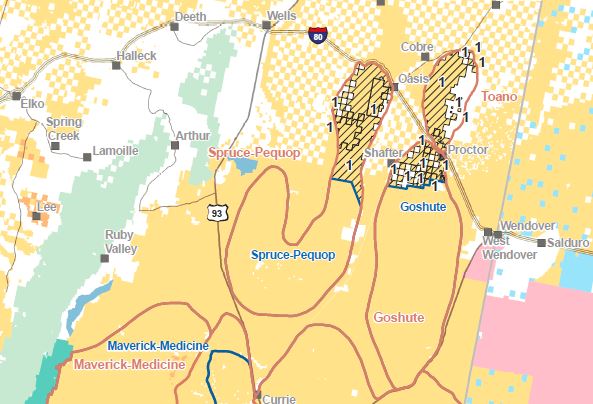
BLM Starts Emergency Gather at Spruce-Pequop

Bait traps will be used to remove approximately 300 wild horses from the Spruce-Pequop HMA, according to a news release issued yesterday.  The stated reason for the roundup is inadequate water and forage relative to the number of horses in the area.

Livestock are present on the HMA but were not mentioned in the announcement.

Gather operations will not be open to public inspection.

The HMA is on the south side of I-80 in eastern Nevada, about 40 miles south of the town of Wells.  It covers 240,744 acres and has an AML of 82, for an aimed-at population density of 0.34 horses per thousand acres.

Goshute_HMA_Map-1

Captured animals will be taken to the Indian Lakes Off-Range Corral in Fallon, NV, where they will be checked by a veterinarian and prepared for adoption.

The announcement did not indicate if the horses would be available for sale (under the the new cash-and-carry rules).  Adoption is better for the horses.  You provide a foster home for a year.  You do the heavy lifting to prove your worthiness.  Then you get title.

Gather stats and daily reports can be found at this page.

Wild Horses in Oklahoma?

Sort of.  The text posted with the video suggests it’s part of the Drummond Ranch near Pawhuska, OK.  Probably an off-range pasture contracted to the BLM.  This is where the older/unadoptable horses end up.  Almost like being on the range…except there are no stallions, no bachelors, no foals, no families.  All mares in this case.

More info in this article.  H/T Sherryl Hannah.

RELATED: BLM Seeks Additional Off-Range Pastures for WHB.