Work Day Set for Tomorrow at Piceance HMA

Piceance Mustangs, an advocacy group for the wild horses at the Piceance-East Douglas HMA in northwestern Colorado, has scheduled a work day for 10/27/18, according to a story posted today in the Rio Blanco Herald Times.

Volunteers work with the BLM to promote healthy horses and rangelands.

Who defines ‘healthy horses and rangelands?’  The BLM, of course.  That means—wait for it—a fertility control program starting next year.

Sure would be nice if the wild horse world could move toward ‘What can we do for the horses?’ instead of ‘What can we do to the horses?’  Keeping them on the range would be a good place to start.

The HMA has an aimed-at population density of 1.25 animals per thousand acres.

RELATED: Stop the Roundups, Fertility Control is Better!

NPS Says Death Valley Burros Have to Go

They’re not a part of the natural ecosystem.  They destroy western rangelands and squeeze out wildlife, just like the horses.

A private organization has been hired to remove them, every one, even though they are dispersed at a rate of approximately one animal per thousand acres (in line with the average density of wild horses on BLM lands).

“Burros, natives of North African deserts, were once among the West’s most precious resources: sure-footed in rugged terrain and capable of carrying heavy loads long distances in extreme temperatures.  But with wild populations that doubled every five years, they were damaging habitat sought after for cattle grazing, mining, development and off-road vehicles.”

Refer to this story, posted today by the Los Angeles Times.  Bait traps have been set up to capture the burros.  If that doesn’t work, helicopters will used to finish the job.

It’s not about saving money.  There are no plans to close departments, sell buildings and lay people off when the roundup is complete.  Who benefits?

BLM Removes Wild Horses, Aids Ranchers Affected by Martin Fire

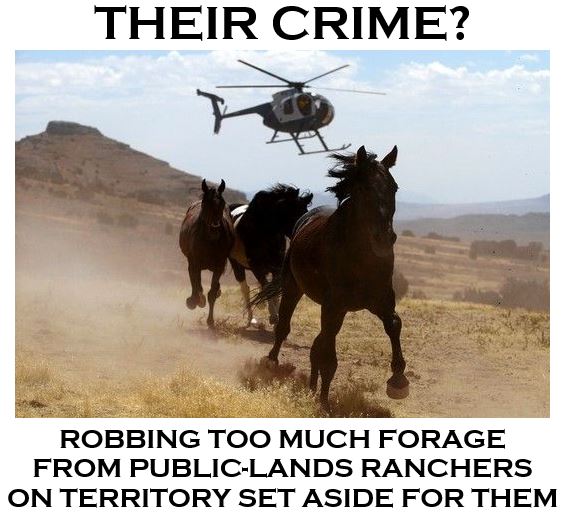
In what can only be described as a shocking development, BLM has moved against the horses in favor of public-lands ranchers, offering assistance to permit holders impacted by the largest wildfire of 2018 in Nevada.  Many of the horses that roamed the area were not available for comment.

“BLM is addressing fencing status and needs, helping coordinate Farm Services Administration funding sources, and holding individual meetings with permittees about future grazing needs and feasibility within the fire perimeter.”

The fire affected seven grazing allotments and eight permittees n the Winnemucca District.  The number of affected grazing allotments and permittees in the Elko District was not provided.

The fire started near Paradise Valley, NV in early July and spread eastward across the Little Owyhee and Owyhee HMAs.  An emergency gather was ordered for September.

If you were thinking that maybe the BLM might be biased a little in favor of the livestock industry, this announcement should remove all doubt.  Their priorities should now be obvious to even the casual observer.

No Comment by Forest Service on Heber Wild Horse Shooting

Personnel with the Law Enforcement Division won’t discuss any details or answer any questions until the investigation is complete, according to a report posted this morning by the White Mountain Independent.

Both horses have been buried.  Necropsies were not performed and the bullets were not recovered.  Apparently, evidence is of no use in these ‘investigations.’

RELATED: Investigation of Heber Wild Horse Shooting Continues.

Legal Action Taken to Stop the Sale of Devil’s Garden Horses

Two advocacy groups have joined forces to block the unrestricted sale of wild horses removed from Devil’s Garden WHT, some of which might end up in slaughter.  Refer to this story, posted today in YubaNet, an online news service in Nevada City, CA.

RELATED: Fate of Devil’s Garden Horses?

UPDATE: See also this story in The Sacramento Bee dated 10/22/18.

There Were Survivors on the Other Side at Little Bighorn

Their descendants roamed an area known today as Theodore Roosevelt National Park, until the NPS rounded them up and sold them off, with some ending up at the Kuntz ranch.  They are the Nokotas.

“Fun fact, depending on what historians you talk to, some believe Comanche was actually the only true survivor of the tragic Little Bighorn battle.”

Refer to this article about a war horse named Comanche that appeared on 10/04/18 in Cowgirl Magazine.  He died in 1890, receiving full military honors.

RELATED: Nokota Horses to Be Dispersed.

Judge Rules in Favor of Alto Wild Horses

A judge has ruled that the New Mexico Livestock Board has no jurisdiction over the wild horses in Lincoln County and can no longer gather and sell them.  The horses live in an area north of Ruidoso, NM.  Refer to the story that appeared yesterday Ruidoso News.

The case was brought by the Wild Horse Observers Association, an ‘advocacy’ group that favors fertility control over roundups.

Helicopter Ops Ended at Little Bookcliffs WHR

The gather is complete according to a report posted yesterday by The Daily Sentinel in Grand Junction, CO, although the BLM has not issued a news release confirming that.

“The agency undertook the operation because of concerns about heavy grazing pressure by the horses, a problem exacerbated by drought.”

The wild horse population at the beginning of the roundup was 190, barely large enough to maintain genetic viability of the herd.

RELATED: Stupid Horses Won’t Take the Bait at Little Bookcliffs.

Fate of Devil’s Garden Horses?

In a guest column appearing today in the Redding-based Record Searchlight, the writer worries about the fate of captured horses but doesn’t say anything about the reasons for their removal.

Yep, it’s okay to pull them off the range and give more of their land and forage to livestock, just don’t ship them to slaughter.

The greatest threat to wild horses and burros is public-lands ranching, not oil and gas exploration, not mineral extraction, not timber harvesting.

The government serfs, along with their allies at the BLM and USFS, are laughing at you, dear, because you focus on symptoms not on causes.

RELATED: Stop the Roundups, Fertility Control is Better!

Off the Reservation in Utah

Wild horses in eastern Utah, somewhere between the towns of Ouray and Bonanza, possibly on BIA land (go to page 3 in this map).  There are no HMAs in that part of the state, only the Bonanza HA (red border), which is no longer managed for WHB due to ‘inadequate food and water.’  Yet there they are!

If you want to deceive the public about wild horse overpopulation, count horses like these, outside of HMAs, and compare the result to the allowable number of horses inside HMAs.

H/T Susan Allison.