A search of the Federal Register yielded no results for 2020. The last meeting of the Wild Horse and Burro Advisory Board was in October of 2019.
RELATED: WHBAB Rubber-Stamps ‘Path Forward?’

Western Horse Watchers Association
Exposing the Hypocrisy, Lies and Incompetence of the Wild Horse Advocates
A search of the Federal Register yielded no results for 2020. The last meeting of the Wild Horse and Burro Advisory Board was in October of 2019.
RELATED: WHBAB Rubber-Stamps ‘Path Forward?’
BLM said yesterday that the annual hearing for the use of aircraft and motor vehicles in managing wild horses and burros would be held in Battle Mountain June 25.
What if those attending said “We object.” What would that accomplish?
Roundups are effects, not causes. They are symptoms of the way public lands are managed. If you want change, you have to go after the causes.
The announcement said the state’s wild horse and burro population currently exceeds 51,500 animals, with 12,811 animals allowed by plan. Is that a problem?
The meeting should not be about what type of equipment is most effective in removing these animals from their home range, but why they are being removed from their home range and what can be done to stop it.

The behavior praised in this video is the same one condemned on their home range.
Fuels reduction is a good idea, unless it’s on grazing allotments.
RELATED: Devil’s Garden Horses Get Short End of Stick.
Almost certainly it was somebody with ties to oil or mining companies.
Let’s take a look at the developer’s bios.
Oh crap, it was invented by a rancher.
On the Montgomery Pass WHT with K. E. Borrelli. Outing hosted by Rock Creek Pack Station. For a description of the WHT, go to page 629 in the final EIS for the Inyo National Forest Management Plan update. The Forest Service shows it on its map but does not provide a link for it.
Public-lands ranchers don’t hide their disdain for wild horses. The Public Lands Council, a cheerleader group attached to the National Cattlemen’s Beef Association, makes their position known on this page.
The American Petroleum Institute, a trade group for the energy industry, must have a similar page on its site. After all, oil and gas companies are major threats to wild horses according to some advocacy groups.
See if you can find it.
After that, please indicate
What’s that? Still haven’t found that policy statement on the API web site?
RELATED: Where Are Your Figures?
A colt separated from his mom was surrounded by onlookers on Friday, causing him to panic, according to a report posted today by The News & Observer of Raleigh, NC.
Remember, you should never approach wild horses—unless you’re stalking them with darting rifles, which the local ‘advocacy’ group does on a routine basis.
How many wild horses in long-term holding can be explained by the ‘rule of four?’
All of them. A quick estimate of the number of horses cheated out of spot on their home range by privately owned livestock is
27,000 × 4 = 108,000
If you removed domestic livestock from half of the HMAs, you could empty all of the off-range corrals and pastures.
But why stop there? Cattle and sheep belong on private land, not wild horses.
Yesterday we discovered a quick way to estimate the number of wild horses an HMA can support. Another simple relationship that falls out of the post about forage supply and demand is for horses displaced by privately owned livestock.
Here’s how they fit together:
New AML = Old AML + Horses Denied = 5 × Old AML
Solve for Horses Denied:
Horses Denied = 4 × Old AML
A simple estimate of the number of horses displaced by other mandated uses of public lands is to multiply the current AML by four.
This corresponds to the four missing horses in the original post!
Returning to the Jackson Mountains example, the number of horses denied a place on their home range should be about 4 × 217 = 868.
This compares favorably to 846, the number of horses denied, computed the hard way.
RELATED: How to Compute Horses Denied.
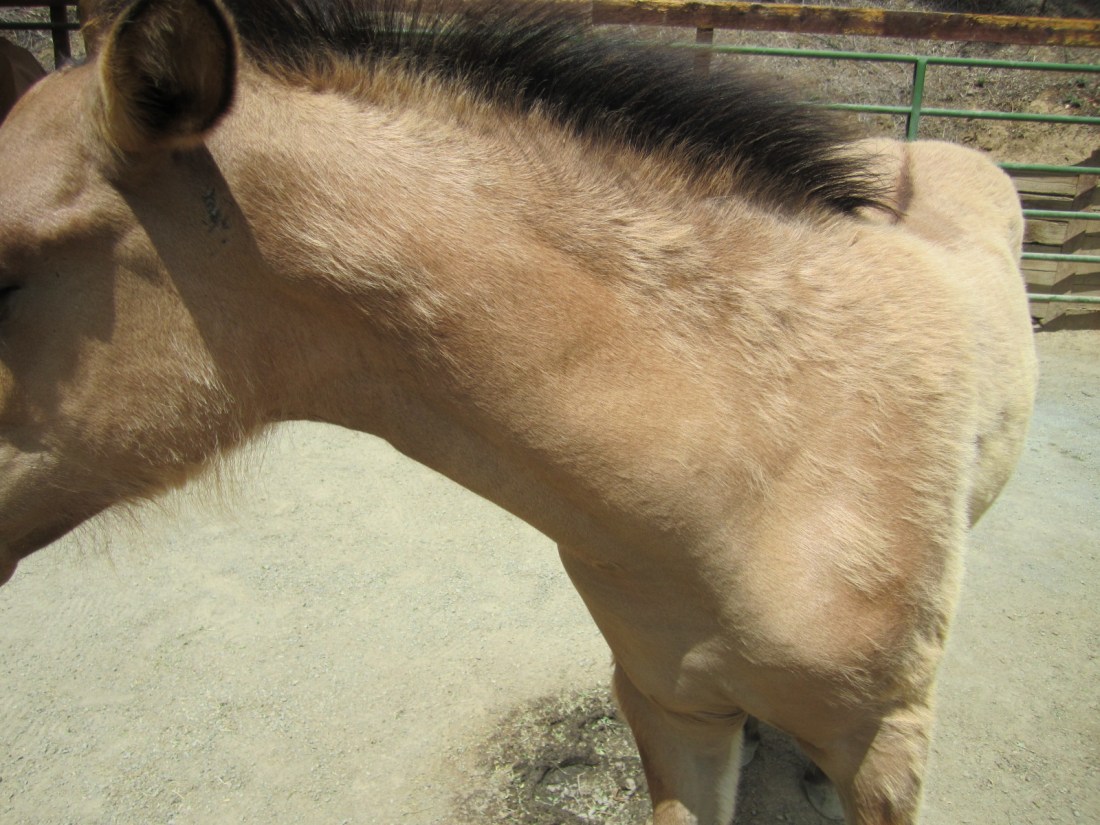
About 10 weeks old in this photo. Born 04-01-20.
Yesterday’s post about forage supply and demand suggests that HMAs subject to permitted livestock grazing (which is most of them) can support five times more wild horses than currently allowed by plan.
For example, the Jackson Mountains HMA, considered on these pages a few days ago, has an AML of 217. The number of horses the area can support is 217 × 5 = 1,085.
That’s a lot easier than digging through the environmental assessment and computing a new AML, which turned out to be 1,063. But it’s pretty darn close.
So if you can’t find the AUM data, there’s your rule of thumb.
It’s not ironclad, just an estimate.
The HMAs should be able to support 135,000 wild horses, not 27,000, and the current population of 90,000 is well within the carrying capacity of the land—if it wasn’t for privately owned livestock.
The problem is not overpopulation, it is public-lands ranching.
The cycle of life repeats on the Virginia Range, despite those who would try to break it.
The topic of forage demand comes up frequently on these pages. We know that one AUM will sustain one wild horse, one cow/calf pair, two wild burros or five domestic sheep for one month. The forage demand of one wild horse is 12 AUMs per year.
The land use plan for an HMA must allocate 2,184 AUMs per year if the AML is 182.
But you can’t write the forage budget until you know how much forage is available.
In some of the environmental assessments for wild horse management actions, forage supply varies from 12 to 18 acres per AUM per year.
Let’s pick the midpoint. A wild horse would need access to at least 12 × 15 = 180 acres to survive. Round the result to 200 acres.
Therefore, a stocking rate of five wild horses per thousand acres should be sustainable.
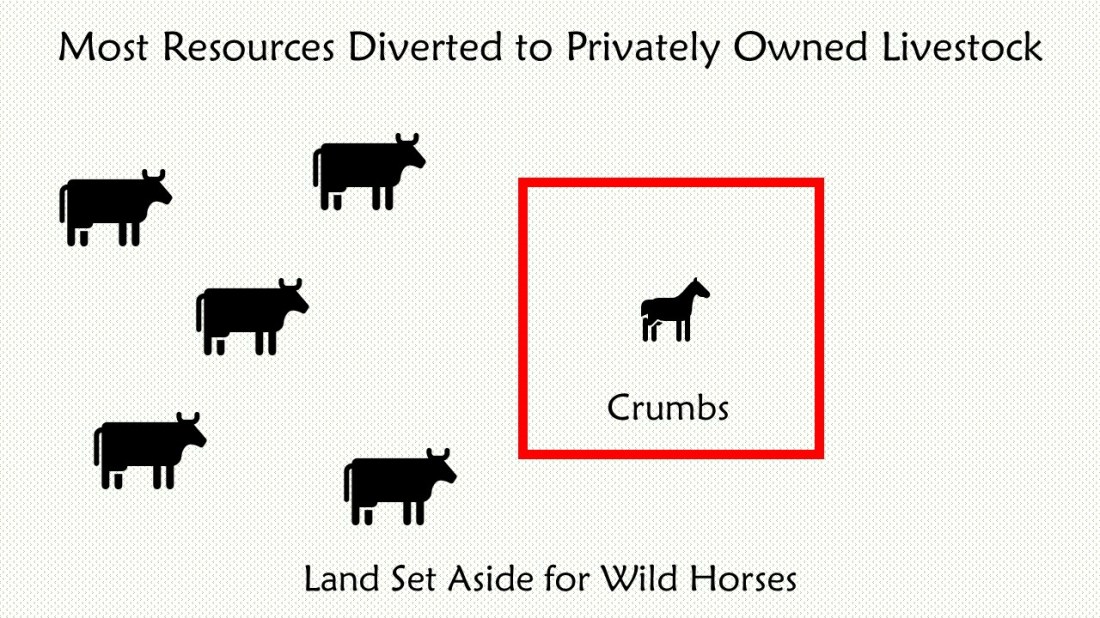
Why does the government limit wild horse herds to one animal per thousand acres?
What happened to the other four horses (80% of the carrying capacity of the land)?
Take a guess.
The 2020 Western States Horse Expo has been cancelled. The event has been moved to May 7 – 9, 2021 at the Murieta Equestrian Center, Rancho Murieta, CA.
No, it’s not a roundup, not on the Virginia Range.
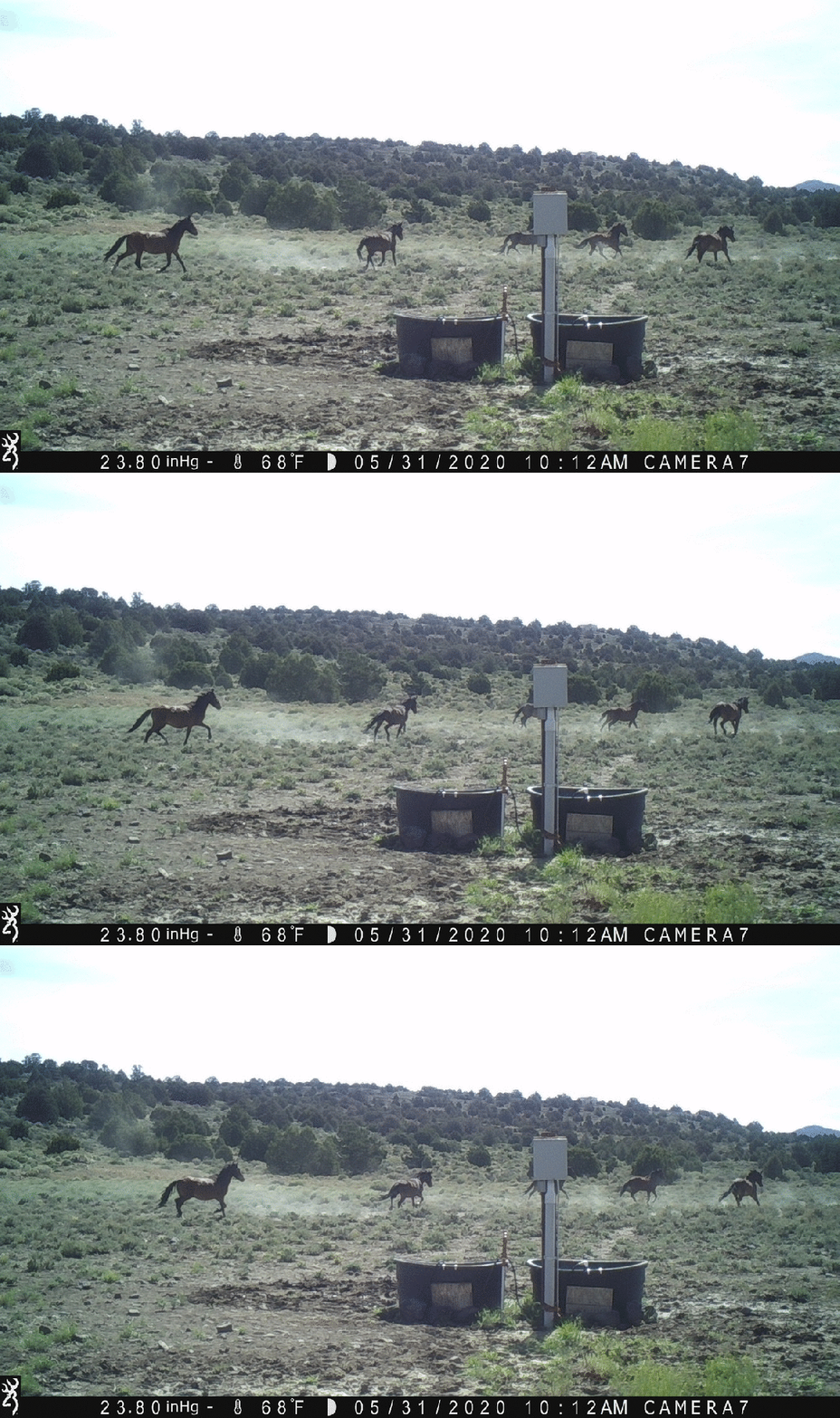
BLM said today that 550 wild horses will be removed from the Swasey Mountains HMA, beginning in July. The news release did not indicate if the operation would be carried out from the air or on the ground. The current population is thought to be 721, plus this year’s foal crop.
Some of the animals will be receive “population growth suppression,” whatever that means, and presumably be returned to their home range.
The HMA covers 134,965 acres in western Utah and has an AML of 100, for an aimed-at population density (stocking rate) of 0.7 horses per thousand acres.

The HMA intersects four grazing allotments, according to Section 3.2.1 of the final EA, with livestock receiving approximately six times as much forage as the horses.
The announcement did not indicate where captured animals would be taken nor did it provide a link to the gather stats and daily reports. It’s not known if the event will be open to public observation.
Land use plans for the Jackson Mountains HMA assign 10,151 AUMs per year to privately owned livestock, according to Table 3.7 in an environmental assessment from 2012, with 2,604 AUMs per year allocated to wild horses.
The HMA covers 283,775 acres, with an AML of 217. The stocking rate allowed by plan is 0.8 wild horses per thousand acres.
The HMA fits the pattern noted two months ago: Low stocking rates correlate with large amounts of forage assigned to domestic livestock.
The HMA intersects six grazing allotments. Grazing seasons were not given in the EA so a period of 4.5 months was assumed. Although cattle and sheep may be authorized on those pastures, the stocking rate was computed for cow/calf pairs, whose resource requirements are said to be equivalent to those of wild horses.
The entire HMA is subject to permitted grazing. The ranchers would have to place 2,256 cow/calf pairs on the land to graze off 10,151 AUMs in 4.5 months, for a stocking rate of 7.9 cow/calf pairs per thousand acres. If the grazing season was longer, the stocking rate would be lower. The AUM distribution would not change.
These figures are compared in the following charts.

The forage assigned to livestock would support an additional 846 wild horses, for a new AML of 1,063.
The rationale for dividing forage in the Jackson Mountain allotment, which represents 67% of the HMA, was 18% to horses and 82% to livestock, per Section 3.3.4 of the EA.
On two other allotments, the forage allocated to wild horses was zero.
And you wonder why there are so many of them in long-term holding.
The problem is public-lands ranching.
RELATED: Jackson Mountains Emergency Roundup Starts Next Week.
On the Virginia Range with itsmissyvonne.
Look both ways before crossing!