A story published yesterday by Fox News of Colorado Springs, CO says that a rescue in Ellicott has reached its capacity and now has a waitlist with eleven more.
An email sent this morning asking if any of the horses are coming in with freeze marks has not been answered.
A BLM public affairs officer reported earlier this month that adoptions had declined this year for similar reasons.
The $2.3 trillion measure includes $900 billion in Covid relief, according to a report published today by AP News, and, presumably, a $14 million increase in the WHB program to pursue an “aggressive, non-lethal population control strategy” for wild horses and burros on America’s public lands.
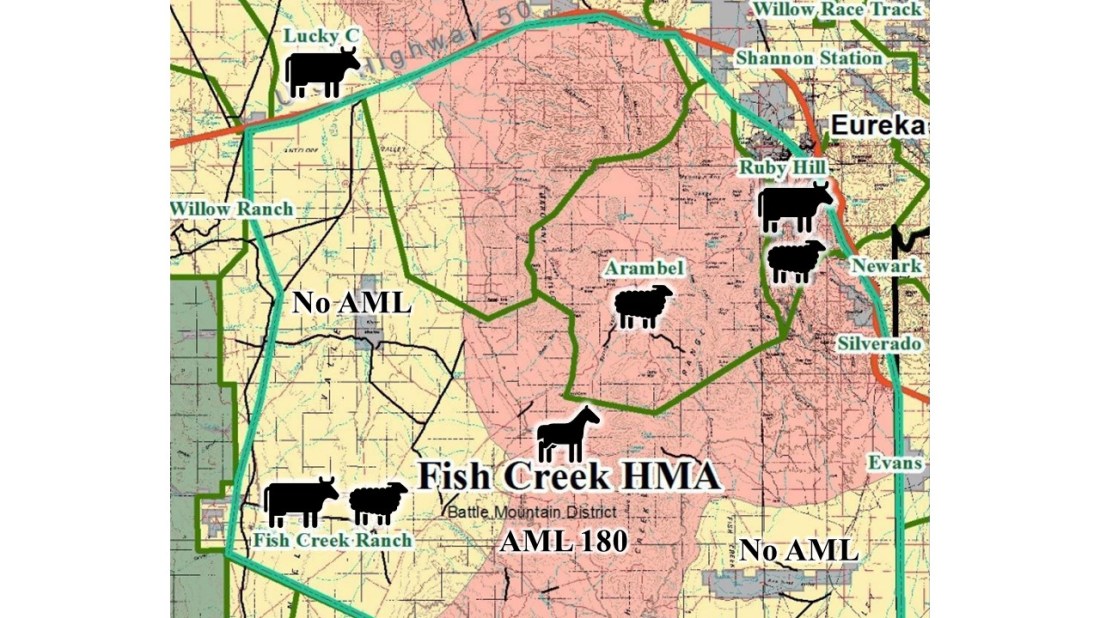
The gather area, based on a map from the 2015 Final EA, includes the Fish Creek Ranch allotment, which is grazed by Borba Land and Cattle LLC, among others, according to a report from the Rangeland Administration System. Borba receives 52% of the active AUMs on the allotment.
The HMA is shown in pink and the gather area, which extends well beyond the HMA, has a light green border. The allotments, four of which intersect the HMA, have dark green borders: Lucky C, Arambel, Ruby Hill and Fish Creek Ranch.
The original piece in The Washington Post begins with a story about Kevin Borba, “a cattle rancher in Nevada.” He appears in the following video by Protect the Harvest, which ties him to the area.
“The horses ain’t ever going to leave,” he says.
Over 500 were removed last year, with another 135 slated for removal this year, so PTH will need to update the video. Less wailing and gnashing of teeth, please.
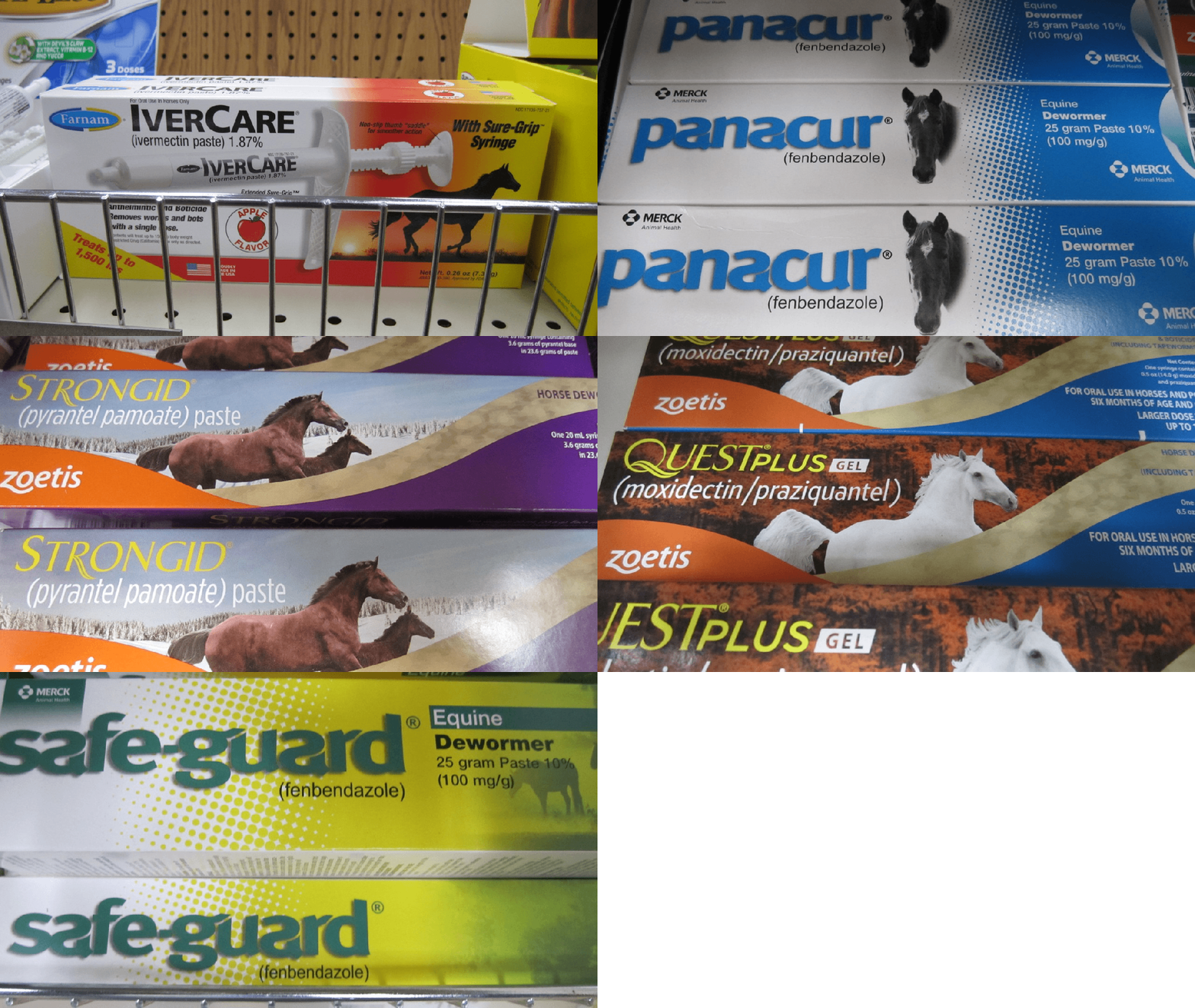
Many in the horse world know it as a dewormer. But if you search for Ivermectin Covid-19, you’ll find reports on its use in treating the virus.
The local feed store had it in paste form on December 24. But it also had several other types of dewormers. There were no special warning signs in that area—Ivermectin not fit for human consumption—and there were no indications that it was being taken off the market or going out of stock.
My guys get Panacur on an as-needed basis. It’s expensive but works well.
Do they agree with the idea of managing HMAs primarily for livestock and HAs almost exclusively for livestock? Sure looks like it.
How do they differ from the public-lands ranchers? The ranchers want AMLs achieved as quickly as possible, while the ‘advocates’ want herd sizes reduced gradually.
Unfortunately, darted mares consume resources assigned to ‘other mandated uses of public lands,’ and that’s at the center of the debate.
That’s how the would-be usurper of the White House referred to a Fox News reporter yesterday, after he asked an embarrassing question, but does the animal actually exist?
Of course it does.
It’s a wild mare subject to ‘humane management practices.’ Barren most of her life, except for the year when the PZP zealots decide not to dart her.
The story does not say when and where the incident occurred, other than it was in Florida, and has been picked up mostly by news outlets in India, such as New Delhi Television and Republic World.
Some of the horses captured in the December, 2019 roundup were to be fitted with GPS radio transmitters and returned to the HMA, according to NEPA Project DOI-BLM-NV-C010-2020-0004-CX, but the news release announcing the end of the incident doesn’t mention it.
The transmitters were to be braided into their tails, according to Attachment 1 of the Categorical Exclusion approved in November, 2019.
The 127 horses remaining after the roundup have blossomed to 215 in less than a year, according to Section 1.2 of the Draft EA for the new resource enforcement plan.
The FY 2021 Omnibus Appropriations and Coronavirus Relief Package, passed by the House yesterday, increases spending for the wild horse and burro program by $14 million, compared to FY 2020, according to the Division G explanatory statement.
That division covers the Department of the Interior (BLM), Environmental Protection Agency, Forest Service and related agencies.
The funds “are in response to the Bureau’s May 15, 2020 proposal to institute an aggressive, non-lethal population control strategy to address the current unsustainable trajectory of on-range wild horse and burro population growth.”
The other 11 divisions can be accessed in a news release dated December 21 by the House Committee on Appropriations.
So says the writer of a letter to the editor of The Salt Lake Tribune, published today.
In the wild horse world, ‘overpopulation’ means they’re consuming more than their allocated share of the resources, usually just crumbs. The lion’s share goes to privately owned cattle and sheep.
Roundups are not necessarily a bad thing for wild horses, according to the writer of the Sac Bee article, because humans will “find them loving homes and a life of fresh hay, warm barns and veterinary care.”
No more hooves stuck in cattle guards.
Instead, they’ll be locked in stalls and fed a steady diet of bits, spurs, tiedowns, blankets, braided tails and maybe even shoes, everything they dreamed of while on the range.
And, of course, everybody has a heated barn with running water, except the host of Western Horse Watchers.