Op-Ed Pushes Contraceptives

There is hope, according to the writers of a guest column published yesterday in Horse Nation, not because the BLM has decided to change the resource allocations and management priorities on lands set aside for wild horses, but because Congress may force it to implement an $11 million darting campaign.

Do they not see that they’ve thrown in with the groups they criticize?  Do they really want HMAs managed primarily for livestock?  How many wild horse herds are truly overpopulated?

The Confusion HMA, subject of next week’s roundup, certainly isn’t.  Would they start the darting program there?  Before or after the roundup?

Next to the government and public-lands ranchers, the greatest threat to America’s wild horses is not the oil companies, not the mining companies, but many of the so-called advocacy groups.

RELATED: Why Should You Oppose Sterilization of Wild Mares?

Confusion Wild Horse Roundup Begins This Weekend

BLM announced today that 500 wild horses will be gathered from the HMA starting on November 29, due to overpopulation.  Approximately 480 horses will be removed, with a small group of mares returned to their home range after receiving “population growth suppression.”

The roundup—an enforcement action—will be carried out with helicopters, according to the news release, and will be open to public observation.

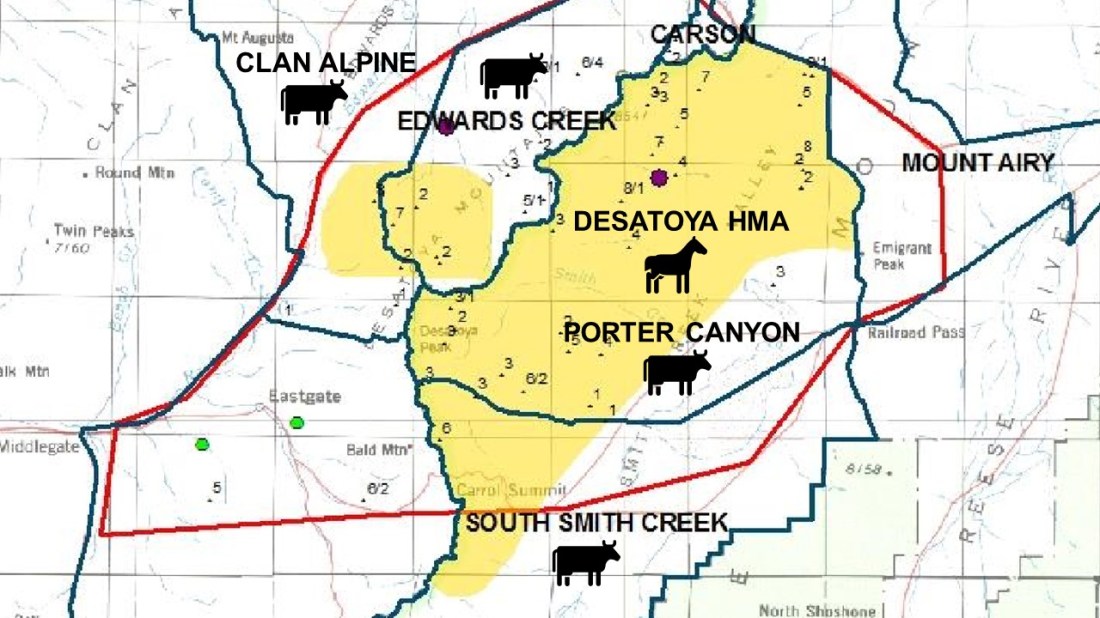
The HMA covers approximately 235,000 acres in western Utah and has an AML of 115.

The HMA intersects five allotments and is managed primarily for livestock.  The current population of 661 is well within the true AML of 932.

Captured animals will be taken to the off-range corrals in Axtell.

Gather stats and daily reports will be posted to this page.

RELATED: Confusion Management Plan In the News.

Wild Horse Wars on Drudge

The link pointed to a copy of the story in the Houston Chronicle.

Wild Horse Wars on Drudge-1

The government spends $57 million per year to warehouse 52,000 wild horses and burros, according to a recent news release, so it can collect an estimated $850,000 in grazing fees from the ranchers to whom their food is sold.

Revenue = 52,000 horses × 12 AUMs per horse per year × $1.35 per AUM

With taxpayers making up the difference, the grazing program is a fine example of redistribution of wealth.  That’s what Protect the Harvest is trying to protect.

RELATED: Wild Horse Wars?, Grazing Program Ancillaries.

Gathers and Removals: Horse Poop Edition

Corral cleaning is like leaf collection: You first have to gather the pieces into piles then transfer them into a container for removal.

The typical manure rake, on the right in the photos below, is made of plastic.  It’s designed for scooping not raking.  When you flip it over and use it as a rake, the tines break off, usually in the middle.  It’s a productivity killer.

Home Depot has a True Temper leaf rake made of metal that works great for gathering the poop into piles.  Only complaint is that the handle is a little short and made of metal.  In the winter it will pull the heat out of your hands if you’re not wearing gloves.

Price is $16.  It’s better and faster than a manure rake for horse poop roundups.

Hookover Bucket Installation

Duraflex buckets won’t work on pipe panels with rail spacings greater than ten inches.

The rails in the Powder River panel below are on 9-3/4″ centers.  Lugs under the hooks lift the bucket, so the lower edge barely contacts the rail.  The galvanized panel in the background has rails on 12″ centers.

The bucket tilts slightly when hooked over the panel, bringing the water level closer to the rim.  Holes for the mounting block should be within an inch from the rim.

The block in these photos is still clamped to the bucket and the brackets for the valve haven’t been secured to it, allowing the valve to slide toward the front of the bucket.

The hose was purchased at Home Depot.  The feed store used to carry them but not any more.  The hose should have 3/4″ male thread on one end, to connect to the float valve, and a 3/4″ female thread on the other, to connect to a standard hose bibb.

A washing machine hose won’t work.

Hookover Bucket Installation Concerns

RELATED: Hookover Bucket Mock-Up.

New Gather Plan for Nevada WHR Approved

BLM announced today the signing of a Decision Record authorizing certain wild horse management actions in the Nevada WHR over a ten-year period, subject to a 30-day appeal period.

The approved action (Alternative 1) features roundups, fertility control, sex ratio skewing and castration.  Refer to Section 2.1 in the EA.

The WHR is in the northern portion of the Nevada Test and Training Range, covering roughly 1.3 million acres of public lands withdrawn for military use.  As such, there is no public access to the area, including hunting, camping and livestock grazing.

The DR and EA were combined into one file and posted with other project documents.

RELATED: Comments Invited on Draft EA for Nevada WHR Roundups.

Teeny Weeny Clarification

In yesterday’s news release about the WHB Program in FY 2020, BLM said it protects wild horses and burros by gathering and removing excess animals from the range and offering them for adoption or purchase at facilities and events around the country.

Except that’s not what Velma had in mind.  They were to be protected on their home range.

Horse #81 is excess in an area where the AML is 80.  Same for horse #240.  The forage assigned livestock can support 450 of them, for a true AML of 530, so a roundup is not necessary.

If Congress wants to write letters to the Secretary of the Interior about the treatment of wild horses and burros, why not condemn public-lands ranching?

Stop the Ovariectomies, Use PZP Instead!

The Animal Welfare Institute said in a news release yesterday that 58 lawmakers from both houses of Congress sent a letter to the Department of the Interior condemning the BLM’s plan to sterilize wild mares from the Confusion HMA in western Utah.

Instead, they suggested, wild horse populations should be controlled with PZP.

Nobody wants to talk about causes.

The HMA is managed primarily for livestock.

Look at the resource allocations and management priorities of the RMP.

Then you’ll understand why the AML is low and the desire to shrink the herd is high.

RELATED: Confusion DR Setting New Precedent in WH Management?

WHB Gather Stats for FY 2020

BLM said today that it removed 10,139 wild horses and burros from western rangelands in FY 2020 and placed 6,162 animals into private care through adoptions and sales.

The fiscal year began on October 1, 2019.

There are 52,000 wild horses and burros in off-range corrals and pastures, according to the news release, at a cost of $57 million annually.

The on-range population is now over three times higher than the number of animals the land can support in conjunction with other legally mandated uses.

Cattle and Horses

Black Mountain Roundup Day 56

The operation started on September 23.  Gather stats through November 17:

  • Burros captured: 478
  • Goal: 500
  • Deaths: 2
  • Returned: 0
  • Shipped: 411

Foals accounted for 13.8% of the total.  Of the captured adults, approximately 52% were jacks and 48% were jennies.

The cumulative total says 482 animals removed.

The number of unaccounted-for burros is 478 – 2 – 0 – 411 = 65.  BLM staff may be holding them on site.  No animals have shipped since November 6.

RELATED: Black Mountain Roundup Day 45.

Forest Service to Reduce Big Summit AML

Wild Horse Education reported earlier this week that the Forest Service has issued a decision notice authorizing a reduction of the AML for the Big Summit WHT, among other things, subject to a 45-day appeal period.

The number of horses allowed by plan would change from 55–65 to 12–57, necessitating a revision to the RMP.  The limiting factor is winter forage.  See “Purpose and Need for Action” in the EA, page 11 in the pdf.

The AML is the number of horses (or burros) an area can support after diverting most of the resources to privately owned livestock.

The horses will require 684 AUMs per year at the upper end of the new AML, while domestic sheep receive approximately 1,700 AUMs per year during a summer grazing season.  The forage assigned to livestock would help the horses bulk up in the summer and be less vulnerable to winter conditions.

The low end of the AML is usually set at approximately 50% of the high end, to provide five years between roundups at a growth rate of fifteen to twenty percent per year.

But the project sets the low end at roughly 20% of the high end, allowing the herd size to be cut to the bone.  This would set new precedent in wild horse management.

If the herd survives from a starting point of 12, how many years would pass before the population reaches 57?  The growth rate at Big Summit is thought to be around 8% per year, according to “Current Conditions” in the EA (page 10 in the pdf).

Here is the mathematical relationship.  Solve for x.

12 × 1.08^x = 57

The answer is 20.24—twenty years to reach the high end of AML.  Throw in some contraceptives and the herd will basically flat-line, the dream of land managers and ranchers everywhere.

RELATED: Comments Invited on Changes to Big Summit Management Plan.

Saylor Creek Release in Photos

Eleven occupiers were released into the disputed territory today, pushing past a small group of its rightful owners.  MagicValley.com has the story.

Welcome to the two-state solution on America’s public lands.  It won’t work here any more than it’ll work in the Middle East.

RELATED: Saylor Creek Release Today.

UPDATE: The release occurred yesterday.  BLM posted this YouTube video.

Tale of Two Interests-1