Roberts Mountain Roundup, Day 9

The incident began on October 22.  Results through October 30:

  • Scope: Roberts Mountain, Whistler Mountain, Fish Creek HMAs
  • Purpose: Pest control, resource enforcement, rancher protection
  • Target: Horses
  • Type: Planned
  • Method: Helicopter
  • Category: Cruel and costly*
  • Better way: Sterilize mares with pesticide-laced darts*
  • Captured: 589, up from 511 on Day 7
  • Average daily take: 65.4
  • Capture goal: 1,106
  • Removal goal: 1,068
  • Returned: None
  • Deaths: 4, no change from Day 7
  • Shipped: 501, up from 347 on Day 7

The location of the trap site was not given.

The death rate is 0.7%.

The capture total includes 229 stallions, 270 mares and 90 foals.

Youngsters represented 15.3% of the animals gathered, suggesting the herd is growing at a rate of 10% per year.

Of the adults, 45.9% were male and 54.1% were female.

Body condition scores ranged from 4 to 5 on Days 8 and 9.

The HMAs and surrounding lands are subject to permitted grazing.

*According to advocates.
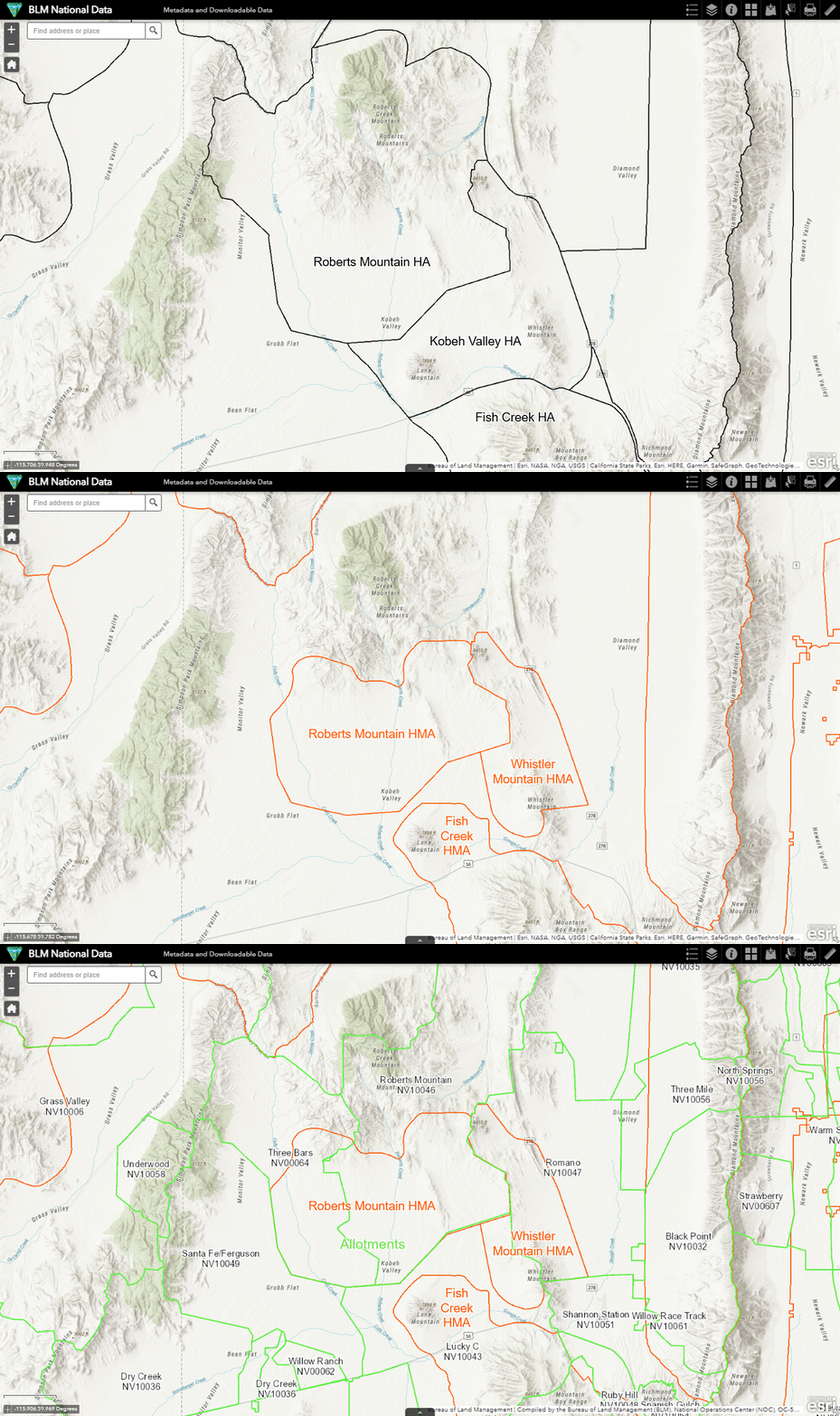
Roberts Mountain Complex with Allotments 10-16-23

Day 9 ended with 84 unaccounted-for animals.

Up to 19 mares will be treated with GonaCon Equine, a fertility control pesticide, before being returned to the range with up to 19 stallions.

Other statistics:

  • Forage liberated to date: 7,068 AUMs per year
  • Water liberated to date: 5,890 gallons per day
  • Forage assigned to livestock: Undetermined
  • Horses displaced from Complex by permitted grazing: Undetermined
  • True AML: Undetermined
  • Stocking rate at new AML: Undetermined
  • Horses removed because of drilling and mining: Ask the advocates

Overpopulation means more horses than allowed by plan, not necessarily more horses than the land can support.

RELATED: Roberts Mountain Roundup, Day 7.

UPDATE: A note was added to the Day 9 report after this post went live: A truck carrying 36 captured horses overturned outside of Delta, UT.  Three were killed, four were humanely euthanized and many suffered minor cuts and bruises.  The remaining horses were taken to a holding facility in Delta where they continue to be evaluated and monitored by the on-site veterinarian.  The driver was not injured.  The cause of the accident is under investigation.

Advocates Say McCullough Peaks Roundup Not Necessary

The mares have been darted with birth control medication for years.  It’s an aging population that will shrink naturally through deaths from old age.

Six horses died over the summer and more will be lost to winterkill according to an advocate interviewed for a story dated October 30 by Cowboy State Daily.

Articles like this confirm your suspicions that they’re sick in the head and want the ranchers to win.

Getting Rid of Wild Horses Is Our Job 10-14-23

The HMA has the unfortunate distinction of being in the motorized and nonmotorized removal sections of the latest schedule.

RELATED: McCullough Herd to Achieve AML on its Own?

Calling it a Vaccine 05-01-23

Barren in Sonoma

At the September 7 “Dust Up” debate in Elko, Nevada State Senator Hansen said the BLM was not in bed with the livestock industry.

But he didn’t say that about the advocates.

Who are they pandering to in the following video?

  • Hunters
  • Ranchers
  • Bureaucrats
  • Rich white liberals
  • All of the above

What do they offer?

  • Barren mares
  • Confused stallions
  • Shrinking herds
  • Injuries and infections
  • Abnormal sex ratios
  • Increasing death rates
  • Tiny breeding populations
  • Sterility
  • Loss of genetic diversity
  • Acclimation to humans
  • Disruption of natural order
  • Prevalence of livestock

That’s what they mean by “A Better Way.”

Filmed during a “Stay Barren” event at the Durell Vineyards in Sonoma, CA.

RELATED: Combatting Duplicity in the Wild Horse World.

Roberts Mountain Roundup, Day 7

The incident began on October 22.  Results through October 28:

  • Scope: Roberts Mountain, Whistler Mountain, Fish Creek HMAs
  • Purpose: Pest control, resource enforcement, rancher protection
  • Target: Horses
  • Type: Planned
  • Method: Helicopter
  • Category: Cruel and costly*
  • Better way: Sterilize mares with pesticide-laced darts*
  • Captured: 511, up from 380 on Day 5
  • Average daily take: 73.0
  • Capture goal: 1,106
  • Removal goal: 1,068
  • Returned: None
  • Deaths: 4, up from 3 on Day 5
  • Shipped: 347, up from 272 on Day 5

The location of the trap site was not given.

A stallion broke a leg in the trap on Day 7 and was euthanized.

The death rate is 0.8%.

The capture total includes 200 stallions, 234 mares and 77 foals.

Youngsters represented 15.1% of the animals gathered, suggesting the herd is growing at a rate of 10% per year.

Of the adults, 46.1% were male and 53.9% were female.

Body condition scores ranged from 4 to 5 on Days 6 and 7.

The HMAs and surrounding lands are subject to permitted grazing.

*According to advocates.

Roberts Mountain Complex with Allotments 10-16-23

Day 7 ended with 160 unaccounted-for animals.

Up to 19 mares will be treated with GonaCon Equine, a fertility control pesticide, before being returned to the range with up to 19 stallions.

Other statistics:

  • Forage liberated to date: 6,132 AUMs per year
  • Water liberated to date: 5,110 gallons per day
  • Forage assigned to livestock: Undetermined
  • Horses displaced from Complex by permitted grazing: Undetermined
  • True AML: Undetermined
  • Stocking rate at new AML: Undetermined
  • Horses removed because of drilling and mining: Ask the advocates

Overpopulation means more horses than allowed by plan, not necessarily more horses than the land can support.

RELATED: Roberts Mountain Roundup, Day 5.

Roberts Mountain Roundup, Day 5

The incident began on October 22.  Results through October 26:

The location of the trap site was not given.

The death rate is 0.8%.

The capture total includes 154 stallions, 175 mares and 54 foals.

Youngsters represented 14.2% of the animals gathered, suggesting the herd is growing at a rate of 9% per year.

Of the adults, 46.3% were male and 53.7% were female.

Body condition scores ranged from 4 to 5 on Days 4 and 5.

The HMAs and surrounding lands are subject to permitted grazing.

*According to advocates.

Roberts Mountain Complex with Allotments 10-16-23

Day 5 ended with 105 unaccounted-for animals.

Up to 19 mares will be treated with GonaCon Equine, a fertility control pesticide, before being returned to the range with up to 19 stallions.

Other statistics:

  • Forage liberated to date: 4,560 AUMs per year
  • Water liberated to date: 3,800 gallons per day
  • Forage assigned to livestock: Undetermined
  • Horses displaced from Complex by permitted grazing: Undetermined
  • True AML: Undetermined
  • Stocking rate at new AML: Undetermined
  • Horses removed because of drilling and mining: Ask the advocates

Overpopulation means more horses than allowed by plan, not necessarily more horses than the land can support.

RELATED: Roberts Mountain Roundup, Day 3.

Trash Threatens Currituck Wild Horses?

It might be a hazard, but it’s small in comparison to the damage inflicted by Meg Puckett and her darting rifle, who laments in the following video the generations lost because a mare was removed from the herd and put on a farm.

What do you think she’s been doing?  How many generations have been lost because of Zonastat-H?  How many of the mares on the beach are now sterile?

These people are such phonies!

Next to the federal government, nobody’s getting rid of more wild horses and causing more long-term harm than the advocates.

Foal Free-Friday, Questioning the Assumptions Edition

The “Path Forward” was a plan for ranching superiority in the lawful homes of wild horses and burros, sometimes referred to as achieving and maintaining AMLs.

Today many organizations support the concept, including the advocacy groups, but there is disagreement on how it should be achieved.

Best Way to Achieve AMLs 10-26-23

The bureaucrats and ranchers want removal by helicopters.

The advocates want removal by pesticides.

But they all want removal.

Nobody’s looking upstream in the management process at the policies and plans that set the priorities and drive the actions on America’s public lands.

RELATED: Foal-Free Friday, Struggling to Survive Edition.

Advocates Trespassing on the Virginia Range?

The advocates would have a tough time cementing their relationship with the bureaucrats and ranchers if they couldn’t access private property on the Virginia Range.

Fortunately for them, but not for the horses, some landowners give them permission to stalk the mares on their property, so they can poison them with Zonastat-H and show their would-be allies that they can be as ruthless as the contractors and that removal by pesticide is a viable alternative to removal by helicopter.

Better Way 10-25-23

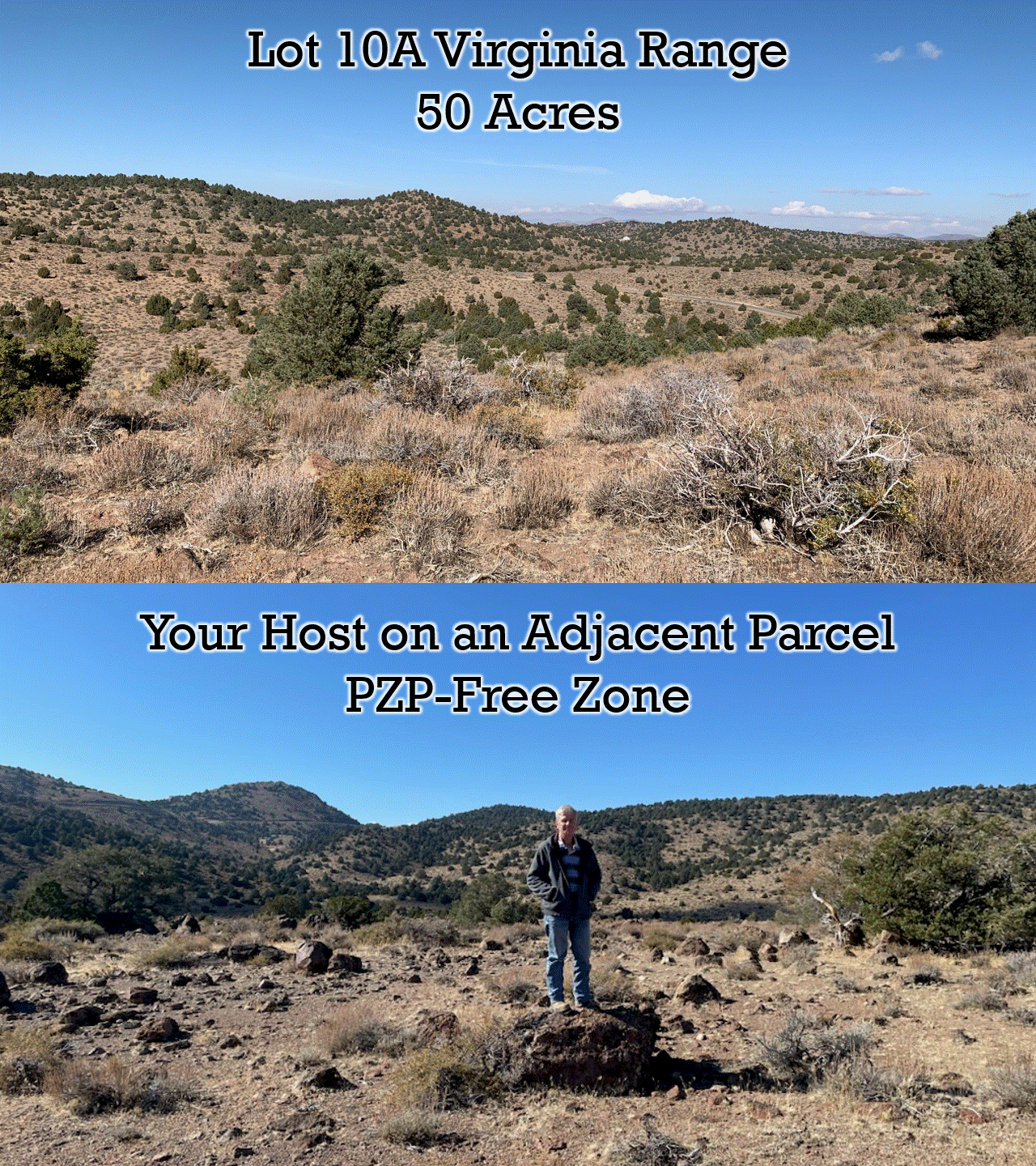
One example is lot 10A in Storey County, APN 004-271-60, on the list of approved properties for darting.

Do the advocates know where the property lines are, so they can respect the wishes of those who don’t agree with them?

Or do they just go wherever the horses are because beating the population down as quickly as possible is the best way to win the approval of the bureaucrats and ranchers?

RELATED: CAAWH Publishes Virginia Range Darting Resources.

Approved Properties for Darting 10-25-23

Roberts Mountain Roundup, Day 3

The incident began on October 22.  Results through October 24:

  • Scope: Roberts Mountain, Whistler Mountain, Fish Creek HMAs
  • Purpose: Pest control, resource enforcement, rancher protection
  • Target: Horses
  • Type: Planned
  • Method: Helicopter
  • Category: Cruel and costly*
  • Better way: Sterilize mares with ovary-killing pesticides*
  • Captured: 243, up from 86 on Day 1
  • Average daily take: 81.0
  • Capture goal: 1,106
  • Removal goal: 1,068
  • Returned: None
  • Deaths: 3, up from zero on Day 1
  • Shipped: 158, up from zero on Day 1

The shipping figures for Day 2 should be 81 (42 Stallions, 19 Mares, and 20 Foals), not 20 (42 Stallions, 19 Mares, and 81 Foals) as posted.

A mare died of a broken neck on Day 2 and a stallion was dispatched for blindness.

On Day 3, a horse (sex not given) was put down for blindness.

The death rate is 1.2%.

The capture total includes 100 stallions, 114 mares and 29 foals.

Youngsters represented 11.9% of the animals gathered.

Of the adults, 46.7% were male and 53.3% were female.

Body condition scores ranged from 3 to 6 on Days 2 and 3.

The HMAs and surrounding lands are subject to permitted grazing.

*According to advocates.

Roberts Mountain Complex with Allotments 10-16-23

Day 3 ended with 82 unaccounted-for animals.

Up to 19 mares will be treated with GonaCon Equine, a fertility control pesticide, before being returned to the range with up to 19 stallions.

Other statistics:

  • Forage liberated to date: 2,916 AUMs per year
  • Water liberated to date: 2,430 gallons per day
  • Forage assigned to livestock: Undetermined
  • Horses displaced from Complex by permitted grazing: Undetermined
  • True AML: Undetermined
  • Stocking rate at new AML: Undetermined
  • Horses removed because of drilling and mining: Ask the advocates

Overpopulation means more horses than allowed by plan, not necessarily more horses than the land can support.

RELATED: Roberts Mountain Roundup in Progress.

Moriah Roundup Ends

Yesterday’s news release said the incident concluded on October 23 but the figures for the last day weren’t posted until this morning.

The daily reports indicate 440 horses captured, 439 shipped, none released and two dead, with one more horse processed than captured.

The sidebar at the gather page shows 441/439/0/2 with no unaccounted-for animals.

The capture and removal goals were identical, 400 each.

The death rate was 0.5%.

The capture total included 137 stallions, 203 mares and 100 foals.

Youngsters represented 22.7% of the animals gathered, consistent with a herd growth rate of 18% per year.

Of the adults, 40.3% were male and 59.7% were female, not what you’d expect in a sample of 340 horses from a random process centered at 50% males / 50% females.

The HA is unfit for wild horses, but the allotments that overlap it can support livestock equivalent to 5.7 wild horses per thousand public acres.

Moriah Allotment Calcs 10-24-23

RELATED: Moriah Roundup Announced.

Calico After-Action Report

The October 20 news release said 145 mares would be treated with GonaCon Equine and be returned to the Complex at a later date.

As of today, 145 stallions have been returned.

The roundup ended on October 17 so the mares should be freed on or about ________, assuming they receive two doses of the pesticide.

a. November 17

b. December 17

c. January 17

d. As interpreted by the WHB specialist

e. Gonacon Equine is a vaccine not a pesticide

Hint:

Gonacon 90-Day Requirement 07-01-23

RELATED: Calico Roundup Ends Early.

Moriah Roundup, Day 5

The incident began on October 17.  Results through October 21:

  • Scope: Moriah HA
  • Purpose: Pest control, resource enforcement, rancher protection
  • Target: Horses
  • Type: Planned
  • Method: Helicopter
  • Category: Cruel and costly*
  • Better way: Sterilize mares with pesticide-laced darts*
  • Captured: 336, up from 203 on Day 3
  • Average daily take: 67.2
  • Capture goal: 400
  • Removal goal: 400
  • Returned: None
  • Deaths: 2, up from zero on Day 3
  • Shipped: 284, up from 103 on Day 3

The figures above are based on the daily reports, not the totals posted by the BLM.

Two colts were put down on Day 5, one because of club foot and another due to lameness in both front legs.

The death rate is 0.6%.

The capture total includes 113 stallions, 151 mares and 72 foals.

Youngsters represented 21.4% of the animals gathered.

Of the adults, 42.8% were male and 57.2% were female.

Body condition scores ranged from 3 to 4 both days.

The HA and surrounding lands are subject to permitted grazing.

*According to advocates.

Moriah HA with Grazing Allotments 10-20-23

Day 5 ended with 50 unaccounted-for animals.

Other statistics:

  • Horses allowed by plan (AML): None
  • Forage liberated to date: 4,032 AUMs per year
  • Water liberated to date: 3,360 gallons per day
  • Forage assigned to livestock: Undetermined
  • Horses displaced from HA by permitted grazing: Undetermined
  • True AML: Undetermined
  • Stocking rate at new AML: Undetermined
  • Horses removed because of drilling and mining: Ask the advocates

Overpopulation means more horses than allowed by plan, not necessarily more horses than the land can support.

RELATED: Moriah Roundup, Day 3.

Combatting Duplicity in the Wild Horse World

The Campaign Against America’s Wild Horses answers three questions about wild horses in a news flash posted by Lucky Three Ranch.

  • Are wild horses and burros overpopulated?  NO!
  • Are wild horses and burros responsible for overgrazing on public lands?  NO!
  • Are wild horses native?  They are a native re-introduced species.

If horses are not the problem, why are they trying to get rid of them?

Combatting the False Narrative 10-22-23

On the Virginia Range, they’ve pumped an astonishing 8,116 doses of Zonastat-H into the herd since 2019.  Many of the mares are now at risk of sterility.

At the Salt River, their affiliate, the Salt River Wild Horse Darting Group, is not trying to slow population growth, they’re trying to reverse it.  Same as the Virginia Range.

At Cedar Mountain in Utah, CAAWH received $91,865.50 from the BLM to spread the poison around in that HMA.  The money didn’t just fall out of the sky, they requested it!

What do these examples have in common?

Their words say “We love the horses” but their deeds say “We despise them.”

This is standard practice for the wild horse advocates.

Getting Rid of Wild Horses Is Our Job 10-14-23

They are like the scribes and pharisees of the New Testament.  They sail the high seas to win one convert then make him twice as deserving of Hell as they are.

Stone Cabin Permittees Demand Immediate Removal of Horses

The case was disclosed on October 18 by KLAS News but the article did not include a link to the complaint.

Yesterday The Nevada Independent covered the story and provided a link.  If you can’t access the document click here.

The plaintiffs allege that the federal government determined that wild horse overpopulation existed within the Stone Cabin Complex and that removal of excess animals was necessary but did not act in a timely manner.

They pointed to §1333(b)(2) in the WHB Act (16 USC 30) which directs the government to immediately remove excess animals to achieve appropriate management levels and restore a thriving ecological balance.

They further allege that they’ve taken up to 56% suspension of AUMs on the allotments to achieve standards for rangeland health.

The plaintiffs asked the court to declare any off-site conditions impeding the timely removal of wild horses to be irrelevant, such as funding, scheduling, contractor availability and space in the off-range corrals, and to compel the implementation of the new pest control plan subject only to on-site conditions as the court deems appropriate.

The Operator Information and Allotment Information Reports at RAS tie the plaintiffs to the following BLM authorizations and allotments:

  • COLVIN & SON LLC: 2706100, WAGON JOHNNIE and STONE CABIN
  • STONE CABIN RANCH LLC: 2706117, HUNTS CANYON, WILLOW CREEK and STONE CABIN

These parcels are mentioned in Paragraphs 10 and 12 of the complaint.

Paragraph 10 also indicates that Colvin & Son have grazing privileges on the Little Fish Lake and Wagon Johnnie Allotments in the Humboldt-Toiyabe NF.

Paragraph 12 indicates that Stone Cabin Ranch has grazing preference on the Monitor Complex, Stone Cabin and Saulsbury Allotments in said forest.

Those allotments are not covered by RAS and do not appear in the National Data Viewer, but the forage allocations, livestock types and seasons of use can be found in the AOIs (Colvin & Son | Stone Cabin Ranch).

The Forest Service allotments can be seen in the Western Watersheds map.

Although the plaintiffs claim they have cooperated with federal agencies to achieve applicable standards for rangeland health, the Allotment Master Report puts all of their allotments in the Improve category (Colvin & Son | Stone Cabin Ranch).

A ruling in favor of the plaintiffs would throw the wild horse and burro program into chaos.

As of today, the Stone Cabin Complex is not in the FY24 roundup schedule.

RELATED: Stone Cabin Decision Published.

Thriving Ecological Balance-3

Advocate Criticizes Your Host

“I am not the only one doubting your advocacy for wild horses,” she wrote in an October 14 email.

You got a mouse in your pocket?

To repeat: I am not an advocate.  I am a voice for wild horses.  The advocates are part of the problem.

If you want to dabble in this field, you need to put on your big girl panties and admit that your ranks are filled with liars and frauds.

There is no two-state solution on America’s public lands, the ranchers must be defeated.

Confine them to their (multi-million dollar) base properties and let them pay the going rate to feed their animals.

No more gravy train, no more sucking on the government teat.

It’s time to man up and oppose the removal of wild horses from their lawful homes by any means, whether it’s helicopters, bait or pesticides.

RELATED: Western Horse Watchers Q&A.

Working Together for a Horse-Free Future 12-21-22

Nevada Stallion Shot, Killed, Marked with Ford Mustang Logo

The remains were found about 50 miles west of Ely by a field worker with the Campaign Against America’s Wild Horses, according to a story by KOLO News of Reno.

The CAAWH Communications Director called for an investigation but did not offer a reward for information leading to arrest and convictions of the person(s) responsible.

Do not be misled.  Next to the federal government, nobody’s getting rid of more wild horses than CAAWH and its army of nitwits.

Not shooters, hunters, ranchers, campers, motorists, drillers, miners or loggers.

Pesticide Pushers 07-17-23