Alvord Permit Renewal Out for Review, Again

A decision rendered earlier this year was vacated in July as a result of appeals submitted by several conservation groups and the project was sent back to the BLM for revision.

A news release from two of the groups circulated at the time.

On September 2, the BLM copied the updated EA to the project folder, along with two other documents, for public review.

The comment period runs through September 17, according to a BLM news release dated September 6.

Some of the details in Section 1.1 of the New EA are a bit confusing and Western Horse Watchers has sent an email to the BLM rep seeking clarification.

The Proposed Action, discussed in Section 2.3 of the EA, would increase the active AUMs in the Alvord Allotment from 7,355 to 9,247 per year.

Most of the increase, about 88%, would occur in the Desert #6 pasture, which lies within the Coyote Lake-Alvord-Tule Springs HMA.  Refer to Table 8 and Map 3.

Alvord Allotment Map 09-08-22

The incremental forage, 1,670 AUMs per year, would support 139 wild horses, on top of the 390 horses currently allowed by plan.

The BLM will collect an additional $2,255 per year in grazing fees if the suspended AUMs in Desert #6 are moved into active status, while it spends $253,675 per year to care for 139 horses in off-range holding that could be returned to the HMA.

Would you say that the Proposed Action constitutes a wise use of the public lands?

Pokegama Roundup Rebooted

A roundup started two years ago will resume this month, according to a BLM news release dated September 7.

The operation, requested by the Green Diamond Resource Company, will remove wild horses from private lands in and around the HMA, as explained in the 2020 Categorical Exclusion and Decision Record.

Horses will be drawn into the traps with bait and the incident will not be open to public observation.

The capture and removal goals were not provided.

The HMA covers about 81,000 total acres (public and private) on the OR-CA border and has an AML of 50.

The current population is thought to be around 230.

Pokegama HMA Map 09-07-22

Green Diamond owns about 79% of the land in the HMA and the horses are consuming forage worth an estimated $25,000 per year.

Captured animals will be taken to the off-range corrals in Hines, OR.

Gather stats and daily report will be posted to this page.

The CX/DR was the only document posted to the project folder in ePlanning.

RELATED: Pokegama HMA Added to 2022 Roundup Schedule.

Protecting the Calico Wild Horses from Removal

The Campaign Against America’s Wild Horses, a thought leader in the wild horse world, has the answer, submitted as a comment on the Draft EA:

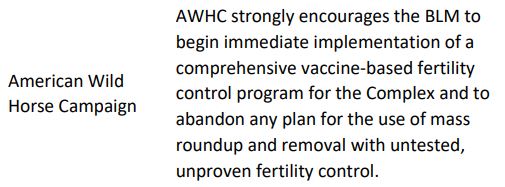
CAAWH Comment on Calico EA 09-07-22

The recommendation was published in a document containing unique comments, according to the file name in the project folder.

Referring to it as original thoughts would be over the top.

The advocates, including the fanatics at the Virginia Range, are protecting their cherished wild horses from removal by getting rid of them with PZP.

RELATED: Calico Roundup Announced.

For Your Cherished Ants and Roaches 08-30-22

Calico Roundup Announced

It’s the last one on the schedule for FY 2022.

The incident will begin on or about September 10, according to yesterday’s news release, with a capture goal of 1,076 wild horses and removal goal of 1,036, compared to 1,556 and 1,445 in the schedule.

Up to 40 cherished mares will be treated with fertility control and returned to the area.

Helicopters will push the animals into the traps and operations will be open to public observation.

Five HMAs are affected.

The Complex covers 584,101 total acres in northern Nevada, as shown in Table 1 of the Final EA for resource enforcement actions, and has an AML of 952 wild horses and 65 wild burros.

An aerial survey in May found 1,593 wild horses in and around the Complex.

The Western Watersheds map shows the layout.

Calico Complex Map 09-07-22

The Complex intersects five grazing allotments.  The forage assigned to livestock inside the HMAs is not known at this time.

Overpopulation means more horses than allowed by plan, not necessarily more horses than the land can support.

Captured animals will be taken to the off-range corrals in Fallon.

Gather stats and daily reports can be found at this page.

The EA was posted with other project documents at ePlanning.

RELATED: Calico Decision Reached.

Commenting at WHBAB Meeting

The announcement in the Federal Register on August 30 said that comments supported by quantitative information, studies, or those that include citations and analysis of applicable laws and regulations are most beneficial, more useful, and likely to assist the decision-making process for the management and protection of wild horses and burros.

Presumably, conclusions based on data would also be welcomed.

Consider this example from the Warm Springs HMA in Oregon.

The 204 horses allowed by plan receive 2,448 AUMs per year.

The HMA coincides roughly with the East and West Warm Springs Allotments.

The Western Watersheds map shows the arrangement.

Warm Springs HMA and Allotments 09-06-22

Livestock receive 18,600 AUMs per year, according to the Allotment Master Report, 7.6 times more than the horses, in an area set aside for the horses.

The horses receive 11.6% of the authorized forage, neglecting wildlife.

The HMA is managed primarily for livestock.

The forage assigned to livestock would support an additional 1,550 wild horses, for a True AML of 1,754.

1. The BLM collects $25,110 per year in grazing fees from ranching activity inside the HMA.

2. The BLM spends $2,828,750 per year to care for the 1,550 horses displaced thereby.

3. The BLM could save up to $2,803,640 per year by placing horses in short-term holding back on the HMA.

Therefore, in keeping with the guidelines above, the recommendation would be to confine the ranchers to their base properties and manage the HMA principally for wild horses, as specified in the original statute, at huge savings to American taxpayers.

This is just one HMA.

The advocates, in their zeal for the Montana Solution, are ready and willing to help the agency achieve the 11.6% specification.

RELATED: WHBAB Meeting Announced.

Chemehuevi Roundup, Day 23

The incident began on August 11 and does not appear in the latest schedule.

As of September 2, 172 burros have been trapped, 172 have been shipped and none have died, according to figures at the gather page.

The daily reports provide totals only.

The capture and removal goals are 275 each.

The cumulative total includes 79 jacks, 65 jennies and 28 foals.

Youngsters represented 16.3% of the animals gathered.

Of the adults, 54.9% were male and 45.1% were female.

The herd can’t be growing at rate of 20% per year with a birth rate of 16%.

The location of the trap was not specified.

The Day 22 report said nine burros had been caught during the night but were set free by hunters who did not want them in a confined space when they started shooting.

Day 23 ended with no unaccounted-for animals.

RELATED: Chemehuevi Nuisance Roundup in Progress.

YPG Roundup Ends

The incident concluded yesterday, according to a statement at the gather page, with 74 burros captured, 74 shipped, none released and none dead.

There were no unaccounted-for animals.

Data quality was good.

The August 10 schedule indicated capture and removal goals of 80 each, with no animals to be returned to the HMA.

The capture total included 31 jacks, 33 jennies and 10 foals.

Youngsters represented 13.5% of the animals gathered.

Of the adults, 48.4% were male and 51.6% were female.

The BLM received complaints from farmers and personnel at Yuma Proving Ground alleging that the burros were creating hazardous conditions near highways and public health and safety issues.

RELATED: BLM to Remove Wild Burros from Yuma Proving Ground?

Millions of Americans Suffering from Chimney Head Syndrome?

They mean well and want to help America’s wild horses but the advocates have been blowing smoke up their butts for years.

The problem is resource management, not wild horses, which they won’t discuss.

Instead, they go on about HMAPs, fertility control, drilling and mining, climate change, sanctuaries, adoption and other off-the-range programs.

“We’re changing the way wild horse herds are managed, not their land.”

Who benefits from this?

Not the horses.

So it’s no wonder that the American people are shaking their heads, some of which are starting to look like smokestacks.

RELATED: Advocates Fall on Swords to Glorify Montana Solution.

Saving Wild Horses 06-18-22

Frisco Roundup Ends Early

The incident concluded yesterday, according to a statement at the gather page, with 51 horses captured, 48 shipped, none released and three dead.

There were no unaccounted-for animals.

The death rate was 5.9%.

Data quality was good.

The August 10 schedule indicated a capture goal of 97 and removal goal of 67, with up to 30 animals returned to the HMA, including 15 mares treated with fertility control.

The gather page suggests that treat-and-release was not part of the plan.

The capture total included 25 stallions, 16 mares and 10 foals.

Youngsters represented 19.6% of the animals gathered.

Of the adults, 61% were male and 39% were female.

The observed percentage of foals suggests the herd was growing at a rate of 15% per year, not 20% per year, a rate used by land managers to predict herd sizes and justify resource enforcement actions.

The HMA has an HMAP and is managed primarily for livestock.

RELATED: Frisco Roundup Announced.

Roberts Mountain Complex Has No HMAP!

As stated in Section 1.3 of the Draft EA, there is currently no Herd Management Area Plan in place for the Roberts Mountain Complex or any of the individual HMAs.

Livestock in Roberts Mountain HMA receive 3.5 times more forage than the horses.

Livestock in Whistler Mountain HMA receive 4.4 times more forage than the horses.

Roberts Mountain Complex Map 08-21-22

What would those ratios look like if they had HMAPs?

Livestock in Roberts Mountain would receive 3.5 times more forage than the horses.

Livestock in Whistler Mountain would receive 4.4 times more forage than the horses.

Both HMAs have resource management problems, not wild horse problems.

HMAPs are not the answer.

RELATED: Roberts Mountain Pest Control Plan Goes Public.

Triple B Pests to Be Released After Fertility Treatment

Up to fifty cherished mares taken from the Complex last month will be returned on or about October 20, after receiving a second dose of GonaCon Equine, according to a BLM news release.

The incident will be open to public observation.

The roundup restored a thriving ecological balance and multiple-use relationship on public lands in eastern Nevada, meaning it shifted large amounts of forage—that the horses tried to reclaim—back to the public lands ranchers.

RELATED: Triple B Roundup Ends.

For Your Cherished Ants and Roaches 08-30-22

Frisco Roundup, Day 3

The incident began on August 29.  Gather stats through August 31:

  • Target: Horses
  • Type: Planned
  • Method: Helicopter
  • Category: Cruel and costly
  • Captured: 34, up from 12 on Day 1
  • Average daily take: 11.3
  • Capture goal: 97
  • Removal goal: 67
  • Returned: None
  • Deaths: 1, up from zero on Day 1
  • Shipped: None

The figures above are based on the daily reports, not the totals posted by the BLM.

A stallion was euthanized on Day 2 because of a club foot.

The death rate is 2.9%.

The capture total includes 19 stallions, 9 mares and 6 foals.

Youngsters represented 17.6% of the animals gathered.

Of the adults, 67.9% were male and 32.1% were female.

The herd can’t be growing at a rate of 20% per year with a birth rate of 18% per year.

A better estimate would be 13% per year, assuming a death rate of 5% per year.

Body condition scores were not provided.

The location of the trap was not disclosed.

The HMA and surrounding lands are subject to permitted grazing.

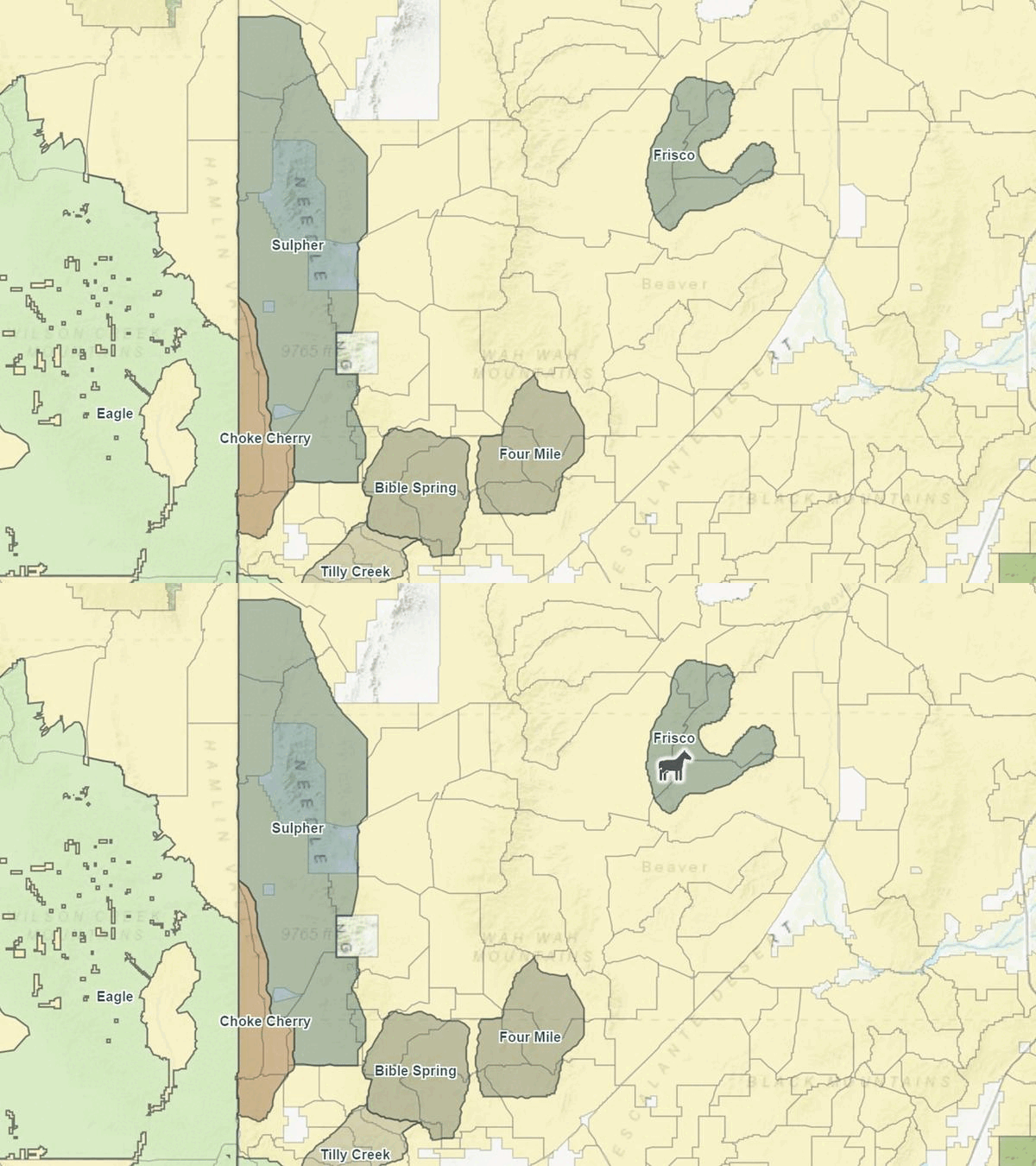
Frisco HMA Map 08-22-22

Day 3 ended with 33 unaccounted-for animals.

Mares treated with fertility control may be returned to the area at a later date.

Other statistics:

  • Horses allowed by plan (AML): 60
  • Forage assigned to horses: 720 AUMs per year
  • Pre-gather population: 137
  • Forage liberated to date: 408 AUMs per year
  • Water liberated to date: 340 gallons per day
  • Forage assigned to livestock: 2,959 AUMs per year (estimated)
  • Horses displaced from HMA by permitted grazing: 247
  • True AML: 307
  • Stocking rate at new AML: 5.1 horses per thousand acres
  • Horses displaced from HMA by drilling and mining: Ask the advocates

RELATED: Frisco Roundup in Progress.