
On the Virginia Range with Kristin McKay.
Month: January 2021
Hunter/Jumper Prospect?
Filmed near Santa Elena Canyon in Big Bend National Park by Navarre Marshall. A bit unusual to see an unattached youngster in the wild. Is there more to the story?
The canyon description ends with this notice: “Illegal border crossings are known to occur in this area. If you encounter anything that appears illegal, suspicious, or out of place, please do not approach or intervene. Note the location, description, time, direction of travel, and call 911 as soon as possible.”
How to See the Currituck Horses Without Going On the Dunes
Fish Creek Roundup Day 5
The incident began on December 29. Gather stats through January 2:
- Horses captured: 198
- Goal: 195
- Returned: 0
- Deaths: 0
- Shipped: 80
Foals accounted for 18.2% of the horses gathered. Roughly 54% of captured adults were males and 46% were females.
Body condition scores are not known.
No horses shipped on Days 1, 2, 3 and 5, according to the daily figures.
The number of unaccounted-for animals is 118. They are probably being held on site, pending the return of 60 horses to the HMA, including 30 mares treated with PZP-22.
Although the target has been reached, the page does not say if gather operations are complete.
RELATED: Fish Creek Roundup Day 3.
Virginia Range Darting Program Spreading to South Africa?
A report by Deseret News says that a researcher from the University of Pretoria will be collaborating with personnel from the American Wild Horse Campaign regarding the use of PZP to manage elephants in limited habitats.
Volunteers on the Virginia Range have treated 1,333 mares in a herd of 3,000 horses that roam on 300,000 acres, according to the story, with an expectation that 600 lives will be denied this year.
You can’t have healthy horses at a stocking rate of ten animals per thousand acres when you’re an ally of those who demand stocking rates of one wild horse per thousand acres or less on public lands in the western U.S.—to accommodate more privately owned cattle and sheep.
These people are preventing wild horses, not protecting them, an insult to Velma’s legacy.
The report confirmed that the ‘One-Horse Pony‘ Amendment was dropped from the FY 2021 spending bill.
RELATED: PZP Zealotry on a Global Scale, So Long, PZP Amendment?

The Horses Are Still a Problem But the Statute Is Not
The WHB Act, formally known as 16 USC 30, turns 50 in December but no longer functions as Velma intended. Most of the protections are gone.
How did we get to the point where almost half of the land identified for wild horses and burros has been taken away and most of the resources on the remaining land have been diverted to privately owned livestock?
- Changes to the statute by Congress (amendments)
- Rules promulgated by the unelected bureaucracy (regulations)
The regulations have probably had the greatest impact.
In the original Act, land where wild horses and burros were found was to be “devoted principally but not necessarily exclusively to their welfare.” That was the only condition.
Today, land is managed principally for them if the bureaucracy says so.
And what has been the response of the ‘advocacy’ groups? Bash oil and mining companies while pushing contraceptives.
Reform has to start on the advocacy side and that’s what this blog is all about.
RELATED: Coming Soon: WHB Act at 50, Statutes and Regulations.
Economic Viability of Wild Horse Roundups
The economic attractiveness of the scenario considered yesterday, which was based on data from Table 3-3 in the Draft EA for resource enforcement actions in the Desatoya HMA, was zilch.
- Spend $954 to remove a wild horse from his home range
- Spend $568 per year to keep him in long-term holding
- Collect $16 per year from the rancher to whom his food is sold
So the question arises: By how much would the grazing fee have to increase to justify the endeavor from an economic viewpoint?
A crude approach to the problem would be to solve for x in the following expression, where 12 represents the forage that would have been consumed by the horse but is now available to livestock (AUMs per year), x is the grazing fee ($ per AUM) and 568 is the cost of long-term holding ($ per year).
12 × x = 568
The answer is x = $47.33 per AUM. The fee would have to increase from $1.35 to $47.33 to pay for long-term holding. But it doesn’t pay for the cost of capture and doesn’t reflect the time-value of money.
That’s why the BLM used present values in the EA.
Another way to answer the question is to model the situation in a Excel, using the built-in present value functions. Most of the cells in this example have text and numbers except B13, B15, B17 and B19, which have formulas.
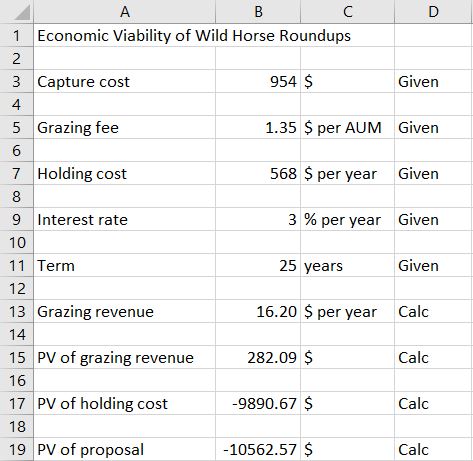
If you put the data in different cells the formulas won’t work. The sign convention for cash flows is negative for expenditures, positive for revenues.
The present value function discounts a series of future payments (or receipts) back to the present, for a given interest rate and time period, which in this case were taken from the EA.
The model assumes that a captured horse is not adopted and is transferred immediately to long-term holding. The analysis in the EA is a bit more complex, using both short-term and long-term holding, a topic for future discussion.
The present value of the capture cost is $954, as it occurs at the start of the process.
The other transactions are assumed to occur at the end of the year and are assumed to be constant over the life of the project.
- Beginning of year 1: Spend $954 to capture a wild horse
- End of year 1: Spend $568 for holding, receive $16 in grazing fees
- End of year 2: Spend $568, receive $16
- End of year 3: Spend $568, receive $16
- ¦
- End of year 25: Spend $568, receive $16
The present value of the proposal is the difference between the present value of the grazing revenues and the present value of the holding costs, minus the capture cost.
The formulas are as follows:
- B13: =12*B5
- B15: =PV(B9/100,B11,-B13)
- B17: =PV(B9/100,B11,B7)
- B19: =B15+B17-B3
The cell formats were changed to two decimals, getting rid of the accounting formats applied by Excel when entering financial functions. You can download a copy of the spreadsheet here.
The present value of the proposal, in cell B19, is negative, meaning the present value of the costs exceeds the present value of the revenues. It is a bad investment.
By how much would the grazing fee have to increase to make the present value of the proposal positive?
Try entering some larger values in cell B5, observing the effect in B19. You may have to enable editing when the file opens, depending on the security settings of your computer.
The amount that flips the present value from negative to positive would be the smallest fee that makes wild horse roundups economically viable. If the proposal involved a mix of short-term and long-term holding, as in the EA, the fee would be higher.
Of course, everything is off the table until areas identified for wild horses and burros are managed principally for wild horses and burros, as specified in the original statute.
Fish Creek Roundup Day 3
The incident began on December 29. Gather stats through December 31:
- Horses captured: 140
- Goal: 195
- Returned: 0
- Deaths: 0
- Shipped: 41
Foals accounted for 18.6% of the horses gathered. Roughly 52% of captured adults were males and 48% were females.
Body condition scores are not known.
No horses have been shipped according to the daily figures.
The number of unaccounted-for animals is 99. The contractor is probably holding them on site.
Sixty horses will be returned to the HMA, including 30 mares treated with PZP-22.
The operation will likely conclude in another day or two.
RELATED: Fish Creek Roundup Day 1.
 Western Horse Watchers Association