Spend Wisely: Today Is Defund the Advocates Day

They want to replace motorized removal with mass sterilization, abnormal sex ratios and faulty immune systems.

They oppose principal use, management at the minimum feasible level and nature’s way.

Withholding your financial support is easy, sensible and costs nothing.

RELATED: Starting a Nonprofit That Actually Helps Wild Horses.

Support the Advocates 09-22-24

Ninth Circuit Hears Arguments in Big Summit Appeal

Attorneys for the Forest Service and Central Oregon Wild Horse Coalition appeared today before a three-member panel regarding a plan to remove at least half of the wild horses in the Big Summit WHT.

The plaintiffs claim that the range can support a much higher population than the government admits.

A story by Courthouse News Service said the court did not indicate when it would rule.

The Forest Service recently started work on a new facility that would hold wild horses removed from the area.

RELATED: Court Sides with Forest Service in Big Summit Legal Challenge.

BLM Closes Public Lands for Murderer’s Creek Roundup

The order covers about 18,800 acres in Grant County, OR and could extend through February 28 according to today’s news release.

No map was provided.

The incident was set to begin on November 25 but no animals have been captured.

The announcement may be an example of the new rule the agency imposed on itself in August.

RELATED: Murderer’s Creek Emergency Roundup Announced.

Wyoming Honor Farm EA Out for Review

The document was copied to the project folder today.

Comments will be accepted through January 2 according to the news release.

In Alternative 1, the Proposed Action, the BLM would award a five-year contract to pay for space, feeding, training and care of up to 200 wild horses and burros.

Alternative 2 would end the inmate training program, which started in 1988.

The facility held 141 horses and 8 burros as of September 23.

RELATED: Scoping Begins for Wyoming Honor Farm Contract Renewal.

NDA Posts Board of Agrigulture Meeting Attachments

The Animal Industry Report offers little if any new information about the Washoe Lake fencing project.

  • NDA has entered into a contract with a vendor for reconstruction of BLM fences and construction of new fences pending the completion of the NEPA study, in the Virginia Range Area
  • Approximately 6 miles of existing fencing have been rebuilt in the Washoe Valley area
  • All funding is sourced from the NDA Feral Horse Management Project
  • John Axtell has taken over as project manager

The botched rescue of 24 Virginia Range horses in August is recounted on page 2.

The report was posted to the BOA meetings page.

RELATED: NDA Schedules Fourth Quarter Board of Agriculture Meeting.

Triple B Roundup, Day 29

The incident started on November 2.  Results through November 30:

  • Scope: Triple B Complex
  • Target: Wild horses
  • AML: 889
  • Pre-gather population: 3,335
  • True AML: 4,551
  • Type: Planned
  • Method: Helicopter
  • Category: Cruel and costly (according to advocates)
  • Better way: Sterilize mares with PZP (according to advocates)
  • Capture goal: 2,255
  • Removal goal: 2,155
  • Captured: 2,102, up from 1,953 on Day 27
  • Shipped: 1,938, up from 1,754 on Day 27
  • Released: 20, no change from Day 27
  • Deaths: 24, up from 23 on Day 27
  • Average daily take: 72.5
  • Unaccounted-for animals: 120
  • Snippet from statute: It is the policy of Congress that wild free-roaming horses and burros shall be protected from capture, branding, harassment, or death
  • Snippet from manual: To protect wild horses and burros from unauthorized capture, branding, harassment or death

The figures above are based on the daily reports.

The sidebar says 1,941 shipped.  If that figure was used, there would be 117 unaccounted-for horses.

A stallion died of a ruptured aorta on Day 28.

The death rate is 1.1%.

The capture total includes 776 stallions, 834 mares and 492 foals.

Youngsters represented 23.4% of the animals gathered, consistent with a herd growth rate of 18% per year.

Of the adults, 48.2% were male and 51.8% were female, no indication of an abnormal sex ratio.

Body condition scores were not given.

The location of the trap site was not disclosed.

The name of the contractor was not provided.

Three HMAs are affected.

Twelve mares have been treated with GonaCon Equine.  The plan calls for up to 50 to receive the pesticide and be returned to the range with up to 50 stallions.

The roundup supports three tenets of rangeland management.

Resources liberated to date:

  • Forage: 24,984 AUMs per year
  • Water: 20,820 gallons per day

The Complex supports livestock equivalent to 3,730 wild horses, so it will always be at 4.2X AML or more.

RELATED: Triple B Roundup, Day 27.

Triple B Complex with Allotments 11-04-24

Socialist Media Update for November 2024

Traffic from Facebook and Twitter accounted for 1.6% of the total during the month, down considerably from the same period two years ago and reaching a new low.

WordPress does not report results for Instagram.

Did you know the Rock Springs HMAs would be well above AML even if all the horses were removed?

The advocates are silent about these things.

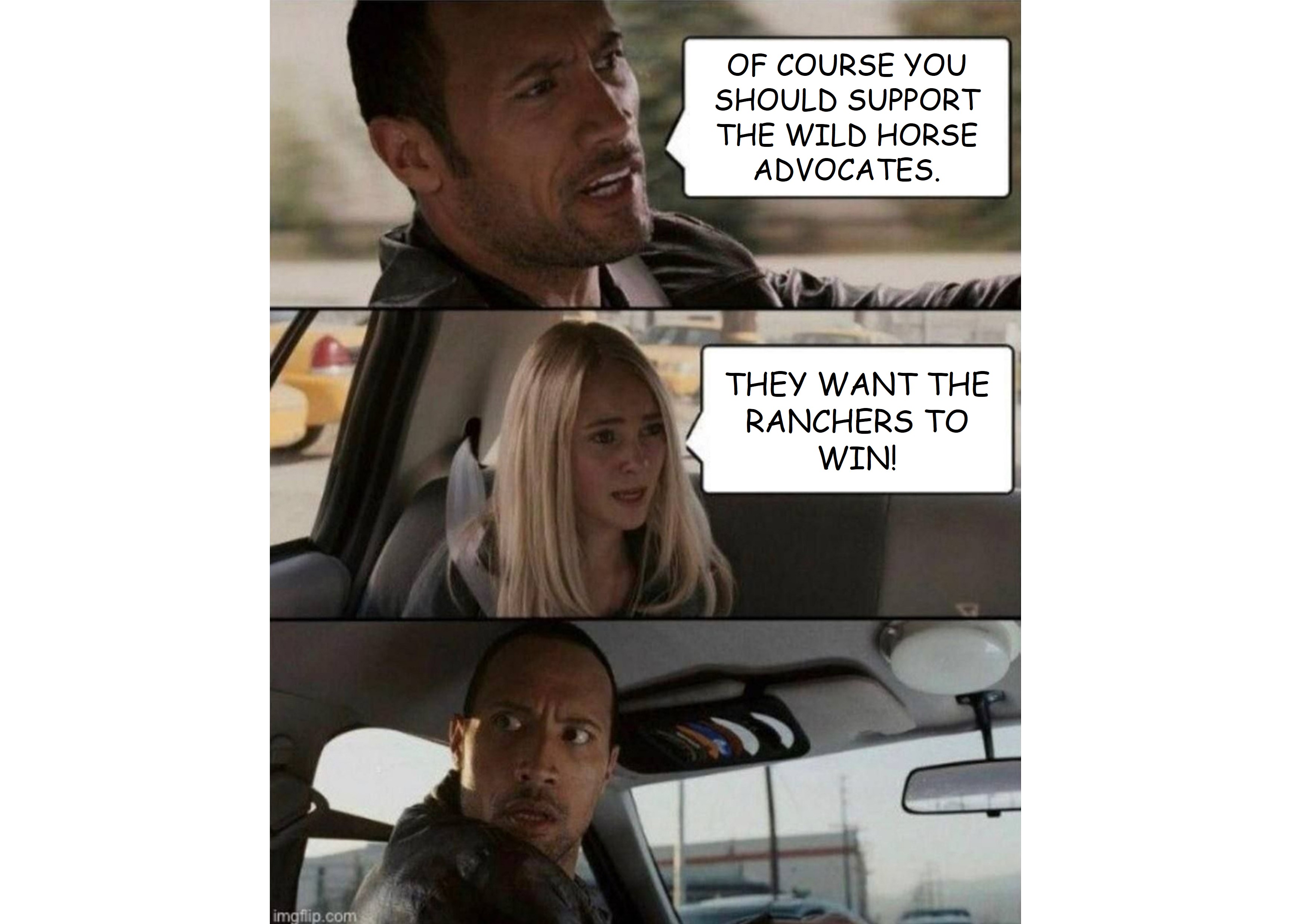
They want the ranchers to win.

Example from PNWHA 12-01-24

Keep that in mind on December 3.

RELATED: Socialist Media Update for October 2024.

Traffic from Socialist Media November 2024 12-01-24

Advocates Take Left-Wing Lunacy to New Heights

There’s a special class of stupidity in the electorate and it’s occupied by the wild horse advocates.

Consider this Google search result for the Salt River Wild Horse Darting Group:

SRWHMG Importance of Family 11-30-24

If you’re a normal person, family is synonymous with husband, wife and their children.

Not so for liberals.  Family corresponds to just about any arrangement, such as two filthy sodomites and their dogs or couples who are aborting/contracepting/sterilizing themselves out of existence.

The advocates project this twisted view onto wild horses.

Humane management is a euphemism for snuffing out new life with ovary-killing pesticides.

Thus, there are no families, only animals that have banded together in a last-ditch effort to survive.

Horses die, and with few if any new foals hitting the ground, the herd will vanish.

Only a lunatic would equate mass sterilization with protection and preservation.

Keep this in mind on December 3.

RELATED: Hypocrisy of Advocates on Full Display at Salt River.

Triple B Roundup, Day 27

The incident started on November 2.  Results through November 28:

  • Scope: Triple B Complex
  • Target: Wild horses
  • AML: 889
  • Pre-gather population: 3,335
  • True AML: 4,551
  • Type: Planned
  • Method: Helicopter
  • Category: Cruel and costly (according to advocates)
  • Better way: Sterilize mares with PZP (according to advocates)
  • Capture goal: 2,255
  • Removal goal: 2,155
  • Captured: 1,953, up from 1,829 on Day 25
  • Shipped: 1,754, no change from Day 25
  • Released: 20, no change from Day 25
  • Deaths: 23, no change from Day 25
  • Average daily take: 72.3
  • Unaccounted-for animals: 156
  • Snippet from statute: It is the policy of Congress that wild free-roaming horses and burros shall be protected from capture, branding, harassment, or death
  • Snippet from manual: To protect wild horses and burros from unauthorized capture, branding, harassment or death

The figures above are based on the daily reports.

The sidebar says 1,757 shipped.  If that figure was used, there would be 153 unaccounted-for horses.

The death rate is 1.2%.

The capture total includes 726 stallions, 773 mares and 454 foals.

Youngsters represented 23.2% of the animals gathered, consistent with a herd growth rate of 18% per year.

Of the adults, 48.4% were male and 51.6% were female, no indication of an abnormal sex ratio.

Body condition scores were not given.

The location of the trap site was not disclosed.

The name of the contractor was not provided.

Three HMAs are affected.

Twelve mares have been treated with GonaCon Equine.  The plan calls for up to 50 to receive the pesticide and be returned to the range with up to 50 stallions.

The roundup supports three tenets of rangeland management.

Resources liberated to date:

  • Forage: 23,196 AUMs per year
  • Water: 19,330 gallons per day

The Complex supports livestock equivalent to 3,730 wild horses, so it’s always at 4.2X AML or more.

RELATED: Triple B Roundup, Day 25.

Triple B Complex with Allotments 11-04-24

Foal-Free Friday, Raising Them Right Edition

Parents, if you have a horse-crazy kid, keep a close eye on her to make sure she’s not being groomed by the advocates to become one of their supporters—or worse, one of their ambassadors or field workers.

This includes strict control of her mobile phone or other device, blocking access to socialist media, where she’ll be indoctrinated into their twisted way of thinking.

Use PZP 11-21-24

If you have a friend or family member who has been assimilated into their cult, or nearly so, the only way out may be an extended stay at a Betty Ford clinic or similar institution, where she can be deprogrammed, cured of her obsession with pesticides and educated in intellectual honesty.  Immediate intervention required.

RELATED: Foal-Free Friday, Crime and Punishment Edition.

Students Learn About Darting 10-26-22

New Fence to Isolate Washoe Lake from Virginia Range?

The fence on the west side, seen in this video, appears to be in good condition.

The Virginia Range is in the background.

Repairs and new construction may occur on the other side of the lake, separating the valley from the hills and putting an end to scenes like this.

The loudest protests will come from those who are sterilizing the mares with pesticide-laced darts, the results of which are evident in the film.

They want you to think they’re the good guys.  Keep that in mind on December 3.

RELATED: NDA Schedules Fourth Quarter Board of Agriculture Meeting.

Triple B Roundup, Day 25

The incident started on November 2.  Results through November 26:

  • Scope: Triple B Complex
  • Target: Wild horses
  • AML: 889
  • Pre-gather population: 3,335
  • True AML: 4,551
  • Type: Planned
  • Method: Helicopter
  • Category: Cruel and costly (according to advocates)
  • Better way: Sterilize mares with PZP (according to advocates)
  • Capture goal: 2,255
  • Removal goal: 2,155
  • Captured: 1,829, up from 1,785 on Day 23
  • Shipped: 1,754, up from 1,586 on Day 23
  • Released: 20, no change from Day 23
  • Deaths: 23, up from 18 on Day 23
  • Average daily take: 73.2
  • Unaccounted-for animals: 32
  • Snippet from statute: It is the policy of Congress that wild free-roaming horses and burros shall be protected from capture, branding, harassment, or death
  • Snippet from manual: To protect wild horses and burros from unauthorized capture, branding, harassment or death

The figures above are based on the daily reports.

Helicopters did not fly on Day 25 due to bad weather.

The sidebar says 1,757 shipped.

Four mares were dispatched on Day 24 due to poor body condition.  Another mare died on Day 25 after breaking her neck, lifting the death rate to 1.3%.

The capture total includes 695 stallions, 718 mares and 416 foals.

Youngsters represented 22.7% of the animals gathered, consistent with a herd growth rate of 17% per year.

Of the adults, 49.2% were male and 50.8% were female, no indication of an abnormal sex ratio.

Body condition scores were not given.

The location of the trap site was not disclosed.

The name of the contractor was not provided.

Three HMAs are affected.

Twelve mares have been treated with GonaCon Equine.  The plan calls for up to 50 to receive the pesticide and be returned to the range with up to 50 stallions.

The roundup supports three tenets of rangeland management.

Resources liberated to date:

  • Forage: 21,708 AUMs per year
  • Water: 18,090 gallons per day

The Complex supports livestock equivalent to 3,730 wild horses, so it’s always at 4.2X AML or more.

RELATED: Triple B Roundup, Day 23.

Triple B Complex with Allotments 11-04-24

NDA Schedules Fourth Quarter Board of Agriculture Meeting

The meeting will be held in Las Vegas on December 6.

It will be livestreamed on Zoom according to the notice and video conferences will be available in Sparks and Elko.

The Washoe Lake fencing project was not called out as a line item in the agenda but will probably be included in the Animal Industry discussion.

As of today, no reports have been posted to the meeting page.

RELATED: Washoe Lake Fencing Not a New Idea?

Wild Horse Effect on Rangelands Confounded with Livestock

Consider five HMAs in Wyoming covered by a 2021 EA for management actions therein:

Rock Springs AML Calcs 07-07-24

If all of the horses were removed from Adobe Town, livestock equivalent to 2,688 wild horses would remain, putting the HMA at 3.4X AML.  Not good for wildlife.

If all of the horses were removed from Great Divide Basin, livestock equivalent to 2,993 wild horses would remain, putting the HMA at 5.0X AML.  Bad for rangeland health.

If Salt Wells Creek was depopulated of horses, livestock equivalent to 4,963 wild horses would remain, putting the HMA at 13.6X AML.  A disaster by any standard.

If White Mountain was relieved of equines, livestock equivalent to 1,589 would remain, putting the HMA at 5.3X AML.  Unacceptable.

If Little Colorado was subject to a 100% roundup, livestock equivalent to 3,750 wild horses would remain, putting the HMA at 37.5X AML.  Immediate action required.

Curiously, nobody’s complaining.  The horses are gone and that’s all that matters.

RELATED: Sage Grouse Study Implicates Wild Horses?

Devil’s Garden Roundup, Day 28

The incident started on October 28.  Results through November 24:

  • Location: Devil’s Garden Plateau WHT
  • AML: 402
  • Pre-gather population: Between 651 and 998
  • Target: Horses
  • Type: Planned
  • Method: Helicopter and bait
  • Goals: Capture 500, remove 500
  • Category: Cruel and costly (according to advocates)
  • Better way: Sterilize mares with PZP (according to advocates)
  • Captured: 301, up from 128 on Day 10
  • Shipped: Unknown
  • Released: Unknown
  • Deaths: 3
  • Average daily take: 10.8
  • Unaccounted-for animals: Unknown

The Forest Service added daily reports to the gather page starting on November 1 but results for October 28 – 31 are missing.

The death rate is 1%.

The capture total since November 1 includes 80 stallions, 99 mares and 40 foals, for a total of 219.

That means 82 horses were taken during the first four days which is hard to believe for an operation that’s been averaging ten per day.

The location of the trap site was not disclosed.

More information may be available on socialist media.

Body conditions scores have been averaging 4 to 5, an indication that the horses are not starving and the herd has not exceeded the ability of the land to sustain it.

The roundup will achieve a thriving ecological balance and multiple-use relationship on public lands, codewords for ranching superiority in the lawful home of wild horses.

RELATED: Devil’s Garden Roundup, Day 10.

Thriving Ecological Balance-3

BLM, Forest Service Fill Three WHBAB Vacancies

Two members are returning from previous terms and one person is new according to a BLM news release.

All three are anti-horse.

The announcement said the Board consists of nine individuals representing a diverse range of stakeholders and interests, and that have been true in the past, but today it’s dominated by ranching interests and chaired by a pesticide pusher.

RELATED: Next WHBAB Meeting Set for Early January.

AML-1

Sage Grouse Study Implicates Wild Horses?

You have to trust BLM data to support it, according to a November 25 report by Wyoming Public Media.

Livestock were factored in, just not directly.

When horse numbers get too high, they impact sage grouse.

If that’s true, the flocks should have been wiped out 100 years ago when there were two million wild horses roaming freely on western rangelands, a bit more than the 27,000 currently allowed by plan.

The analyst used GPS to monitor 1,000 sage grouse in central and southern Wyoming.

How exactly did he do that and what was the effect on the birds?  Horses tracked by GPS wear collars or tail tags.

When is a herd at 3X AML a threat to rangeland health?  When it’s accompanied by livestock equivalent to 4X AML, typical in areas identified for wild horses.  Forage supply can’t keep up with demand.

If you remove the livestock, 3X AML is not a problem.

Who commissioned the study?

Who paid for it?

The ranchers and their allies are always looking for ways to bludgeon wild horses and prop up their failed industry.