The Campaign Against America’s Wild Horses does, as stated in an undated solicitation for volunteers on Mobilize, a site for community organizers and other left-wing kooks.
There are more horses than allowed by plan but not more than the land can support.
The problem is the way your public lands are managed.
It’s not Ajax, Riptide or Thunderbolt. It’s Twist.
Those four guys accounted for 36% of this year’s foal crop.
Name
Foals produced
Twist
12
Ajax
8
Riptide
8
Thunderbolt
8
Refer to this spreadsheet for a complete breakdown.
A public relations officer with the Chincoteague Fire Company told Western Horse Watchers on August 19 that the herd consisted of 23 males and 126 females.
The advocates cannot comprehend foal production. Like the legacy contractors, they are experts at herd reduction.
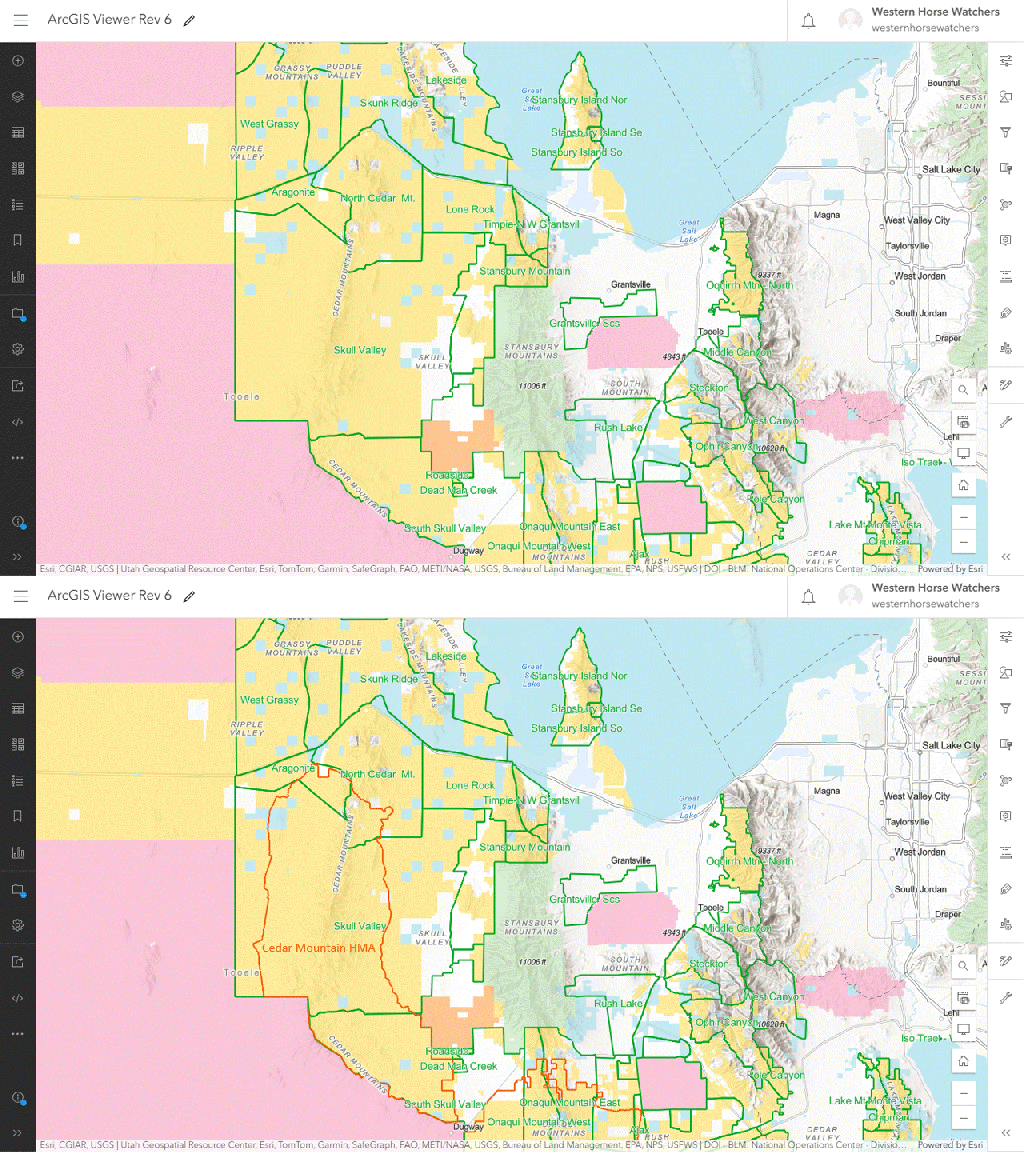
Together they offer 20,719 active AUMs on 330,757 public acres, equivalent to 5.2 wild horses per thousand public acres.
As for the HMA, the management plan allows 390 wild horses on 204,674 public acres, or 1.9 wild horses per thousand public acres.
Therefore, it should be able to support (1.9 + 5.2) × 204,674 ÷ 1,000 = 1,453 wild horses, meaning that 1,453 – 390 = 1,063 wild horses have been consigned to off-range holding because of permitted grazing.
A report by USA Spending indicates that the Campaign Against America’s Wild Horses has received $173,975 for the service, out of $217,549 authorized.
The August 5 schedule indicates 20 mares treated at Cedar Mountain. If that’s on an annual basis, then 40 mares will be treated over the two-year life of the project, which works out to over $5,000 per head.
Would you say that’s a wise use of taxpayer money?
Snippet from statute: It is the policy of Congress that wild free-roaming horses and burros shall be protected from capture, branding, harassment, or death
Snippet from manual: To protect wild horses and burros from unauthorized capture, branding, harassment or death
The figures above are based on the daily reports.
Results for Day 5 were not posted until today. The gather page says it’s over but not with 199 unaccounted-for animals.
Two horses died on Day 4, followed by one on Day 5, lifting the death rate to 5.2%.
The capture total includes 94 stallions, 85 mares and 31 foals.
Youngsters represented 14.8% of the animals gathered.
Of the adults, 52.5% were male and 47.5% were female.
The location of the trap site is not known.
The name of the contractor was not given.
There are no plans to treat any of the mares with fertility control pesticides and return them to the range.
Both areas are subject to permitted grazing. Resources liberated to date:
Like the original commentary, this one is for subscribers only.
Other parties are equally culpable, such as the wild horse advocates, farm bureaus, wildlife associations and public lands councils.
The aim of the grazing program is to ensure that high net worth individuals receive generous government benefits with no means testing and no expiration date.
Presiding over the scam are the Secretaries of Interior and Agriculture.
The incident will not be open to public observation.
Captured animals will be taken to the contract facility in Sutherland via off-range corrals in Cedar City.
There are no plans to treat any of the mares with fertility control pesticides and return them to the range, suggesting that the removal goal is also 120.
Snippet from statute: It is the policy of Congress that wild free-roaming horses and burros shall be protected from capture, branding, harassment, or death
Snippet from manual: To protect wild horses and burros from unauthorized capture, branding, harassment or death
The figures above are based on the daily reports.
Three horses were dispatched on Day 2, followed by five on Day 3. No details were given.
The death rate is 4.7%.
The capture total includes 72 stallions, 76 mares and 23 foals.
Youngsters represented 13.5% of the animals gathered.
Of the adults, 48.6% were male and 51.4% were female.
The location of the trap site is not known. The capture rate suggests that the method of removal is helicopter, not bait.
The name of the contractor was not given.
There are no plans to treat any of the mares with fertility control pesticides and return them to the range.
Both areas are subject to permitted grazing. Resources liberated to date:
Most of the debate occurs on socialist media but occasionally appears in local news outlets, such as this letter to the Daily Independent of Sun City, AZ.
Nobody’s talking about the long-term prospects for the herd, which has been ruined by the advocates.
A population target of 100, or any other value, will be impossible to maintain when you’ve driven the birth rate to zero—permanently.