Foal-Free Friday, Pounding the Pill for Pesticides Edition

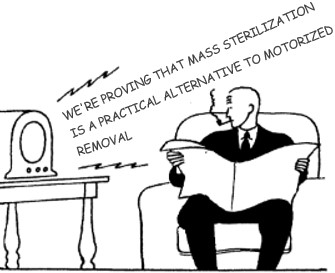
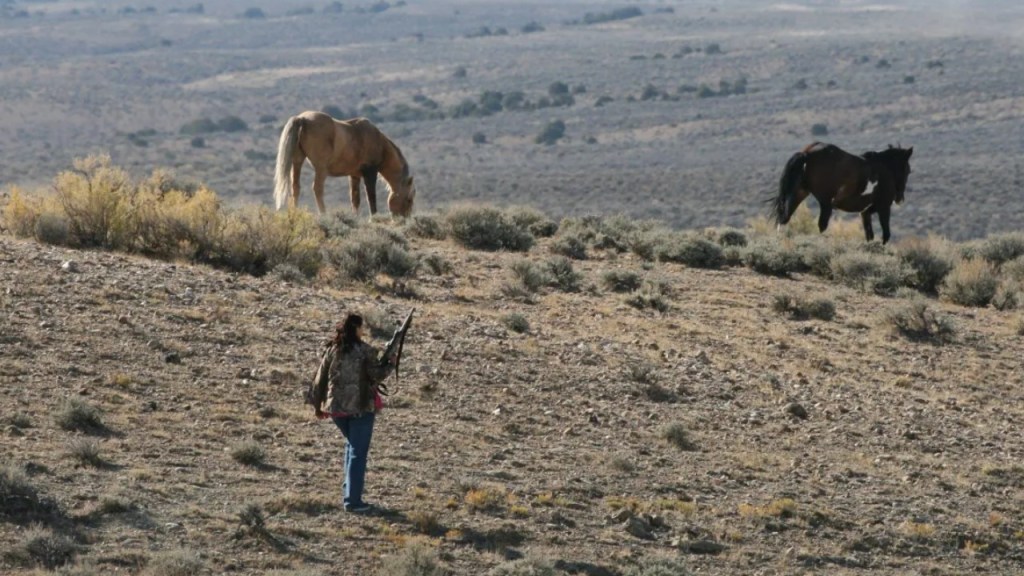
Like their overlords, the Campaign Against America’s Wild Horses, the Salt River Wild Horse Darting Group sells mass sterilization as wild horse preservation.

Here’s the deal: If you hit the links they’ll hit the mares with PZP-laced darts.

Then they’ll quietly slip out of town before you realize they’ve ruined the herd forever.

RELATED: Foal-Free Friday, Attempting the Impossible Edition.

BLM Among Top Ten Donors to CAAWH?

The agency, a servant of the public-lands ranchers, gave $125,682 to the Campaign Against America’s Wild Horses in FY24 according to a report by USA Spending, on top of $91,867 in FY23.

The FY24 payment was likely the second installment on a grant to sterilize the mares at Cedar Mountain.

The nonprofit, which serves commercial interests, appears on the last page of the Cooperative Agreement Summary, one of the documents supplied to the WHBAB at the January meeting.

High Desert Strategies, on page two, received approximately $1,070,000 in FY24 and $391,532 in FY23 for pest control services in Oregon according to the USA Spending report.

It’s another nonprofit that serves a commercial interest.

Costs of Off-Range Holding Going Up?

Figures can be found in the Program Budget section of the Program Data page.

In 2024, the BLM spent 2.3 times as much for off-range holding as it did in 2012.

But as a percentage of total expenditures, are the costs really going up or just escalating with everything else?

A run chart provides some evidence of an increase.

The trendline, in black, also appears to be going up.  It was fitted to the data with the Analysis Toolpak in Excel.

However, the ANOVA table provided by the toolpak tells a different story.

The p-value of the F-statistic is .095—too large to conclude that the passage of time, on the x-axis, is of use in explaining the variations in the percentage, on the y-axis.

Although there is some evidence of a long-term increase, it’s not enough to provide a basis for action.  A p-value smaller than .01 might signal adverse change.

The advocates, on the other hand, believe the costs are spiraling out of control and use the narrative to push their ruinous darting programs.

Colorado Wild Horse Working Group Meets Next Week

The online meeting begins at 8:00 AM local time on April 17.

The agenda covers placement, preserves and pesticides.

A wild horse refuge is not worthy of your support if it doesn’t include public lands and doesn’t displace livestock therefrom.

The group should establish a base property fund and be ready to pounce when the right listing hits the market.

RELATED: Beware of the Sanctuaries.

Assateague Herd Grows Slightly

The Park Service reported in an undated news release that the population in March 2025 was 79, up from 73 a year earlier.

The herd consisted of 47 females and 32 males, a ratio of approximately 1.5 to 1.

Four deaths and ten births were recorded.

The article did not indicate if mares had been brought in from other areas to replace those ruined by the darting program.

The population has remained below target for seven years.

RELATED: If PZP Is Reversible, Why Is the Assateague Herd Still Shrinking?

DOI Taking Bold Steps to Restore Domestic Energy Production

Recent announcements from the BLM news site:

Western Horse Watchers was unable to find a statement declaring man-made climate change to be a hoax, a fine example of communist subversion.

The chicoms don’t have to bomb our refineries and chemical plants, we’ll destroy them ourselves.

Foal-Free Friday, Attempting the Impossible Edition

The Salt River advocates are trying to cut the herd size in half with PZP, as if they can put it into a nosedive for ten years and have it come in for a soft landing.

The Virginia Range advocates are trying to achieve a reduction of 80% or more with the same pesticide.

The herds will auger in.

The final populations will be zero because most of the mares will be sterile, if they aren’t already.

Those that bear fruit, not enough to overcome the death rate, likely have faulty immune systems, a trait that could be passed on to their offspring.

This is what the advocates bring to the table.

RELATED: Foal-Free Friday, Uproar and Outrage Edition.

Lahontan Planning Documents Out for Public Review

A preliminary environmental assessment has been copied to the project folder with several appendices.

Comments will be accepted through May 12 according to the news release.

The Proposed Action, discussed in Section 2.3 of the EA, would remove all excess horses from an area that is roughly 25 times larger than the HMA.

Figure 1 shows the arrangement.

The current population is thought to be 518.

The AML is 7 – 10 so 511 animals are on the chopping block.

There are no plans to treat any of the mares with fertility control pesticides and return them to the range.

A roundup does not appear on the latest schedule.

Table 1 says the HMA is 100% within the Lahontan Allotment but Figure 2 suggests otherwise.

RELATED: Scoping Begins for Lahontan Wild Horse Roundup.

San Bernardino County Launches New Plan for Wild Burros

Officials have contracted with DonkeyLand to relocate orphaned, sick or injured animals and castrate 100 jacks over the next year according to a report by the Los Angeles Times.

The article did not indicate if the Campaign Against America’s Wild Horses, a leader in nonmotorized removal, had offered to pummel the jennies with pesticide-laced darts at no cost to the government.

RELATED: San Bernadino County Hits Pause on Reche Canyon Burro Removal.

Legislation to Protect TRNP Wild Horses Introduced in Senate

The bill would maintain a genetically diverse herd of at least 150 animals according to a report by KX News.

The story did not indicate if it was prompted by SCR 4006.

The measure was introduced on April 9, read twice and referred to the Committee on Energy and Natural Resources.

The bill text was not immediately available.

RELATED: Breeding Population More Important Than Herd Size.