Silver King Roundup In the News

A friendly reminder from The Ely Times: Helicopters will be pushing ‘excess’ horses off the Silver King HMA starting next week, because the land can’t support them along with other wildlife.  That the HMA is subject to several grazing allotments seems to have been overlooked by the writer(s).

The concern, of course, is not the body condition of the horses, but the body condition of the livestock.  Can’t let those horses rob the public-lands ranchers of their birthright!

AML_Roundup_Criteria_Rev-1

If the management plan is successful, roughly ten percent of the available forage will be allocated to horses, with the balance going to cattle and sheep.

RELATED: BLM to Gather Silver King Horses After Thanksgiving.

Climate Report Proves Federal Government Run by Liberals

First it was global cooling.  Then it was global warming.  Then they switched to climate change so they could play it both ways.

If you have a wildfire, it’s climate change.  If you don’t have a wildfire, it’s climate change.

If you have a hurricane, it’s climate change.  If you don’t have a hurricane, it’s climate change.

If you have an earthquake, it’s climate change.  If you’re Danny Glover.

See this report posted today by AP News.

Devil’s Garden Outplacement Program Up and Running

Twenty former wild horses were adopted last weekend, with twenty four sold, according to a report posted 11/22/18 by the Herald and News of Klamath Falls, OR.
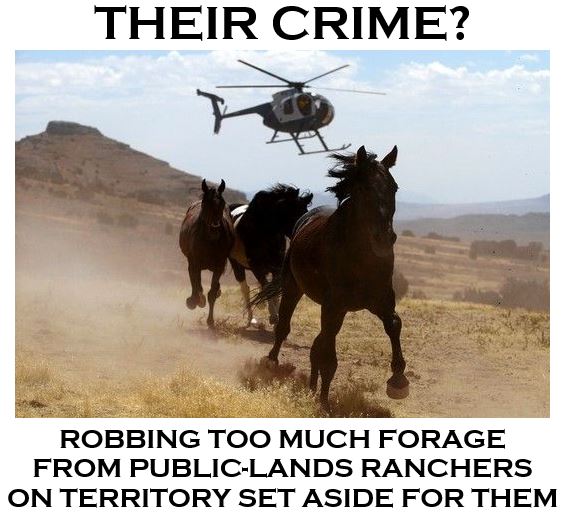
Robbing_Too_Much_Forage-1

Over 200 ‘excess’ horses remain at the made-to-order Double Devil Wild Horse Corrals in Alturas, CA.

RELATED: Forest Service Ends Devil’s Garden Roundup.

UPDATE: Refer to this legal complaint, filed in October on behalf of the Devil’s Garden ranchers against the U. S. Forest Service, for reducing the AUMs available to livestock.

The Forest Service had issued permits for 26,880 AUMs per year on the WHT, which means at least 4,480 cow/calf pairs were allowed, assuming they graze six months per year or less.  The allowable number of horses on the WHT is 402.  These are aimed-at numbers.  The horses would consume 4,824 AUMs annually.

The carrying capacity of the WHT is unknown.

The pre-gather wild horse population was 3,900.  The livestock population at the time of the gather is also unknown.

“Currently, wild horses on the Modoc NF [National Forest] are consuming more forage than is allocated in the wild horse territory for livestock, wildlife, and wild horses combined.”

They seem to forget that these lands were to be managed ‘principally but not necessarily exclusively’ for wild horses.

If the Forest Service is forced to achieve the targets, there will be roughly ten cow/calf pairs on the range for every wild horse, a ‘thriving ecological balance’ indeed.

Park Service Shares Results of Assateague Pony Census

There were 21 males and 57 females in the herd this month, according to a report posted today by WMDT-47 in Salisbury, MD.  Sounds about right, what’s the problem?

Well, the proportion of males seems low.  Alternatively, the proportion of females seems high.

The expected proportion of males is .50.  Ditto for females.  But those are properties of herds that are indefinitely large.

For herds of 78 animals, the observed proportions should fall within calculated limits, namely, .50 plus or minus an amount attributable to random variation.

Using p-chart limits, with n = 78 and p = .5, the proportion of males (or females) in the herd should fall between .33 and .67.  The observed proportion of males is 21 / 78 = .27, which is assignably low.  The observed proportion of females is 57 / 78 = .73, which is assignably high.

What is happening to the Assateague ponies?  A special cause should be sought.

Bands of free-roaming stallions might be bad for tourism so maybe they are the subject of an outplacement program.

Could it be that the fertility control program is screwing up the herd by interfering with natural breeding patterns?  Why would mortality favor males?

What might this portend for other herds where PZP is administered?

RELATED: Baby Boom Next Year on Assateague Island?

USFS Considers Increase to Big Summit AML

The Forest Service has tried to keep number of horses at Big Summit WHT between 55 and 65 according to a management plan established in 1975.  Today the population is around 150.

Advocates say the herd should contain at least 150 animals for genetic viability.

The territory sits between a grazing allotment to the east and highway 26 to the west so others will want the herd maintained at its historic level.

Big_Summit_WHT_Map-1

Refer to this report dated 11/18/18 by The Bulletin of Bend, OR.  The WHT covers 27,300 acres east of Prineville, OR in the Ochoco National Forest.

Baby Boom Next Year on Assateague Island?

NPS has been darting mares with PZP for several years to reduce the number of wild horses on the barrier island but the herd is now at the low end of the desired population range so the effort was suspended.

Biologists are now testing their poop to determine how many mares are pregnant, which will help them predict the size of next year’s foal crop.  Refer to this story, posted today, by the Maryland Coast Dispatch.