Wanted: More Off-Range Pastures for WHB

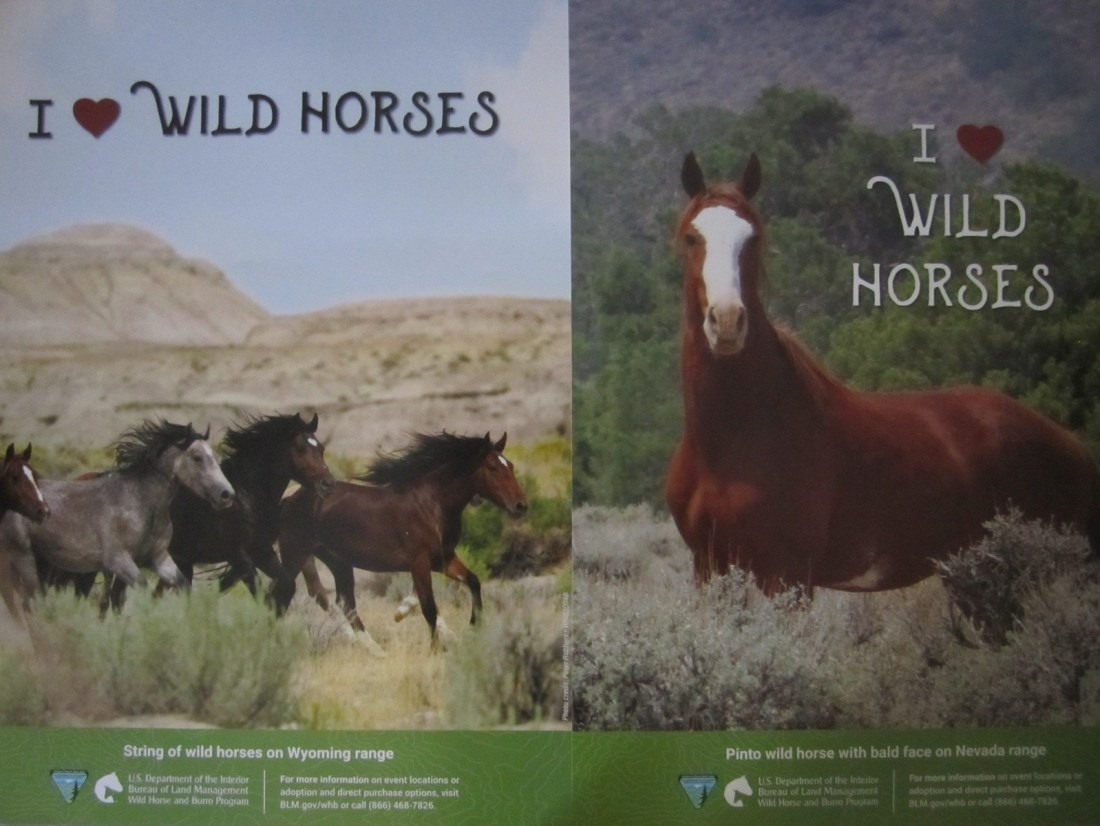
BLM requested bids today for long-term care of wild horses and burros removed from public lands in the western U.S.  A similar request was posted last June.

Facilities must be located in Colorado, Idaho, Kansas, Montana, Nebraska, Nevada, North Dakota, Oklahoma, Oregon, South Dakota, Texas (panhandle only), Utah, Washington or Wyoming.  Contracts will be awarded for 200 to 5,000 animals, with four-year and nine-year renewal options.

Western rangelands can’t support the current number of wild horses and burros in conjunction with ‘other legally mandated uses,’ according to the news release, a euphemism for ‘privately owned livestock.’

What does this say about the 2019 roundup season?  Ten thousand plus?

The forage currently allocated to livestock on public lands managed by the BLM would support 750,000 wild horses and burros, enough to empty all of the off-range corrals and long-term pastures fifteen times over.

RELATED: Wild Horse Overpopulation?, Economics of Wild Horse Gathers.

UPDATE: See also this report posted today by Oregon Public Broadcasting.
Barn Fire Kills Four Horses

A fire at Paint’d Horse Stables in Monroe, WA destroyed the main barn and arena on 02/28/19, claiming four horses, two tons of hay and some ranch equipment, according to a report posted today by KIRO-7 News in Seattle.

The facility rescues wild horses from the Yakama Indian Reservation that would otherwise go to slaughter.

The report did not indicate if the deceased animals were locked in stalls.

IRRC Expands Propaganda

The remarks from 12:39 to 13:15 in this video demonstrate the arrogance of these people.  Everybody bow to the public-lands ranchers, all hail the government serfs!

It’s not their land, it’s their birthright.  Share it with anything but wild horses, notably absent in the film.

The aim of the Idaho Rangeland Resource Commission is not to inform and educate, but to brainwash and gloss over those parts of history they don’t want to remember, such as the rancher’s treatment of wild horses over the last hundred years.

North Hills Gather Approved

Today the BLM authorized the removal of 213 wild horses from the North Hills JMA in southwestern Utah.  The roundup would occur later this year.

The area, consisting of the North Hills HMA and North Hills WHT, is managed jointly by the BLM and Forest Service.  It is northwest of Enterprise.

North Hilla JMA Map-1

The roundup would restore a balance between the horses and other public land resources, according to the news release.  Given that livestock grazing occurs on the HMA (but not on the WHT), those resources are probably cattle or sheep.

The distribution of AUMs among the inhabitants of the JMA was not provided in the announcement but odds are that the lion’s share goes to livestock, with some crumbs going to horses and wildlife.

Never mind that the land was set aside for the horses.

RELATED: Wild Horse Overpopulation?, Livestock Grazing in Utah.

UPDATE: Added chart from page 28 in the Decision Record.

North Hills JMA AMU Chart-1

Wild horse AUM consumption, pre-gather, is about 3,000 AUMs per year.  Post-gather AUM consumption will be 500 AUMs annually, assuming forty horses remain on the HMA (which puts the herd in the ‘Not Genetically Viable’ category).

Three Assateague Mares Missing in Latest Census

A report that appeared today in Delmarva Now says they are presumed dead.

No problems though, mares outnumber studs on the island by a margin of almost three to one according to the census from November 2018.  Can’t possibly be related to the ‘humane management practices’ sanctioned by the Park Service and supported by most of the wild horse ‘advocates.’

The report also indicated that (only) four of the mares were in foal.

Public-Lands Ranching in Idaho

Video from BLM’s Rangeland Management page.  Fun facts, with their timestamps:

  • 600 cow/calf pairs graze on 50,000 acres (0:12)
  • 20% of the forage is utilized (5:29)

Public lands in Idaho can sustain twelve cow/calf pairs per thousand acres at a 20% forage utilization rate, suggesting a carrying capacity of sixty cow/calf pairs per thousand acres.

However, public lands in the state can only support 1.5 wild horses per thousand acres, according to the Herd Management page.

Probably because climate and resources vary wildly from allotment to allotment, with wild horses finding themselves in one of the bad spots.

Satellite Adoptions

Video posted in 2016 by the Michigan Farm Bureau about wild horse and burro adoptions at non-BLM facilities.  A list of these events for 2019 can be found here.

Roundups drive the adoptions and ‘multiple use’ drives the roundups.

Which of these ‘other mandated uses,’ mentioned at 2:26, interferes most directly with the health and welfare of wild horses and burros?

a. Recreation

b. Oil and gas development

c. Livestock grazing

d. Wildlife

How many reports have you read about

  • Wild horses being attacked by hikers and campers?
  • Wild horses being slaughtered by oil companies?
  • Wild horse herds being wiped out by wildlife?

The great destroyer is public-lands ranching, which explains the remark at 2:20 about no natural predators.

Sunday News Program Looks at Wild Horses

A segment yesterday on Full Measure with Sharyl Attkisson briefly discussed the wild horse ‘problem’ in the western U.S.  Although it did mention the costs of helicopter roundups and long-term holding, it did not consider ‘other mandated uses’ of the territory where the horses roam.

Much of the information was sourced from the BLM so, of course, the public-lands ranchers get a pass.  No wild horse advocates were interviewed.

An aerial view of the Palomino Valley Off-Range Corrals appears at 1:27 and ranching shill Chris Stewart makes a few remarks at 2:26.  The guy is bought and paid for.

At best, the piece is incomplete.  At worst, it is biased against the horses.

RELATED: Wild Horse Overpopulation?