“PZP is reversible.”
The pesticide pushers cooked up the sperm-blocking theory to make it seem like it was, even though they knew it wasn’t.
RELATED: If PZP Is Reversible, Why Hasn’t Assateague Herd Rebounded?

Exposing the Hypocrisy, Lies and Incompetence of the Wild Horse Advocates
“PZP is reversible.”
The pesticide pushers cooked up the sperm-blocking theory to make it seem like it was, even though they knew it wasn’t.
RELATED: If PZP Is Reversible, Why Hasn’t Assateague Herd Rebounded?
The advocates will do it for free.
With the Assateague and Currituck herds imploding because of too many nonviable mares, a fact they will never acknowledge, the advocates can point to their darting programs at the Salt River and Virginia Range as examples of mass sterilization supported by the public.
Except they won’t call it that. They’ll say it’s in-the-wild management.
Some observers claim that the FY24 budget cut will push the agency toward permanent solutions such as surgical sterilization.
RELATED: Mass Sterilization OK if Done with PZP.

The event runs from April 17 to 19 at the Grand Sierra Resort as explained in a March 29 news release.
If you’re tired of being propagandized about HMAPs, fertility control and the wonders of public-lands ranching, not necessarily by the presenters but by other conferees and hangers-on, here are some options for quick getaways:
Velma’s Burial Site – Mountain View Cemetery, along I-80 west of hotel. Refer to the map in this video.
Virginia City – Go south on 580, take exit 25B and turn left onto State Route 341 about a mile ahead. When you get to the top you’ll hit a straightaway known as Five Mile Flat, where you may see wild horses. For a scenic detour through the residential area and a better chance to see some Virginia Range mustangs, turn left onto Cartwright then right onto Lousetown at the fire station. Lousetown will take you back to 341 and Virginia City. The best time to see wild horses in this area is May and June.
Tahoe Reno Industrial Center – Go north on 580 from the hotel, then east on I-80 to State Route 439, USA Parkway. You may see wild horses in this area but few if any foals thanks to the advocates. Highway 439 runs south to Highway 50, where you can go west to Carson City then north back to the hotel on 580. As you go west on 50, horses on the right are probably Virginia Range and horses on the left are Pine Nut Mountains but there is some intermixing. The Pine Nut HMA also features barren mares, courtesy of the advocates.
RELATED: Tough Choices: SOWH&W Conference Overlaps FREES.

Undoubtedly, the decision will keep their base fired up and the donations rolling in, a top priority for nonprofits, but areas identified for wild horses will still be managed primarily for livestock.
BEFORE HMAPs
AFTER HMAPs
Conclusion: HMAPs don’t make the needed changes, they maintain the status quo.
As for the burden on taxpayers, the advocates have an answer for that too.

RELATED: Court Sends Pancake EA Back to BLM for Further Analysis.
The case centered around the absence of a Herd Management Area Plan (HMAP) for the Complex, which would summarize the management goals for the area and the actions required to achieve them.
The judge stated that “Engaging in the decision-making of an HMAP without actually preparing an HMAP could therefore deprive interested parties of the administrative review processes to which they are entitled,” according to a news release on EIN.
What is the overarching goal of rangeland management in areas identified for wild horses and burros? Ranching superiority, with few exceptions.
HMAPs cannot change that. Management priorities and resource allocations are documented in the land-use plans which are beyond the scope of the order.
RELATED: Reading the Pancake Tea Leaves.
The BLM allows 11,987 wild horses and 824 wild burros on 14,032,947 public acres in Nevada, according to the statistics released earlier this week.
The current population is thought to be 28,314 wild horses and 3,804 wild burros.
The Nevada WHR and Marietta WBR are not subject to permitted grazing so let’s deduct their acreage, AMLs and current populations from the totals.
The management plans for Nevada HMAs allow 11,487 wild horses and 720 wild burros on 13,968,481 public acres, compared to a current population of 27,939 horses and 3,248 burros.
That’s equivalent to 11,487 + (720 ÷ 2) = 11,847 horses allowed by plan on 13,968,481 public acres, compared to a current population of 27,939 + (3,248 ÷ 2) = 29,563.
The stocking rate allowed by plan is 11,847 ÷ 13,968,481 × 1.000 = 0.8 wild horses per thousand public acres.
The bureaucrats and ranchers tell us that public lands in the western U.S. can only support one wild horse per thousand acres (27,000 animals on 27 million acres), so Nevada comes up on the short side of the target.
The current stocking rate is 29,563 ÷ 13,968,481 × 1,000 = 2.1 wild horses per thousand public acres.
We know from previous discussion that BLM allotments in Nevada can support 4.3 wild horses per thousand public acres, for an estimated carrying capacity of 0.8 + 4.3 = 5.1 wild horses per thousand public acres, which surpasses the current stocking rate by a factor of 2.4.
You don’t have a wild horse problem, you have a resource management problem.
For every horse allowed on Nevada public lands, five have been consigned to off-range holding because of permitted grazing.
The HMAs in Nevada should be able to support an additional 60,000 wild horses.
The advocates couldn’t care less. They want to end wild horse reproduction, not public-lands ranching.
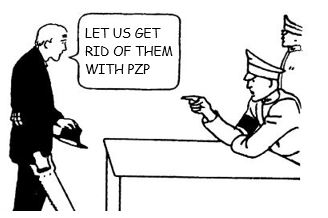
To wit, here is the arithmetic they understand and use on a daily basis:
0.5 cc PZP solution + 0.5 cc modified Freund’s Complete Adjuvant = 1 dose of primer
0.5 cc PZP solution + 0.5 cc modified Freund’s Incomplete Adjuvant = 1 dose of booster
Give one primer and five to six boosters until the mares are sterile.
RELATED; Foal-Free Friday, Holier Than Thou Edition.
The incident will begin on or about April 1 and will not be open to public observation according to today’s news release.
Horses will be drawn into the traps with bait.
The capture and removal goals are identical at 350 each.
There are no plans to treat any of the mares with fertility control pesticides and return them to the range.
The Complex consists of nine former HMAs in eastern Nevada.
It’s unfit for wild horses but currently supports a population of 1,022 plus an untold number of privately owned livestock.
Captured animals will be taken to the off-range corrals in Axtell, Delta and Sutherland Utah.
Receiving only lukewarm support from Congress in the form of FLPMA, PRIA and the Burns Amendment, the bureaucrats have embarked on a long-term plan of nullifying the WHB Act through the planning process, one HMA at a time.
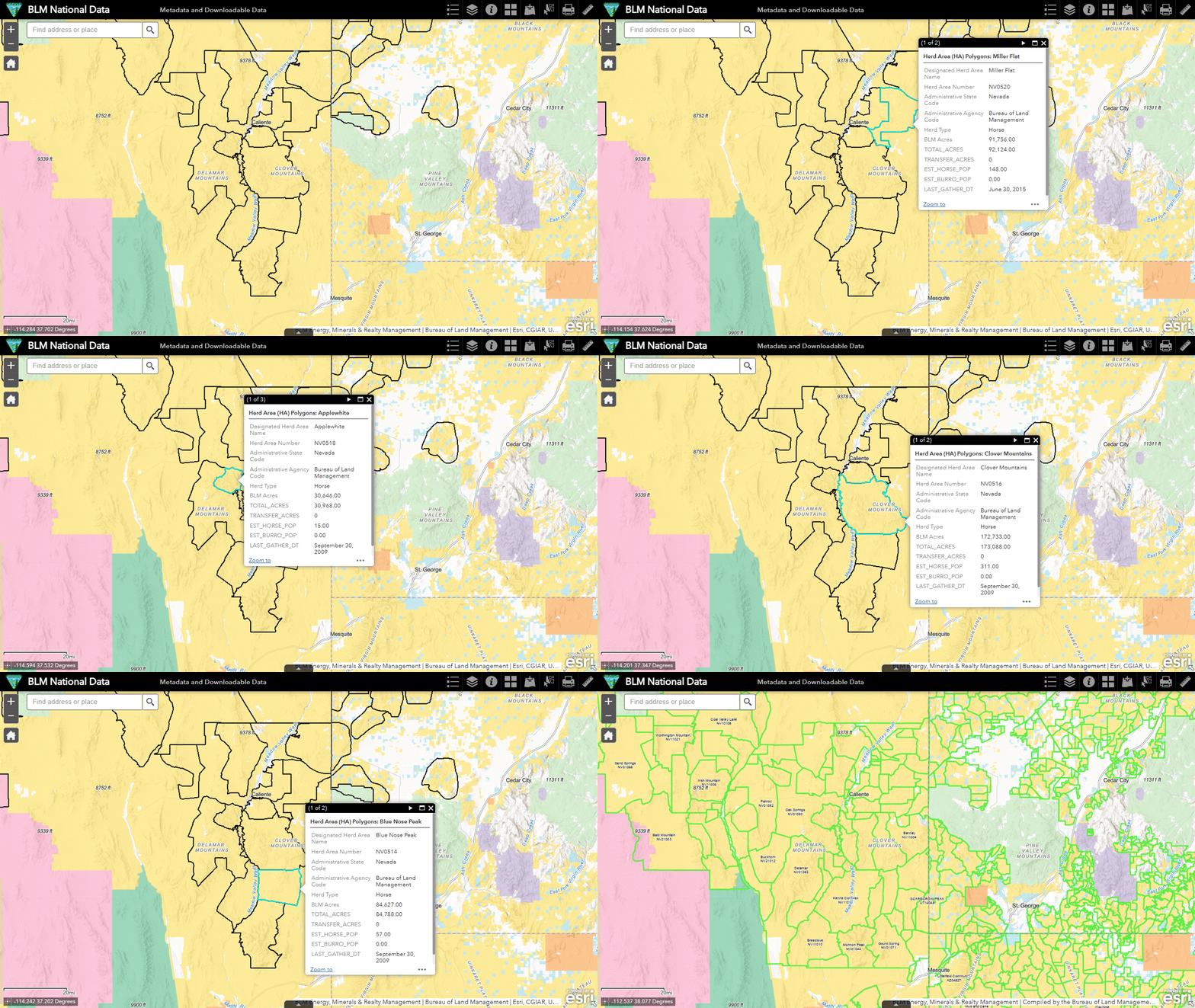
So says the writer of an opinion piece in today’s edition of the Reno Gazette Journal.
But it can support privately owned livestock equivalent to 173,000 wild horses!
BLM allotments in the state offer 2,081,076 active AUMs on 40,194,360 public acres according to the Allotment Information Report at RAS.
That’s equivalent to 173,423 wild horses on 40,194,360 acres, or 4.3 wild horses per thousand public acres.
This brings more distress to the bureaucrats and ranchers, who claim that public lands in the western U.S can only support one wild horse per thousand acres (27,000 animals on 27 million acres).
To find the active AUMs, add the numbers in column Q of the unfiltered dataset.
You’ll have to filter the data for duplicate rows to get the total public acreage.
The author of the commentary affiliates with the Coalition for Healthy Nevada Lands.
RELATED: Ranchers Fighting Proxy War Through Wildlife Groups?
Repairs to the visitor center are complete and the facility is now open to the public according to today’s announcement.
“Public lands in the western U.S. can only support one wild horse or burro per thousand acres (27,000 animals on 27 million acres).”
Pure fiction, but the advocates have swallowed it hook, line and sinker.
File under: Allotments.
Instead of explaining the lopsided forage allocations that favor the ranchers and drive the roundups, the Campaign Against America’s Wild Horses, a leader in nonmotorized removal, agreed in a statement today that wild horse numbers should be reduced, but they should come down with ovary-killing pesticides, not helicopters.
That’s according to a story by KLAS News.

We know from their March 8 testimony in Las Vegas that they’ve bought into the overpopulation narrative and want to help the wild horse detractors.
Overpopulation means more horses than allowed by plan, not necessarily more horses than the land can support.
The bureaucrats and ranchers claim that public lands in the western U.S. can only support one wild horse per thousand acres (27,000 animals on 27 million acres), which is a fairy tale.
For every horse allowed on the range, three to six have been consigned to off-range holding because of permitted grazing, not because of inadequate fertility control.
RELATED: BLM Releases 2024 Wild Horse and Burro Population Dataset.
UPDATE: A March 26 news release by Return to Normal (Before WHB Act) says the same thing: Get rid of them with pesticides, not helicopters. The ranchers couldn’t have asked for better allies.
The incident concluded today with 22 burros captured, 19 shipped, none released and three dead.
There were no unaccounted-for animals.
The death rate was 13.6%.
The capture total included six jacks, fifteen jennies and one foal.
Youngsters represented 4.5% of the animals gathered.
Of the adults, 28.6% were male and 71.4% were female.
There were no plans to treat any of the jennies with fertility control pesticides and return them to the range.
The roundup supported three tenets of rangeland management.
RELATED: McGee Mountain Roundup Starts Next Week.
UPDATE: The BLM news release said the incident restored a thriving natural ecological balance and multiple-use relationship, codewords for maximizing rancher prosperity.
When you see headlines like this:

The first link, from this morning’s edition of Drudge, pointed to a story by CNBC.
RELATED: Wild Horse Advocacy in One Word.
There were an estimated 73,520 wild horses and burros on BLM-managed public lands as of March 1, compared to 82,883 animals at the same time last year, according to today’s news release.
The number of animals in off-range holding was 64,382 as of January 22.
Between 2020 and 2023, the agency removed about 50,000 wild horses and burros from said lands, compared to 27,000 animals between 2016 and 2019.
Overpopulation means more horses and burros than allowed by plan, not necessarily more horses and burros than the land can support.
AMLs are small relative to the available resources because most of them have been assigned to privately owned livestock—a practice the advocates should be fighting instead of perpetuating.
RELATED: FY24 to See More Horses and Burros Off the Range Than On?
On the Virginia Range with wrightwood92397.
They would have an AML of 1,438 and a stocking rate of 7.4 wild horses per thousand public acres.
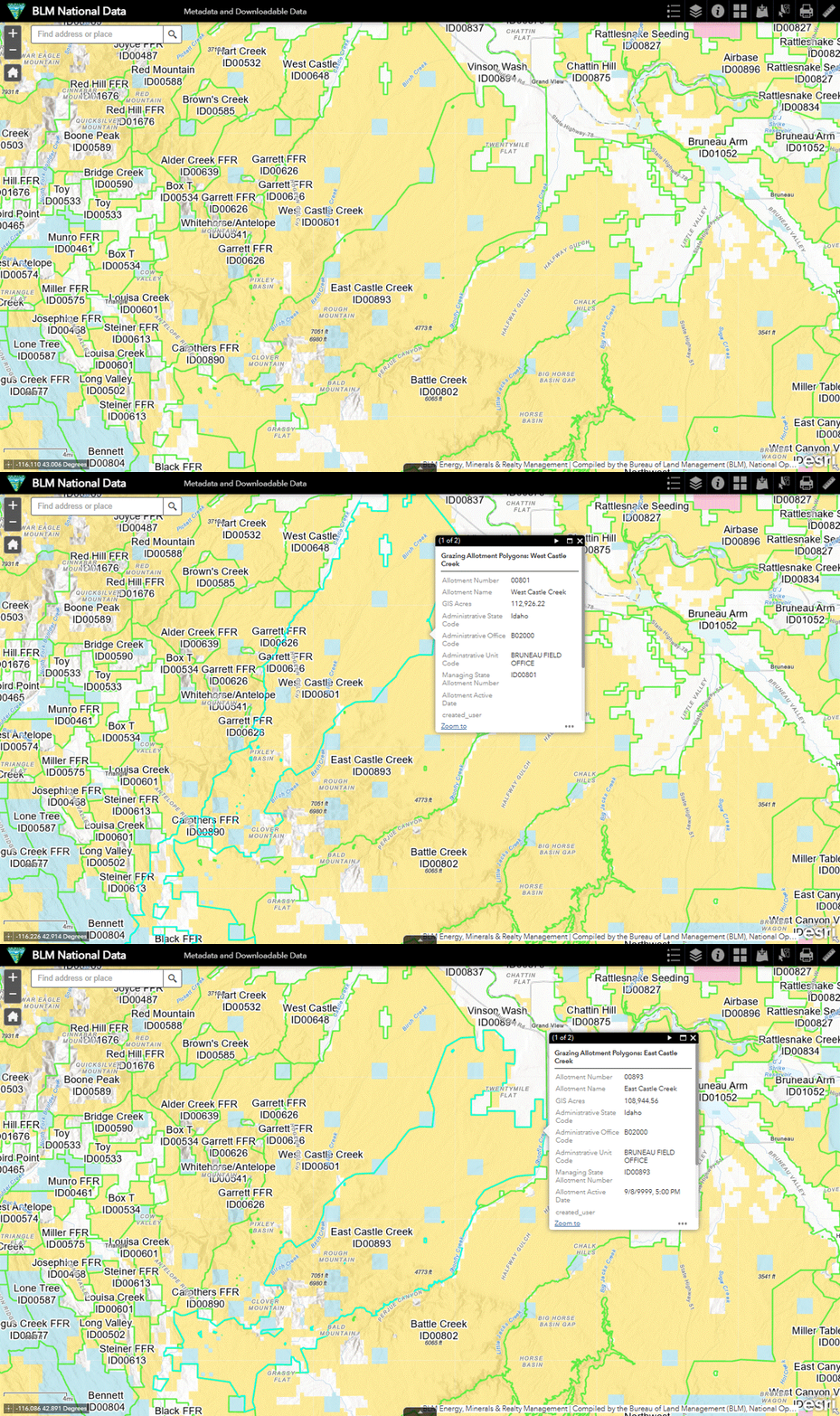
The allotments, located west of Bruneau, ID, offer a combined 17,251 active AUMs on 195,240 public acres, according to the Allotment Master Report.
The bureaucrats and ranchers claim that public lands in the western U.S. can only support one wild horse per thousand acres (27,000 animals on 27 million acres).
The advocates bolster the narrative with their darting programs.
If it was an HMA, the AML would be around 200 and 1,238 wild horses would be consigned to off-range holding because of permitted grazing.
RELATED: The Allotments Tell the Story: They’re Lying, All of Them.
The advocates are constantly shifting their vocabulary to keep you in the dark.
Like the bureaucrats, their goal never changes: Ranching superiority in the lawful homes of wild horses, sometimes referred to as achieving and maintaining AMLs.
To fulfill this purpose, they set up PZP darting programs and recruit dummies like you to carry them out.
Euphemisms for the process include:
They all mean the same thing: Sterilizing the mares with ovary-killing pesticides, leading to the destruction of entire herds in just five years.
RELATED: Understanding Advocatespeak.
It would have an AML of 974 and a stocking rate of 7.6 wild horses per thousand public acres.
The allotment, located west of Bruneau, ID, offers 11,682 active AUMs on 127,954 public acres, according to the Allotment Master Report.
The bureaucrats and ranchers claim that public lands in the western U.S. can only support one wild horse per thousand acres (27,000 animals on 27 million acres).
The advocates prop up the fairy tale with their darting programs.
If it was an HMA, the AML would be around 130 and 844 wild horses would be consigned to off-range holding because of permitted grazing.
Almost 98% of the AUMs go to J.R. Simplot.
RELATED: The Allotments Tell the Story: They’re Lying, All of Them.

Who’s the greater threat to wild horses? A grifter who sends letters to county wildlife boards seeking their removal from public lands or a real estate agent who’s taking them off the range with ovary-killing pesticides?
That’s the underlying issue in the latest installment of “Wild Horse Tales,” written by a PZP darter and appearing on page 18 of the March edition of Horse Tales.
You will not question the advocates. You will not doubt their authority.
They are the old guard, allies of the ranchers, leaders of the blind.
RELATED: Foal-Free Friday, Confessing Your Loyalties Edition.
It would have an AML of 2,492 and a stocking rate of 11.1 wild horses per thousand public acres.
The allotment offers 29,899 active AUMs on 224,268 public acres adjacent to Craters of the Moon National Park, according to the Allotment Master Report.
The bureaucrats and ranchers insist that public lands in the western U.S. can only support one wild horse per thousand acres (27,000 animals on 27 million acres).
The advocates ratify the narrative through their darting programs.
If it was an HMA, the AML would be around 225 and 2,267 wild horses would be consigned to off-range holding because of permitted grazing.
RELATED: The Allotments Tell the Story: They’re Lying, All of Them.


