What Happened to New Public Lands Rule?

The BLM’s April 18 news release said it would appear in the Federal Register in the coming days, but a search of that site for “Conservation and Landscape Health,” the subject of the unofficial prepublication version, yields no new results.

A search of Regulations dot gov for the same term also yields no new results.

The rule would put conservation on equal footing with other multiple uses of public lands, an attempt to amend FLPMA while bypassing the people’s representatives.

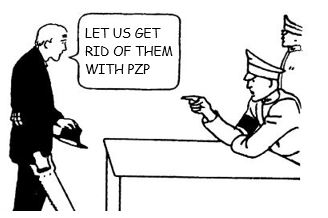
Iron-Fisted Government 11-08-23

The principal or major uses of public lands are limited to domestic livestock grazing, fish and wildlife development and utilization, mineral exploration and production, rights-of-way, outdoor recreation and timber production according to the statute.

You know the rule is bad for the country and good for our enemies because it was promulgated by liberals.

In a similar way, you know an idea is bad for wild horses if the advocates promote it.

Simone Neterlands with Darting Rifle 09-02-23

RELATED: Comment Period Extended for Proposed Public Lands Rule.
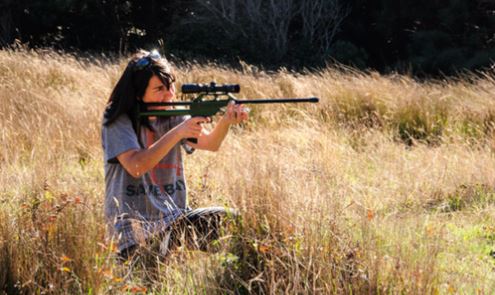
Should the Warm Springs Horses Stay or Should They Go?

The current population is 326 and the AML is 178 according to the 2024 HA/HMA Report.

Of course they should go, if you’re an advocate.  The HMA is overpopulated.

Best way to being the numbers down is nonmotorized removal, also known as humane management or in-the-wild management.

Deniz Bolbol TCF Darter 03-11-23

Mind not required.

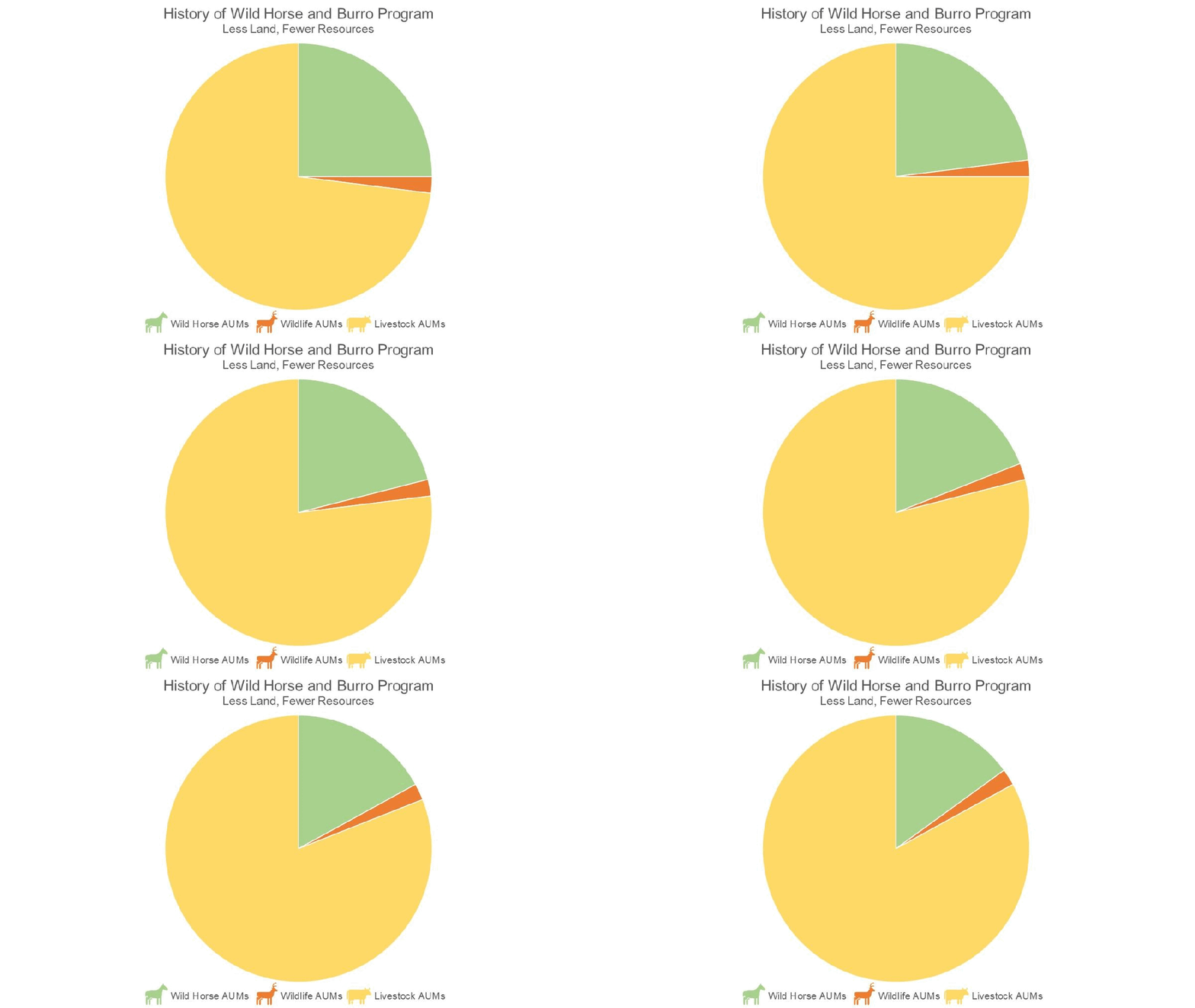
Consider these data from a 2018 EA for population management in the HMA (page 17 in the pdf).

Warm Springs AUM Summary-1

The forage allocation for horses tells you the AML was 2,424 ÷ 12 = 202, which is consistent with the HMA page but not the HA/HMA Report.

The forage allocation for livestock tells you the HMA supports cattle equivalent to 19,392 ÷ 12 = 1,616 wild horses, so the True AML is 202 + 1,616 = 1,818 which far exceeds the current population.

The horses can stay.

Mind required, plus a sincere desire to help wild horses.

The advocates have neither.

We Want to End Wild Horse Reproduction 04-08-24

RELATED: SHOCKER: Advocates Don’t Know What to Do.

SHOCKER: Advocates Don’t Know What to Do

Let’s see, the WHB Act no longer affords the protections sought by Velma, roughly half of their land is managed principally for livestock and the other half is managed primarily for livestock, and you don’t know what to do?

An organizer of the Save Our Wild Horses conference told KRNV News in a story dated May 2 “We don’t know if [the horses] should be rounded up at all, but we also don’t know can we improve the range conditions and leave the horses on the range where it doesn’t cost the taxpayers any money?  Right now, we’re doing these expensive roundups, putting horses in holding where we’re keeping them.”

A schoolboy could figure this out but we’re not dealing with schoolboys.

If forage demand exceeds forage supply, you have a problem.

Once you understand that AMLs correspond to a small portion of the total authorized forage, and that most of the resource has been assigned to privately owned livestock, you’ll realize that public lands in the western U.S. can support many more horses than the bureaucrats and ranchers admit and that overpopulation is a myth.

RELATED: The Allotments Tell the Story: They’re Lying, All of Them.

History of Wild Horse and Burro Program 12-01-22

Clark Mountain Reward Grows?

At one point it topped $100,000 but as of today stands at $36,000 according to a BLM update.

Remarks by those pledging the funds are especially troubling: The Humane Society of the United States, the PZP registrant who looks the other way as the Campaign Against America’s Wild Horses, another sponsor, uses the pesticide to wipe out entire herds.

When will these charlatans be brought to justice?

RELATED: Vehicles-of-Interest Identified in Clark Mountain Burro Shooting.

RTF Seeks PZP Darter, Launching Pest Control Business?

The signatory to the “Path Forward,” a 2019 plan for ranching superiority in the lawful homes of wild horses, has placed an undated job ad in High Country News for a wild horse population field coordinator and technician.

The successful candidate will report to Celeste Carlisle, RTF science advisor, chair of the Wild Horse and Burro Advisory Board and co-leader of the FREES Population Management Working Group.

In this role, you will work with RTF staff to identify wild equine herds in several herd management areas to determine tractability and appropriateness for current and future range projects.

You should be familiar with 4WD travel, firearms, hiking, camping, map reading, fixing flat tires and bringing survival gear into field, such as extra food and water, layers, batteries, flashlights, blankets or sleeping bags and first aid supplies.

In short, you’ll help RTF leadership transform the organization into a government contractor specializing in nonmotorized removal, just like the Campaign Against America’s Wild Horses.

Join the race to the bottom today!

RELATED: RTF: Surgical Sterilization Bad, Chemical Sterilization Good.

Working Together for a Horse-Free Future 12-21-22

Foal-Free Friday, Starting New Families Edition

A young bachelor stallion spends his days trying to steal mares from the family bands as discussed in the April edition of Horse Tales.  Go to “Wild Horse Tales” at the bottom of page 7.

It’s risky business and injuries do occur, but that’s how nature operates.

Speed, strength and shrewdness are passed on.  Weakness is not.

If he succeeds, he faces a more formidable challenge: The advocates.

They don’t like families.  They don’t like procreation.  They don’t like Velma, principal use and the 92nd Congress.

They like ranchers.  They like pesticides.  They like thriving ecological balances in the lawful homes of wild horses.

They rank among the lowest and sleaziest of the nonprofits.

They are phonies, leaders of the blind, irrelevant.

RELATED: Foal-Free Friday, Selecting for Weakness Edition.

Thriving Ecological Balance-3

Virginia Range Darting Update for April 2024

The Campaign Against America’s Wild Horses, an appendage of the BLM and leader in mass sterilization, reported today that 201 mares received 205 doses of PZP during the month, 61 given as a primer and 144 as a booster.

Over the life of the program, which began in 2019, the advocates have pumped 9,140 doses of the pesticide into 2,027 mares, for an average of 4.5 doses per mare.

Sixty-four foals have been born year-to-date.  Four died of unspecified causes.

The current population is thought to be 3,519 with 370 horses listed as missing, compared to 3,480 with 353 horses listed as missing in March.

The population was 3,444 with 338 horses listed as missing in February and 3,465 with 342 horses listed as missing in January.

The agreement with NDA expired on April 30 but the report indicates the following goal for May: “Continue to maximize booster treatments to mares across the Virginia Range as we move through the rest of spring breeding season to prevent pregnancies, and continuing to allow for humane population decrease.”

Protect Wild Horses from Advocates 08-29-21

Not discussed:

  • Long-term population goal
  • Number of viable mares
  • Size of breeding population
  • Loss of genetic diversity
  • Changes in death rate and sex ratio
  • Unlawful use of pesticides

PZP is a restricted-use pesticide that tricks the immune system into attacking the ovaries, resulting in sterility after five years of treatment.

The report will be submitted to the Nevada Department of Agriculture.

RELATED: Virginia Range Darting Update for March 2024.

Adjectives for Pests 12-01-23

Scoping Begins for Blue Wing HMAP

A new project has been created in ePlanning and three files have been placed in the documents folder.

The Scoping Statement brings forth certain requirements from the RMP that the new plan must satisfy.

The goal is to achieve and maintain a thriving ecological balance and multiple-use relationship on public lands, codewords for ranching superiority in the lawful homes of wild horses and burros.

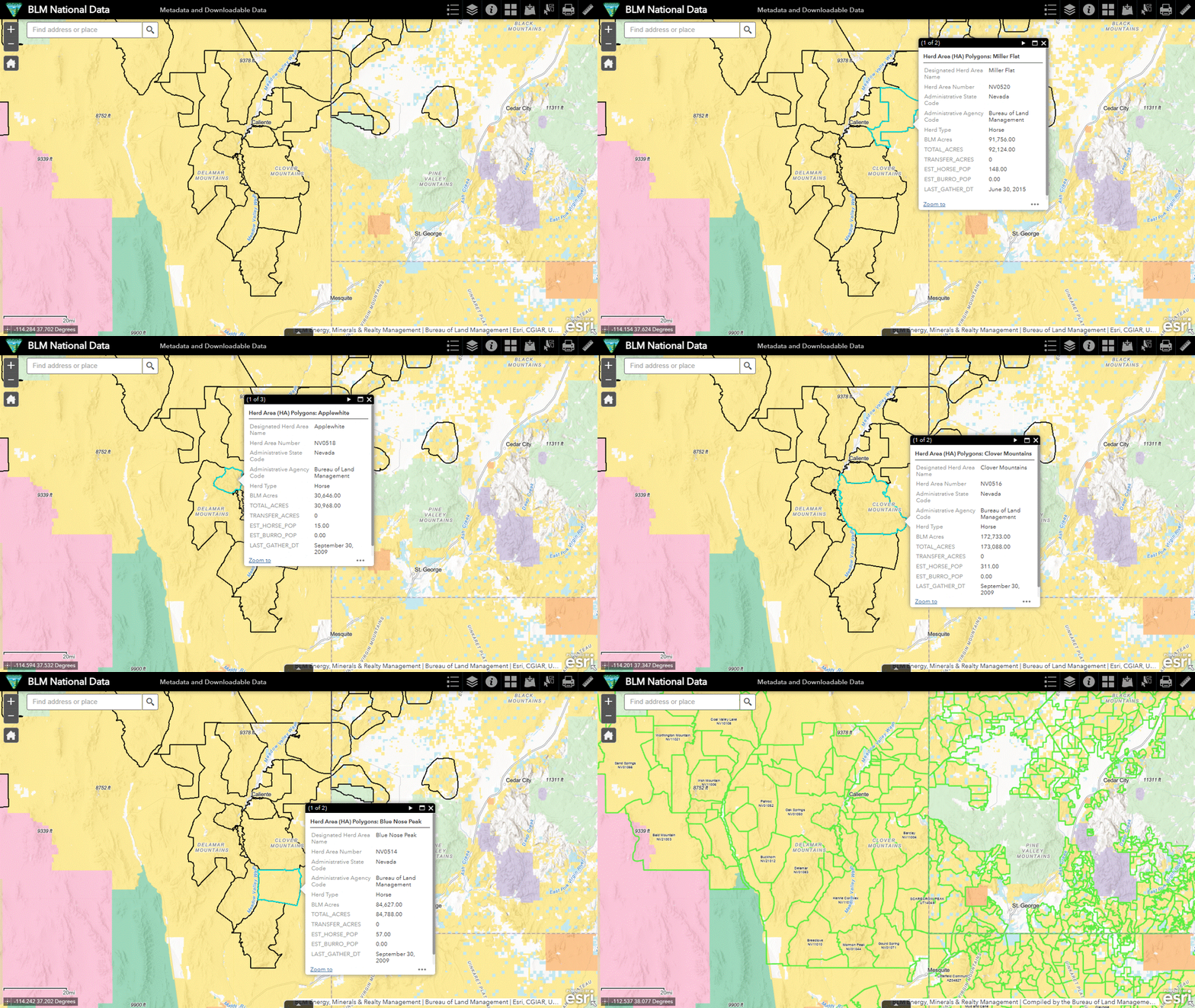
The Blue Wing Complex consists of eleven HAs that were reconfigured into five HMAs lying within the Blue Wing / Seven Troughs Allotment.

The new HMAP cannot

  • Change forage allocations
  • Confine the ranchers to their base properties
  • Restore the original HAs

The advocates would have you believe it’s panacea for the Blue Wing horses and burros.

Comments will be accepted through June 1 according to today’s announcement.

RELATED: Blue Wing Legal Action Centers Around HMAPs.

Blue Wing Complex with Allotments 05-02-24

Red Rock Roundup, Day 3

The incident started on April 29.  Results through May 1:

  • Scope: Red Rock HMA
  • Target: Horses and burros
  • Type: Planned
  • Method: Bait
  • Goals: Gather 112 horses and remove 92, gather 70 burros and remove 70
  • Captured: 84 horses, up from 54 on Day 1
  • Shipped: 69 horses, up from zero on Day 1
  • Released: None
  • Deaths: None
  • Average daily take: 28.0
  • Unaccounted-for animals: 15

The figures above are based on the daily reports.

The capture total includes 39 stallions, 33 mares and 12 foals.

Youngsters represented 14.3% of the animals gathered.

Of the adults, 54.2% were male and 45.8% were female.

Body condition scores were not given.

The HMA is not subject to permitted grazing.

Up to ten mares will be treated with GonaCon Equine, a fertility control pesticide, and be returned to the range with up to ten stallions.

RELATED: Red Rock Roundup in Progress.

Red Rock HMA with Allotments 04-23-24

Tour of Gray Horse ORP Set for June 22

The privately owned ranch covers approximately 26,000 acres of grassland in northeastern Oklahoma according to yesterday’s news release.

The January Facility Report shows two pastures, Gray Horse East, with a capacity of 1,735 mares, and Gray Horse West with a capacity of 1,015 geldings.

The populations as of January 1 were 1,783 mares and 775 geldings.

These animals were removed from public lands in the western U.S. and sent here to die not because of inadequate resources but because the bureaucrats have assigned most of their food to privately owned livestock.

Thus, the facility plays an important role in achieving and maintaining AMLs, sometimes referred to as ranching superiority in the lawful homes of wild horses.

RELATED: BLM to Extend Gray Horse ORP Contract?

Currituck Herd Expands by One

A new colt is the third foal born in 2024 according to a report by OBX Today.

Why is this important?

The advocates have been poisoning the mares with PZP, a restricted-use pesticide that tricks the immune system into attacking their ovaries.

The size of the breeding population and the number of viable mares is not known.

Curiously, the story ends with a remark about protecting and preserving this critically endangered herd.

Protecting Them From Removal 12-03-23

RELATED: Currituck Outer Banks to Become Like Assateague Island?

Sour Grapes: Advocates Criticize Indian Lakes Wild Horse Deaths

The privately owned facility experienced an 11% mortality rate in 2023 according to a report dated April 29 by KLAS News.

Information for the story was supplied by the Campaign Against America’s Wild Horses, a leader in nonmotorized removal.

The concluding remark about the dark realities of the BLM’s roundup and removal program does not arise from a genuine concern for wild horses.

Rather, it reflects their frustration in taking market share from the legacy contractors to expand their pesticide business.

We Want to End Wild Horse Reproduction 04-08-24

As for the horses, better if they weren’t even born.

TRNP Wild Horse Reduction Plan by the Numbers

Alternative C, a fully contracepted herd that dies off, is no longer on the table but it could still become a reality.  Here’s how.

The herd needs to be reduced from 200 to 60 or less according to the story by AP News.

Motorized removal will draw the same negative reaction as the original plan.

The advocates have had some success in convincing the public that attrition by pesticides is better than attrition by helicopters, and nobody talks about getting rid of wild horses more than they do, so let’s see what would happen if the Park Service turned to them for advice.

Better Way 10-25-23

The initial population is 200 and the goal is 60.

Assume a six percent death rate and zero percent birth rate.

Let x = number of years to achieve goal by nonmotorized removal.

TRNP Population Calcs 04-29-24

The advocates will need almost 20 years to achieve the goal.

Actually, they only need five years.  The mares will be sterile after that and the herd will implode, just like Assateague Island.

The assumption of a constant death rate is probably not valid.

With no new foals hitting the ground, the average age of the herd will increase, along with the death rate, so the goal could be achieved sooner than expected.

RELATED: TRNP Decision Offers Mixed News to Wild Horse Advocates.

Caliente Roundup, Day 13

The incident started on April 16.  Results through April 28:

  • Scope: Caliente Complex
  • Target: Horses
  • Type: Planned
  • Method: Bait
  • Goals: Gather 350, remove 350
  • Captured: 115, no change from Day 11
  • Shipped: 112, up from 96 on Day 11
  • Released: None
  • Deaths: 3, no change from Day 11
  • Average daily take: 8.8
  • Unaccounted-for animals: None

The figures above are based on the daily reports.

The death rate is 2.6%.

The capture total includes 49 stallions, 51 mares and 15 foals.

Youngsters represented 13.0% of the animals gathered, consistent with a herd growth rate of eight percent per year.

Of the adults, 49.0% were male and 51.0% were female.

Body condition scores were not given.

The location of the trap site is not known.

The Complex is subject to permitted grazing.

  • Forage liberated to date: 1,380 AUMs per year
  • Water liberated to date: 1,150 gallons per day

There are no plans to treat any of the mares with fertility control pesticides and return them to the range.

The roundup supports three tenets of rangeland management.

RELATED: Caliente Roundup, Day 11.

Caliente Complex with Allotments 03-28-24

New Pest Control Plan for Little Book Cliffs WHR?

A new project has been created in ePlanning but the folder only contains maps.

The proposed plan includes forcible removal by helicopter, relocating some animals to other parts of the range to maintain herd genetic viability, selective return to maintain band integrity, and application of fertility control methods such as pesticides (which the advocates are already doing) and IUDs.

It would be effective for ten years.

The WHR covers 36,100 total acres northeast of Grand Junction, CO, including 35,178 public acres, and is not subject to permitted grazing.  Surrounding lands are.

The 150 horses allowed by plan require 1,800 AUMs per year and the stocking rate allowed by plan is 4.3 wild horses per thousand public acres, four times higher than the target rate across all HMAs.

The current population is thought to be 211 according to the latest HA/HMA Report.

A roundup is on the latest schedule with a start date of September 11.

Little Book Cliffs WHR with Allotments 04-28-24

New Colt Puts More Pressure on Salt River Darting Program

Advocates with the Salt River Wild Horse Darting Group, an affiliate of the Campaign Against America’s Wild Horses, are supposed to be getting rid of them.

This little guy probably has a weakened immune system as discussed on Friday.

If a predator doesn’t get him, disease will, which is great news for the advocates.

RELATED: Salt River Darting Program by the Numbers.

Caliente Roundup, Day 11

The incident started on April 16.  Results through April 26:

  • Scope: Caliente Complex
  • Target: Horses
  • Type: Planned
  • Method: Bait
  • Goals: Gather 350, remove 350
  • Captured: 115, up from 103 on Day 9
  • Shipped: 96, up from 82 on Day 9
  • Released: None
  • Deaths: 3, no change from Day 9
  • Average daily take: 10.5
  • Unaccounted-for animals: 16

The figures above are based on the daily reports.

The death rate is 2.6%.

The capture total includes 49 stallions, 51 mares and 15 foals.

Youngsters represented 13.0% of the animals gathered, consistent with a herd growth rate of eight percent per year.

Of the adults, 49.0% were male and 51.0% were female.

Body condition scores were not given.

The location of the trap site is not known.

The Complex is subject to permitted grazing.

  • Forage liberated to date: 1,380 AUMs per year
  • Water liberated to date: 1,150 gallons per day

There are no plans to treat any of the mares with fertility control pesticides and return them to the range.

The roundup supports three tenets of rangeland management.

RELATED: Caliente Roundup, Day 9.

Caliente Complex with Allotments 03-28-24