
At the Onaqui Mountain HMA with fureyfamily.
Foal Spotted on Virginia Range!
This is an essential part of their existence and the advocates are trying to shut it down.

Advocates Starting Prayer Service for Salt River Horses?
Everything is going according to plan. The birth rate is almost zero.
If they are to convince the bureaucrats and ranchers that removal by pesticide is a viable alternative to removal by helicopter, the older horses need to die.
Won’t you join them in praying for divine intervention?
While you’re at it, throw them a few bucks so they can buy more poison.
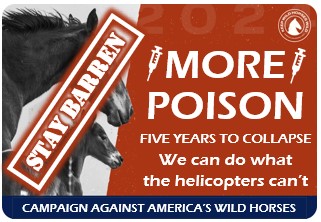
The Salt River Wild Horse Darting Group is an affiliate of the Campaign Against America’s Wild Horses, a leader in nonmotorized removal.
RELATED: Death Wish for Wild Horses?
If Wild Horses Had Principal Use of Snake River
The allotment, on the east side of the Sand Wash Basin HMA, offers 6,082 active AUMs on 53,855 public acres, according to the Allotment Master Report.
The forage allocation for horses is zero.
How many wild horses could live there?
Using the principle of forage interchangeability, the True AML would be 6,082 ÷ 12 = 507, the number of horses the land could support if it was managed principally for them as specified in the original statute.
The stocking rate would be 507 ÷ 53,855 × 1,000 = 9.4 wild horses per thousand public acres.
Why is this important?
The bureaucrats and ranchers claim that public lands in the western U.S. can only support one wild horse per thousand acres (27,000 animals on 27 million acres).
The advocates give their assent though their darting programs.
If the allotment was an HMA, the AML would be 54 and 453 horses would be consigned to off-range holding because of permitted grazing.
BLM allotments in Colorado carry livestock equivalent to 49,546 wild horses on 7,448,367 public acres, for an average of 6.7 wild horses per thousand public acres.
RELATED: The Allotments Tell the Story: They’re Lying, All of Them.

Caliente Roundup, Day 32
The incident started on April 16. Results through May 17:
- Scope: Caliente Complex
- Target: Horses
- Type: Planned
- Method: Bait
- Goals: Gather 350, remove 350
- Captured: 159, up from 124 on Day 28
- Shipped: 136, up from 113 on Day 28
- Released: None
- Deaths: 5, up from 3 on Day 28
- Average daily take: 5.0
- Unaccounted-for animals: 18
The figures above are based on the daily reports.
A stallion was dispatched on Day 31 due to a fractured leg along with a mare because of blindness, lifting the death rate to 3.1%.
The capture total includes 65 stallions, 70 mares and 24 foals.
Youngsters represented 15.1% of the animals gathered, consistent with a herd growth rate of ten percent per year.
Of the adults, 48.1% were male and 51.9% were female.
Body condition scores were not given.
The location of the trap site is not known.
The Complex is subject to permitted grazing. Resources liberated to date:
- Forage: 1,908 AUMs per year
- Water: 1,590 gallons per day
There are no plans to treat any of the mares with fertility control pesticides and return them to the range.
The roundup supports three tenets of rangeland management.
RELATED: Caliente Roundup, Day 28.
Deerwood Ranch Open House Set for June 8
The event runs from 9 AM to 3 PM, registration is not required and there is no admission fee according to a story dated May 18 by the Laramie Boomerang.
BLM staff will be on-site to answer questions and approve adoption applications.
The January Facility Report put the capacity at 350 and current population at 340.
The off-range pasture, described by its owners as a wild horse ecosanctuary, represents victory for the ranchers and failure for the horses.
Bordo Atravesado Roundup, Day 16
The incident started on May 1. Results through May 16:
- Scope: Bordo Atravesado HMA
- Target: Horses
- Type: Planned
- Method: Bait
- AML: 60
- Estimated population: 276
- Goals: Gather 235, remove 225
- Captured: 140, up from 129 on Day 13
- Shipped: None
- Released: None
- Deaths: 2, no change from Day 13
- Average daily take: 8.8
- Unaccounted-for animals: 140
The figures above are based on the daily reports.
The death rate is 1.4%.
The capture total includes 69 stallions, 53 mares and 18 foals.
Youngsters represented 12.9% of the animals gathered.
Of the adults, 56.6% were male and 43.4% were female.
Body condition scores were not given.
The location of the trap site is not known.
The destination of captured animals was not disclosed.
The HMA is subject to permitted grazing. Resources liberated to date:
- Forage: 1,680 AUMs per year
- Water: 1,400 gallons per day
Ten mares will be treated with GonaCon Equine, a fertility control pesticide, and be returned to the range according to the latest schedule.
The roundup supports three tenets of rangeland management.
RELATED: Bordo Atravesado Roundup, Day 13.

Foal-Free Friday, Abnormal Sex Ratios Edition
The Draft EA for Little Book Cliffs WHR, released for public review earlier this week, indicates in Section 2.1.3 that mares outnumber stallions by a margin of nearly two to one, and that the BLM intends to adjust the ratio to one to one.
How did it get so far out of whack?
The advocates and their safe, proven and reversible darting program.
They don’t refer to the condition as an abnormal sex ratio, they say the mares are living longer.
What’s the solution?
More of the same.
Curiously, they’ve scrubbed their home page of any references to PZP and plastered it with images of foals.
As for the Little Book Cliffs herd, the number of viable mares and size of the breeding population are unknown.
RELATED: Foal-Free Friday, Principal Use Edition.
Wild Horse Pop Quiz
Q. What do you call women who seek nonmotorized removal when the land can support five to ten times more wild horses than the government admits?
A. Advocates.
Q. What do you call men who demand motorized removal when the land can support five to ten times more wild horses than the government admits?
A. Ranchers.
Q. What do you call government workers who bring these groups together to push their anti-horse agenda?
A. Bureaucrats.
Welcome to the Love Triangle on America’s public lands.

Little Book Cliffs Draft EA Out for Public Review?
Today’s news release says comments will be accepted through June 15, but the project folder contains only three maps, no EA or supporting documents.
It may auto-populate overnight.
RELATED: New Pest Control Plan for Little Book Cliffs WHR?
UPDATE: The EA has been copied to the folder with five appendices.
Caliente Roundup, Day 28
The incident started on April 16. Results through May 13:
- Scope: Caliente Complex
- Target: Horses
- Type: Planned
- Method: Bait
- Goals: Gather 350, remove 350
- Captured: 124, up from 115 on Day 13
- Shipped: 113, up from 112 on Day 13
- Released: None
- Deaths: 3, no change from Day 13
- Average daily take: 4.4
- Unaccounted-for animals: 8
The figures above are based on the daily reports.
No activity was reported between May 3 and May 13.
The death rate is 2.4%.
The capture total includes 51 stallions, 55 mares and 18 foals.
Youngsters represented 14.5% of the animals gathered, consistent with a herd growth rate of nine percent per year.
Of the adults, 48.1% were male and 51.9% were female.
Body condition scores were not given.
The location of the trap site is not known.
The Complex is subject to permitted grazing. Resources liberated to date:
- Forage: 1,488 AUMs per year
- Water: 1,240 gallons per day
There are no plans to treat any of the mares with fertility control pesticides and return them to the range.
The roundup supports three tenets of rangeland management.
RELATED: Caliente Roundup, Day 13.
Bordo Atravesado Roundup, Day 13
The incident started on May 1. Results through May 13:
- Scope: Bordo Atravesado HMA
- Target: Horses
- Type: Planned
- Method: Bait
- AML: 60
- Estimated population: 276
- Goals: Gather 235, remove 225
- Captured: 129, up from 103 on Day 9
- Shipped: None
- Released: None
- Deaths: 2, up from zero on Day 9
- Average daily take: 9.9
- Unaccounted-for animals: 127
The figures above are based on the daily reports.
A horse died of injuries sustained in the roundup on Day 10. No details were given.
A horse was dispatched for a pre-existing condition on Day 12. No explanation.
The death rate is 1.6%.
The capture total includes 65 stallions, 49 mares and 15 foals.
Youngsters represented 11.6% of the animals gathered.
Of the adults, 57.0% were male and 43.0% were female.
Body condition scores were not given.
The location of the trap site is not known.
The disposition of captured animals was not stated.
The HMA is subject to permitted grazing. Resources liberated to date:
- Forage: 1,548 AUMs per year
- Water: 1,290 gallons per day
Ten mares will be treated with GonaCon Equine, a fertility control pesticide, and be returned to the range according to the latest schedule.
The roundup supports three tenets of rangeland management.
RELATED: Bordo Atravesado Roundup, Day 9.
If Wild Horses Had Principal Use of Hubbard Vineyard
The allotment, located north of Wells, NV, offers 13,031 active AUMs on 112,213 public acres, according to the Allotment Master Report.
The forage allocation for horses is zero.
How many wild horses could live there?
Using the principle of forage interchangeability, the True AML would be 13,031 ÷ 12 = 1,086, the number of horses the land could support if it was managed principally for them as specified in the original statute.
The stocking rate would be 1,086 ÷ 112,213 × 1,000 = 9.7 wild horses per thousand public acres.
This brings more distress to the bureaucrats and ranchers, who claim that public lands in the western U.S. can only support one wild horse per thousand acres (27,000 animals on 27 million acres).
The advocates bolster the narrative with their darting programs.
If the allotment was an HMA, the AML would be 112 and 974 horses would be consigned to off-range holding because of permitted grazing.
BLM allotments in Nevada carry livestock equivalent to 173,144 wild horses on 40,194,360 public acres, for an average of 4.3 wild horses per thousand public acres.
RELATED: The Allotments Tell the Story: They’re Lying, All of Them.

Public Lands Rule Published
The new rule appeared in the Federal Register on May 9.
They will use it to bludgeon wild horses while coddling the ranchers.
CBS Sunday Morning Visits Black Hills Wild Horse Sanctuary
Sanctuaries represent victory for the ranchers, failure for the horses.
Forage Interchangeability: Key to Wild Horse Carrying Capacity
Call it dietary overlap if you’d like.
Horses graze in allotments and cattle graze in HMAs.
It’s the same land.
Forage doesn’t grow with little tags on it. “I’m for horses.” “I’m for cattle.”
Once you understand that it’s easy to compute the True AMLs, the number of animals the land can support if it was managed principally for them.
RELATED: How to Estimate the Carrying Capacity of HMAs.

NPS Developing Management Plan for Ocracoke Ponies
A meeting will be held on May 21 at the Ocracoke Community Center to receive public input ahead of the plan’s development according to the May 6 news release.
An online option is not available.
A search of the Cape Hatteras planning list yielded no results for “horses” or “ponies.”
Herd demographics and previous management actions were not discussed.
No foals have been born since 2018 according to the FAQs at the Ocracoke Horse page.
A driver of the project is man-made climate change and sea level rise, a hoax.
Mustang Monday
At Sand Wash Basin HMA with Julie Price.
Red Rock Roundup Over
The incident concluded on May 11 with the following results:
- 115 horses captured, 98 shipped, 11 released, 7 to be released and 2 dead
- 70 burros captured, 69 shipped, none released and 1 dead
- 1 mule captured and 1 shipped
The capture goals were 112 horses and 70 burros.
The removal goals were 92 horses and 70 burros.
Data quality was poor. More horses were processed than captured.
The figures for burros and the mule balance.
Seven mares received an initial dose of GonaCon Equine on May 8.
They will receive another dose in 30 days according to the final daily report, constituting unlawful use of the pesticide.
RELATED: Red Rock Roundup Announced.
UPDATE: The numbers in the news release don’t balance either.
Horses returned to HMA = 115 captured – 100 removed = 15
Horses identified for return = 11 stallions + 7 mares = 18
An Open Letter to the Wild Horse Advocates on Mother’s Day
We know you’re frauds.
We know you’re obsessed with pesticides.
We know you’re in cahoots with the bureaucrats and ranchers.
We know you want the ranchers to win.
Stop taking money from well-meaning individuals who actually care about the horses.
Publish your donor lists.
Stop referring to cherished wild horses when you mean pests.
Stop saying mares living longer when you mean abnormal sex ratios.
Cut the “Stay Wild” crap when you mean “Stay Barren.”
Stop complaining about genetic diversity and inadequate herd sizes when you’re driving the breeding populations into the single digits.
Stop saying in-the-wild management when you mean nonmotorized removal.
Stop calling them vaccines when you know they’re pesticides.
Stop calling them reversible when you know they destroy ovaries.
Stop saying conservation when you mean eradication.
Stop saying protection when you mean sterilization.
Stop saying preservation when you seek total herd collapse.
Stop talking about families as you snuff out new life.
Stop looking to their future while you’re praying for the older horses to die.
Stop talking about keeping them in balance with their environment when most of their food has been given to the ranchers.
Today, you’re celebrating sterility, not fertility.
You give death an unfair advantage over life, and your allies appreciate what you do.
Happy No-Mothers Day.
File under: Charlatans.

