New Exclosures to Separate Pine Nut Horses from Springs

The project description says overuse by wild horses has resulted in the almost complete loss of riparian vegetation and the compaction of soils at three springs in the northern part of the HMA, but the CX indicates two.

The exclosures will either be steel pipe attached to posts pounded into the ground or steel buck and rail sitting on the surface.

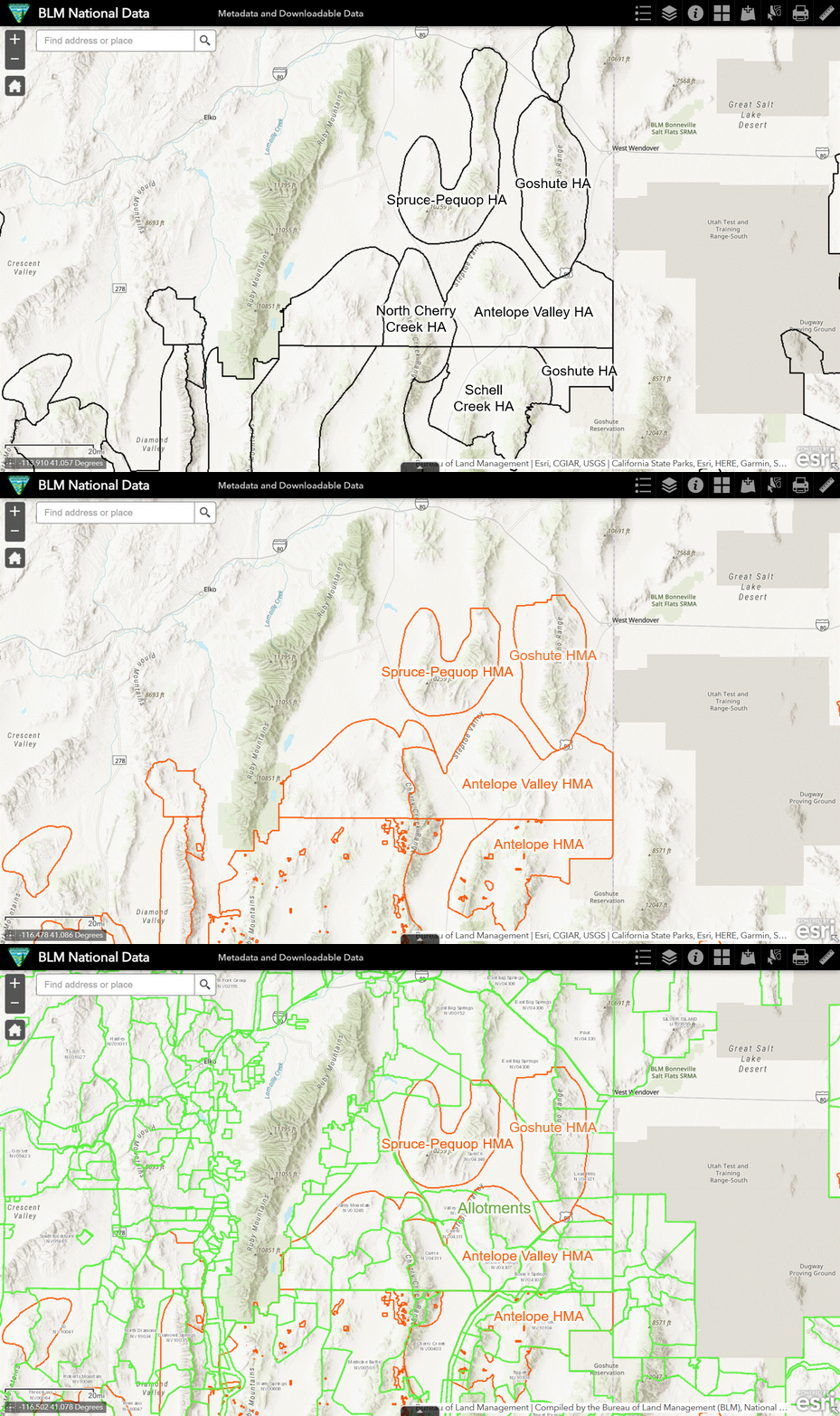
Little Nettles Spring is on the eastern edge of the Eldorado Canyon Allotment and Rose Spring is in the Clifton Allotment.

The National Data Viewer shows the arrangement.  Click on image to open in new tab.

The Allotment Master Report shows no grazing authorizations and no active AUMs.

The CX was signed on June 7 but was not published until July 24.

There were no opportunities for public involvement.

Pine Nut Spring Exclosures 07-28-23

Sixth Annual Devil’s Garden Roundup Announced

The incident will begin on September 4, according to a story posted yesterday by the Lake County Examiner.

The capture goal is 500 and the current population is thought to be 1,339 wild horses in and around the WHT.

The AML is 402.

Your host was unable to find a news release at the Modoc National Forest home page.

Modoc staff remain committed to managing wild free-roaming horses in a manner that achieves and maintains a thriving ecological balance and multiple-use relationship on public lands, meaning that ranchers can access most of the food and water in the lawful homes of wild horses.

Operations will be carried out by Cattoor Livestock Roundup and limited opportunities for public observation will be available.

The destination of captured animals was not given and a link to the daily reports was not provided.

RELATED: Fifth Annual Devil’s Garden Roundup Starts Next Month.

Thriving Ecological Balance-3

Antelope Roundup South Over

The incident concluded today with 1,107 horses captured, 1,095 shipped, two escaped and ten dead.

There were no unaccounted-for animals.

The death rate was 0.9%.

The capture total included 368 stallions, 507 mares and 232 foals.

Youngsters represented 21% of the animals gathered.

Of the adults, 42% were male and 58% were female.

Two HMAs were affected.

The BLM news release said removal of excess horses protects habitat for other wildlife such as sage grouse, pronghorn antelope and mule deer, but the top priority is to protect the gravy train known as public-lands ranching.

RELATED: Antelope Roundups Announced.

Antelope Roundup South, Day 17

The incident began on July 9.  Results through July 25:

  • Scope: Antelope, Antelope Valley HMAs
  • Purpose: Pest control, resource enforcement, rancher protection
  • Target: Horses
  • Type: Planned
  • Method: Helicopter
  • Category: Cruel and costly*
  • Better way: Poison mares with ovary-killing pesticides*
  • Captured: 1,107, up from 1,071 on Day 15
  • Average daily take: 65.1
  • Capture goal: 1,107
  • Removal goal: 1,107
  • Returned: 2, no change from Day 15
  • Deaths: 10, up from 9 on Day 15
  • Shipped: 1,057, up from 939 on Day 15

The figures above are based on the daily reports, not the totals posted by the BLM.

Helicopters did not fly on Day 16 due to equipment maintenance.

A stallion was put down on Day 17 due to a missing eye, a non-life-threatening condition.

The death rate is 0.9%.

The capture total includes 368 stallions, 507 mares and 232 foals.

Youngsters represented 21.0% of the animals gathered.

Of the adults, 42.1% were male and 57.9% were female, outside the expected range of variation from a simple random process centered at 50% males / 50% females with a sample of 875 adults.

How to Compute p-chart Limits 02-10-22

A 21% birth rate corresponds to a growth rate of 16% per year, a bit less than the 20% growth rate used by land managers to predict herd sizes and management actions.

Body condition scores were not provided.

The location of the trap site was not disclosed.

The HMAs and surrounding lands are subject to permitted grazing.

*According to advocates.

Antelope Complex with Allotments 07-06-23

Day 17 ended with 38 unaccounted-for animals.

The capture goal is 100% achieved.  Operations will likely conclude this week.

Mares treated with fertility control pesticides will be returned to the area at a later date.

Other statistics:

  • Forage liberated to date: 13,260 AUMs per year
  • Water liberated to date: 11,050 gallons per day
  • Forage assigned to livestock: Unknown
  • Horses displaced from area by permitted grazing: Unknown
  • True AML: Unknown
  • Stocking rate at new AML: Unknown
  • Horses removed because of drilling and mining: Ask the advocates

Overpopulation means more horses than allowed by plan, not necessarily more horses than the land can support.

RELATED: Antelope Roundup South, Day 15.

Johnnie Roundup, Day 5

The incident started on July 20.  Results through July 24:

No horses were captured on Days 4 and 5, leaving the total at 16.

All have been shipped.

Ten burros were taken on Day 4, followed by 17 on Day 5, bringing the total 47.

Twenty-three burros have been shipped.

No deaths were reported and no animals were returned to the range.

The location of the trap site was not disclosed.

The capture and removal goals are identical, 25 wild horses and 100 wild burros.

RELATED: Johnnie Roundup, Day 3.

Antelope Roundup Summary, Day 15

The incidents began on July 9 (North | South).  Combined results through July 23:

The figures above are based on the daily reports, not the totals posted by the BLM.

The death rate is 1.1%.

The capture total includes 523 stallions, 740 mares and 311 foals.

Youngsters represented 19.8% of the animals gathered.

Of the adults, 41.4% were male and 58.6% were female, outside the expected range of variation from a simple random process centered at 50% males / 50% females with a sample of 1,263 adults.

A birth rate of 20% per year corresponds to a herd growth rate of 15% per year.

Day 15 ended with 185 unaccounted-for animals.

The HMAs and surrounding lands are subject to permitted grazing, with livestock receiving over seven times more forage than horses inside the Complex.

*According to advocates.

RELATED: Antelope Roundup North, Day 15, Antelope Roundup South, Day 15.

Antelope Complex with Allotments 07-06-23

Antelope Roundup South, Day 15

The incident began on July 9.  Results through July 23:

  • Scope: Antelope, Antelope Valley HMAs
  • Purpose: Pest control, resource enforcement, rancher protection
  • Target: Horses
  • Type: Planned
  • Method: Helicopter
  • Category: Cruel and costly*
  • Better way: Poison mares with ovary-killing pesticides*
  • Captured: 1,071, up from 963 on Day 13
  • Average daily take: 71.4
  • Capture goal: 1,107
  • Removal goal: 1,107
  • Returned: 2, no change from Day 13
  • Deaths: 9, no change from Day 13
  • Shipped: 939, up from 856 on Day 13

The figures above are based on the daily reports, not the totals posted by the BLM.

Gather activity was cut short on Day 15 due to temperature.

The death rate is 0.8%.

The capture total includes 350 stallions, 493 mares and 228 foals.

Youngsters represented 21.3% of the animals gathered.

Of the adults, 41.5% were male and 58.5% were female, outside the expected range of variation from a simple random process centered at 50% males / 50% females with a sample of 843 adults.

How to Compute p-chart Limits 02-10-22

A 21% birth rate corresponds to a growth rate of 16% per year, a bit less than the 20% growth rate used by land managers to predict herd sizes and management actions.

Body condition scores were not provided.

The location of the trap site was not disclosed.

The HMAs and surrounding lands are subject to permitted grazing.

*According to advocates.

Antelope Complex with Allotments 07-06-23

Day 15 ended with 121 unaccounted-for animals.

The capture goal is 97% achieved.  Operations will likely conclude this week.

Mares treated with fertility control pesticides will be returned to the area at a later date.

Other statistics:

  • Forage liberated to date: 12,828 AUMs per year
  • Water liberated to date: 10,690 gallons per day
  • Forage assigned to livestock: Unknown
  • Horses displaced from area by permitted grazing: Unknown
  • True AML: Unknown
  • Stocking rate at new AML: Unknown
  • Horses removed because of drilling and mining: Ask the advocates

Overpopulation means more horses than allowed by plan, not necessarily more horses than the land can support.

RELATED: Antelope Roundup South, Day 13.

BLM Using Outdated Information to Apply GonaCon Equine?

The Reveille mares, captured in a roundup earlier this month, are affected.

Up to 27 will be treated with GonaCon Equine, a fertility control pesticide, and be returned to the HMA with 26 stallions.

They have already received a primer.  When will they receive the booster?

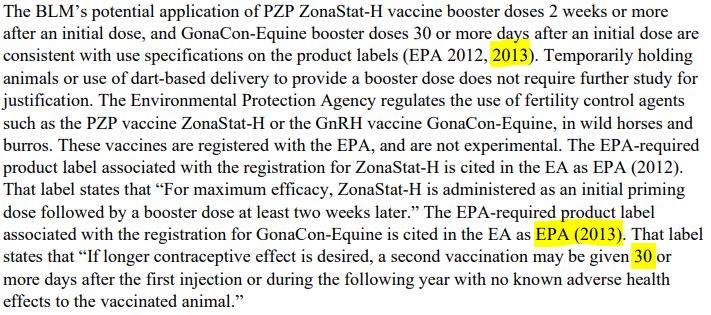
Appendix E, released last week with the Final EA and DR for pest control actions in the Owyhee HMAs, refers to the 2013 product registration on page 4, which authorized a 30-day interval between treatments.

GonaCon Citations in Owyhee Appendix E 07-24-23

A 2015 registration amendment maintained the 30-day interval and restricted-use designation.

However, a 2017 amendment that dropped the RUP designation also extended the interval between treatments to 90 days.

Therefore, application of the boosters 30 days after the primers could be construed as misuse of the product, a violation of federal law.

RELATED: Owyhee Decision Published.

Antelope Roundup North, Day 15

The incident began on July 9.  Results through July 23:

  • Scope: Spruce-Pequop, Goshute, Antelope Valley HMAs
  • Purpose: Pest control, resource enforcement, rancher protection
  • Target: Horses
  • Type: Planned
  • Method: Helicopter
  • Category: Cruel and costly*
  • Better way: Poison mares with ovary-killing pesticides*
  • Captured: 503, up from 444 on Day 13
  • Average daily take: 33.5
  • Capture goal: 2,000
  • Removal goal: 2,000
  • Returned: 1, up from zero on Day 13
  • Deaths: 9, up from 8 on Day 13
  • Shipped: 429, up from 371 on Day 13

The figures above are based on the daily reports, not the totals posted by the BLM.

The number of horses shipped to date is 435 according to the summary.

The number of mares taken on Day 11 was changed from 34 to 35.

A case of equine scoliosis was reported as a death on Day 14, suggesting that the stallion was dispatched for a non-life-threatening condition.

A death appearing on Day 15 with no remarks may correspond to the release/escape of a mare.

The death rate is 1.8%.

The capture total includes 173 stallions, 247 mares and 83 foals.

Youngsters represented 16.5% of the animals gathered.

Of the adults, 41.2% were male and 58.8% were female, outside the expected range of variation from a simple random process centered at 50% males / 50% females with a sample of 420 adults.

How to Compute p-chart Limits 02-10-22

A 16% birth rate corresponds to a growth rate of 11% per year, considerably less than the 20% growth rate used by land managers to predict herd sizes and management actions.

Body condition scores on Days 14 and 15 ranged from 3 to 4.

The location of the trap site was not disclosed.

The HMAs and surrounding lands are subject to permitted grazing.

*According to advocates.

Antelope Complex with Allotments 07-06-23

Day 15 ended with 64 unaccounted-for animals.

There are no plans to treat captured mares with fertility control pesticides and return them to the area.

Other statistics:

  • Forage liberated to date: 6,024 AUMs per year
  • Water liberated to date: 5,020 gallons per day
  • Forage assigned to livestock: Unknown
  • Horses displaced from area by permitted grazing: Unknown
  • True AML: Unknown
  • Stocking rate at new AML: Unknown
  • Horses removed because of drilling and mining: Ask the advocates

Overpopulation means more horses than allowed by plan, not necessarily more horses than the land can support.

Roundups and first-hand accounts thereof are too late, too far downstream in the management process to be of any use to America’s wild horses.

RELATED: Antelope Roundup North, Day 13.

Johnnie Roundup, Day 3

The incident started on July 20.

No animals were captured on Day 2.

Four horses were taken on Day 3, along with 20 burros, bringing the totals to 16 horses and 20 burros.

No deaths were reported and none were returned.

All horses have been shipped.

BLM personnel are probably holding the burros in a temporary pen.

The location of the trap site was not disclosed.

The capture and removal goals are identical, 25 wild horses and 100 wild burros.

RELATED: Johnnie Roundup in Progress.

Owyhee Decision Published

The Decision Record signed on July 20 authorizes Alternative B, the Proposed Action, which will establish Herd Management Areas Plans (HMAPs) for the Black Mountain, Hardtrigger and Sands Basin HMAs in western Idaho.

These plans would achieve and maintain AMLs through roundups, fertility control treatments, selective horse removals and periodic introduction of fertile animals from other HMAs to boost genetic diversity.

AMLs are small relative to the available resources because most of the food and water in areas identified for wild horses have been assigned to privately owned cattle and sheep.

But when you see the introduction of animals from other areas, you know the bureaucrats have cut the herds and breeding populations to the bone, a further concession to the public-lands ranchers.

How will the new HMAPs make life better for the horses?

Contrary to what the advocates have been telling you, they won’t.

HMAPs must conform to the land-use plans.

Herd sizes will be minimized, ranchers will receive the lion’s share of the food and water and the mares will be poisoned with ovary-killing pesticides.

As shown in the following map from the National Data Viewer, the horses suffer not from habitat loss, but from resource confiscation and reapportionment.

The EA and DR were copied to the project folder with other supporting documents.

RELATED: Comments Invited on Owyhee Resource Enforcement EA?

Owyhee HAs and HMAs with Allotments 07-23-23

Antelope Roundup South, Day 13

The incident began on July 9.  Results through July 21:

  • Scope: Antelope, Antelope Valley HMAs
  • Purpose: Pest control, resource enforcement, rancher protection
  • Target: Horses
  • Type: Planned
  • Method: Helicopter
  • Category: Cruel and costly*
  • Better way: Poison mares with ovary-killing pesticides*
  • Captured: 963, up from 826 on Day 11
  • Average daily take: 74.1
  • Capture goal: 1,107
  • Removal goal: 1,107
  • Returned: 2, no change from Day 11
  • Deaths: 9, up from 7 on Day 11
  • Shipped: 856, up from 783 on Day 11

The figures above are based on the daily reports, not the totals posted by the BLM.

Lameness and club feet were reported as deaths on Day 13, suggesting that the animals were taken alive but killed by the wranglers.

The death rate is 0.9%.

The capture total includes 312 stallions, 440 mares and 211 foals.

Youngsters represented 21.9% of the animals gathered.

Of the adults, 41.5% were male and 58.5% were female, outside the expected range of variation from a simple random process centered at 50% males / 50% females with a sample of 752 adults.

How to Compute p-chart Limits 02-10-22

A 22% birth rate corresponds to a growth rate of 17% per year, a bit less than the 20% growth rate used by land managers to predict herd sizes and management actions.

Body condition scores were not provided.

The location of the trap site was not disclosed.

The HMAs and surrounding lands are subject to permitted grazing.

*According to advocates.

Antelope Complex with Allotments 07-06-23

Day 13 ended with 96 unaccounted-for animals.

Mares treated with fertility control pesticides will be returned to the area at a later date.

Other statistics:

  • Forage liberated to date: 11,532 AUMs per year
  • Water liberated to date: 9,610 gallons per day
  • Forage assigned to livestock: Unknown
  • Horses displaced from area by permitted grazing: Unknown
  • True AML: Unknown
  • Stocking rate at new AML: Unknown
  • Horses removed because of drilling and mining: Ask the advocates

Overpopulation means more horses than allowed by plan, not necessarily more horses than the land can support.

RELATED: Antelope Roundup South, Day 11.

Antelope Roundup North, Day 13

The incident began on July 9.  Results through July 21:

  • Scope: Spruce-Pequop, Goshute, Antelope Valley HMAs
  • Purpose: Pest control, resource enforcement, rancher protection
  • Target: Horses
  • Type: Planned
  • Method: Helicopter
  • Category: Cruel and costly*
  • Better way: Poison mares with ovary-killing pesticides*
  • Captured: 444, up from 347 on Day 11
  • Average daily take: 34.2
  • Capture goal: 2,000
  • Removal goal: 2,000
  • Returned: None
  • Deaths: 8, up from 5 on Day 11
  • Shipped: 371, up from 268 on Day 11

The figures above are based on the daily reports, not the totals posted by the BLM.

The number of horses shipped to date is 377 according to the summary.

A stallion was put down on Day 12 due to blindness in one eye, a non-life-threatening condition.

He’d be alive today if there was no roundup, so this “act of mercy” is chargeable thereto.

Two leg fractures were reported as deaths on Day 13, suggesting the animals were also killed by the wranglers, one related to the roundup and one pre-existing.

The death rate is 1.8%.

The capture total includes 152 stallions, 221 mares and 71 foals.

Youngsters represented 16.0% of the animals gathered.

Of the adults, 40.8% were male and 59.2% were female, outside the expected range of variation from a simple random process centered at 50% males / 50% females with a sample of 373 adults.

How to Compute p-chart Limits 02-10-22

A 16% birth rate corresponds to a growth rate of 11% per year, considerably less than the 20% growth rate used by land managers to predict herd sizes and management actions.

Body condition scores on Days 12 and 13 ranged from 3 to 4.

The location of the trap site was not disclosed.

The HMAs and surrounding lands are subject to permitted grazing.

*According to advocates.

Antelope Complex with Allotments 07-06-23

Day 13 ended with 65 unaccounted-for animals.

There are no plans to treat captured mares with fertility control pesticides and return them to the area.

Other statistics:

  • Forage liberated to date: 5,328 AUMs per year
  • Water liberated to date: 4,440 gallons per day
  • Forage assigned to livestock: Unknown
  • Horses displaced from area by permitted grazing: Unknown
  • True AML: Unknown
  • Stocking rate at new AML: Unknown
  • Horses removed because of drilling and mining: Ask the advocates

Overpopulation means more horses than allowed by plan, not necessarily more horses than the land can support.

RELATED: Antelope Roundup North, Day 11.

Antelope Roundup Summary, Day 11

The incidents began on July 9 (North | South).  Combined results through July 19:

The figures above are based on the daily reports, not the totals posted by the BLM.

The death rate is 1.0%.

The capture total includes 366 stallions, 557 mares and 250 foals.

Youngsters represented 21.3% of the animals gathered.

Of the adults, 39.7% were male and 60.3% were female, outside the expected range of variation from a simple random process centered at 50% males / 50% females with a sample of 923 adults.

A birth rate of 21% per year corresponds to a growth rate of 16% per year.

Day 11 ended with 108 unaccounted-for animals.

The HMAs and surrounding lands are subject to permitted grazing, with livestock receiving an estimated 7.7 times more forage than horses inside the Complex.

*According to advocates.

RELATED: Antelope Roundup North, Day 11Antelope Roundup South, Day 11.

Antelope Complex with Allotments 07-06-23

Antelope Roundups in the News

A report dated July 19 by AP News says the stallion that broke his leg trying to escape from the trap was pressured by wranglers, not helicopters.

The advocates point to the incident as justification for their ruinous darting programs while saying almost nothing about the causes of roundups and beneficiaries thereof.

The story has been picked up by major new outlets.

RELATED: Helicopter Ban Is Not the Answer.