
At the Ozark National Scenic Riverways with Emily Gauthier.
Category: Range
On the range
East Pershing Roundup, Day 11
The incident began on December 28. Results through January 7:
- Scope: Sonoma Range HA, East Range HA, Humboldt HA, Tobin Range HMA, North Stillwater HMA, Augusta Mountains HMA
- Purpose: Pest control, resource enforcement, rancher protection
- Target: Horses
- Type: Planned
- Method: Helicopter
- Category: Cruel and costly*
- Better way: Get rid of them with PZP*
- Captured: 940, up from 838 on Day 9
- Average daily take: 85.5
- Capture goal: 2,875
- Removal goal: 2,875
- Returned: None
- Deaths: 11, up from 9 on Day 9
- Shipped: 841, up from 803 on Day 9
The figures above are based on the daily reports, not the totals posted by the BLM.
The trap site was moved to the Humboldt HA on Day 11.
A stallion was dispatched on Day 10 due to blindness in one eye. A colt was put down due to injuries sustained in capture.
The death rate is 1.2%.
The capture total includes 408 stallions, 447 mares and 85 foals. The sidebar at the gather page says 441 mares captured.
Youngsters represented 9.0% of the animals gathered, consistent with a herd growth rate of four percent per year.
Of the adults, 47.7% were male and 52.3% were female, no evidence of an abnormal sex ratio.
Body condition scores ranged from 2.5 to 3.5 on Days 10 and 11.
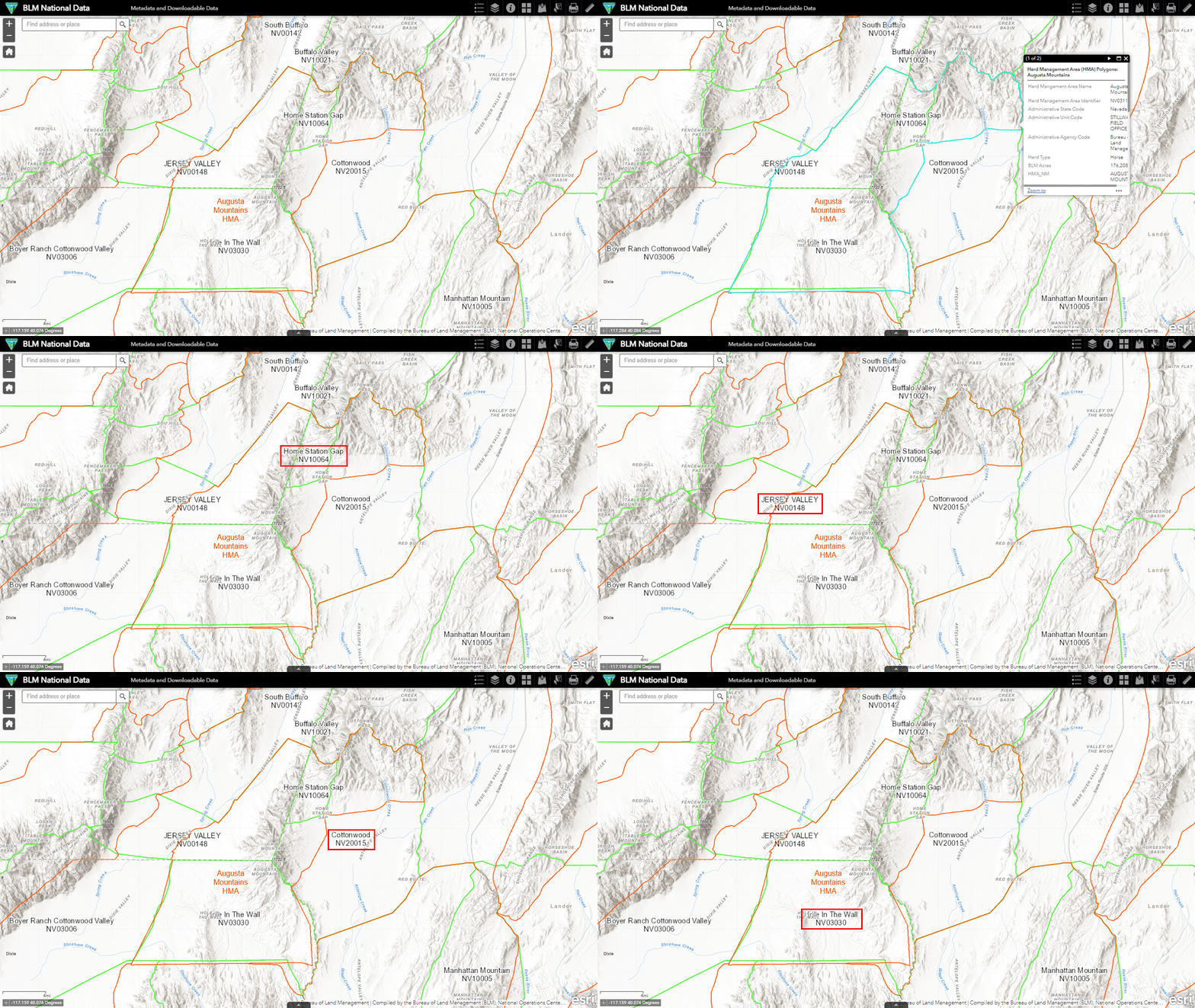
The Complex is managed primarily for animal agriculture. The National Data Viewer shows habitat loss and grazing allotments. Click on image to open in new tab.
*According to advocates.

Day 11 ended with 88 unaccounted-for animals.
There are no plans to treat any of the captured mares with fertility control pesticides and return them to the range.
Other statistics:
- Forage liberated to date: 11,280 AUMs per year
- Water liberated to date: 9,400 gallons per day
- Horses allowed by plan: 555
- Pre-gather population: 3,375
- Forage assigned to horses: 6,660 AUMs per year
- Forage assigned to livestock: Not determined
- Horses displaced from Complex by permitted grazing: Not determined
- True AML: Not determined
- Stocking rate at new AML: Not determined
- Horses displaced by drilling and mining: Ask the advocates
Overpopulation means more horses than allowed by plan, not necessarily more horses than the land can support.
The ability of the Complex to sustain wild horses has been limited by the bureaucrats, who have assigned most of their food to the public-lands ranchers.
Refer to these reports for an indication of the problem:
RELATED: East Pershing Roundup, Day 9.
East Pershing Roundup, Day 9
The incident began on December 28. Results through January 5:
- Scope: Sonoma Range HA, East Range HA, Humboldt HA, Tobin Range HMA, North Stillwater HMA, Augusta Mountains HMA
- Purpose: Pest control, resource enforcement, rancher protection
- Target: Horses
- Type: Planned
- Method: Helicopter
- Category: Cruel and costly*
- Better way: Poison the mares with ovary-killing pesticides*
- Captured: 838, up from 733 on Day 7
- Average daily take: 93.1
- Capture goal: 2,875
- Removal goal: 2,875
- Returned: None
- Deaths: 9, up from 8 on Day 7
- Shipped: 803, up from 608 on Day 7
The figures above are based on the daily reports, not the totals posted by the BLM.
Helicopters did not fly on Day 9. No explanation was given.
A stallion was dispatched on Day 8 due to a previous leg injury.
The death rate is 1.1%.
The capture total includes 363 stallions, 405 mares and 70 foals.
Youngsters represented 8.4% of the animals gathered, consistent with a herd growth rate of three percent per year.
Of the adults, 47.3% were male and 52.7% were female, no indication of an abnormal sex ratio.
Body condition scores ranged from 2 to 4 on Day 8.
The location of the trap site was not given.
The Complex is managed primarily for animal agriculture. The National Data Viewer shows habitat loss and grazing allotments. Click on image to open in new tab.
*According to advocates.
Day 9 ended with 26 unaccounted-for animals.
There are no plans to treat any of the captured mares with fertility control pesticides and return them to the range.
Other statistics:
- Forage liberated to date: 10,056 AUMs per year
- Water liberated to date: 8,380 gallons per day
- Horses allowed by plan: 555
- Pre-gather population: 3,375
- Forage assigned to horses: 6,660 AUMs per year
- Forage assigned to livestock: Not determined
- Horses displaced from Complex by permitted grazing: Not determined
- True AML: Not determined
- Stocking rate at new AML: Not determined
- Horses displaced by drilling and mining: Ask the advocates
Overpopulation means more horses than allowed by plan, not necessarily more horses than the land can support.
The ability of the Complex to sustain wild horses has been limited by the bureaucrats, who have assigned most of their food to the public-lands ranchers.
Refer to these reports for an indication of the problem:
RELATED: East Pershing Roundup, Day 7.
NDA Program to Reduce Horse-Car Collisions on Virginia Range?
An article dated January 4 by SFGate says the Nevada Department of Agriculture is close to announcing a new program, headed by a to-be-announced new hire: a Virginia Range feral and estray horse program manager, who will oversee programs set by Director J.J. Goicoechea and his team.
WARNING: The story contains images of family bands with foals, which will be disturbing to most advocates.
The author claims the Virginia Range is part of the Sierra Nevada, which your host disputes.
The mustangs arrived later in the 1980s and 1990s, according to Goicoechea, who said there were no wild horses in the area in 1984 according to NDA records.
He may be referring to a declaration by the BLM that there were no unbranded and unclaimed horses eligible for protection under the WHB Act.
But that doesn’t mean the Virginia Range was a horse-free area. We know that horses were present because of Velma’s encounter in 1950.
Further, the declaration may have pertained only to public lands administered by the BLM, which represent a third or less of the total landmass.
The Virginia Range covers almost 300,000 acres, not 2,800 acres as stated in the report.
NDA already hired a VRE program manager.
As for population growth and horse-car collisions in Reno, how much of the problem can be attributed to liberal lunacy in California that’s driving people out?
Goicoechea, a large-animal vet and public-lands rancher, holds 158 active AUMs on the Newark Allotment in the Bristlecone Field Office.
His dad receives 6,681 AUMs per year on the same parcel, equivalent to 556 wild horses.
RELATED: What’s So Important about the Virginia Range?
Assateague Pony Census, January 2024
The herd on the Maryland side of the island consisted of 14 bands and 79 horses according to the January 3 inventory, compared to 15 bands and 81 horses in December.
Two older stallions died of natural causes.
One small bachelor band and an unattached mom/baby pair were noted.
No new foals were reported.
Two mares(?) were listed as “presumed missing.”
The safe, proven and reversible darting program was shut off in 2016 but the herd has not rebounded.
Not included in the update:
- Ratio of females to males
- Size of breeding population
- Number of viable mares
The BLM WHB Handbook indicates the breeding population should exceed 50 animals to maintain an acceptable level of genetic diversity.
The herd likely has an abnormal sex ratio, with many more females than males, and this may explain why there are so few unattached stallions.
Western Horse Watchers believes the reports are intentionally vague because the herd has been ruined by Zonastat-H, a miracle drug according to the advocates.
The Assateague Island Alliance updates the lists.
RELATED: Assateague Pony Census, December 2023.
How Many Wild Horses Can the Augusta Mountains HMA Carry?
Augusta Mountains is one of three Herd Management Areas in the East Pershing Complex, now subject to the largest roundup of FY24.
The HMA covers 177,570 total acres, including 176,208 public acres, according to the 2023 HA/HMA Report. The figures for acreage at the HMA page are incorrect.
The 308 horses allowed by plan receive 3,696 AUMs per year.
The stocking rate allowed by plan is 1.7 wild horses per thousand acres, slightly higher than the target rate across all HMAs of one wild horse per thousand acres (27,000 animals on 27 million acres).
Table 8 in the Final EA for pest control and resource enforcement in the Complex shows four allotments that overlap the HMA.
The strategy for answering the question involves three more steps: (1) Determine the forage assigned to livestock inside the HMA, (2) Convert that number to wild horses and (3) Add the result to the current AML.
The Allotment Master Report at RAS provides acreage, management status and active AUMs.
Three allotments are managed by the Humboldt River Field Office and one is managed by the Mount Lewis Field Office so two reports were created (HRFO | MLFO).
The overlap percentage in Table 8 for Hole in the Wall is 100% but the National Data Viewer shows a small portion outside the HMA so 95% will be used in the calculations.
Table 8 indicates 100% of Cottonwood is inside the HMA but the NDV shows much of it outside, so 40% will be used.
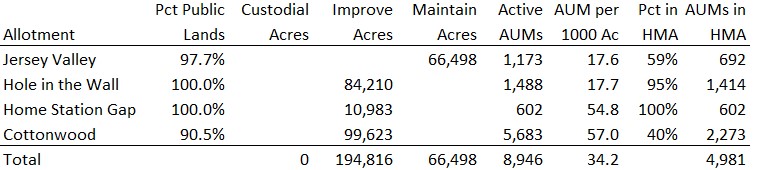
The bureaucrats have assigned an estimated 4,981 AUMs per year to livestock inside the HMA, equivalent to 415 wild horses. This is the number of horses displaced from the HMA by permitted grazing.
The True AML, the number of horses the HMA could support if it was managed principally for them as specified in the original statute, is 723.
The stocking rate at the new AML would be 4.1 wild horses per thousand public acres.
Hey Western Horse Watchers, is that a lot? The Virginia Range was carrying ten before the advocates got involved.
The BLM will collect 4,981 × 1.35 = $6,724.35 per year from ranching activity inside the HMA while it spends 415 × 5 × 365 = $757,375 per year to care for the horses displaced thereby.
Would you say that’s a wise use of the public lands?
The True AML can be achieved by confining the ranchers to their (multi-million dollar) base properties in a year-round off season.
RELATED: How Many Wild Horses Can the Tobin Range HMA Support?
East Pershing Roundup, Day 7
The incident began on December 28. Results through January 3:
- Scope: Sonoma Range HA, East Range HA, Humboldt HA, Tobin Range HMA, North Stillwater HMA, Augusta Mountains HMA
- Purpose: Pest control, resource enforcement, rancher protection
- Target: Horses
- Type: Planned
- Method: Helicopter
- Category: Cruel and costly*
- Better way: Beat their numbers down with ovary-killing pesticides*
- Captured: 733, up from 605 on Day 5
- Average daily take: 104.7
- Capture goal: 2,875
- Removal goal: 2,875
- Returned: None
- Deaths: 8, no change from Day 5
- Shipped: 608, up from 398 on Day 5
Helicopters did not fly on Day 7 due to snow.
The death rate is 1.1%.
The capture total includes 316 stallions, 360 mares and 57 foals.
Youngsters represented 7.8% of the animals gathered, consistent with a herd growth rate of two to three percent per year.
Of the adults, 46.7% were male and 53.3% were female, no evidence of an abnormal sex ratio.
Body condition scores averaged 3 on Day 6.
The location of the trap site was not given.
The Complex is managed primarily for animal agriculture. The National Data Viewer shows habitat loss and grazing allotments. Click on image to open in new tab.
*According to advocates.
Day 7 ended with 117 unaccounted-for animals.
There are no plans to treat any of the captured mares with fertility control pesticides and return them to the range.
Other statistics:
- Forage liberated to date: 8,796 AUMs per year
- Water liberated to date: 7,330 gallons per day
- Horses allowed by plan: 555
- Pre-gather population: 3,375
- Forage assigned to horses: 6,660 AUMs per year
- Forage assigned to livestock: Not determined
- Horses displaced from Complex by permitted grazing: Not determined
- True AML: Not determined
- Stocking rate at new AML: Not determined
- Horses displaced by drilling and mining: Ask the advocates
Overpopulation means more horses than allowed by plan, not necessarily more horses than the land can support.
The ability of the Complex to sustain wild horses has been severely limited by the bureaucrats, who have assigned most of their food to the public-lands ranchers.
RELATED: East Pershing Roundup, Day 5.
How Many Wild Horses Can the Tobin Range HMA Support?
The Tobin Range HMA, one of three Herd Management Areas in the East Pershing Complex, covers 198,236 total acres, including 186,654 public acres.
The 42 horses allowed by plan receive 504 AUMs per year, or 2.7 AUMs per year per thousand public acres.
The stocking rate allowed by plan is 0.2 wild horses per thousand acres, compared to a target rate across all HMAs of one wild horse per thousand acres (27,000 animals on 27 million acres).
Why is it so low?
Table 8 in the Final EA for pest control and resource enforcement in the Complex shows five allotments that overlap the HMA.
The overlap percentages seem reasonable based on the arrangement in the National Data Viewer, except for Buffalo Valley. Western Horse Watchers believes the figure is closer to 15%, not 27%, so that amount will be used in the calculations.
The Allotment Master Report at RAS supplies acreage, management status and active AUMs.
Three of the allotments are managed by the Humboldt River Field Office and two are managed by the Mount Lewis Field Office, so two reports were created (HRFO | MLFO).

The allotments offer a weighted average 54.8 AUMs per year per thousand public acres, 20 times more than the land can produce for horses!
How is this possible?
The land-use plan has assigned most of the forage to livestock—in the lawful home of wild horses. Thus it is true that the horses have been cheated by the bureaucrats in favor of the ranchers with the cooperation of the advocates. (The advocates don’t like to talk about resource management. They want the ranchers to win.)
How many horses have been displaced from the HMA by permitted grazing?
Horses displaced = 11,187 ÷ 12 = 932
What’s the True AML?
True AML = 42 + 932 = 974
What’s the stocking rate at the new AML?
Stocking rate = 974 ÷ 186,654 × 1,000 = 5.2 horses per thousand public acres
The HMA is managed principally for livestock, with the horses receiving just 4.3% of the authorized forage, neglecting wildlife.
The BLM will collect 11,187 × 1.35 = $15,102.45 per year from ranching activity inside the HMA while it spends 932 × 5 × 365 = $1,700,900 per year to care for the horses displaced thereby.
Would you say that’s a wise use of the public lands?
The calculations above assume considerable dietary overlap between horses and livestock and uniform distribution of forage across the allotments.
RELATED: How Many Wild Horses Can the East Range HA Support?

East Pershing Roundup, Day 5
The incident began on December 28. Results through January 1:
- Scope: Sonoma Range HA, East Range HA, Humboldt HA, Tobin Range HMA, North Stillwater HMA, Augusta Mountains HMA
- Purpose: Pest control, resource enforcement, rancher protection
- Target: Horses
- Type: Planned
- Method: Helicopter
- Category: Cruel and costly*
- Better way: Pummel the mares with pesticide-laced darts*
- Captured: 605, up from 324 on Day 3
- Average daily take: 121.0
- Capture goal: 2,875
- Removal goal: 2,875
- Returned: None
- Deaths: 8, up from 4 on Day 3
- Shipped: 398, up from 148 on Day 3
Three stallions and one mare were dispatched on Day 4 due to blindness in one eye, a non-life-threatening condition.
The death rate is 1.3%.
The capture total includes 260 stallions, 302 mares and 43 foals.
Youngsters represented 7.1% of the animals gathered, consistent with a herd growth rate of one to two percent per year.
Of the adults, 46.3% were male and 53.7% were female, no indication of an abnormal sex ratio.
Body condition scores averaged 3 on Days 4 and 5.
The location of the trap site was not given.
The Complex is managed primarily for animal agriculture. The National Data Viewer shows habitat loss and grazing allotments. Click on image to open in new tab.
*According to advocates.
Day 5 ended with 199 unaccounted-for animals.
There are no plans to treat any of the captured mares with fertility control pesticides and return them to the range.
Other statistics:
- Forage liberated to date: 7,260 AUMs per year
- Water liberated to date: 6,050 gallons per day
- Horses allowed by plan: 555
- Pre-gather population: 3,375
- Forage assigned to horses: 6,660 AUMs per year
- Forage assigned to livestock: Not determined
- Horses displaced from Complex by permitted grazing: Not determined
- True AML: Not determined
- Stocking rate at new AML: Not determined
- Horses displaced by drilling and mining: Ask the advocates
Overpopulation means more horses than allowed by plan, not necessarily more horses than the land can support.
The ability of the Complex to sustain wild horses has been severely limited by the bureaucrats, who have assigned most of their food to the public-lands ranchers.
RELATED: East Pershing Roundup, Day 3.
Mustang Monday
In the Reveille HA with Gary Brandt. The Reveille Allotment overlaps the HA.
FY24 to See More Horses and Burros Off the Range Than On?
The total estimated on-range population as of March 1 was 82,883.
The number of animals in off-range holding was 61,915 as of November 26.
The latest schedule calls for the removal of 19,870 animals.
Let’s use round numbers: 83,000 on the range, 62,000 in off-range holding and 20,000 to be removed.
If everything goes according to plan, the on-range population will be 63,000 and the off-range population will be 82,000 at the end of FY24 (September 30).
The crossing of the two trend lines will be hailed as a major achievement by the bureaucrats and ranchers, along with some advocates.
East Pershing Roundup, Day 3
The incident began on December 28. Results through December 30:
- Scope: Sonoma Range HA, East Range HA, Humboldt HA, Tobin Range HMA, North Stillwater HMA, Augusta Mountains HMA
- Purpose: Pest control, resource enforcement, rancher protection
- Target: Horses
- Type: Planned
- Method: Helicopter
- Category: Cruel and costly*
- Better way: Thin the herd with ovary-killing pesticides*
- Captured: 324, up from 142 on Day 1
- Average daily take: 108.0
- Capture goal: 2,875
- Removal goal: 2,875
- Returned: None
- Deaths: 4, up from zero on Day 1
- Shipped: 148, up from zero on Day 1
Two mares were dispatched on Day 3 due to injuries sustained in capture.
Two horses were put down for pre-existing conditions on Day 2 but the details are not visible in the daily reports.
The death rate is 1.2%.
The capture total includes 143 stallions, 175 mares and 6 foals.
Youngsters represented 1.9% of the animals gathered.
Of the adults, 45.0% were male and 55.0% were female.
Body condition scores averaged 3.
The location of the trap site was not given.
The Complex is managed primarily for animal agriculture. The National Data Viewer shows habitat loss and grazing allotments. Click on image to open in new tab.
*According to advocates.
Day 3 ended with 170 unaccounted-for animals.
There are no plans to treat any of the captured mares with fertility control pesticides and return them to the range.
Other statistics:
- Forage liberated to date: 3,888 AUMs per year
- Water liberated to date: 3,240 gallons per day
- Horses allowed by plan: 555
- Pre-gather population: 3,375
- Forage assigned to horses: 6,660 AUMs per year
- Forage assigned to livestock: Not determined
- Horses displaced from Complex by permitted grazing: Not determined
- True AML: Not determined
- Stocking rate at new AML: Not determined
- Horses displaced by drilling and mining: Ask the advocates
Overpopulation means more horses than allowed by plan, not necessarily more horses than the land can support.
The ability of the Complex to sustain wild horses has been severely limited by the bureaucrats, who have assigned most of their food to the public-lands ranchers.
RELATED: East Pershing Roundup Begins.
KTVN News Looks at East Pershing Roundup
The incident supports three tenets of rangeland management: Pest control, resource enforcement and rancher protection.
Why do they consult with the Campaign Against America’s Wild Horses?
They’re using PZP to shrink the Virginia Range herd, not stabilize it as their spokesidiot claims. Read their reports to NDA!

BLM likes motorized removal while CAAWH likes nonmotorized removal. There’s little if any difference in their attitudes toward wild horses.
RELATED: East Pershing Roundup Begins.
Wolves Prey on Colorado Cattle Despite Axtell Burros
The latest incident involved a calf last week, according to a report posted this morning by The Colorado Sun.
Colorado Parks and Wildlife said it would not use lethal methods to alleviate the threat.
The agency delivered six wild burros from the Axtell off-range corrals to the Gittleson Ranch in 2022 to deter wolf predation.
The condition of the animals was not disclosed.
Foal-Free Friday, Truth or Consequences Edition
The advocates claim PZP is safe, proven and reversible while condemning Gonacon Equine as a sterilant.
The truth about PZP: Damage begins with the first injection and proceeds to sterility after five years of treatment. The advocates call these mares “self-boosting.”
The consequences of PZP: The herds implode. The advocates can achieve results that helicopters can’t, to the delight of the bureaucrats and ranchers.

There’s no need to spend tens of millions of dollars every year on roundups and off-range holding. You just need to be patient.
RELATED: Foal-Free Friday, Unlawful Use of Pesticides Edition.
East Pershing Roundup Begins
The incident started today as advertised, with 142 horses captured, none shipped, none released and no deaths.
The location of the trap site was not disclosed.
RELATED: East Pershing Roundup Starts Next Week.
Assateague Herd Loses Two Stallions in December
They were found dead of natural causes, according to a report posted today by the Maryland Coast Dispatch.
The herd consisted of 81 horses earlier in the month.
General Harker was a band stallion according to the AIA list dated December 6.
Yankee was unattached.
The loss keeps the sex ratio skewed in favor of females, a documented effect of PZP.
The list shows just two other bachelors, unusual for a herd of wild horses.
The article said the Park Service completes a full census of the horse population six times per year but did not mention that it stopped publishing the results to the Assateague news page four years ago, when the long-term effects of the fertility control program became obvious.
At the time the herd size was 75 and there were 2.4 mares for every stallion.
The darting program was shut off in 2016.
RELATED: If PZP Is Reversible, Why Hasn’t Assateague Herd Rebounded?
BLM Publishes Final EIS for Use of New Herbicides
A record of decision will be published in early 2024 according to today’s news release.
The EIS was copied to the project folder on December 22.
Unlike Zonastat-H, a pesticide applied to cherished wild horses, none of the new ingredients could be found in the RUP Report.
RELATED: BLM to Trial New Herbicides on Cherished Plants and Weeds.

Who Benefits from Sage-Steppe Restoration Projects?
The Applegate Field Office has proposed the removal of juniper trees in northeastern California to stimulate the development early seral grass and forb species preferred by mule deer and other sage-steppe obligate species.
Curiously, the project area, which covers 13,790 public acres, coincides roughly with the Nelson Corral Allotment. Refer to Figure 1 in the DNA.
Perhaps there are other intended consumers of the tender young plants not mentioned in the analysis?
The Allotment Master Report puts Nelson Corral in the Maintain category.
The allotment offers 1,802 active AUMs on 12,849 public acres, or 140.2 AUMs per year per thousand public acres, equivalent to 11.7 wild horses per thousand acres.
This brings more embarrassment to land managers who claim that public lands in the western U.S. can only support one wild horse per thousand acres.


 Western Horse Watchers Association